Do not panic. We accept late submissions for TechCrunch50, but please submit soon. »
News Via Old Fashioned Means Put On Deadpool Watch
by Duncan Riley on March 1, 2008

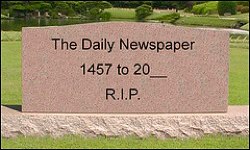
rip.jpgSurvey results released by We Media/Zogby earlier this week show that more people turn to the internet for news than any other source.

The survey found that nearly half of all people in the United States (48%) cite the internet as their primary source of news and information, compared to 29% for television, 11% for radio, and a dismal 10% for newspapers. There was an age difference at the lower end, with only 7% of people aged 18-29 getting news from newspapers, vs 17% of those 65 and older.

67% of Americans believe traditional journalism is out of touch with what they want from their news.

It should be noted that the survey did not break down the types of news sites respondents were reading online, so by no means do the results equate with the death of the mainstream media (ie they could well be reading mainstream media sites online). The figures do suggest that some forms of offline news reporting may well be headed to the Deadpool over the next 5-10 years, at least in the United States. It will be a long and slow death, but as newspapers and radio slump into lower and lower single figures, it’s a given that the presence of both will shrink; we’re already seeing massive across the board downsizing now in print media.

(in part via Reuters, image credit: Brian Solis)

Comments rss icon

  • Newspapers will decline but there could be opportunities for magazines - people will still want thoughout in-depth articles.

  • It’s just the delivery method that is dying. Reading NYTimes.com is still reading the NY Times newspaper, just online. E-Ink might also change things a bit.

  • I read most of my news on the Internet nowadays. The timely nature of cyberspace is a big advantage over print and it’s free.

  • I noticed that the survey was conducted on the Internet. This should call the validity of these numbers into question. I believe the results are skewed based on knowing how the survey was conducted. I agree that we are seeing downsizes in these other types of traditional media. However, we need to be critical of the results. Thoughts?

  • I still have not figured out how to read news via the web when sitting on the potty.

  • Phil Meyer, author of The Vanishing Newspaper, has a sort of atomic or doomsday clock for when he says the last reader of a daily newspaper will die or just stop reading.

    I recommend Phil’s book (disclaimer: he is my colleague here at the UNC School of Journalism and is retiring this year).

    http://www.amazon.com/Vanishin.....0826215688

  • Anyone remember printed newsletters? About a decade ago you’d get a dozen or so… and they migrated to our inboxes from our mailboxes - the trend has been obvious to those watching for years.

    As a recruiter I try and keep an eye on where people get their information. it’s no secret that the readership of newspaper classified ads in general has been plummeting for years - as has the number of those just getting their daily news in print.

    I used to have a daily ritual of rising early to go unwrap the paper and thumb through it for news of interest over a morning cup of coffee before leaving for work.
    Now? I’m simply thumbing through my blackberry for keyword rss feeds while on my morning commute - and my blackberry doesn’t leave ink on my hands. :-)

    In my humble (but correct) opinion the trend away from print isn’t a curve - it’s a cliff.

  • That definitely skews the results if the poll was conducted on the web. Also, it’s not 48% of people in the United States that are now turning to the internet for news, it’s 48% of the people that responded to the poll. I was never asked this question by them, so no one can say all of the US.

    That said, this isn’t surprising. My only concern is exactly where people get their news online. Like someone said, going to NYT.com makes me more comfortable than say, someone telling and retelling “news” from The Onion. Though I guess there are those that swear by rag papers in print nowadays.

  • A side note regarding the graphic. Nothing resembling a newspaper really showed up until the 1600’s and dailies weren’t really possible until a century or two after that.

    Dailies really picked up during the industrial revolution when production and distribution made it economically feasible.

    One more note:

    Imagine any industry where you told the owners that you had a method for them to turn their distribution costs to zero. They’d be thrilled.
    Here, it’s like a death sentence.

    I’m talking more about news over at my new blog if you are interested:

    htpp://gangbuster.org/blog/

  • Dave, I get my potty news via cellphone/PDA.

  • This will not happen for a while to come atleast unless some other means of reading about what has happen that day or night before arises, think about how many people get newspapers to read of there commutes in large cities on the metro systems and on flights and commuter trains.

    the survey is probably inaccurate of those people they surveyed where did they live, what age group and what social class all of that plays a factor in these surveys I take journalism classes and we go over things like that

    They probably got some people from the same social class age group and ethnicity there was probably no detail in this to get correct info from different classes and age groups because i think that the results would be different.

  • Print media is certainly in decline, but a lot of news organisations can still thrive online if the content is relevant and timely. Content is still king, and some news organisations blame the internet when they should simply look and the (lack of) quality they deliver. For those who produce great journalism, there is still hope. For the rest, it sure looks like the deadpool is around the corner.

    My fear though is that soon news organisations won’t be able to afford to pay journalists, and serious investigative, journalism will also join the deadpool. That would be a shame.

  • Hello, Duncan -

    You cheapen the meaning of “deadpool watch” when you cite 5 - 10 years
    as the time print papers will be spiraling downward; with that length of
    outlook, likely more than half the companies TC covers are on “deadpool
    watch.”

    Print papers will have 5 - 10 years left based on their current
    readership if they do next to nothing. They’re no longer doing next to
    nothing. They’ll shrink and morph, many will die off in their current
    incarnation. Many will find
    success
    once they alter their models appropriately.

    The deadpool’s a handy tool; please don’t water down its meaning.

  • I believe they will be in deadpool in more that 5-10 years, but for sure the future is in the net…

  • baah-baah-the-black-sheep - March 1st, 2008 at 1:05 pm PST

    Duncan, just another shoddy sensationalist post by you.
    @3 - true
    @5 - dead right!

    Mike, can’t you find a decent writer from this part of the world or at least provide a separate RSS excluding Duncan’s musings?

  • Even though I spend much of my life on the net, I still like to sit down and read the daily newspaper at breakfast. Turning each page, you never know what story you might find interesting, stories that you might not normally search out.

    For example - I certainly don’t use the net to go hunting who was murdered lately or who died recently. Yet virtually every single day, I read of at least 2 or 3 separate and violent murders (usually in San Jose, SF, Oakland or Richmond areas). Most often, the weapon of choice is a gun.

    Seeing stories likes this gives a better view of the world we live in. IT helps to recognize that not everyone is above average in intelligence, has a cushy white collar technology job and/or lives in a safe, suburban neighborhood.

    There also seems to have been a noticeable increase over the last 6 months or so in the number of people listed in the obit’s. Some were quite young and in the prime of their life but succumbed to cancer, heart attach, tumor, etc. Again, these are only some items that I normally wouldn’t search for on the net or be aware of. Makes one think.

    The SF Chronicle (the paper I read) recently made a number of changes to lower the cost of producing the paper. One real strange and annoying change was to print the business section BACKWARDS On Monday’s and Tuesday’s at the rear of the Sport’s section. They claim this leads to more efficient printing. I find it weird to read backward. I guess this shows how troubled the SF Chronicle finances are.

  • Print will never be a growth industry, at least not the newspaper end. The best it can hope for, a select few, is to hold steady, or bleed only a little, and keep churning out small profits.

    Some of the cream of the crop are still holding their own, like the WSJ and USA Today, each with more than two million daily readers. I believe USA Today actually posted an increase last year. Why? It offers interesting, in-depth content right up front that’s not ‘time sensitive’. Of course they’re desperately trying to maximize their online presence as well. They see the writing on the wall like everyone else. And it continues to fade for most.

    But I think the best and most interesting papers and magazines, in combination with top notch online versions, can hold steady over time, or shrink at a much slower rate than most. There are enough consumers still interested in print as a content delivery method. Boomers and Generation Jones (Boomer subset) number 78 million, and all grew up on print. Local papers will continue to die in droves. If they’re smart, they’ll capitalize on their community roots and presence to offer the best hyper local news online, to compete against the likes of EveryBlock.

    I still love to papers and mags. But I’ll never get them for the ‘latest news’. If they have interesting, in depth pieces and relevant, unique content, I’ll continue to plunk down some quarters each week. Meanwhile, I’ll continue to spend 90 percent of my ‘information soaking’ time online, via my laptop and new Nokia N95-3.

  • Here is a video of Sam Zell addressing some of the Chicago Tribune staff a few weeks ago.

    http://www.chicagotribune.com/.....561.column

    He is imploring them to wakeup to the realities of the business. The problem is many of the people he’s dealing with in journalism are really a bunch of children who were told at a very early age that everything has to be fair. They are stuck in that mode. Evan Sayet calls them Modern Liberals.

    Watch Evan’s talk at

    http://www.youtube.com/watch?v=eaE98w1KZ-c

    where he describes this mindset. The video is all about this Modern Liberal philosophy that has taken over a lot of people. People have said for years that many journalists were “save the world” types. It’s really not about saving the world, it’s about making sure everything is equal. Zell is upsetting the applecart because these people think things are going to get better all by themselves.

    Please watch Evan’s talk. The Q&A at the end is good too. (I have posted a link here to Evan’s talk before, but it seems to explain so much that I think it’s important for people to see it.)

  • The mainstream media is a corrupt and censored disgrace. At best, much of what it reports is propaganda. At worst, fiction. The MSM cannot be trusted any longer as a watchdog over our totally dysfunctional government. They are, instead, in fact, in bed together…

  • I think papers will hang on for a while yet. Not that I read them much. Apart from the odd one I’ve read sitting in a coffee shop, or handed out free on an airplane, I hardly look at one. I think the only ones I’ve bought in the last year or so have been when my daughter asks me to get one, but thats only because she uses it to line the bottom of her bird cages!

  • I still like the feeling of reading newspapers. I still prefer the smell (rather disturbing) of newspapers. I’ve always felt like news on the Internet is a very cold way of doing it.

  • Here in Halifax, Nova Scotia The Halifax Daily News just closed a few weeks ago. Now there is only one paper for the whole city.
    Even when i do read the paper, it usually online.

  • I’d agree that the trend of a printed paper is spiraling downwards, but I don’t think it’s a fast trend. There are a lot of people who prefer it because it’s easily portable and relatively cheap (and includes special features - comics, stats, crosswords, etc) that aren’t as easily available elsewhere. However, I’d say the trust level is declining because where once the traditional news outlets really concentrated on News, now they concentrate primarily on propaganda. They have to sell their stories. Watch how most newspapers put good stories about Conservatives somewhere inside the paper, but the worst stories make front page news, even if unsubstantiated. From CBS’ story with the false documents (that were easily verifiable) to the recent NYT piece on McCain (with no verifiable sources or facts), they want to paint as bad a picture as possible for Conservatives. I prefer Fox News for a lot of things, but they have a bias towards a favorable image of conservatives, though I think it’s less pronounced than the Liberal bias of most mainstream media.

    With that in mind, I rarely read through a regular newspaper without wondering what the real story is. Once you lose that trust level, it’s hard to regain. Tell me the news, the facts, don’t spin the facts one way or another - just give me all of the information. And if you find out that you were wrong on a really “important” story, don’t bury the correction in the middle of the paper or in some lame 5-second clip in the News broadcast.

    Personally, my main reason for getting a paper weekly is to get the coupons from them. There’s still not a better way to pick up coupons without a newspaper. When I do that, I also read the comics :).

  • I don’t think that they will be dead. Most people still like the feel of newspaper, especially the sport section. :)

  • I like to hold the paper and take my time with it, that’s the beauty of it. Sure I know the news is outdated, but some stories that come to press aren’t always easy to find online. And the local coverage is still something of note, as it’s gathered up for you on a daily basis, better than some RSS feeds can manage.

    I agree they’ll probably be pushed out as technology warrants, but I see them around for a long time, if not forever if they embrace new technologies…

  • Yes, it will take a while for those used to reading their daily paper to make the switch to digital, but that day will come. Computer interfaces will become more user-friendly and less taxing on the eyes. Cell phones with mini-projectors will allow for simple and elegant web surfing anywhere. Vested local bloggers, photographers and videographers will produce and aggregate much richer information than a small team of paid reporters. Paper will go up in price as the environmental costs are factored in.

  • With the advance of OLED displays that make it possible to have multi-use newspapers, it will probably be something of a mix between online and traditional paper media.

    Similar technology is used in Optimus Maximus keyboard. And it is only a start. Here are some pictures of a laptop with customizable OLED keyboard:

    http://smart-parts.net/blog/?p=212

Leave Comment

Commenting Options

Enter your personal information to the left, or sign in with your Facebook account by clicking the button below.

Alternatively, you can create an avatar that will appear whenever you leave a comment on a Gravatar-enabled blog.

Trackback URL
bugbugbug
The CrunchBoard
  • MediaTemple Logo
  • QuickSprout Logo
  • OpenX Logo
  • Cotendo Logo