
Delver Comes Out Of Stealth With a New Twist on Social Search
by Roi Carthy on January 28, 2008

delver-logo.pngWhat if a search engine knew who your friends were and delivered results based on their actions and content across the Web? Today at the DEMO conference, an Israeli startup called Delver (formerly Semingo) is coming out of stealth and announcing its upcoming launch as a semantic social graph search engine.

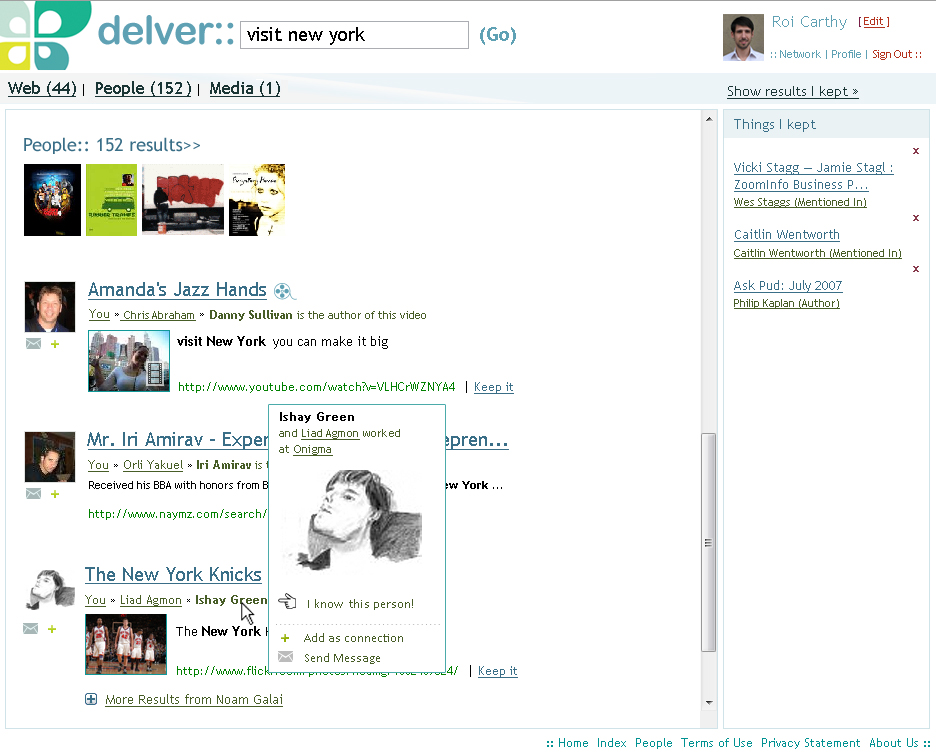
Delver is attempting to solve two key search-related problems. The first is that current search engines do not take into account the identity of the searcher. For example, a teenager and a senior citizen performing the same query will get exactly the same results. The second is that current search engines do not allow users to search for information created and referenced by their own social graph. This is an important point because, let’s face it, social networking doesn’t offer much functional value beyond allowing people to connect with one another. The fact that you have 300 friends on Facebook, 200 on MySpace and 100 connections on LinkedIn doesn’t actually help you locate information. This is where Delver comes in. Search for “New York,” and the results that will pop up will be blog posts from people you know that mention or are about New York, or Flickr photos, YouTube videos, Delicious bookmarks, and the like.
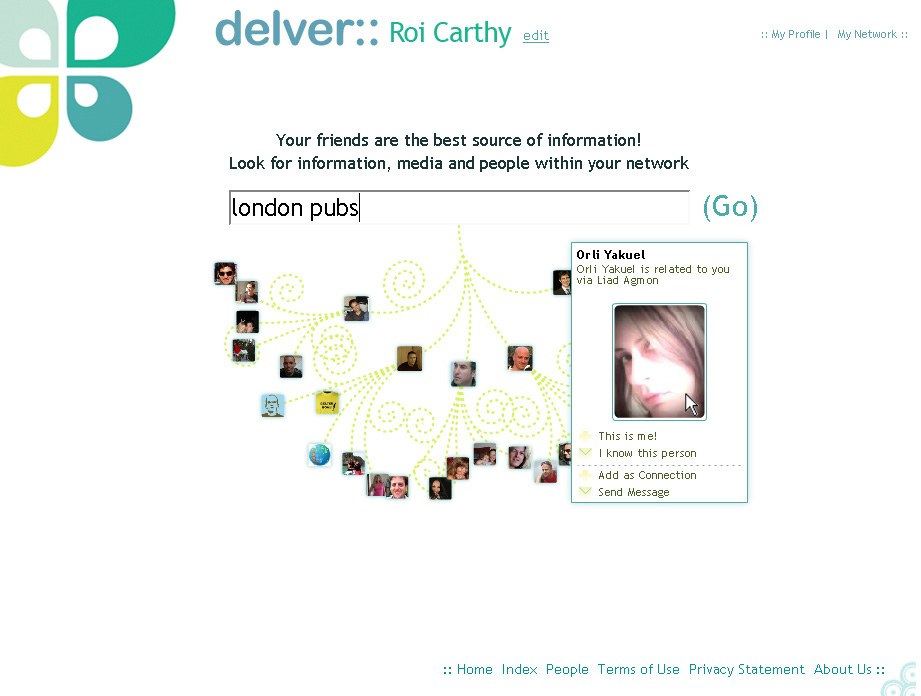
delver1-small.pngThe technology, which has been in development since 2005, combines search technologies, semantics and Natural Language Processing (NLP). Delver begins by crawling the Web in order to map users’ social connections. The information it finds on social networking profiles, blogs, bookmarks, photo and video-sharing sites is then cross-linked to the searcher’s social graph, which is built on-the-fly. Delver then prioritizes its results based upon the searcher’s social graph, thereby improving the relevancy of the results. Since every person’s social graph is unique—much like a fingerprint—the same Delver query will produce significantly different results for each person—as reflected through the collective experiences of each person’s contacts.

Using Delver doesn’t require users to sign-in, they can just enter their names (and some additional identifying details such as city, in the case of a common name). An email address will also allow Delver to leverage the popular social networks to locate users’ social graphs.

Registered users can claim their profile and authenticate the sources they want to associate with. This means that if I provide the username and password of my Flickr account, Delver considers this account to be mine and will not allow any other user to claim it. Placing authentication aside for the moment, users can indeed claim to be other people. The information Delver crawls is public so there’s no privacy issue here. There is also no real benefit to users who would do such a thing, in fact, it would be rather pointless. For example, I can Delver Michael Arrington’s social graph, but that would generate results that are relevant to him and not to me. However, as mentioned above, Arrington can easily claim his profile and that would be the end of that.

Founded in June 2007, Delver is currently based in Herzelia, Israel and is due to open a US office in the spring. The 20-strong team is headed by Liad Agmon who was co-founder and CTO of Onigma, a security company in the Data Loss Prevention space, and sold to McAfee less than two years after inception for $20M.

Delver will launch its private beta in March and we will make sure TechCrunch readers will be among the first to take it out for a spin.
delver2.jpg

Advertisement

Comments rss icon

  • Respectfully, who cares?

    I would NEVER use such a service as my search needs are 100% independent of my friends needs.

  • My initial reaction is, “What if all my friends are idiots?”

    If I’m searching for “flu remedy”, and my friend recommends a healthy dose of aspirin-laced bourbon, is that really the result I’m looking for?

    This seems like an odd direction to take search. I don’t really see the utility. Just because your friend blogged about his bar crawl in New York doesn’t mean that’s the first result you want when searching for New York.

    In general, wouldn’t you want the result that is the most authoritative on whatever topic you’re searching? Unless your friend is an expert in that field, I don’t see how this product gets you closer to your desired answer. And if your friend IS such an expert on New York (for example), why wouldn’t you just contact him directly?

  • @Warren Benedetto
    “why wouldn’t you just contact him directly?”
    This is exactly why you would use this. Because then you would know that your friend or your friend’s friend visit NY and you can now contact him.

  • Its a good attempt at the concept of re-enventing searching.

    To be truthfull I think understanding your users may only go someway. Thus I may be a 15 years old kid , I may not be always looking for things for 15 year old kids and whats to say when I looking for information on Rwanda attrocities Im not looking for more adult detailed information.

    I think somebody just needs to take a look at google and improve the search engine quality. The problem with google is that its soo spammy , full of ebay junk , full of shopping junk , full of blog spam. If somebody can get the quality to google in the 98-99 period then they will be onto a winner.

    Its a shame hardware / bandwidth needed for a full scale search engine is so expensive otherwise id be doing it properly.

  • Mike or any of the guys.

    Go a tip fo ya. Try http://www.vlite.net/

    If your using Win Vista . This tool rocks as it reduces Vista to its barebones without all the bloatedness .

    —————
    http://www.xencasino.com

  • Mikeal…why exactly would I strip down Vista when you can just install XP.

  • I can’t find a single thing to make fun of. I wanna see it in action first, but I have to say that I really like the not having to sign in feature, and even though I don’t rock too many socialz, that IS a dang clever idea. OPTIONAL authentication is smart too. Let me decide if I want to dip my toe or my whole foot in and I’ll at least walk by your pool to check it out. As long as they execute it well, it should be OK. We’ll see.

  • 1-4: ze sheatem lo ohavim, ze lo omer sheatem zrichim lekalkel leakherim!!!!

  • I like the concept. A teenager and senior citizen have different desire from search results. Its (could be) that a kid or senior will enter same query . I will go this new search engine tech.

  • Nice logo. Seen from a previous DEMO company. http://www.cozi.com

  • because XP runs faster and is better than XP . Try it you may like it.

  • @Gilbar – Yeah, that logo looks stolen! Also, this product sounds ridiculous.

  • No offense but is this a press release from Delver? It is suspiciously rich in functional details and benefits and contains no real criticism of the business itself. You’d think an independent writer would at least question whether the problem being solved is important to users and will support the business. If this is a press release, shouldn’t it be labeled as so? I come to Digg for independent commentary and thought that is what this site was about.

    Also, can someone please explain why the term “social graph” is preferred over other more user-friendly terms such as “contacts”, “friends and family”, etc. It seems like these terms are used to give credibility but does it really do any good? Does the average user understand the term “social graph”? Do we really want to create a divide between us internet geeks and the rest of the world with obscure language? I sure as hell would like to market to as many people as possible and believe language like this just gets in the way…

  • CREEPY and STUPID. Someone designed a search engine that presumes to filter out my results based on what they think is right for me? Utterly ridiculous and useless.

  • Anyone who’s studied information-seeking behaviour will tell you that people will often ask their question of a trusted friend or family member before consulting a formal or external source of information, such as a library or the Web. A service like Delver essentially moves the “ask a friend” process to the web, streamlining it in the process. I’ll be interested to check this out.

  • Although interesting, the use of this type of search will be of interest to only a very small percentage of search users. This type of information will be more natural to say users of Facebook who think the Beacon information is useful (not many). Although Robin (#15) above has a point, I cannot really see this being classified as a main search source…only ‘periphery’ search. It will bome to function as more of a recommendation engine than traditional search.

  • sorry: “bome” -> “come”

  • Intriguing, but I suspect that this will run into the same content bias problems that plague Digg and others: It will be dominated by geeks.

    If half my friends are tech geeks, and half of my friends are not, one thing is certain — the geek half will be over-represented in the Delver universe. Therefore my search results will be geek-biased. This will be true whether I am 15- or 55-years old.

    So, much as is the case with Digg and its progeny, the tech community will adopt it as a success, while the rest of the world will continue to choose to get its information from other sources where the top result isn’t perpetually some article about a new Facebook app.

  • While a good attempt at trying something new. I would never use a service that presumes to know what I want. The fact that two people searching for the same thing will get different results is absurd.

    Search should be objective. Period. Facts are not subjective, so why should the search for them be?

  • Really? Seriously?

    What problem are we solving here? Call me a luddite, but I kinda like the fact that my search results are the same as grandpa’s when we search for the same thing. I really don’t care what my friends are searching for. I’m smarter than most of them anyway.

    @13: Good point. This sounds like a press release, not any kind of journalism. And they use “social graph” because it makes it look as if they are doing something related to computer science or math. Not just rehashing the same horrible ideas that have been getting funded for years now.

  • your results are as good as your friends are…

  • Back in 2003, Eurekster partnered with Friendster to power their web search. We created a unique search engine for each user, and the results were influenced by the activity of your 1st degree friends, and to a lesser degree by your 2nd and 3rd degree network. Not dissimilar to Delver.

    We found that statistically, your friends rarely search for exactly the same terms as you do – which is why we added the 2nd and 3rd degree network influence: to increase the chances that you would see the effect of your network. However, we found that this didn’t exactly make the results more relevant to your search because we weren’t taking into account the context of the search. (”Bass” – was that for music or fishing?)

    At that point, we refined our focus on groups within Friendster to provide context. (i.e. a search engine for the ‘music’ interest group.) We found the behavior of these ‘communities of interest’ were more consistent and easier to harness than ‘communities of relationships’. We also found that in this context, users didn’t need to be logged in to provide and derive value.

    Eventually, we created a product around this concept that we called ’swicki’ – which allows anyone to create a custom vertical search engine that can be placed on any site or blog and learns from the activity of that community.

    I’m looking forward to trying Delver to see if they have managed to make friend-of-a-friend based social reranking work at producing more relevant results. Good luck.

  • It sounds like delver is actually the first subjective search engine. Interesting idea. I can think about several things that I would not like to search there (Porn), But, actually it can be very helpful for finding stuff like skills, hobbies, ideas, opinions and stuff.
    Cool.

  • Sounds like an interesting idea. I would be concerned with my search results changing over time or as my social sphere evolved. If I was trying to re-find something I had seen before it sounds like this search engine might not be the best. If I used it in conjunction with a http://www.webmynd.com type product that might solve this problem.

  • This is going to be a fabulous way to increase traffic and tighten up the network connections on small to medium blogs that have trouble outranking the greasy SEO types on traditional search engines. This service will facilitate more emails like “Hi, I’m a friend of so-and-so and was really impressed with your thoughts on #topic. Let’s find each other at the next Lunch 2.0 to exchange ideas!”

  • so many social tools, how many do we need

    http://www.yupnup.com

  • this idea seems to be new, we will see …

  • So wait…they stole cozi.com’s logo? Why is that not addressed in the article or something? That’s messed up!

  • Will small business follow suit? Be ahead of the curve in comparison to Enterprise?

  • Oh, good. Another Web geegaw that assumes we already have friends.

  • This seems like the same idea warmed over….Does anyone know if these guys have taken any venture capital or outside funding?

    BTW…does anyone know of any good web sites that detail or summarize technology capital investments?

  • I’ve already saw something similar so they are NOT the first:

    http://web2berl...m/profiles/6397

  • Lijit (lijit.com) has been doing the same thing since about a year.
    (which doesn’t mean that there shouldn’t be more competitors in the same space, the more, the merrier of course :-) )

  • Looks interesting, started a page for them here:

    http://www.mahalo.com/Delver

  • Market Validation - February 1st, 2008 at 9:05 am PST

    Google’s Marissa Mayer – Social search is the future @
    http://ventureb...-is-the-future/

  • Its an appalling idea. I just stumbled across a profile meant for me using google updates. Its full of out of date and incorrect (in the sense it was never true) information about me – none of which is currently indexed by google for instance. That’s just going to annoy people and (in the UK) has data protection difficulties.

    Sure, deliver up what you find about me, but if you munge it all together its bound to become inaccurate and without sourcing unverifiable.

    Hope it crashes and burns.

Leave Comment

Commenting Options

Enter your personal information to the left, or sign in with your Facebook account by clicking the button below.

Alternatively, you can create an avatar that will appear whenever you leave a comment on a Gravatar-enabled blog.

Trackback URL
bugbugbugbug
Techcrunch on Facebook