
The UK Says No to Over 50 Year Music Copyright
Nick Gonzalez
32 comments »
The British government turned down a request by the UK music industry to extend copyright for sound recordings beyond 50 years to 70. Artists are now particularly concerned with copyright as demand for their back catalog and accompanying royalties grow.
Such an extension would retain the ownership rights and royalties for artists like Cliff Richard, Paul McCartney, and their publishers. Cliff Richard, whose 1958 hit “Move It!” is nearing the cut off, would be one of the first to lose his ownership.
The government decided against the extension because it would require pushing the European Commission for changes and may increase costs while not benefiting the majority of performers. Predictably, artists and the industry fired back saying the government was simply refusing to support artists.
The Who’s Roger Daltrey was one of the most vocal critics, saying, “Thousands of musicians have no pensions and rely on royalties to support themselves. These people helped to create one of Britain’s most successful industries, poured money into the British economy and enriched people’s lives. They are not asking for a handout, just a fair reward for their creative endeavors.”
The government based its claims primarily on the Gower’s Report (PDF), a study of intellectual property rights in the UK conducted by former FT editor Andrew Gowers. The report’s recommendations were focused on maintaining intellectual property rights while keeping costs of enforcement low. The report recommended against a previous request extending the length of copyright to an even longer 95 years, matching the US term. The report determined that the UK doesn’t suffer from a deficit in creativity due to the disparity in terms.
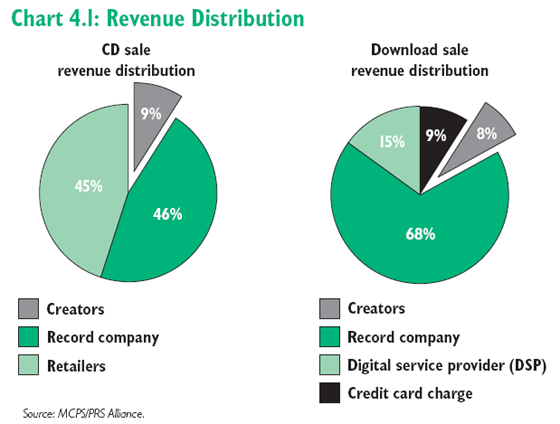
The chart below was a key diagram in the Gowers report citing that increased terms would not necessarily be the best way of supporting artists. Few records continue generating royalties after 50 years and the chart argues that re-evaluating recording contracts in favor of artists may prove a more effective method.
The continued resurgence of talks over specific copyright terms seems increasingly arbitrary, depending mostly on whose work is soon to fall into the public domain. Artists accusations that maintaining current copyright limits discourages creativity and deprives them of income seem increasingly ridiculous considering artists were still motivated enough to produce the works in full knowledge of the current limits.
The United States had previously extended the length of copyright to 95 years with the 1998 Sonny Bono Act. However, the Act was derided as the “Mickey Mouse Protection Act” under accusations that it was passed primarily to keep Micky Mouse out of the public domain, long after the death of his creator. As Lawrence Lessig has claimed, continued extensions of copyright terms have turned Congress’ Constitutionally granted authority to grant copyright for a limited time into an effective grant for perpetuity.


Does this mean I can incorporate Mickey Mouse onto my website without fear of being sued?
Semi-off-topic: I now know who wrote a post here without reading the author’s name specifically. Do I get a medal?
(Even though Nick won’t respond to any questions regarding specifics, like competitors, tech limitations, or anything else even to discredit the value of the question)
That’s rather greedy…
Just looked at those pie charts and I never knew artist were being ripped so bad…unreal. 9%??? WTF
@OMG That’s called signing a contract, getting upfront money, long-term contracts etc. People look at the total dollar amount more than the percent. They complain about it only much much later.
I don’t think it’s greedy, the 50 years seems to no longer match up with the lifetime of the artist as it once would have. I don’t have a problem with creators keeping the rights to their creation at all.
Its about time the government stepped in somewhere in the public’s interest. Its about time Copyright Protection got back to its orginal legal concepts. Artists and the Corporations that distribute the materials should have an opportunity to profit but at some point it is and should be recognized as a matter of public domain because it is the public who has paid for it to be commericially successful. It is completely perverse the way the Entertainment Industry can take public domain material from the Bible for example (the way Disney has with some of its works) and then argue that their studio version of the story basically deserves perpetual copyright protection.
What will be really interesting is to see if derivative works sourcing British art older than 50 years is allowed in the US and other countries with ridiculous copyright regimes. . .
these artists need to make money in other ways. I understand the issue of royalties and such, but why would the government step into to fix rules that have been the same for so long? These artists are far too greedy and likely most of their music can be downloaded for free on the P2P networks anyways. I think artists should be able to monetize on their talent forever, but why only their “products” after 50 years? These should be added to the public domain and used in mash-ups, 50 years is a looong time…
So it’s not lifetime? In other countries you retain lifetime ownership of your songs.
Three cheers for common sense. If an artist is still making money on a song 50 years after it was written, chances are they’ve been earning from it enough over the last 50 years for it not to make too much of a difference to them. Perhaps the artists ought to be more concerned with not getting shafted by the record companies than with copyright running out after 50 years.
Besides, there’s a good 24 years left for Sir Cliff to capitalise on “Wired For Sound” before the copyright runs out. Hurry! To the Cliffmobile, away!
I forgot to add this to here — Why waste your time as an artist wishing to make money from royalties only? If you have had your song out there for 50 years, wouldn’t you just be sick of your big hit song earning you royalties?
I remember coming across this one wired article and I completely forget what it was titled but then I added ideas for monetizing on one’s music outside the boundaries of royalties with ideas added. Feel free to add any other music earning ideas to the wiki article or just let me know in this comment section –> http://wiki.imarketingguru.com.....keting_2.0
I find it interesting that Roger Daltry is quoted as complaining about musicians not having a pension, whilst still being paid for something he did up to a maximum of 50 years ago. Sounds like a damn fine retirment fund to me…
Roger “poured his money back into the economy” (drugs, alcohol, etc.) instead of saving it like “normal” (non-rockstars) do (if they can). The funny thing here is that the record companies complain about “piracy” by customers (or non-customers, whatever) when they’re the ones who’re making out like bandits, contracts or no contracts. If you’re an artist who signed away over 90% of your “earnings”, then why don’t you blame the record company for stealing your “livelihood”? or maybe yourself?
It’s long been known that artists make their money from touring and not from CD sales. I guess that’s my rationale for never feeling bad about not buying a CD. I don’t mind ripping off the corporation, but the artist I might think twice.
I also agree that if you are making royalties for 50 years and don’t have money left over, then you deserve to starve.
I wonder any entrepreneur has thought about this: Don’t all VCs behave to entrepreneurs just as record companies do to artists? Well, they have the capital, and we have our tiny piece of idea and get our share of stocks in the whole company after rounds of funding. If we hit big, we get money just like an artist get his one hit or two hit wonder in top 1 and we can go all the way as rock stars? If we tanked, we are just dead like a no name band and VCs just need to write it off from other hits by other artists? VCs have not idea but trends, just like recored companies, no idea about creativity but trends in charts?
I just wonder how many of you are songwriters or composers? You speak as if music doesn’t have a much value as other creations such as intellectual property, software, patents, etc. Shouldn’t an artist get to at least own something until the end of their life? Shouldn’t their legacy continue and their loved ones have a chance to own those copyrights? I’m just so sick of the disrespect. It’s not greedy for Sam Walton to leave his business to his family, which is the one of the riches families in the world. No one calls them greedy. Why is a creator of music greedy if they don’t want the Government ordering them to give up their copyrights?
Those charts are appalling! I mean, artists’ revenue is even less then credit cards companies’ one? And look at record company percentage! How can artists be so damn stupid? :O
Haha… The greed of record companies has been plain to see for so long, yet artists still sign along the dotted line…
Quote - The Who’s Roger Daltrey was one of the most vocal critics, saying, “Thousands of musicians have no pensions and rely on royalties to support themselves”.
Well Mr Daltrey, you knew about your pension situation, and you knew about the 50 year rule, so if you’d saved a little more of your ‘earnings’ while you were making them, rather than living the high life, then you’d be able to afford a comfortable retirement which is more than I can say for most hard working souls in the UK.
Quote - These people helped to create one of Britain’s most successful industries, poured money into the British economy and enriched people’s lives.
Well so do doctors, nurses, firemen and the like, but you don’t see them jetting around on private planes, buying huge mansions, spending tens of thousands on pure self-indulgence and then bleating about not having quite such a luxurious lifestyle in their old age.
If artists want sympathy, they should act like adults and not like spoiled children who have just been told the sweet shop is now closing.
I really do have very little sympathy with Richard and Daltrey. When they signed the publishing contracts they agreed to a 50 year exclusive licence and everytime “Summer Holiday” or “My Generation” has been played on the radio they receive a royalty. Now that they are getting to the end of the contract they want to change to rules - tough.
Perhaps the solution to the “pension” problem is for these artists to write some new material and produce, market and publish it on their own without the record company in the middle getting fat off the profits.
“If you have had your song out there for 50 years, wouldn’t you just be sick of your big hit song earning you royalties?”
Er… no, I think I’d be glad of the extra cash.
That you British Government! You would become a “honorary user” of copywrong.de!
I was shocked to find out that British musicians are still alive 50 years after they started creating music. That doesn’t seem to make sense with the lifestyle.
Earth to Roger Daltry. A 50 year monopoly wasn’t enough for you?
If you own your copyright, start your own label. Sign yourself to your company. Run your business! Your business owns the copyright as an assett. You own your business. Talk to a good lawyer if you don’t know how. You make money? You’re a business, like it or not !
Roger - get a good lawyer and own your sh**! If it has value you can always make money. If not, invest smart now! Yessir!!
Hello! Good Site! Thanks you! swqftwtiheuxwq
As a muscian, composer, video artist etc. I think the 50 year copyright thingy is a good thing. Longer is bad. I mean, I like to sample stuff, mashup stuff. But those things never leave the safe confines of the studio because of copyright issues. A 50 year limit to copyright increases the amount of material that can be safely sampled every year. The US is worried that I might sample Mickey Mouse and make my own Mickey Mouse movie, and if I wanted to do that I should be allowed. Mickey Mouse is ancient. As the pie-charts show, we the creators should be more worried about signing decent contracts with our publishers and record companies. When a band I was in released an album we made our own record company, I do think this is the way forward. That way we get 100% of everything we make(and also, carry the losses ourselves…). And orginisations like the RIAA should be more concerned about embracing new ways of distribution instead of suing the online community to death. Their loss estimates are way off anyway, what teenager can afford to own 5000 albums? Not many, but somehow the RIAA manage to post all these albums as a “loss” and then go on to complain that lose billions every year. If there was zero piracy they wouldn’t be making all those billions anyway. CD is a scam anyway, when CDs first came they increased the price of an album by 50%(In Norway, an LP cost NOK 100 and a CD cost NOK 150, when people kept buying LPs they finally increased the price of the LPs to NOK 150), and since then they have only gone up. Their excuse was “the increased productions costs”, which if it was ever true, is certainly not true now…
my two cents
b