
The news may overflow with stories about the social networking giants, such as Facebook and MySpace, but a horde of companies are doing their best to reduce the fundamental features of these websites to mere commodities. These up-and-coming companies provide so-called “white label” social networking platforms that enable their customers to build their own social networks (often from scratch) and to tailor those networks to a range of purposes.
The idea of white labeling a network is to make the platform provider as invisible as possible to the social network’s users and to brand the network with the builder’s identity or intent. While definitions of “social networking” may vary, social networks are primarily defined by member profiles and some sort of user generated content.
There are roughly three types of companies that have emerged in the space of white label social networking. The first provides hosted, do-it-yourself solutions with which customers can largely point and click their way to a brand new social network. Companies of this type interact minimally with their customers and rather focus on providing the network-building tools that they demand.
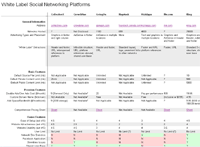
We have taken a sample of nine of these companies – Ning, KickApps, CrowdVine, GoingOn, CollectiveX, Me.com, PeopleAggregator, Haystack, and ONEsite – all of which provide free baseline services, and reviewed them individually below. We have also included the chart on the right summarizing all of these companies’ offerings. Credit for initial research into these companies goes to Jeremiah Owyang who compiled a comprehensive list of white label social networking services.
The second type of company provides social networking software for download and installation onto one’s server. The third type works very closely with clients to build a social network based on their needs. These companies might suite your needs much better than any do-it-yourself social networking service, so you may want to check out companies such as Social Platform (a personalized service) or phpFox (a downloadable solution). We’ll take a deeper look at these services in Part 2 of this post.
Out of the services that we review below, we found that Ning provides the best platform for setting up good-looking, sophisticated social networks with minimal effort. KickApps provides the best platform for integrating social networking components into existing websites. CrowdVine and Haystack are viable options for organizations that are looking for simple social networks to improve personalized communication online. CollectiveX is most suitable for existing groups that want to collaborate online. And GoingOn provides a promising hybrid solution with capabilities shared by both Ning and KickApps.
More details on each are below.
 Ning (which means “peace” in Chinese, in case you were wondering) currently provides by a wide margin the best platform for setting up fully functional and visually appealing social networks from scratch. While Ning attempts to provide essentially the same out-of-the-box service as GoingOn, Me.com, PeopleAggregator, and ONEsite, none of its competitors can yet match the professionalism of its product.
 The company’s superior execution has so far earned it 76,000 hosted networks (although, browse Ning’s list of “popular” networks and one gets the strong sense that the vast majority of these networks were set up by tire kickers and promptly abandoned).
The standard Ning package allows affiliates to build at no cost an ad-supported network with all of the features that they offer. This entails a point-and-click setup process in which an affiliate chooses a theme, tweaks appearances, and loads features such as photos, videos, groups, and blogging. Within minutes, the affiliate has created an impressive, fully-featured (albeit rather cookie-cutter) network that is ready to accept its first batch of members, which can be invited by email or Ning ID.
 For most affiliates, the ease in which you can set up a solid network will be the selling point. However, Ning also has offerings for more advanced affiliates that allow networks to partially break out of the standard Ning format. Affiliates can disable ads or run their own ads for $20 per month, and they can mask their networks’ URLs for only $5 per month. Furthermore, they have access to Ning’s comprehensive Developer Documentation and an API for when they desire advanced customization. Effectively, their API allows developers to take the standard Ning network and retool it, whereas KickApps (discussed below) encourages advanced customization by providing developers with a bare foundation on which to build.
While the Ning platform can be made almost entirely invisible by removing the top Ning toolbar and masking the URL, all networks hosted by Ning share the same user base. When a user joins your Ning network as a member, he or she obtains a Ning ID that works with all other Ning networks. On the one hand, this system facilitates the process by which users sign up for more than one network. On the other, it serves as a constant reminder that the network is actually hosted by a white label social networking platform. Many affiliates will not mind this system at all, but others who want to completely brand their community will consider this a detraction.
 Whereas Ning holds your hand from start to finish as you construct your social network, KickApps is targeted more at web developers (and companies with web developers on staff) who want to incorporate social networking features into their existing websites without going through the hassle of coding and maintaining those features on their own. As such, when you begin to construct your social network with KickApps, you will be presented with a pretty bland, default template that you then must mould to create anything decently attractive. Ning helps you customize your network with premade templates, but KickApps gives developers more immediate control over header and footer code and CSS styling. Consequently, it takes more time and expertise to get a KickApps network looking good, but in the end it may very well look more seamless and professional than any network hosted on Ning.
 Other features provided by KickApps emphasize the intention for its social network components to integrate nicely into an existing site. The company allows you to customize your network’s URL for free so users don’t feel as though they are leaving a main site. Also free of charge: unlimited storage and bandwidth for all that multimedia content (video, audio, photos, etc.) you want your users to upload. Furthermore, each network is given its own user base so that members feel as though they are signing up for a particular network, not a platform (as is the case with the Ning’s universal ID system). To top it off, the company is willing to work individually with affiliates to make their platform as invisible as possible (by removing all references to KickApps, etc).
 KickApps’s advertising scheme is particularly unique. Whereas other platforms charge a flat rate to turn off the advertising that supports their free service, KickApps follows a pay per performance model in which affiliates who opt to turn off or run their own advertising only pay KickApps in amounts proportional to their networks’ traffic. With the free platform package, all but a single skyscraper area of an affiliate’s network are controlled by KickApps. However, once an affiliate decides that it wants to control advertising it pays roughly $2-5 for every thousand pageviews to its network, with rates decreasing as traffic grows.
KickApps also provides the most robust set of widget creation tools, which is intended to help affiliates promote their networks through viral marketing. The widgets that affiliates create with an easy-to-use control panel display content shared or produced on a particular network and can be embedded on other websites or social networks. These widgets drive traffic to one’s network by channeling anyone who interacts with a widget back to the network from which it comes.
KickApps’s 4,000 networks may pale in comparison to Ning’s 76,000 but the company appears to be gaining traction as it continues to roll out features. The recently released v2.2 of its platform improves the platform’s video and content moderation capabilities and suggests that the company is moving towards providing better tools for quick and easy customization, thereby competing more directly with Ning for the patronage of laymen. Concurrently, KickApps is developing an extensive API (currently in private beta) that should reinforce its primarily role as service providers for web developers.
 CrowdVine may not be pretty or intricate but it’s not meant to be. Until recently a one-man show embodied by Tony Stubblebine, CrowdVine provides the simplest, most basic solution for those looking to set up their own social network.
 The main features of CrowdVine are member profiles, blog posts, and public messaging. You won’t find any rich media sharing capabilities, such as photo and video, in the basic package because Tony intended CrowdVine to be all about connecting people and not about sharing their forms of self-expression. As such, the platform has appealed mainly to conference organizers and attendees, alumni (of businesses and schools), intranet users, and professionals.
The lack of control over the look and feel of one’s social network corroborates the idea of CrowdVine as a utility provider. So does the fairly unique feature of having all members respond to network-specific questions, the answers of which become tags that facilitate the browsing of members by criteria. For example, new members to the PodCamp Atlanta network are asked about their interests and expertise, and their answers become linked tags on the homepage of the network that enable visitors to view members, for example, by their interest in “blogging” or expertise in “video production”.
 While Tony is not rushing to add features to CrowdVine, he is happy to work with affiliates to add functionality to their networks. The Foo Camp network has taken advantage of the Tony’s accessibility by integrating calendar and wiki support as well as color coding of members. Tony is also willing to work with affiliates to set up custom URLs and deactivate ads (for a fee of course), thereby achieving more of a “white label” result.
 Representatives for GoingOn (still in beta) admit that their site is ugly (and, I should add, quite disorganized), but appearances tend to mask the potential of this company’s platform, which is intended to straddle the divide between those of Ning and KickApps. Built on top of Drupal, GoingOn provides easy network setup a la Ning, but the company is also partnering with media companies (with results such as Forbes Office Pranks and the American Superstar Mag Lounge) to integrate social networks into existing websites a la KickApps.
 Currently, GoingOn executes neither of these services as well as Ning or KickApps. However, its platform does provide a wider range of features than either of these two companies (unfortunately, most of these features, or “modules”, are currently half-baked). If you demand features that neither Ning nor KickApps currently provides, it may very well be worth dealing with all of the imperfections that come along with GoingOn’s beta status.
There are structural and strategic aspects of GoingOn that make it worth tracking over the coming year. Since it is based on Drupal, the company claims that it can more readily deploy open source software packages on its platform. This translates into even more features over time, which may help it maintain its feature lead on its major competitors. Its Drupal heritage also facilitates the creation of a Drupalesque API, which the company tenatively plans to roll towards the end of the year.
 GoingOn, the self-described “network of networks”, maintains a shared user base for its hosted networks. Unlike Ning, however, it explicitly plans to take advantage of this shared authentication system by providing networks within networks. For example, teachers at one point may be able to join a nation-wide network that contains sub-networks for the country’s school districts. The possibility of nesting networks may give GoingOn the edge with hierarchical organizations.
Affiliates can opt for one of five GoingOn network packages, each of which provides progressively more customization capabilities. Most affiliates will probably choose between a Free Network and a Pro Network, of which the latter costs $20 per month but allows affiliates to manage their advertisements. Custom URLs are free of charge for all packages.
 CollectiveX is a borderline white label social network platform. Its questionability arises from its orientation around exclusive groups (“groupsite” being its word for “network”) and from its very narrow range of customization options. Additionally, members of a CollectiveX group cannot friend each other, so it lacks a basic feature of virtually every social network (apparently, it is presumed that everyone within a group knows each other).
 However, beyond these idiosyncracies, CollectiveX provides an impressively refined way for people to share information and content within a controlled, social network environment. The main features of a CollectiveX site include a calendar, forum, and file area (for general uploads and photos in particular). These offerings are not extensive, but the mantra “quality over quantity” certainly applies.
Unique to CollectiveX is the ability of a network’s members to list personal objectives and to declare any “key connections” (read: relationships) they have with particular individuals. These features reinforce the feeling that groupsites are meant primarily for business professionals who are looking to network (in the business sense of the word) in addition to collaborating online with associates.
 While CollectiveX’s free package is supported by advertisements as with other platforms, the company’s strategy seems to be particularly focused on earning money through selling premium features. For $9 per month, network admins can remove advertising, but apparently there is no way to run your own advertisements. For additional payments of $9 per month, admins can also gain more control over group permissions, enhance network security with 128-bit SSL encryption, and increase storage capacity to 3 gigabytes. For a one-time fee of $99, CollectiveX will “white label” your network, which basically entails just dropping your own graphic into the header and importing members from another user base.
 Me.com, which runs on top of software called SNAPP, is the MySpace of white label social networking platforms (and I mean that derogatorily). The idea, as with Ning, is to set up a network in a minimal number of steps. However, each of Me.com’s themes is an eyesore and, worse, the organization of elements throughout the default network is horrible. If you like this MySpace approach to user interface design, then you’ll be right at home. I, for one, get a headache just looking at the thing.
 Style considerations aside, Me.com provides an abundance of features, although many of them are poorly implemented. The audio and video sections, for example, don’t support file uploads; you actually have to record the media directly into the browser using a webcam or similar device.
The most bizarre feature is the cars section in which you can actually list the cars you own/once owned/want to own/dream about, etc. Criticisms aside, Me.com does integrate a pretty slick chat applet into each network and the same can’t be said for most of the other platforms.
 Network packages on Me.com come in three flavors, which are conveniently compared to one another in a features chart. The biggest differences, of course, are between the free, ad-supported package and the other two. For a minimum (!) of $199 per month, affiliates can control advertising, customize their URL, and implement basic site branding (color schemes, logos, etc.).
 Broadband Mechanics’ PeopleAggregator is an experiment in building social networks around open standards so that people can easily move between networks, whether or not those networks are run by the same owners or contain the same features. If the social networking world were run the way Broadband Mechanics’ CEO Marc Canter envisions, Facebook users would easily be able to carry their identity (including all the information they owned on Facebook) over to MySpace, Orkut, and Friendster. Then any changes to their identities on those networks could be brought back over to Facebook.
 As a model for this sort of interoperability, PeopleAggregator (which comes in both hosted and downloadable versions) implements the OpenID authentication system and strives to support all open standard identity schemes. Broadband Mechanics also provides an API that is meant to enable the import and export of data to or from a PeopleAggregator network. As a long run strategy, the company entreats web service providers to embrace open standards that facilitate interfacing between social networks and non-social networks such as Google Calendar, YouTube, and Yahoo Messanger.
 Five years from now, we may look back on PeopleAggregator and consider it a pioneering product. However, in its present condition the platform is clunky and unsatisfying. Others seem to agree: the largest network on PeopleAggregator, Poker Players Alliance, with 499 members gave up on PeopleAggregator and moved its operations to an old school, phpBB forum.
PeopleAggregator could be improved in a number of obvious ways. For starters, the company could and should promptly clean up the platform’s landing page, which is littered with nonsensical text that doesn’t exactly create a stellar first impression. More substantially, the company ought to allow for at least some management of advertisements and to permit more control over the structure and styling of networks. Unless you are banking on open standards as the way of the future, there’s not much for you here.
 Haystack, a Cerado product, is a social networking utility that is even more stripped down than CrowdVine. Networks (or “haystacks”) built on this platform are very simple, both visually and functionally. The main features consist only of profiles and group blogging.
 Haystacks are so plain because their intention is fundamentally different from those of most social networks. While we generally think of social networks as ways for people to interact with one another within a network, haystacks are more outwardly focused as they are meant to provide visitors with detailed information about people in a particular organization. According to Christopher Carfi of Cerado, the initial idea for Haystack was to enable organizations, and particularly businesses, to present interactive information about externally-facing individuals (such as those in sales and support).
 Like CrowdVine, Haystack makes good use of tagging as a way to find people according to criteria. Members across all hosted haystacks can search for each other by the tags they have assigned to themselves, and there is even a handy Google Maps integration that shows you where the people in your search results are located across the globe.
Recognizing that the default haystack layout may cramp some people’s styles, Cerado provides an API that can be used by developers to take advantage of the haystack data structure and create applications on one’s own sites.
 ONEsite, a subsidiary of the hosting company Catalog.com, provides a hybrid social networking/website hosting solution. They allow you to mask your social network’s URL so that it meshes with an existing website, but they won’t offer you their free social networking solution unless you buy a domain with them. In the limited time of this study, we weren’t able to set up a network of our own.
 Browsing the showcased networks, however, gives one the sense that ONEsite’s platform is not half bad. Some of the networks (such as the CEO’s Crull Zone) follow a standard, ONEsite template with simple customizations while others (such as iVillage connect) are more fully integrated into existing websites. However, it is unclear whether the more fully customized networks are designed by the ONEsite team under the expensive, $2,500-per-month Enterprise package or created by affiliates themselves with ready-made tools. I suspect that the former is the case.
Regardless of the platform’s quality, ONEsite’s offerings are steeply priced and their user limits are a bit draconian. The free offering only permits 100 users on your network, the $30-per-month offering permits 1,000, and the $200-per-month offering permits 10,000. I suppose no one is really intending to build the next MySpace on this platform, but from a cost point of view, the difference between 100 and 10,000 users for ONEsite is probably near nothing.
If you have created a network with ONEsite, please let us know about your experience with them in the comments.