Prosper and other peer-to-peer lenders like Zopa and Lending Club may turn out to be collateral damage from the credit crisis. Yesterday, Prosper suspended new lending in order to register with the S.E.C to create a secondary marketplace for the loans on its site. As recently as Monday, Prosper didn’t think it would have to register as a seller of securities. But the new climate of heightened regulatory oversight in light of the current financial meltdown has changed all of that.
Lending Club previously had to do the same thing and suspend new lending last April . (The S.E.C just gave it the green light to start lending again on Tuesday). Zopa shut down it’s P2P lending site in the U.S. last week.
Even before the increased regulatory scrutiny, P2P lending took a massive hit along with the rest of the financial industry. As Brad Stone points out in an excellent piece in the NYT:
Monthly loan volumes at the company have been declining since the credit crisis worsened this spring. Prosper, which is unprofitable after raising $40 million in venture capital, now faces the damaging possibility that lenders may take their money off the site instead of waiting for the S.E.C. to allow lending to resume. That could take several months.
You can see on Lending Stats that Prosper’’s membership growth and the number of active lenders and borrowers took a dive starting last April. And delinquencies for loans more than 18 months old are trending at higher than 30 percent. That is because a large portion of Prosper’s loans are in the sub-prime category. People who couldn’t borrow from a bank, borrowed from their neighbors on Prosper instead.
Now they are temporarily shut down.
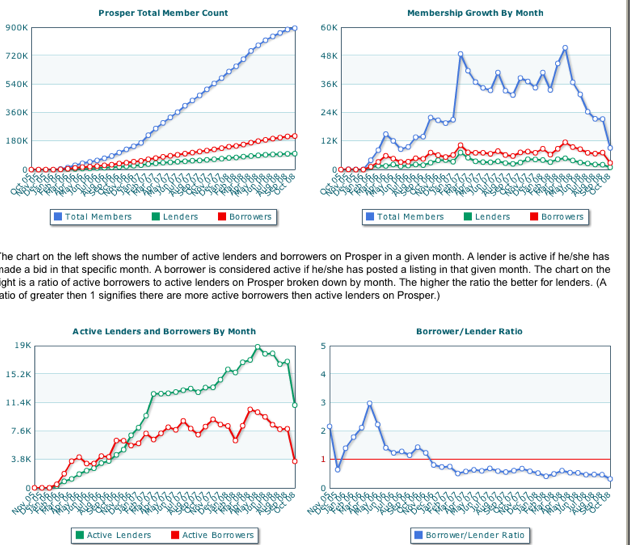


If big banks cannot lend money obviously individual donors are going to cut back on that type of stuff for a while. We might even see sits like prosper going under.
http://www.techNmore.com
Everybody is tightening the pockets and watch their backs….
Lending Club has a different focus than Prosper though: they are focused on Prime lending and have less than 2% default. There is a third party site reporting Lending Club’s data: lendingclubstats.com.
If one compares lendingstats.com and lendingclubstats.com i.e. the data on Prosper vs. Lending Club respectively, Prosper’s borrowers are 67.8% current, 14.3% late, 4.6% default and 13.3% paid… Lending Club on the other hand is 89.1% current, 4.2% late, 1.9% default and 4.8% paid. That’s a pretty considerable difference.
P2P lenders should switch to Kiva.org instead. Less risk, tax writeoffs, and good for the soul.
I think Kiva is doing some great work, but it’s not like the non-profits have a monopoly on the more “human” side of things. Lending Club could be seen as doing an honorable thing too, especially in light of the current credit crisis, because nowadays banks are turning away borrowers even when their credit’s good… Like, give the people who have earned it a break.
Good article. I think long term P2P lending is here to stay but the space is definitely still in its infancy. Like all new industries there will be challenges until the model is fine tuned. Props to Prosper, Lending Club and others to leading the way.
It looks like Prosper saw that Lending Club got approval and said, “oh snap! We should probably do that too….”
Zopa is out. Prosper now out for who knows how long. Looks like it’s now Kiva for the soul and Lending Club for the pocketbook.
The article misses a major point. Lending Club got SEC approval this week, which is a major step forward. Why does everything has to be so negative? Because negative sells?
I think you guys have this completely wrong. It looks like Lending Club is leading the pack here and has already received the regulatory approval that is lacking at prosper. Also, Lending Club’s losses are around 2% so they are not even in the same ball park as prosper. This story should be a positive one about how Lending Club’s door are now open again and they are lending money in this market where most of the top banks have gone under. What is happening to TechCrunch when you are trashing innovation in favor of what – old line banks? If I want that approach, I can just read the New York Times.
TechCrunch is turning into TechTrash! There is a tremendous opportunity to disintermediate the banks in the credit market and define a new category for both borrowers AND lenders. This opportunity is magnified by the credit crunch environment we are living in. I would encourage the reporter to raise his standard above the journalism integrity of The National Enquirer and the critical thinking ability of Sarah Palin… How much homework did you do before writing your trash piece?
The link in your post to the NYT’s article is broken. Here’s the correct link:
http://www.nyti...ups/16peer.html
Wow.
It really IS surprising that TechCrunch jumped right in on the band wagon with NYTs to turn their backs on the P2P Lending world. Yes, the industry seems to be going through lots of changes, but the concept is just maturing… not going away.
C|net seems to have done a better job than TechCrunch this time:
http://news.cne...10068507-2.html
Lending Club may be back, but if you read the fine print, you’ll notice that it’s now restricted to only 16 states. Even large states like California and Texas are left out.
RE: “Everybody is tightening the pockets and watch their backs…”
The general theme here is an easy one to follow, but its worthwhile to delve into the facts. If the conclusion remains the same so be it, but to the issues at hand:
1. The regulatory framework
2. Prospers credit policies
3. The banking crisis
These three matters are mutually exclusive and need to be thought through carefully. Its too easy to amalgamate them and form a conclusion as the person above did, but the reality is different.
The assumption that “Everybody is tightening the pockets and watch their backs…” assumes an anarchistic system where everyone is trying to save themselves.” We do not live in an anarchist society.
The current banking system crisis (3. above) is driving many to think that way, but now is the time to close your eyes and think out 6 months, 6 years – what will be the situation then?
Prosper have moved from an entirely open borrower availability to increased restrictions and clearly their approach is outside the norm of the consequential social lenders.
Lastly the SEC and other regulatory authorities have been caught off guard by social lending, so some catch up is necessary.
In total there is much going on here, so lets not through the baby out with the bathwater. Lets stick to facts, and individual situations, and see where social lending develops.
Prosper is a bad example, for they have had problems before the credit crunch. Their growth stopped after lenders became wary because of the high Prosper default rates. And know Prosper goes into the quiet period with bad timing.
Lending Club on the other hand showed exceptional growth before entering their quiet period in April. And now they are the first major p2p lending service with a secondary market. Even more important their default rates are much lower then Prosper’s
Could allow them to catch up with Prosper counting by loan volume (even so it’s not directly comparable, because Lending Club allows only lenders with high credit grades.
Internationally especially the microfinance concepts (Kiva, MyC4 – see http://www.wise....com/myc4-loans for stats)
are booming, furthermore p2p lending is expanding in some national markets (UK, Italy, Germany – see http://www.wiseclerk.com/smava for stats, Poland) while failing in others.
Several industry insiders still consider the credit crunch to be the best thing that could have happened to the p2p lending players. With people distrusting banks they have windfall (volume) profits – Zopa UK already reported a large influx of lenders and borrowers.
And in many markets new platforms are launched (e.g. Maneo in Japan). Not all will thrive, but those that manage to control default rates (again see Zopa UK with 0.04%) will grow to considerable size. Gartner’s prediction for 2010 seem a bit optimistic to me though
Claus Lehmann
Editor
http://www.p2p-banking.com
@ David
19, I believe. They have announced to add more states over the next weeks.
Furthermore residents of all states can buy notes at the Lending Note Trading Platform (that’s strange, is it not).
Claus Lehmann
Editor
http://www.p2p-banking.com
I’m eager to find new credit qualified people to lend to so I can recover some of the my stock market losses over the next few years.
So far, my Prosper investment has not made money, but it’s “less of a loss” than my mutual funds.
P2P lending is here to stay.
Prosper is stopping its lending process now because of some new SEC regulations.