How to Profit off the Poor… and Keep Your Soul
by Sarah Lacy on November 15, 2009

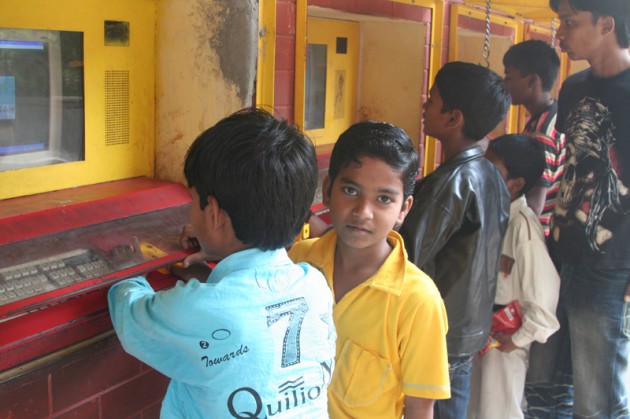
holeinthewallDELHI, INDIA–“I’ll take you! I live there!” a small boy with a blue shirt and a perfect toothy grin said as he ran ahead of me. His quiet friend in yellow jogged beside him smiling shyly, his jet-black Elvis curl bobbing on his forehead. The boy in blue stopped a few yards in front of me turned around, beaming and added in Hindi, “I know computers quite well.”

These weren’t middle class kids on the well-trod, parent-driven Indian path to seats at IIT. These were Delhi slum kids, whose families likely live on less than $2 a day. And yet, for the last five years, they’ve spent several hours of their free time every day playing games and learning English, Math and Science on computers.

So how have they bridged the much-agonized-about digital divide without a hand out from a chip company, computer company or wealthy philanthropist? A for-profit Indian company called NIIT.

It started back in 1999 when Sugata Mitra, NIIT’s chief scientist, noticed his kid could learn how to use gadgets like a mobile phone far faster than tech-savvy adults could. At this time, most computer “labs” in Indian schools were one or two computers that were only to be used under the strict supervision of a teacher. The reasoning was computers were expensive and required training and supervision. As a result many kids only got to look at them from afar in the classroom.

Instead Mitra wondered what would happen if he left a computer out in the open for a group of children to discover. So he literally knocked a hole in the office wall to the slum on the other side.  He shoved a computer in the hole and set up a camera on a tree limb to record what happened. A 13-year-old, illiterate kid who’d never seen a computer wandered over tentatively, and soon realized he could move the cursor by moving a finger across the touch pad. Within four hours, a small group of kids had gathered. They had figured out how to open Internet Explorer and were playing a game on Disney’s Web site. “All of us were absolutely shocked watching that,” says Abhishek Gupta who heads the program now. Some expected the kids to break or even try to steal the computer.

A pilot project with the World Bank followed, and 22 of these “Hole in the Wall” kiosks were set up around the country from 2001 to 2005. The organization studied the results closely. The most obvious take-away was that kids left on their own will learn computers. The project also helped develop team-building and social skills—with 200 kids sometimes huddled around one screen. Whether the computers lead to more general academic improvement was less clear, but in many cases it was up measurably, Gupta says.

But interestingly when that partnership was over, NIIT didn’t take the project down the non-profit route. It’s not because the company is adverse to such things—it’s also opening a new high-end university that is run as a non-profit. But there’s a unique attitude in India that believes the way to eradicate poverty is to turn India’s scrappiest, free-market entrepreneurs on the problem, not to increase handouts.

NIIT now sells the kiosks at between $6,000 and $20,000—depending on which model and how many screens—to the government, who puts them mostly in schools in India’s poorest areas. There are 500 stations in India and a handful in 10 different African countries.

Having customers means NIIT has had to compromise on the original vision. For instance, the government requires administrators to keep an eye on the systems. They’re not open when an administrator isn’t there. But running the program as a business has assured its survival and given NIIT the cash flow to pour money into content creation so it doesn’t have to rely on the country’s spotty Internet connections for kids to stay engaged. Gupta says his job isn’t necessarily to be a profit center. Success is running a break-even program that makes a social impact. But that’s still a world away from a donor-funded program.

NIIT isn’t alone. For profit companies have made microfinance loans for years in India. One of the most known is SKS Microfinance. It was run as a non-profit in the early days, but when it was time to scale, decided to turn into a Sequoia Capital-backed startup. “It’s important to realize the poor have been paying three-to-four times more to the local money lender,” says Surendra Jain, a managing director with Sequoia in Bangalore. “There’s nothing wrong with using the same tools to scale the way other companies scale. The question is: In your heart are you doing the right thing?”

Even non-profits I’ve met over the last two weeks run themselves to rely on revenues not donors. An example is LabourNet,  a company that seeks to move India’s huge informal workforce into a formal channel. The company organizes phalanxes of construction crews, drivers, cooks and retail clerks and matches them with the best employers. How does it reach them? Word of mouth and SMS. So far 7,000 workers are in the system.

It was started by Solomon JP. His umbrella non-profit organization, MAYA, has already produced one self-sustaining company that trains poor youth in making high-value furniture. With a grant from Bill and Melinda Gates Foundation, CHF International, an international NGO addressing urban poverty in India, is providing technical and financial support to help LabourNet become a self-sustaining enterprise. “Being poor isn’t about not having money, it’s a lack of capabilities,” JP says. So LabourNet doesn’t stop at getting poor people a job, it offers access to healthcare benefits, issues ID cards, and helps with bank accounts, literacy, and job training too. The worker pays a small fee, and the employer pays LabourNet a larger one in exchange for matching them up.

It’s hard work. JP has been working with the poor in Bangalore for some 15 years and says it’s like Hotel California. “I don’t recommend this path. I can never leave. I’m trapped!” he says with a weary half-smile. (I’m not sure what percentage of that is a joke.) But he believes he and others can solve the problem through self-sustaining means as long as organizations don’t sacrifice humanity in the name of efficiency.

It’s a dramatic difference from China, where most entrepreneurs are building businesses that are aimed squarely at the top of the pyramid or the burgeoning middle class. But since India is a democracy—and not an authoritarian one—it doesn’t have the same social safety net of other emerging worlds. It’s fitting that it’s trying to use a free-market economy to solve its social ills instead— something American do-gooders could probably learn from. After all, we’ve got our own digital divide.

One final note on NIIT’s Hole in the Wall program: It was allegedly the inspiration for the book “Slumdog Millionaire” which spawned the movie. “Where’s my Oscar?” is a favorite joke of Rajendra Pawar, the chairman and co-founder of NIIT. I asked a lot of people working to eradicate poverty how they felt about the movie, and most said it was neutral-to-positive for India. It doesn’t hurt to show rich Americans how one-third of India’s 1.2 billion-person population lives, even if it was sensationalized. The difference is none of them are banking on a one-time windfall as the answer.

Advertisement

Comments rss icon

  • Hey Sarah,

    If u r interested some interesting case studies here:
    http://www.bus....ult.htm#Serving

    There is a growing belief that the best solution to eradication of poverty is entrepreneurship and small biz economics…

  • Holy shit, he can open a proprietary browser by MSFT and visit the site of company to earn it advertising money… *gasps*

    Nice story, but don’t aim for the low fruit. Get these kids programming and I’ll be interested.

  • Hey Sarah, All India needs is the eradication of corruption. Everything else will be pretty much solved.

    Someone needs to shut the whole country down for one day and just THINK it over.

    These stories make for good TV.

    • yea wy dont we also nuke india…it seemed to work for japan..NOT

      • WTF are you talking about? There’s nothing wrong with ending corruption in India

        • you mean reduce corruption – you can’t get rid of it – the whole world including UK and USA is riddled with corruption – a bit like the carbon footprint/ greenies, each person can do their bit to reduce damage – but don’t lie and say you can’t get rid of it – that is false hope.
          Z.

          • I’m from India. Yes, the US probably has a lot of corruption right at the top — the things that led to recession — for example (yes, not a straightforward case, but would you not call such negligence as corruption?) — and how taxpayer money was used to rescue them so that they can make enormous profit again (left to see how these companies will be regulated so it does not go back to the square one). Money might have distorted morality and defeated democracy. It has always been the right time for the “few good men” to never fail to ask questions, debate and protest.

            In India, the “right to information act” is a new and nifty tool to obtain information about public spendings.

            While information can be sought and had, everybody must decide for themselves how “socially aware” or “socially responsible” they would be or should be.

      • And may be Nuke wall street too ! Would end a lot of woes for America

      • I always thought ppl visiting techCrunch were educated, guess I was wrong!!

    • i was watching fareed zakeria gps interview some great people scholars about china, people who have dealt with china oficially for a long time, live there, are chinese, etc…the other guy was british, forgetting his name but very very smart man and he basically said the same thing. he said that for all the good things about china and it’s people, that corruption is a big deal there. never knew that. didn’t know the amount of corruption happening in african and central & south american countries are happening in east asia. interesting.

  • Gullible western journalist falls for Indian business PR once again. Have a nice day ;-)

  • Hey Sarah,

    Great article and as always great writing

    BOP (Base/bottom of pyramid) is biggest and most overlooked market.

    If more organizations like these sprouted out around the world, more of the disenfranchised and poor would move into the capitalist society vs. those societies championed by Al-Queda, Taliban etc.

  • Very Well Balanced Article Sara. I am an Indian living in a plush appartment in one of the major highrises of a major Metro reading TechCrunch and updating about nitty gritties of my life on Facebook and twitter like so many others in my peer group, most of the time arm chair debating on the socio economic outlook of India in the next five years, pretty much oblivious of whats going on in the rest of the country, or for that matter, the slum next to my highrise from where we source the cleaning and cooking maids.

    Thanks for bringing in a perspective, although probably temporary, yet important. One of a thousand yuppies working for a Mckenzie or a BCG or a Bain or a Google or a MSFT or an Amazon will probably wake up and smell the coffee and do something local, solve something local. Its not that we don’t want do it, we are inspired enough.

    • Correction to above post: Its not that we don’t want do it, we are *NOT* inspired enough.

      • Inspiration? Ok, tell me if this real-life story inspires you…I have a friend who starting social service in a small way, like many others, donating money. Then he started a not for profit organization. He’s been running it successfully for the past 4 years. He’s a Software engineer with a leading services company in India. And guess what, after years of relentless, selfless efforts, he’s decided to go one up on himself…he’s quit his job and taking care of the organization full-time. We, friends of him, have been helping him financially. The organization has 3 centers and will have a 4th center shortly, with emphasis on education for the not-so-privileged.
        The organization is called Social Welfare Funds. Check them out. In your free time, you could choose to visit these centers and draw INSPIRATION!

    • I think there are a lot of people working on local projects. For instance, I am working on a open source MIS for MFIs. And I know a lot of other people who are working for various social businesses.

      • A good friend of mine, traveled all over the world to finish her thesis on transparency from MFIs and get her degree. She’s working hard on her project, setting up a new NGO, etc.

        That’s the kind of commitment we need nowadays. That’s the power ONE person has to change the world we live in. That’s be the kind of people we should be admiring, aiming to be and taking cues for inspiration from.

        BOP was also addressed not so long ago at TED talks in an incredible presentation on how the integration of the so called black markets into a formal structure is the way to go.

        @piyush: You might be interested in reading her publication at her site, http://www.jess...cahaeussler.com which is licensed under Creative Commons.

    • MP. Intriguing comment. Sounds like one day you will leave that plush apartment , take a pay cut and do something.. Meantime if you can assuage your conscience by passively helping others who have already found the inspiration.. Child relief and you– may be?

  • Great writing and inspiring story. It’s daunting to imagine how much money we would have to funnel into poverty to solve it with brute force, so it’s nice to see self-sustaining ideas.

  • Great article.

    For a second however I thought I was reading the history of the Montessori method, originated by Italian educator Maria Montessori.

    It’s a shame that India does not use all of that talent to build a decent infrastructure.

    • Its not that we want to… The red tapism in our country coupled with widespread corruption is responsible for the sorry state of affairs.

      The contract to build a road goes to the company which can pay maximum kickbacks to the signing authority.

      Since the kickbacks are not extragenous expense and cannot be added to the cost, it is recovered by lowering quality of construction. So a road built which should last 10 years lasts 1 and a half.

      And then you pay off the committee which comes to inspect the road and wait for the new contract to open after 1.5 years.

      They keep repeating this, both the govt official and the contractor makes money paid by the people as taxes and the common man using the road gets fcked in the ass.

      • @Nitin The “right to information (RTI) act” in India can be a powerful tool to handle such cases. I’ve been working on a RTI wiki: easyrti.in There are also forums like rtiindia.org where you can seek advice about how to tackle such cases. Now that we have the tools/weapons it is our “responsibility” to use them to our needs.

  • The principle of Botttom of Pyramid actually makes much sense even though big multinationals might not be interested as they dont see big profit margins. However we are talking about the empowerment of common people earning less than $2/hour and hence very relevant

    We can potentially solve third world poverty by making everyone consumers!

  • I don’t understand what this kind of old school journalism with insights garnered over short stays and meeting pr folks for various organizations accomplish.

    Why is NIIT even been given the publicity, what they have done and accomplished, so why allow such companies to get goodwill and publicity at the cost of the poor. This is nothing but gratuitous exploitation of their cause, and by publishing this techcrunch is becoming part of it.

    If Sarah wanted to do a piece on India’s poor she would have contacted an entirely different set of people, not NIIT.

    • this is so true!

      ++++10000

      NIIT is a scam, a complete utter SCAM

    • I am not sure that I understand what you mean. I thought that it was a good article and I learned something; I do not think that it aimed to be hard core investigative journalism. What came out of the article was the amazing ability of little children to learn computer skills (well, we certainly knew that to some extent), as well as the unique Indian take on solving their problems through free market economics with a social conscience. I did not even remember that company’s name after reading the article.

  • Why is Techcrunch covering India so much these days ?

    • Probably ’cause anything India these days is linked to white collar tech jobs being lost. The same people who are the intended audience of these blogs.

      These people coupled with some Pakis in stealth mode would invariably flame the topic and up goes the website’s hit count :)

    • vivek and sarah are in india. jobs are moving from western countries to eastern countries. it’s true. anyone who is saying that the trend that people mentioned in the past isn’t actually happening is someone wearing rose coloured goggles. the world is becoming global and things that were once thought to be set in stone are shifting. i mean today i heard that the chinese think that the yuan is undervalued and i also heard that the americans think that the chinese need to add value to their currency so that the two currencies and exchanges are and business done by both countries are more balanced because apparently america feels like the chinese are fixking the system, keeping their rates purposely low. i don’t believe all of that and think the truth is in the middle but i wouldn’t be surprised. a lot is happening in these BRIC countries, Brazil, Russia, India, China. Lol. where’s venezuala? you know chavez would love to be in that group. and where’s uae, iran, etc…

    • I guess it has something to do with: India is a sister democracy, and the largest democracy by population.

  • Why is Techcrunch on India’s case so much these days ?

  • Hey Sarah, I am happy to see even TC is writing about social entrepreneurship! If you want to meet other people and find other stories about social innovation/entrepreneurship, go to The Bay Area Hub http://bayarea....hub.net/public/

  • Hi Sarah,
    Interesting and uplifting post.
    Regards
    Taylor

  • That’s a real fine article, Sarah! I am lookin fwd to you talk more about it in NBC Bay Area ‘Press Here’ (pressheretv.com) once you are back.

  • You know what a better idea would be? Perhaps giving kids computers for free to learn programming and then letting the kids keep the computers, but on the condition they learn programming and undertake a reduced rate employment for 1 or so years.

    That way the kid is helping the company with programming duties at a cheaper rate and the kid gets to keep his own computer.

  • capitalism isnt a theory its the way the world works, whether people like it or not.

    donkeys years ago when people were subsistence farmers and tried to sell any left overs was capitalism. When after the black death subsistence farmers tried to improve their lot in life by buying more land, was capitalism. the industrial revolution, when people choose to move from their subsistence farms to work in the so called, dark satanic mills capitalism improving peoples lives. The industrial revolution itself, that led to people like titus salt setting up factories and villages around those factories, complete with schools and hospitals and churces and even the invention of the weekend was capitalism improving peoples lives.

    the state can help and provide a safety net, but capitalism and philanthropy has 1000 years proof of improving peoples lives in the long term.

    compare that to socialism, the collapse of the soviet union, north korea a temperate country whose people are reduced to an almost permenant state of famine and china who were in such trouble that they had to declare that ” to be rich is glorious”.
    not to mention britain, look at what the stupid socialists did to us!

    a theory is only a theory until it is either proven or disproven.

  • A very interesting article.
    One thing that seemed to be implied by the text and photo was that primarily (only?) little boys were using the kiosks and gaining this informal education. If that is so, it would have been interesting to hear more about that why that was the case. (Is it not considered appropriate for girls to run around unsupervised in the same way? Are they discouraged from ‘mixing’ with the boys? Are they discouraged from using the kiosks?)

    • You have a complete old and narrow image of things AJ(not sarcastically).
      Girls are allowed to run, jump, or do anything.. and they can mix with boys, these are small kids..
      A simple answer to your doubt is small girls are naturally shy maybe(not a general case but up to some level) so maybe when a ‘foreigner’ Sarah comes there, they won’t be as excited as boys to show them the kiosks..

      My opinion..

  • I love the idea of this and I feel as though if you bring computing to the hands of anyone, you will see serious build-ups of strength.

    These kids aren’t programming yet, but they will be very soon likely. Especially considering India is becoming the R & D center of the world. If you can get all of these kids acting and thinking like entrepreneurs, you will be arming them with the best of the new world

  • the sad part is that you feel the need to make the point that you can keep your soul and profit from the poor and keep your soul at the same time.

    most business people, most of the time, engage in voluntary mutually beneficial trade and by definition all participants keep their souls and walk away with more than they came with

    of course, how often this happens depends on how strong the rule of law is in a given area. the rights of all market participants need to be protected for everyone to prosper. hopefully this is beginning given a growing amount of attention in developing countries

    • I’m sorry but I would have to disagree. I have studying economics for seven years now, and if one thing is true, it’s that the market works best when it’s being monitered by the state. Of course, the state needs to be reasonable, and we could disagree on what reasonable means. If you need proof that business practices can be soleless, look no further than the subject of this story: India. The zamindari (land-ownership) system was and is exploitative, and a similar attitude extends into many other spheres of economic activity. Markets are good, but even adam smith didn’t think they were holy and virtuous.

  • That’s a real fine article, Sarah!

  • Hey Sarah, great article. I’ve bookmarked it, and will use it as case study and try to implement something similar in my african home country. It’s great to see peoples try to make the world better while earning some cash as well.

    (beta comment)

  • Awesome article. Nice to see TC expanding its horizons to cover how technology is influencing lives not just in the US but outside, especially in the developing countries. Real Tech Crunching! Keep them coming.

  • whats with these fluff articles nowadays?

    i guess techcrunch hasn’t realized that if twitter or facebook has no news, then it has to deliver filler.

    its sad that i learn more about interesting tech on the NYT.

  • The best way could be “Each one teach one”.

  • ,
    an interesting Talk from Prof. Yunus in Berlin University in germany on social entrepreneurship: http://labor.en...trepreneurship/

  • This may be a little offtopic..
    But, if you open YCombinator, TechStars branches in India, you’ll know how much the Indian startups are capable of..

  • Didn’t know about these holes, though I stay in India.

  • Development should follow Top-Down Approach.
    Bottom-Up Approach is only good on paper.

  • I am an Indian studying in the US and think it’s remarkable what the NIIT guy tried and managed to accomplish. Having said that, there is no need to put solutions to poverty inside boxes and trying to turn everything into a state versus market debate. The market works sometimes, and sometimes the state does. It is not true that India has the “unique belief” in eradicating poverty through market mechanisms – look up the National Rural Employment Guarantee Act, and if you’re uncertain about its impact, look up the reception to it from civil society as well.

    I think virtually every reasonable Indian will agree, and indeed people around the world should agree, that solving the problem of poverty is a part-state, part-market problem. Let’s not politicize poverty eradication. Instead, let’s get the job done.

  • @Srihari, there’s a company in bangalore called upstart.in on the lines of Ycombinator. you should check it out.

  • One of the few articles on (ad)crunch that is worth a read. Report on it more. Please. And try to get people to strip away the candy coating. Anyone who says they were neutral on Slumdog is trying to be nice. People here think that is what the entire country of India is like, a movie. it is not. You should know. You are there.

  • Here’s what I got from this article…

    “The most obvious take-away was that kids left on their own will learn computers.”

    So tell schools to stop teaching kids how to use computers “like it’s the military,” when they already know how to use one already (The easy way, of course)

    Good stuff, keep up the good work
    Computers rule!!!

  • Sarah, i have been enjoying all your amazingly written posts, i wonder how long it takes you to write each one up.

  • With this title, I was sure the article would be about organizing a religion!

  • just how everything happens in India.. accidentally..

  • read the whole thing. definately good write up sarah. i’m surprised by the comments talking about corruption in india preventing the country from fully developing/moving forward, but i guess it’s inevitable based on the region their located. there’s a lot of indians and other east asians where i live but i guess i have a romanticised view of india because the truth isn’t broadcasted. i understand there’s a lot of corruption but i also thought that india was one of the oldest democracies, atleast if not oficially then in the way the caste system works and is recognized among people.

    anyways there was a documentary on the tv lastnight about how the youth is in real trouble in india because so many of them don’t go to school and aren’t educated. they work from really young and miss the opertunity. i didn’t know that. they’re doing that school bus program, the mobile library/schools which go to the different parts of cities/villages and en masse teaches kids for a few hours a day. it was quite a depressing and inspirational doc.

    • *oppertunity…and other mistakes.

      the best part about seeing that doc was seeing all the kids genuinely excited to learn and all the people who put in their time to this movement of education and literacy. it’s very important. it’s so easy for people to take those institutions like education and health for granted when in some places you can’t have any of those things. i mean i heard a lady on the radio right now just say how surprised she was when she had a swiss chalet meal where she had a plate with a whole chicken leg and some other foods and asked if that was all for her to eat…they were discussing food and the crisis in ethiopia or some other african country because this is world hunger month. it was so sad because it made me realize how incredibly selfish and uncaring i am. i mean i have access to so much and i’m whining about meaningless shit whereas somewhere in the world some kid is surviving on nothing. i’ve been there before but i can’t believe that being a westerner has me so removed from just basic commen beliefs. like i feel i can insulate myself from that because it’s not me, i’m not there, and i’m not living like that anymore. granted life on this side of the ocean isn’t all gravy, people are still struggling and people are still corrupt, crazy, selfish, etc…but it’s all relative. in some places there are no systems set up to catch the outliers (not the ones malcom gladwell talks about…but it could be)…the poor. it’s just all too sad and kind of unforgiving. i mean what’s wrong in this world when kids can’t eat and can’t read or write or have a future or work especially when jobs are being sectioned off for those who have and the have nots.

      good piece lacy. thanks for writing it.

      • just saw the evening news and they had another piece about india, business and corruption. i think it’s focus on india or east asia because of apec, and because our head of state is over there now. they mentioned that according to a transparency organization 50+% indians reported that they’ve been bribed before and that truck drivers pay bribes along the way even through they’re doing the job that keeps the industries/economy at a fundamental level, rolling. truck drivers have paid over 5 billion in bribes. i heard all of this and i was shocked. i didn’t know corruption was so deeply rooted in india. wow. some business man said that aside from the other negatives and the positive of establishing a business there and having it grow fast, that companies wouldn’t go to india mostly because of the curroption. that’s so unfortunate.

  • “A 13-year-old, illiterate kid who’d never seen a computer wandered over tentatively, and soon realized he could move the cursor by moving a finger across the touch pad. Within four hours, a small group of kids had gathered. They had figured out how to open Internet Explorer and were playing a game on Disney’s Web site.”

    Not really sure I believe that. I think if I was an illiterate 13 year old who’d never encountered a computer, I wouldn’t have mastered the art of double-clicking within four hours, let alone navigating the web, installing flash player, playing games on foreign websites.

    • @ Chris,

      I don’t know whether the kid was illiterate. But I know for sure the kid has never seen a computer in his real life. And still managed to master the art of double clicking. It usually takes the longest for the first kid to master the mouse. Once he does that, he teaches the other kids and everybody starts exploring the internet for the first time in their life.

  • I don’t believe that if a kid is uneducated, he can type a URL correctly and can sign-in to a website and start playing games.

    This sounds like a bit of over-hype to me. I’d like to see this happen on a video or something to believe.

    If someone can’t figuer out A B C since he is un-enducated, how can he type a URL and login and play games.

    C’mon.

  • I’ve read TC since day 1. This HAS to be one of the most interesting and worthwhile article since your inception. Thanks Sarah!

  • Interesting read. I don’t get why so many people on this board just want to analyze things to death and be so skeptical.

    At least these guys in India are DOING SOMETHING.

    It doesn’t mean you have to blindly support them, but what’s the value in criticizing their efforts? Does that help anything at all?

Leave Comment

Commenting Options

Enter your personal information to the left, or sign in with your Facebook account by clicking the button below.

Alternatively, you can create an avatar that will appear whenever you leave a comment on a Gravatar-enabled blog.

Trackback URL
Short URL
bugbugbugbug
Techcrunch on Facebook