Have you nominated someone for a Crunchie today? »
Wikipedia Runs Ads Highlighting Their No-Ad Policy
by Michael Arrington on November 13, 2009

Moments after Craigslist founder Craig Newmark joins the Wikimedia/Wikipedia advisory board things start to go crazy.

Way back in 2006 Jason Calacanis, then an executive at AOL, was trying to convince Wikipedia to puts ads on the site. It would generate $100 million a year in revenue, he said, which could fund the project and other charities:

I sat next to Jimbo at a Wikipedia dinner over the summer. I begged him to put a leaderboard on Wikipedia and told him I would get AOL to sell it and host Wikipedia–for free. He declined saying there will never be ads on Wikipedia. I then explained to him in detail how that one leaderboard could make over $100M per year. I told him that they should take the $100M and give it to charity. They could help fund MediaWiki, the EFF, Firefox, and dozens of other open source projects.

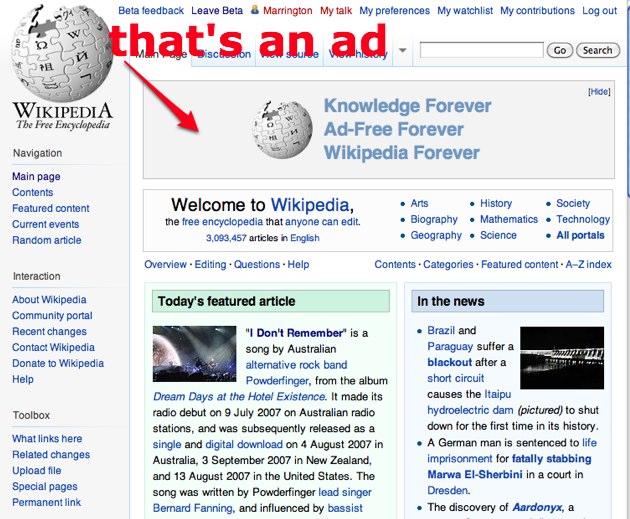
Agree with them or not, Wikipedia has held firm to their no-ads philosophy, struggling through with donations instead. But today Rex Hammock noticed something on Wikipedia – a banner ad.

These aren’t “real” ads promoting third party sites, products, etc. They’re just in house ads reiterating the policy that Wikipedia will never have ads. But they clearly are ads. As a commenter notes below, Adblocker even filters them out.

“Knowledge Forever, Ad-Free Forever, Wikipedia Forever,” say the ads. They link to this page asking for donations to the Wikimedia Foundation.

Update: Readers point out that this is an annual effort by Wikipedia.

Advertisement

Comments rss icon

  • They really should put ads and donate the money to charity, I like that idea Mike.

  • Do people actually go to the Wikipedia homepage?

  • It’s as much of an advert as the techcrunch banner is. Sure it’s technically an advert in the loosest sense, but it’s not truly an advert and it’s far from hypocrisy.

  • Wikipedia is being extremely stubborn for not adopting the ad model. The ads won’t hurt the user experience of gaining and contributing knowledge. I just don’t get it.

    • Ads can deter some wikipedia contributors, or make them less enthusiastic to devote their time to it. I think many people contribute just because there are no ads. Also, I can ask you a counter-question: why having ads, when they are able to secure the money through donations?

  • If I was a billionaire I’d personally finance them so they never have to worry about destroying something great by running ads..

    Stick to your guns Jimmy! :D

  • There are two benefits to Wikipedia staying strict in regards to their “no ad” policy:

    1) It keeps them from starting down the slippery slope of “when is advertising too much advertising?” and “how much do we monitor/control our advertisers’ content”

    2) Say “no” to ads, and the revenue that would come with it, also protects their business model somewhat. A company that becomes too reliant on ad revenues may find that their revenue will fluctuate more wildly as fads change and the economy goes up or down… so refusing to run ads and accept ad revenue keeps them from blowing up their organization into an overhead-heavy business that then struggles when ad budgets get cut

    Phil

    • 1) The slippery slope is a management and policy issue.

      2) Ads will only generate revenue. The fluctuation is again another management issue.

      So, if you’re implying that Wikipedia is sticking to their guns because they fear they cannot manage these things to generate a revenue stream to fund their cause, then that’s just being lazy.

  • one single text ad as leader board not going to hurt them or us at all… i like that idea of AOL GUY!!

  • “Forever” thing is frightening. It reminds me of “Duke Nukem Forever”….

  • I think the idea is to keep it ad-free so as to keep the site independent and free from entertaining advertisers’ agendas. Kind of like PBC, the BBC or NPR.

  • Wow. This is seriously on TechCrunch?

    Michael, sorry man. But articles like this make me think TC is becoming the next TMZ, HuffPost or maybe even Drudge Report.

    That’s not an ad in the sense that most people understand it (is it selling anything? is there a campaign behind it?). Even in your post your acknowledge this and yet the title of this article says otherwise.

    Please don’t create article like this (or at least misleading titles such as this one). They tarnish the other quality articles that are here.

  • It is an ad. It takes you to a landing page where the action they are soliciting is a donation to their foundation.

  • forget the ads, tell us more about that beta you are in.

  • I think there is a significant difference between asking for donations to fund a non-profit and having product-selling advertisements on a page.

  • @jason was right. and the revenue would be a lot higher now.

  • Translation: Donate us or we will put nasty ads on Wikipedia

  • Jason was right, but still, there is something perversely admirable about saying “no, absolutely no”.

    That said, this IS an ad, and that’s too bad. I’d call the “absolutely no ads” a failure at this point. Is it better to beg for donations, than to generate loads of revenue from “normal” banners? At least this way, there is no question whatsoever of any conflict of interest on the part of advertisers. Just your run-of-the-mill editor’s cartels and wiki vandalism ;-)

  • This is part of their 2009 fundraising campaign:

    http://blog.wik...dia-fundraiser/

    It doesn’t seem much different than last year’s campaign:

    http://blog.wik...-banners-click/

    And I don’t think that was the first year, either. So shocking or not, this isn’t the first time.

  • not ads!
    if there were ads on wikipedia the advirtisers will control the content.

    please donate.

  • “But today Rex Hammock noticed something on Wikipedia that has never been there before – a banner ad.”

    Wow, been on the Internets long?

    Wikipedia has run banner ads for its fundraiser every year for several years running. That’s why they call it an annual fundraiser.

  • thats not an ad dude.

  • They’ve had ‘ads’ before requesting donations to wikipedia, nothing new here.

  • What, accuracy in reporting? Surely that would get in the way of the holy jihad against that devil Wales!

  • I don’t see nothing wrong with having ads on wikipedia. IT is an excellent revenue source for them. I know they want to be different, but you have to be realistic in running a business. Look at all the ads on Techcrunch does it bother anyone? Over the years Techcrunch has added more and more and don’t see anything wrong with it. It is revenue to grow and Wikipeidia needs to start thinking like a business. But it is up to the owner.

  • Re: Previous ads. Yes, there have been “snipes” and messages across the top of Wikipedia for every fundraising campaign. I’d be happy to believe differently if someone can produce a screenshot to disprove it, but I believe this is the first time they’ve run banner ads in an IAB standard format. And this ad is running on all Wikipedia pages, not just the front. And more power to them — I hope they raise tons of money. I’m donating.

  • This is a dull article, Rex Hammock should find a better use for his time. Wikipedia have been trying to drum up donations through these types of ‘ads’ for a while…. so what?? They provide an excellent service.

  • Wikipedia still survives without ads. That shows the value of its existence. How many online ventures can prove that? It survives on donations cause those who donate to it, (WMF) truly believe in it.

    The ad whores can go to hell. Everyone wants to sell something 24/7/365.

  • Of course, the question we should be asking is “Why did the Wikimedia Foundation take $2 million from the Omidyar Network on the same day they seated a partner from Omidyar Network on the Foundation board, knowing full well that the Omidyar Network is also an investor in the Foundation’s Chairman Emeritus’ FOR-PROFIT enterprise, Wikia, Inc.?”

    Maybe back-room deals are too complex for the average TechCrunch editor, much less reader.

  • Well that’s definitely an AD!

    What makes me laugh is the way how they emphasize “knowledge forever” or even “ad free forever”

    If you ask me, that ad should definitely have the worst possible conversion rate.

    Something like “Donate to keep Wikipedia alive” would be much much better than saying “wikipedia forever”

    Damn … it seems like a communist speech to me

    Viva Fidel …

    • It’s reasonable to assume that “ad-free” refers to 3rd party corporate promotion. The same type of ad appears in every user/listener/viewer supported organization during their funding drives.

  • On the coming week no ads will be displayed.

  • @Arrington

    If you are linking to one of the pages of your internal site from your site’s main page it is considered as an Ad?

    Then even related posts link on the TechCruch would be also an Ad.!!!!!!!!

  • Wikipedia works. It’s still working because it’s leveraging the pristine, idealistic community culture that it has grown along the way.

    Introducing commercial and competitive elements into the mix might jeopardize all that, and the risk is just not worth it.

    Objectivity is key for Wikipedia.

    • Really? Objectivity is key for Wikipedia?

      Are you sure you have ever actually used or read wikipedia? Objectivity is one thing you aren’t going to find there.

  • That’s not even an ad?

    Nothing commercial what so ever, it doesn’t even look like an ad.

    Also promoting the website you are already on.

    Stupid.

  • I learned on Wikipedia the great wall of china was built to keep the rabbits out.

  • Ads distract the user from the subject matter (as they are intended to do) and are directly counter to the principles that make sites like Wikipedia and Craigslist appealing in the first place. Sure, there is great potential in huge sums of cash, but success isn’t always measured in cash. If the goal is to function and expand continuously without corporate advertising then I’d say that Wikipedia is a success.

  • There’s pretty funny protest page here:

    http://www.wiki...rg/explanation/

    (disclaimer: I have no connection to this site, I just think it’s amusing)

  • That’s not even an ad. Give me a break!

  • What’s so hard to understand about their position? Not everything is about money Mike. It is good to see a business with the integrity to stick to it’s principals despite the option of dirty money always beating at their door. Why the hell should Jimbo listen to you on monetizing his business? I think he knows what’s what and has obviously done perfectly fine on his own. I just don’t get why you are so concerned that money isn’t being made, it’s none of your business frankly and if I were in charge at wiki I would tell all who kept pushing me to get ads to f$%# off.

  • There is a VERY strong ethos against advertising amongst the major editorial contributors to Wikipedia – why should they devote many hours per week to maintaining the site against vandalism, updating articles etc, for nothing if the Wikimedia Foundation was rolling in advertising cash? The Foundation could never employ enough people to maintain the site in place of the volunteers regardless of how much money was brought in by ads. Back in 2003 the very idea of introducing ads was enough to fork the Spanish language version.

  • I agree that Wikipedia shouldn’t have commercial ads for for-profit companies.

    However, those “ad spots” would be a great place to ask for charitable donations for other non-profit organizations. Clearly, the debate over which non-profits Wikipedia should promote will become contentious, but what isn’t anymore. Despite whatever controversy may arise, this is definitely a great place to add more good to the world by helping bring light to organizations that do good like Wikipedia.

    You could use create a recommendation engine within Wikipedia to show certain non-profits based on the article that the user is reading.

    As a business model that could bring additional contribution back to Wikipedia – maybe for every dollar that gets donated to another organization, wikipedia gets a 10% kickback as a referring site.

  • So if that Wikipedia banner is an ‘ad’, is that globe in the upper-lefthand corner an ad?

    I mean, it prominently mentions that one is on ‘Wikipedia’, and even advertises it as ‘The Free Encyclopedia’. And it’s been there for *years*, even as WMF promises no ads. Dastardly!

  • Michael,

    I think you are right on this one: it *is* an ad! (a fund raising ad for Wikipedia). Even more obvious than what were, in my opinion, ads for Skype on craigslist — ostensibly because Craig Newmark *just liked* Skype…– but I definitely wondered if craigslist was getting paid by Skype for having those links on the site (at the time, when the Skype links were introduced, craigslist was claiming to derive benefits *mostly* from paid ads but has never clarified what other sources of revenue have been). Even if craigslist wasn’t getting paid for it, those links were still, in effect, a heck of a lot of ads for Skype!

    ~Delia

    P.S. you have *way* too many things commenters have to allow to post here (I usually have all that crap blocked) D.

  • Mike understands the difference between a 501(c)(3) charitable organization which chooses to rely on donations from the general public (which involves, necessarily, now and then actually bothering to *ask* for the donations) and an advertising-supported business model.

    To ask me why we choose one over the other is of course a valid question – and it is one that I think we should all consider in a mature and thoughtful way. I say “we should all” consider it because Wikipedia is part of the infrastructure of the Internet that we all rely on daily, it is built by a strong community, and one of our great strengths is open participation in the marketplace of ideas. If you think it’s a good idea for Wikipedia to accept ads and use the money for the furtherance of its charitable mission, well, there are plenty of useful venues to start that conversation where it will have impact.

    But to pretend not to know the difference between the two is just – as many people in this thread have indicated – not a very persuasive position. This isn’t a junior high school class, and I know that Mike can do better.

    • In the version I just posted to my facebook wall, I struck the remark “This isn’t a junior high school class, and I know that Mike can do better.” That was too aggressive. I changed it to “I know that Mike can do better.” I know he can, there was no reason for me to throw in that dig.

    • *You* can do better than that, Jimmy… You still have my respect for having made and kept Wikipedia a non-profit, (a huge contrast with craigslist) but you are wrong on this one… and if this was indeed Craig’s advice that you/Wikipedia took, I’d do without such adviser… ~Delia

      P.S. keep it open and honest (it’s not worth messing it up after you did the right thing for such a long time) D.

      • @Delia – Note the history of Wikipedia is a rather different story than the common misconceptions about it. Wikipedia was originally planned as an ad-supported site, and Jimmy Wales was in favor of ads. It was only made into a non-profit when it seemed it would both never make much profit, and that people would stop working for free if commercial ads were put on it. See the extensively researched column I wrote about this:

        “Wikipedia isn’t about human potential, whatever Wales says”
        http://www.guar...ipedia.internet

        • thanks, Seth!

          we’ve talked about this in the past and I still believe he could have *sold it* before turning non-profit and there would have probably been no Wikipedia today.

          I continue to believe he deserves respect for this, for NOT doing what Craig did, making it a *for profit* and keeping people laboring and in the dark as to what’s really going on.

          Sure, he’s not a “purist” (e.g. I suppose he could have donated all his honoraria to Wikipedia, although it did take a lot of his private time to get to the point where he would be offered anything of the kind) but, as far as I’m concerned, there is really no comparison between what he did and what Craig did.

          Delia

          P.S. and no! I don’t believe Wikipedia should have any ads on it and that banner ad *is* an ad blocked by ad-blocking software

          thanks for this link –> very on point! D>

          http://lists.wi...rch/001605.html

  • How much does the greedy Wikipedia Corporation pay Wikipedia every time they (Wikipedia) host one of their (Wikipedia’s) ads?

    Wikipedia has cornered the Wikipedia advertising market! The government must step in to break up this monopoly!

  • @Micheal “ad” or not, i think this story is not even worth it at all.
    The question should be, Did techcrunch run out of ideas for worthy news / content?

Leave Comment

Commenting Options

Enter your personal information to the left, or sign in with your Facebook account by clicking the button below.

Alternatively, you can create an avatar that will appear whenever you leave a comment on a Gravatar-enabled blog.

Trackback URL
Short URL
bugbugbugbug
Techcrunch on Facebook