Live from the RealTime CrunchUp »
Tragedy Of The Social Gaming Commons: A Blueprint For Change
by Guest Author on November 3, 2009

Our series of ScamVille posts on social gaming scams are nearly over. There have been some surprises along the way, like Zynga, RockYou and MySpace making quick policy changes to protect consumers. But we want to end this series with a glimmer of hope, and a proposed way for app developers to make a good living over the long run. All previous posts can be read here (including updates at the bottom).

During our research we spoke to dozens of scam artists, game developers, advertisers and legitimate and illegitimate middlemen. One company was consistently mentioned as being the most above board with their approach to the market – TrialPay. So to end the series, we’ve asked TrialPay CEO Alex Rampell to write a guest post on how he sees the market, and how it can move forward in a healthy way.

TrialPay is an 80 person company company in the payment processing and promotions space that works with over 7500 companies like Skype, McAfee, Match.com, Photobucket, Kmart, 1800Flowers, and Playfish. Alex started TrialPay four years ago after pioneering the use of “alternative payments” in consumer software products and games, and previously co-founded a company that became known as SiteAdvisor.

Alex believes that the recent coverage about the dangers of advertisements and advertising in the social gaming space is a welcome debate that may help save this industry from what this insider sees as the social gaming equivalent of the “tragedy of the commons,” where all constituents – users, advertisers, offer providers, and app developers – could permanently lose. The recent Zynga, RockYou, and MySpace announcements are an encouraging first step, but more needs to happen.

Unconstrained Markets Can Create Harmful Advertisers

In an efficient ad marketplace, the top keyword usually goes to whoever can spend the most money on it, normalized for conversion. Who can afford to spend the most money? Unfortunately, it’s not always the company with the best product, service, or price; under pure laissez faire advertising, it can be the company that tricks, lies, and steals more pennies out of each customer than any competitor. This often forces ethical competitors to make a very tough choice: roll over and stagnate (or die), or play a similar game. Playing to win means staying microscopically behind the red line or breaking the rules and not getting caught.

Let’s keep that as the backdrop as I tell a sordid story about lead generation on the Internet.

Offers Can Be Done Well and Benefit Everyone

First, “offers” and “incentives” don’t have to be dirty words, and when used properly provide consumers better value. Four quick examples:

  1. You’re buying a new phone, say a Blackberry. You get the Blackberry for free if you agree to a 2 year contract with Verizon, but it’s at your option. You get a better price (free, if you’re OK being locked into Verizon), Verizon gets a guaranteed customer, and RIM sells another Blackberry.
  2. You need to buy flowers for Valentine’s Day. You’d normally just search for “flowers” on Google, but you happen to already be on McAfee’s website evaluating anti-virus software. You see that you can get McAfee AntiVirus for free if you buy your flowers from FTD, so you shop at FTD. You get McAfee software for free, McAfee gets paid by FTD, and FTD gets a new customer.
  3. You get $30 off your order at Amazon.com if you sign up for a (free) Amazon.com Visa card. Amazon gets a higher order since you spend more, Chase gets a new customer, and you get a better value.
  4. You have $20 in your shopping cart at Amazon and you are offered free shipping if you spend another $5, so you buy another book and get free shipping.

These real examples work very well for all parties, all of them can be and have been extended to social games, and it would be hard to argue that they are not legitimate. The problem is that they are crowded out by less legitimate alternatives that are proliferating today, a theme which Michael nailed in his last post. Incentive marketing can be a disaster if not done right, though, and the “win-win-win” can turn into “lose-lose-lose.”

Two Examples of Getting It Right In Social Gaming

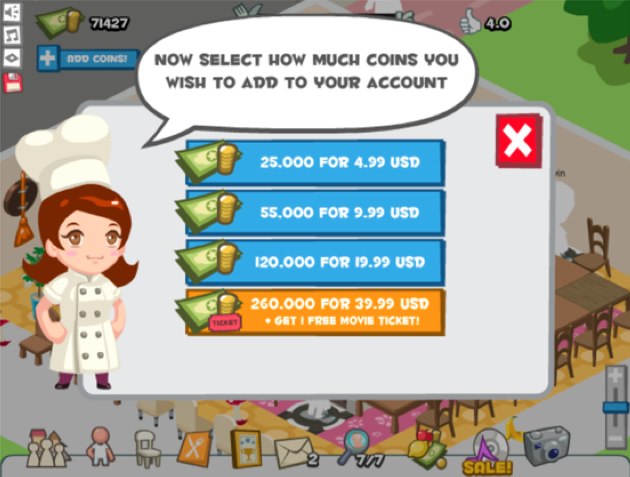
Example Screenshot: Remember Amazon.com’s free shipping if you spend over $25? No such thing as shipping in online games, but Restaurant City, one of the leading Playfish games with over 17M monthly active users has offered customers a free movie ticket to anyone who selects the $39.99 option
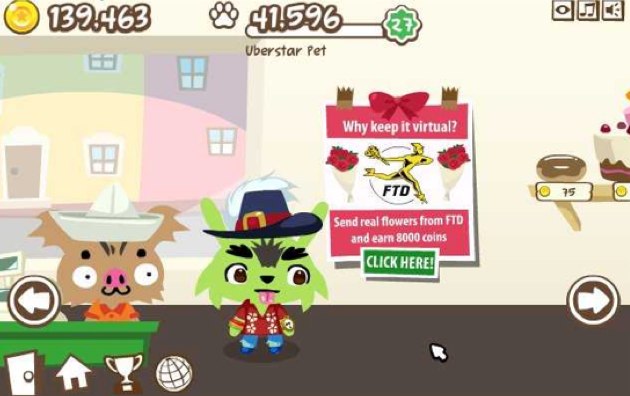
Example Screenshot: PetSociety, Playfish’s most popular title with over 21M monthly active users, enables customers to purchase flowers from FTD during Valentine’s Day and receive 8,000 coins toward their account.
Historically, Offers Have Been Implemented Poorly

Consumers Scamming Advertisers – Cash For Clunkers: Back in the late 90’s and even after the bubble burst, a lot of companies offered you “cash” for signing up for offers (like Blockbuster, Vonage, etc). Netflip (aka MetaReward) scaled to nearly $70M in revenue before being shut down by its acquirer, Experian. The reason? The lead quality was bad – no, atrocious. At one point in 2006, Earthlink was paying $200 to acquire a customer for its moribund dialup business. “Cash back” sites would offer consumers $100 to sign up for a $20/month service, which said consumers would summarily cancel, netting the cash back site a $100 profit and Earthlink a $200 loss. Result: Consumers scammed advertisers, and advertisers ran for the hills, but it took years for this to happen and the ecosystem to devolve.

Advertisers Scamming Consumers – Free iPods: A few years later, and fueled by cheap media, “Free iPods” (often referred to as “Free iPod Scams” and later encompassing “Free [product X]”) grew to over a half billion dollar/year industry. It was a pure breakage model; your iPod would be delivered, but only if you got through dozens of pages of co-registration advertisements and offers. It got scammier and scammier since barriers to entry were low, and whoever scammed customers the most received the most revenue to get more customers. Everyone went along for the ride because every website and ad network benefited in the form of more “free iPod” advertisements. Eventually, the FTC came in. Result: Consumers got scammed, and legitimate advertisers ran for the hills, but this too took years.

Social Gaming Today: Offers Still Done Poorly, But With Hope?

Now it’s 2009 and the age of social networking. Replace “free iPod” with “free virtual currency” and see if you can figure out how this story could end. It’s actually worse because every time a consumer signs up for another offer, he or she earns more currency – yet by the 100th offer, the chance of lead quality being high for non-shopping offers (e.g., Gap, BestBuy, Target, etc) is infinitesimal; somebody who immediately signs up for both Netflix and Blockbuster to earn coins will probably be a bad customer for both. Returning to the “tragedy of the commons,” the network (or app developer) with a conscience for quality who won’t let consumers do 100 untargeted offers will simply be out-monetized by the network/developer who will, and that hurts the long term prosperity of everyone.

Many legitimate advertisers have already started to cut their payouts or bail, such that the “scammy” offers yield the highest returns. Many app developers don’t want to run scammy offers but don’t have a choice if they are to stay competitive in another tragedy of the commons.

Where Are the Complaints?

There’s also a large obfuscation layer between the user and the advertiser. It often looks like this:

User->App Developer->”Offer Provider” X->Ad Network Y->Advertiser

The offer providers are companies like Offerpal, SuperRewards, DoubleDing, Gambit, Firecue, GratisPay, and to some extent my own TrialPay, and ad networks are companies like Adteractive, CPAStorm, SearchCactus, Gratis Internet, ClickBooth, Affiliate.com, etc. The app developers often rotate different offer providers, and the offer providers often rotate different ad networks, even though the user at the beginning and the advertiser at the end stay constant. This makes it easier for users to scam advertisers, harder for offer providers to correctly track completions (there are more links in the chain to break – many people sign up for offers and are not “credited”), and easier for scammy offers to keep resurfacing such that the game publishers don’t always know what’s going on. It’s the price they pay for higher short term revenue.

Moreover, user complaints are often directed at the advertiser since the offer provider and ad network are relatively invisible in this chain, which is why you’ll hear many app developers and offer providers claim they get no complaints even though scammy offers collectively yield tens of thousands of complaints to various attorneys general, the FTC, and internet message boards. Despite this clever obfuscation, it’s still bad for the game publisher; users have less money to spend directly (since they had a chunk of change “scammed” away), and ill-will is bred towards the game publisher.

To Prevent Further Damage, Here’s What Needs to Happen

It doesn’t have to end this way – there are numerous legitimate forms of incentive marketing (see my initial four examples), but they’re not as profitable on a short term basis as allowing users to scam advertisers 100 times, or allowing advertisers to scam users several times (even the most naïve users get the hint after a few interactions). This has been tough for my company because we’ve felt the only way for us to “win” was not to play the game, and focus on higher quality and sustainability. That’s ok because only a small fraction of our revenue comes from social gaming, so we aren’t desperate to monetize at any cost, but I’d hate to see the industry implode.

So how do we emerge from this sad state of affairs?

  1. Market forces (hopefully). It’s about quality and not quantity. At some point, there may be an inflection point where the “legitimate” offers (shop at Gap, shop at BestBuy, etc), shown ONLY to the “legitimate” users, actually outperform scamming by users or scamming of users. This is because a disciplined approach yields higher quality, and advertisers reward higher quality with higher payouts. One reason why QuinStreet, a leading performance advertising company, beat its competition over the past decade was because it focused on the quality of its leads.
  2. Regulation (hopefully). Facebook cracks the whip and bans app developers who show scammy offers. I think most app developers would welcome this regulation as they don’t like this stuff but have no choice if their competitors do it.

Actions Needed Today

The solution is a mixture of both. Having Facebook crack the whip does nothing to solve the problem of users scamming advertisers, which imperils the whole ecosystem. Indeed, we work with companies like McAfee and Skype, assiduously measure our quality because we work directly with the vast majority of our advertisers, and we have seen the tremendous volume (and often abysmal quality) of incentivized social gaming traffic sour some advertisers to the point of throwing the baby out with the proverbial bathwater.

The problem is similar to click fraud in search engine marketing, and the solution is similar:

Advertiser Feedback Loops: Offer providers need to establish direct relationships with advertisers and create a quality feedback loop. The vast majority of our advertising deals are direct, and we insist on feedback loops (did the user “quick cancel” a trial?) so we can eliminate bad sources of traffic. It doesn’t mean that all of our traffic is perfect, but we spend a tremendous of time eliminating the negative externalities, which provide for better unit economics. App developers who care about quality might even want to consider working directly with advertisers, lest they receive the lowest common denominator of payouts from offer providers who don’t focus on quality.

Limits on Offers: There should be strict limits on what users can sign up for – not by law but by rational self-interest, since this will yield more long term revenue. The vast majority of our “alternative payment” business revolves around letting users pay for an item like McAfee VirusScan by transacting with one and only one advertiser of the user’s choice. This increases the quality, which lets advertisers pay us more, and in turn lets us pay McAfee more. Advertisers will pay more if they recognize that fraud is lower and quality is higher, just like with search engine marketing. Multiple offers can work (e.g., retail shopping at different stores) but it’s much more complex in lead generation.

Game Publishers Should Insist on Long-Term Partnerships: Game publishers who think about long term quality (and don’t swap out providers, where the providers don’t swap out networks) will make more long-term money – partially because they won’t burn as many customers, but primarily because quality breeds higher payouts from advertisers.

Let’s hope we can solve the tragedy of the social gaming commons. Virtual currency is a multi-billion dollar industry growing at a massive rate, and reckless short term behavior can threaten an even more prosperous long term future.

Advertisement

Comments rss icon

  • Should there be some consideration of banning payment via premium SMS… especially recurring billing?

    I know mobile game developers who love premium SMS because they see it as the only way to bill a consumer in a recurring manner with little chance of an opt-out. Low threshold payment, applied to a confusing mobile bill. Cha-ching! Potential for mass fraud.

    • there’s plenty chance to opt out as the carriers require that reminder and billed messages have this information inside the SMS. it’s then not difficult to reply “STOP” to opt out.

      it’s not fraud although the problem revolves around parents paying for their kids mobile bill. that’s where the real issue is.

      • As an employee of the largest mobile phone company in the country, I can personally attest that there are large numbers of parents and grandparents that have no clue when it comes to premium SMS billing, and furthermore believe it’s the mobile phone companies bilking them of their money rather than these 2-bit shill operations. I understand that it’s hard to feel sorry for Verizon, At&T, Sprint, etc. but they truly get the shaft in this, refunding money in courtesy credits because they don’t want to lose long-time customers with teenagers who took idiot quizzes and didn’t read the fine print (if there was any to read at all.)

  • facebook game developer - November 3rd, 2009 at 11:36 pm PST

    I don’t think it’s fair for everyone to call on facebook to crack down on game developers. We’re focused on building cool games, developing a plot, scaling the app, and dealing with loads of emails and comments from users. Usually this happens in small teams, or sometimes only 1 person handles everything. To monetize, most of us just link to one or several of the “offerwalls” that all users are already familiar with and probably have their payment information saved, making it easier for our users to make payments. Unfortunately ALL of these offerwalls have scammy offers, and although over 80% of my revenue comes from direct payments, I don’t like the idea of my app being removed from facebook because Offerpal Media decides that one day they’re going to let an IQ quiz go through and some facebook employee sees it on my app. We use the offerwalls so we don’t have to micromanage payments – dealing with fraud, chargebacks, credit cards, banks, etc. We also don’t have the time or resources to police Offerpal’s offerwall everytime they make an update to it (probably multiple times per day and it’s probably different for each user).

    • facebook game developer - November 3rd, 2009 at 11:43 pm PST

      Final note, if Facebook came up with their own direct payments system without taking a huge cut, I’d much rather use that and get rid of all the damn offers that cause more harm than good (I get tons of emails everyday from users complaining about some offer they gave up all their personal info to and never received the currency (and no revenue was generated for me) – in these cases I reward the currency no questions asked and take the loss).

      • You’re taking the loss giving up the virtual currency for free? :)

        BTW, I agree with everything else you wrote

        • It’s a gangster mentality, Mark. “My money is mine. Your money in your pocket that I can take from you is mine too” – no matter whether the actual stealing has taken place already. :)

    • You admit to showing scammy offers to your users. The fact that this is done indirectly by “offerwalls” doesn’t seem much of a defense.

      Kudos for compensating those victims (and alleged victims) who contact you directly, but has it ever occurred to you that there are others who don’t?

      A Facebook crackdown seems long overdue.

      • @Pete Austin

        He has no choice, if he wants to make money from this he needs to link to these “offerwalls”, he doesn’t have a choice about the offers that they show. If Facebook had a payment platform that didn’t take huge cuts there would be absolutely no need for these, the problem lies with Facebook in this case, not the developer.

    • Perhaps FB should regulate the payment & offer-payment providers directly. This is a much smaller universe and holds those responsible, accountable.

  • Second Life is also full of systems like this. I don’t know if any of them are scams but a lot of the most popular places in the virtual world give free Linden Dollars in exchange for filling out surveys and affiliate offers. These places have nothing to do with Linden Labs as the metaverse is just another platform like the Web. They are created by third parties who own some virtual land.

  • >In an efficient ad marketplace

    This marketplace just isn’t efficient yet but the market forces are already working to make it efficient. User’s get informed, become more sensitive to scams, the market players get incentives to protect users and value quality higher.

  • I think these system is not helping users and even advertisers but offer companies are earning a quick buck out of it and developers have no problem as long as they are getting money from offer provider… So the real culprit of here are – Offer providers. They need to be regulated..

  • This post led me to go checkout TrialPay offers. I remembered ZoneAlarm has a deal with them, so I checked it out.

    Personally I got offers that don’t ineterest me at all but thats not my point.

    Using TrialPay you can get ZoneAlarm Internet Security suite free for 1 year ($49.99 value) by buying PC Booster for $29.99.

    So let’s do a bit of math:
    I’m paying PCBooster $29.99. Lets say they play TrialPay a ridiculous amount of $20 for the lead. That mean that TrialPay can pay a maximum of $20 to ZoneAlarm.

    Now Alex tells us its a win-win situation. I pay less for software, PC Booster also gets a new customer, ZoneAlarm gets paid and TrialPay gets paid. Just marvelous.

    I’m sorry to say but in my eyes, this is just another scam, only this time the ones getting scammed are the users paying full price for ZoneAlarm.

    What ZoneAlarm are basically saying is that they’re will to sell you the software for much less then their asking price, but before they let you in on it, they check if you’re by any chance willing to pay a lot more.

    I’m going to start a new company today… It’s going to sell a widget to retailers, where the user gets a price and a button saying ‘Price to high for you?’, when clicked they get a lower price. The user keeps clicking until they actually get to the price ZoneAlarm is willing to sell their software.
    Its going to be heaps of fun… Like going to the flee market…

    I’m going to be a billionaire.

    • That is the stupidest thing I’ve ever read in my life.

      Have you heard of Priceline? You can get a hotel room on Priceline for a lot cheaper than on the hotel’s website directly. I guess that means the hotel is scamming you!

      How about any airline, where the person sitting next to you might be paying half as much? Does that mean you were scammed?

      How about Walmart, which sells products for less than your local “mom & pop” store? Is your local store scamming you?

      Some people value time more than money and will pay full price. Some people value money more than time and will search around for a better deal.

      • I’m sorry to say that none of your examples even closely resembles what TrialPay are all about and you totally missed my point.

        When a company wants to sell a product, it goes on calculating costs, margins and how much users are willing to pay and decide a price point which works for them. They usually don’t say – we’re willing to sell product X for $10 and then go ask people to pay $20 and if that person refuses they say, oh well how about $10.

        Another important point I believe that this offer is on ZoneAlarm’s site. It’s not a reseller stuck with stock and trying to get rid of it or something. This is ZoneAlarm spitting in the face of every customer which knew he wanted to buy ZoneAlarm product but didn’t first click the free trial option, but choose to add the product to his shopping cart.

        Now to your examples:
        1. Walmart vs. “mom & pop” – “mom & pop” store can’t compete with Walmart on price. They have higher rent, they buy products at a higher price. They also give me a different service. It’s close to my house maybe and most importantly when I ask for a super glue they go telling me $20 and when I say “It’s way to high” they go ok $2. If they do they are just as worse as ZoneAlarm.

        2. Airline tickets do all sorts of math to try and get the optimal price for a ticket at a point in time. If you buy the ticket tomorrow it might be higher cause only a few tickets left, or lower because tons of tickets are left, but the point is the airline decided at every point in time how much a ticket is worth and asks the customer to pay that price.

        3. Priceline – When you book something through priceline you get a very different deal than if you book using other places. Canceling policy is radically different. When I use TrialPay I get the exact same product.

        • Ron, you are an idiot.

          I just bought a television at BestBuy. I negotiated the price down from the salesman.

          Does that mean that everyone who paid full price at BestBuy was scammed? Let’s do an expose! Class action suit for all the customers who don’t like to negotiate!

          What about coupons? If you don’t get a coupon, you are scammed? Call the lawyers!

          How can you POSSIBLY argue that ZoneAlarm is scamming people by giving them a better price?

          Let’s forget about how much ZoneAlarm receives, is Amazon scamming people who don’t opt for the Amazon.com visa card?

          Give it up, man. And for the record, I bought ZoneAlarm although haven’t used it since Vista, but Vista sucked almost as badly as your comment.

        • What you are failing to take into account is that allowing the alternative for an offer sign-up as a means of payment will improve aggregate conversion rates.

          In your ZoneAlarm example, I’m a buyer that’s going to pay cash no matter what. However, a lot of people don’t upgrade from software free trials, so if you can get them ‘over the hump’, you’ve converted someone who would not have converted otherwise. I don’t care that the other user may have paid less than I did because I value my time too much to go through the process to save a few bucks. And heck, another user could have chosen Netflix and paid more over the lifetime of their membership. Furthermore, the average Joe doesn’t really understand the behind-the-scenes pricing of affiliate marketing, so they aren’t really clear what the value of their sign-up translates to in an affiliate payment.

          Obviously, it’s working for ZoneAlarm. The blended avg CPA might be lower than their published price, but getting people to pay for software can be a challenge. I’d imagine virtual currency suffers from the same challenge – many users just aren’t going to pay for it, but they might sign up for Netflix.

        • Although I don’t think people are being scammed this way, you do have a point.

          ZoneAlarm, unlike an Airplane ticket or a Hotel room is a software. You can make a zillion copies of it and it would cost nearly the same; whereas an Airline ticket and a Hotel room are inventory. If one person takes it, poof..you’ve got one less of it.

          So Hoteliers and Airliners sell off a part of their limited inventory at a discounted rate to keep a steady occupancy rate. And when there’s more demand, and less supply, the prices shoot up. That’s the whole idea. Which doesn’t quite apply to the software world and ZoneAlarm.

      • One more thing about Priceline, they don’t pretend its a win-win situation.

      • AMEN! And how about the price differential between hardcover books, which are released earlier than the cheaper softcover books. The products are essentially exactly the same. These are all principals of is price discrimination 101 – perfectly legit in a free economy. Ultimately its about consumer choice.

        • Your argument is flawed in so many ways. What about clearance sales, many people only buy at deep discounts so everyone else is getting ripped off.

          Your point #2 about priceline actually favors the offer idea, in that McAfee or whoever actually is figuring that many people who don’t want to pay full price for a piece of software may want to use TrialPay. Thus earning something from that user rather then having them click away without earning anything from that user. $20 is better than zero and they get a new client, which I think the article mentions they can upgrade and renew in the future. Lifetime value of the client….

          • I never suggested that ZoneAlarm isn’t benefiting from this, of course they are like you said, get $20 from someone is better than not getting anything.

            My issue is that ZoneAlarm (in this case) is charging some users full price and some users a lower price only because those were not ready to pay the full price.

            What they are doing is like have a link in the top page to buy the app for $50 and a link at the bottom to buy for $30. If you buy the software for $50 and then learned that if scrolled down you have gotten it for $30 you wouldn’t feel scammed?

  • nice post, alex. i was hoping you’d chime in on this debate!

  • Icanhascheetburger - November 4th, 2009 at 9:17 am PST

    A the only online retailer it appears, I will say that we don’t see what we are doing is scamming users. What pricing is a reflection of inventory stock levels, time of year, demand for said brand, inventory turn history, cash flow requirements, season and a host of other factors.

    Ron when we accept the product back after it’s been used are the users scamming us? When users buy more than the need bc te want to try a bunch of items on and return the rest, are not the customers scamming us? When have to liquidate inventory bc it’s been sitting in our warehouse for 2 years and we sell below our purchase price – are we scamming users? Technically someone in 2006 paid full price but here in 2009 someone is getting said product for 80% off msrp. Who’s the sucker? Well it’s the cost of doing business. Win some lose some.

    We have to make our best guesses as to demand for any product a year in advance. We sit on that inventory for sometimes 3 years. That’s a massive tie up of capital in order to get the volume pricing that funds the free shipping and warraNties etc. We are all subject to fuel costs, credit issues, devaluating currency etc. Yet the customer demands xyz regardless. So you tell me who is Scamming whom? I think users realize that pricing is a fluid thing based on many variable at that moment in time. Eg prices are often higher in the holiday period and lower first of the year? Should the govt mandate consistent pricing practices and a level playing field? Shoul the govt legistlated at what price I sell any good and moreover what price you should be willing to pay?

    It would seem you have a bigger problem with capitalism and marketing than simply retailers looking for ways to invent people to buy their wares.

    If I have x marketing dollars I can either give it to google or peel off some % and put it in the hands of my customers. In that way I think incentive based marketing can serve a vital service making customers engge with brands more meaningfully than thru text link ads or annoying pop ups. Wouldn’t you like to hare in the 100b ad budgets vs just wpp or omnicom or google. After all it is YOUR time and attention shouldn’t you get something out of the process? As a marketer I’m happy to pay my prospects, I just need a means to do it in an efficient predictable way.

    • I couldn’t agree more about that prices are fluid, but they should be fluid for the reasons you mentioned. There should be a price for getting a new product now and not in 3 months, but you can see the trade-off. But for the extra cost I get to use to product now and now it 3 months. What TrialPay I offering is for retailers to try and charge full price for the product and if that fails let them have it for a greatly reduced price. Nothing has changed – there was no trade off. Only me click on the ‘free trial’ button instead of the add to cart button.

      I really think this is equivalent to entering the supermarket getting some eggs, and then at the checkout when they say $20 and you say no way, they go… oh well – we had to try – you can have it for $4. How is this not trying to scam uneducated consumers? If I didn’t know how much eggs cost I would just pay $20.

  • So he’s basically saying, focus on quality and everything else will fall into place.

    It’s easy to say that, but much harder to implement when all your competitors are raking in the cash hand over fist while you’re out there looking for quality hoping that the payouts will come in the future.

  • We use TrialPay to allow users to upgrade to a ads free version of our website.

  • Lol focus right, ah as my german friend says vawncast izh bein, change is inevitable either way.

  • Peanut Labs is conducting a new survey for users to gauge opinion on this whole controversy and we invite anyone to submit questions they would like to see answered by users across our network. We’ll pick the best and put them in our next survey.

    Feel free to send questions directly to support-media@peanutlabsmedia.com or check out our post for more details: http://peanutla...er-controversy/

  • Dare I say that the answer is as simple as extending joint and several liability to the transaction. It will amaze everyone how quickly Facebook, the offerwalls and the game developers suddenly have time to pay attention when they are the ones being scammed, not the consumer.

    Meanwhile, cry me a river for Verizon and At&T, who surely charge back for any SMS charges the refund.

  • Hey, don’t forget the user. At the end of the day these guys are the best judges. user adjudication of adverts via some kind of rating system may weed out to the biggest offenders?

Leave Comment

Commenting Options

Enter your personal information to the left, or sign in with your Facebook account by clicking the button below.

Alternatively, you can create an avatar that will appear whenever you leave a comment on a Gravatar-enabled blog.

Trackback URL
Short URL

RealTime CrunchUp Sponsors:

bugbugbugbug
Techcrunch on Facebook