
For advertisers on the Web, behavioral targeting is held out as the nirvana they’ve been waiting for: the ability to show ads only to those people most likely to be interested in them based on their past behavior. The growth of this type of ad targeting also raises a host of privacy concerns, but setting those aside for a second, do these ads even work? Do they perform better than regular ads? If they did, you’d expect advertisers to pay more for them and for Website publishers to be flocking to them.
At least for Google, the answer seems to be “No.” According to estimates by Jim Brock, founder of PrivacyChoice, chairman of Attributor, and a former senior VP at Yahoo, only about 25 percent of AdSense sites are serving targeted ads, which Google calls “interest-based advertising.”
Brock comes to this figure by counting the links to Google’s privacy policy, which is a requirement of the program. Google counts 277,000 links, and Yahoo counts 224,000 links, so he splits the difference and divides it by the one million AdSense publishers Google recently disclosed in its latest earnings call to come up with 25 percent. Google actually said there are more than one million AdSense publishers, so the percentage using interest-based advertising is probably lower.
Google started behavioral targeting last March. It tries to determine your interests by placing cookies in your browser and tracking what types of sites you visit. You can see what interest Google has assigned to you and even change your interests by visiting Google’s Ad Preference Manager. You can also opt out of the program entirely.
So why isn’t there a higher adoption of this type of advertising among publishers? One answer could be that they don’t want to wade into controversial waters. But that’s never stopped Websites or advertisers before. If these ads were performing significantly better than regular AdSense ads, there would be a stampede to adopt them more broadly.
Brock suspects Google’s interest-based ads aren’t working so great because Google doesn’t actually know most people’s interests. He’s trying to get some more data on this. You can help him by using this survey tool which lets him count how many people have their interests mapped by Google. So far, based on a very small sample, only one in four do. And of those who can be targeted, the average number of interests is only five, which isn’t a lot.
I guess I’m the exception, because Google has my interests down pat. It shows ten different interests, including technology news, business news, mobile phones, blogging services, advertising, and air travel. Am I really so transparent?
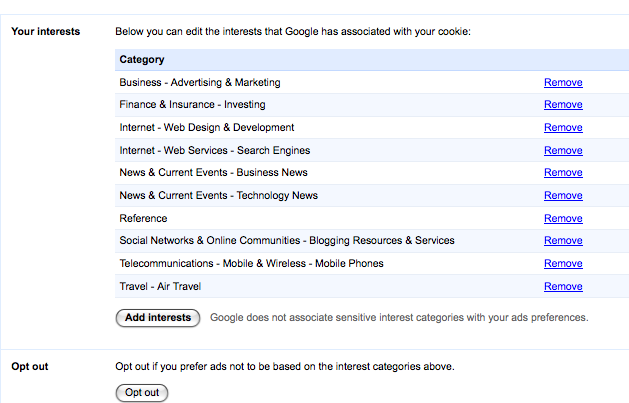


Maybe part of the reason (from the publisher’s perspective) is that it’s not widely known. I’ve been using AdSense for years and check my account weekly, yet this is the first time I’m hearing about this.
What if most of your interests are going to adult-related but you don’t want to be tracked for this. I imagine a lot of privacy watchers don’t want their online habits recorded.
One more key point in this research — it isn’t the sheer number of adopting AdSense sites that matters as much as the quality and volume of traffic on those sites that do adopt.
We will only get a good sense of the reach of Google’s interest-based targeting by counting how many people have interests recorded and how deep those interests run.
More on this experiment here:
http://privacyc...-our-interests/
Yep, I’m not using it…
It nailed mine too, everything I would have expected was on the list. Pretty cool to see it, actually.
It doesn’t seem to have anything on me.
A bit strange considering the volume of websites I visit every day.
A possible reason is that they are mainly doing this for US/CANADA citizens.
Doesn’t seem to be the case. I’m from Brazil and they had a lot of my interests mapped.
It wasn’t 100% to me, but still got most correct.
Counting the links to the privacy policy is likely a very poor metric, as a lot of small publishers simply don’t keep up to date on all the intricacies of the AdSense program.
The larger advertisers earning the most from Google AdSense probably have updated their privacy policies by now, since the behavioural ads would increase income. Thus, even if one went by “25% of publishers” as a metric, it’s probably representative of more like 90%+ of AdSense pageviews and earnings.
Yeah. I totally agree. I doubt many publishers even knew they had something they could do to turn this on.
I personally thought this was on by default.
http://www.traderbots.com
I also thought it was on by default for publishers, and in fact it is.
I didn’t even realize there was a setting to turn it off, but after some digging I found it buried in the My Account > Account Settings page.
I never turned this on, so they turned it on by default for me.
They have me profiled pretty well. Yet I never click on ads, much less even look at them.
Their profiling is a bit weak. The preferences you can choose are limited. However, I would say that 25% is still a big number and there is a long way to go before advertisers really understand how to use it and enough people ge prefrenced cookies to create large enough segments. Once that happens, it’ll be audience-targeting and should be higher uptake.
AdRocket’s publishers are definitely making higher CPMs with our targeting than they were without, so I can guarantee this type of interest targeting works.
i am in the minority in that I would rather tell google everything about me so that i am always served relevant ads. nothing is free – and if i expect good content without paying i should be willing to (at least) view ads. I know most will disagree with that, and they are entitled to their own opinion as well. if google gave me an option to take a 20 or 200 question survey (5 minutes or 1 hour) that asked me what i like, dislike, own, like to do, etc. I’d gladly exchange that info if the ads they in turn serve up to me were more relevant on publishers i visit. at the end of the day, online THERE IS NO SUCH THING AS PRIVACY so we may as well accept it and let technology work for us.
Maybe I’m in the minority, but for a relatively new service, 25% penetration seems like significant traction.
When did Google roll out behavioral ad targeting?
To your point on Google does not know people’s interests well – although Google controls almost everything on the web today, cookies have their limitations. What is more interesting is how the Ad targeting technology will evolve from Cookies to Packets. Obviously, there will be huge privacy concerns and it will be interesting to see how FTC reacts. The recent FTC guideline for using opt-in instead of opt-out has already raised some shackles in the Ad industry. More on the technology and privacy here – http://wp.me/pw0hs-8t
I agree. Isn’t 25% penetration a success measured against the historical adoption rates of Internet based advertising programs?
I can tell you that as someone who sells Internet Ads, 90% of the people I talk to don’t know what targeted advertising means in terms of buying (or selling) ad space online.
I can tell you why I won’t use it – traditional adsense campaigns are based on what a user is searching for RIGHT NOW. That means that they are in the middle of a search, and I’m paying to have my link served up while it’s relevant to exactly what they’re searching for.
On the opposite side, these behaviorally targeted links would be potentially serving up my ad while the user is actively engaged in something else.
From a user point of view, if I’m searching for, let’s say, televisions and I get served a link about the NHL because it’s something I’m interested in, I’m probably going to keep looking for televisions and ignore the link about the NHL.
As a marketer, that type of response makes search based adsense campaigns much more likely to succeed than behaviorally based ones.
Just my two cents…
That’s a good point.
But how about this: when you’re searching for televisions, you are served a link for a TV against a competitor you just viewed but didn’t purchase; likewise, you are also served an ad for a tech magazine/blog giving a rundown on the latest TVs.
Targeted advertising makes content-relevant ads (e.g. Adsense & Adwords) an amazing service for everybody.
Now the real question is if a cookie can capture all the nuance that the potential has…Thoughts anyone?
Don’t think so – traditional Adsense is not based on any search (I think you’re mixing it with Adwords which appear on google search results as sponsored links). Adsense is contextually targetted, based on website content and thus assumed audience focus area.
If I’m on a car website and targeted with a finance ad because that’s what I’ve been looking for most recently, which am I likely to respond to? Maybe both, a car ad or a finance ad. but the finance ad is rightly going to earn the car website more CPM because the targeting is more refined.
Sure, if your current activity has a clear goal, than ads for completing that goal are the best match. But if you are browsing entertainment sites, occasional BUY F150 truck NOW might be effective if you were postponing it for a while. And even a helpful reminder
Actually, 25 percent is probably pretty good. Adsense publishers are generally lazy, anyway, right? I would actually expect about 10 percent to use it.
Jim Broke,
Adsense Publishers fear from decreasing their earnings by using ad targeting.
Yes, I agree that a even a 25% adoption rate within a year and half is quite good! As the awareness about its benefits grows, the adoption curve will soon be the steeper.
Without a doubt, behavioral targeting is the future of advertising delivery models. We at MyContextualAds.com have been working on this very same idea for some time and have recently released our service for public consumption.
What kind of methodology is this? If a publisher has 50 sites, how many times do they count? Also, having a link doesn’t mean you’re using the program – it just means you complied with one of the requirements.
I think these people pulled the 25% number out of their arse.
I think people want to buy things on the spot, rather than waiting in the future. Search is real-time
I had 3 interest categories mapped out by google but they were all irrelevant. I spend most of my time on music websites and my interests were: politics, myth & folklore, education. This is pretty much the only 3 things in the world I am NOT interested in (maybe apart from education). So well done google!