Browser maker Opera has released its latest ‘State of the Mobile Web’ report this morning, claiming that there was a huge surge in mobile web usage past September.
Last month, more than 35.6 million people used Opera Mini (which is now serving over 500 million pageviews per day on average on a wide range of mobile devices), up 11.5% compared to August 2009 and more than 150% compared to September 2008. The Norway software developer also claims more than 2 petabytes of data is now processed by its servers on a monthly basis. That’d be 2,000 terabytes.
Data traffic through Opera’s mobile browser — which compresses up to 90% of the data to save network bandwidth – rose 8.7% in September compared to August, the company said. In total, it gained about 4 million new Opera Mini users in that same period of time.
Opera also said users in the top 10 countries (Russia, Indonesia, India, China, Ukraine, South Africa, United States, United Kingdom, Poland and Vietnam) save up to $672 million USD per month, or over $8.1 billion USD per year, thanks to the compression rate of 90% and the subsequent savings in mobile data charges from users’ operators.
To calculate these numbers, which I question, Opera looked at the top operators in each country, determined how much they typically charge per MB of browsing, and averaged those figures together. The average cost of browsing in each country was then multiplied by the amount of traffic generated in each country, and the resulting totals were summed and compared to the totals for uncompressed data traffic. The big caveat: Opera’s survey only reflects metered rates (cost per MB) and not flat-rate subscription options, which skews the numbers in their favor.
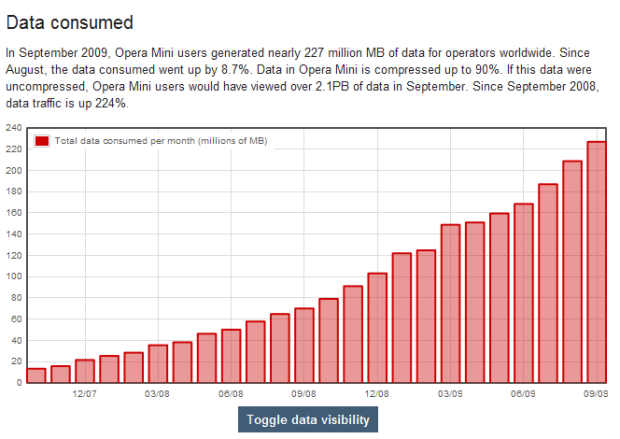
The fact that mobile web usage continues to surge is hardly surprising, but Opera’s monthly reports reflect the rate of increase quite nicely on a monthly basis. Here’s a graph that shows the evolution as measured by data consumption:


“The big caveat: Opera’s survey only reflects metered rates (cost per MB) and not flat-rate subscription options, which skews the numbers in their favor.”
I guess that’s technically true, but I think it’s the only way to get a per-MB data rate, unless someone knows a better way with flat-rate plans.
Now, what would be interesting is to see what the average flat-rate data plan cost is in each country and multiply it by the number of users.
Or find out the cost to serve the data and see how much Opera Mini saves operators in bandwidth costs since I’ve read that AT&T has been struggling with the demand for data from iPhone users.
Besides UK and US, other top markets for Opera Mini don’t have flat rates, so the figure is accurate enough to be taken. At least the order of the number is correct.
why would you take solid data like then question it? Opera mini is by far and away the most popular web browser on mobiles. Is it because you’re an iphone owner and can’t accept that it only makes up the tiniest fraction of world wide sales? if opera was allowed on the iphone it would probably be an acceptable figure for you british americans or is it usicans?
Need I add to that last comment? Sent from my not iphone mobile phone
Belgian, so not even close. And chill out, Opera admits that it’s fair to question these numbers because it leaves out flat data rates. But I’m sure they’re happy with their users’ devotion.
How else could you possibly calculate per-MB data rate? Moreover, if you would have read the findings, a majority of the countries mentioned probably do not offer flat rate plans.
Opera Mini’s unique compression technology saves both money and time! That is why it is the best mobile browser available.
If there can be alternative apps for core services like addressbook, iPhoto, why can’t there be an alternative browser for Safari on iPhone? Time to drop the pigheadedness.
Since when 2 petabytes are 1000 terabytes?
Thanks for the heads up, wanted to say a petabyte is 1000 terabytes but it was definitely confusing. Fixed now.
A petabyte is 1024 terabytes.
Sorry, actually, a petabyte is 1000 terabytes, a pebibyte (petabinarybyte) is 1024 teribytes (terabinarybytes), a teribyte is 1024 gigabytes, a gigabyte is 1024 megabytes etc.
They’d better use pebibytes instead of petabytes to avoid the confusion
1.000 petabytes is a Ferbie
1000 terabytes, 1024 terabytes…not a huge difference – whats 24 extra terabytes anyway? heheheh
Opera Mini is one of the best browsers for the mobile and performs very well in almost all mobiles. Even I have started using it recently and I am quite happy with the way it shows the website
NextBingThing is mobile-browser war and Opera already ahead of all other browsers. Firefox, are you listening?
They are. Fennec is already, despite being an early beta, quite promising product.
The recent Morgan Stanley report clearly how iPhone was driving web usage. Opera Mini and Nokia inspite of significantly larger numbers over a longer period of time don’t compete simply because they are not internet devices.
Browsing the net on small screens with numerical keypad cannot compete with a 3.5 inch touch screen with a full qwerty keyboard. This itself would explains the huge growth in internet usage on mobile phones after the release of the iPhone. And Android and Palm pre only add to this.
And yet, Opera is the biggest mobile phone browser, not the iPhone. Odd thing, that. And that is despite the fact that iPhone users generally have unlimited data plans!
Wow, it´s just incredible that mobile users have double the usage time than regular users form desktops!
I’ve an HTC hero… though the default browser is good…. it can’t beat opera in data compression rates. Here in India it costs me Rs.95 or $2 for 90 MB with one month validity. with any other browser that 90 mb is gone in no time, even with images turned off. After reaching 90 mb limit it costs me $1 for 5 MB…. those are just ridiculous prices (atleast here). But thanks to opera, it is a challenge to reach that 90 mb in one month.
“To calculate these numbers, which I question,”
Of course TechCrunch question it…you guys hate Opera and love only google/apple/twitter and facebook.
Look back on all your articles about Opera or that mention it and you always have a dig at them.
Like another article today mentions google chrome on the mac and you are using a pre-beta build and raving about it…even though it crashes.
I’m convinced that you have an agenda…(or shares in google).
In fact all your authors should disclose details of shares they hold in any company/product that they review. Transparency would renew my respect of this blog.
We just launched our new mobile site for smart phones and it has become our second most visited area on the site in less than a week!
Interesting, but when you look at the big picture with statistics like this from Net Applications:
http://marketsh...t.aspx?qprid=61
Mobile browsing is still less than 1% of the internet audience.
You can’t trust Hitslink/Net Applications. They are liars, and have even admitted that their own stats are useless.
It has to, with social network on mobile. wait when Africa takes it on with AfroSocio.com
afrosocio.com
The more the iPhone and other smart phones drop in price, the more these phones end up in the hands of consumers. With the iPhone only $100 (for the 3G), I’m sure many are picking that over the $60 flip phone. There are so many times I find myself checking Facebook, TC, sports, news, etc, from my Blackberry while just standing in line somewhere.
And we can’t forget the popularity of smart-phoning while on the toilet! That’s probably the biggest cause for the jump!
As @Thomas suggested the falling price of the iPhone is putting it into more users’ hands. Case in point my brother-in-law just purchased an iPhone for his wife. It was a no brainer because it’s more than a phone with all of the apps that are out there.
In terms of the usage of the entire mobile Internet, when one considers that 60% of web browsing is done through the iPhone (I think Admob has a stat on this) one can truly get a sense of how much data is actual being consumed on Internet smart phones.
“60% of web browsing is done through the iPhone”
WRONG.
Opera has nearly 30% mobile browser market share. The iPhone has a little more than 20.
AdMob is NOT a reliable source because they include iPhone applications. It goes without saying that their numbers are therefore invalid.
Mobile Web Usage thought it had a going problem…. Turns out it had a growing problem…
The competition in mobile web usage is keep growing and growing because now people don’t have enough time to use internet on laptop or computers.
What’s the math to get from 227 MB of user data with 90% efficiency and 2.1 PB of carrier related viewing data? With the efficiency factor stated, wouldn’t you get to 2.27 TBytes of data, not PBytes of data. I’m sure I’m missing something. We’re these numbers to be related to each other or not? Can anyone clarify? tks..m.