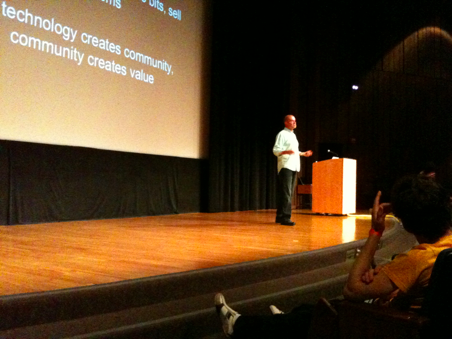
 Wired Editor-in-Chief Chris Anderson is now speaking at Y Combinator’s Startup School about Freemium Business Models. Anderson likened freemium to handing out muffins on the street to entice people to start eating your muffins. But with muffins there’s a significant cost to giving away each muffin. With digital goods, you can give away 90% of your product for free, without any cost for those goods.
He says ‘free users’ aren’t free loaders, and that it’s okay to let the minority (paid users) subsidize the majority. Because the free users will recommend to friends, it’s a great form of marketing. And for those paid users, many of them are very strong customers — they may be price insensitive, with very little churn.
Anderson says that for Wired, the magazine is sold in various forms (news stand, subscriber, digital form online). And there’s price segmentation on this — lots of distribution given away for free, the bits are free. The ‘atoms’ (physical good) are the premium. 90,000 customers for newstand edition, 800,000 at $1/month subscription.
Anderson than started talking about the very popular game Club Pengiun, which is free to play. Parents are used saying no to credit card purchases for stuff on TV. But if they’re on Club Penguin, they see the child has built an igloo, and has their friends, etc. But if you pay, you can get into the cool igloo, etc. It’s easier to hand over the credit card that way, because it’s clear that the child isn’t just reacting to what they saw in an ad.
What will people pay for? They will pay to save time. Younger people have more time than money. Older people have more money than time.
Anderson then outlined some of the models he’s seen for Freemium models.
Feature limited
Gives users real utility initially, then they convert if they want it even better. But this also means that you have to build more features (things people would want to pay for). And you have to maintain multiple products.
Time Limited
Easy to do. But there’s less commitment and engagement.
Capacity limited
Easy to do (e.g. limit the number of megabytes in a Email box), but it doesn’t always work for a product.
Seat limited
Easy to do. But it doesn’t work for every product, and people can ‘cheat’ by only purchasing a few seats, or segmenting company into lots of 5 person teams so they’re free.
Customer Class Limited
Bizspark is free to businesses if you’re under 3 years old, less than a million in revenue. Once you graduate you pay. This is easy to implement, but harder to enforce. Anderson says that Chinese Pirates had a similar model with Microsoft — Bill Gates said that China was developing, if they were going to steal software, they’d rather they steal Microsoft’s software, so they develop for Microsoft.
As one last example, Anderson spoke about Open Source Hardware, brought up his company 3D Robotics, which makes DIY Drones. Open-source unmanned vehicles. They give the ‘bits’ away (the software) and plans so you can build your own. This helps build a community. And then it sells finished goods on the store. Charges 2.6x what it costs. Need two 40% margin — one for you, one for retailers, who you want to have sell your stuff.
Q: Free was available on the iPhone, I got it for free. And they took it back and I had to pay $10.
A: I didn’t know about that. That sucks. I have no idea how that happened. Free for four weeks on Scribd, free on Google Books, free forever audio form, free in other places as well.
Q: One risk with freemium that I’ve experienced as consumer is feeling that free version is crippled. Yahoo Mail, they can get away with it because people keep sending to your old address. Unless you have that kind of lockin. How would you do that?
A: I recommend not having crappy products, even free ones. If your free version is crippled, it won’t work as advertised, won’t work as a form of marketing.