
Today at the Web 2.0 Summit in San Francisco, Mike Schroepfer, Facebook’s VP of Engineering talked a bit about the infrastructure of the company.
Basically, Schroepfer’s key point is that Facebook is not afraid to be bold and take risks to get done what it needs to from an engineering perspective. They’ve come up with a number of their own solutions to solve a massive scaling problem, and sometimes we (the users) see bugs as a result of that. But, in a world where the much smaller Twitter goes down regularly, Facebook’s relative stability is pretty impressive.
How impressive? Schroepfer threw out some huge numbers. Among them:
- Users spend 8 billion minutes online everyday using Facebook
- There are some 2 billion pieces of content shared every week on the service
- Users upload 2 billion photos each month
- There are over 20 billion photos now on Facebook
- During peak times, Facebook serves 1.2 million photos a second
- Yesterday alone, Facebook served 5 billion API calls
- There are 1.2 million users for every engineer at Facebook
Below find the earlier live notes (paraphrased)
- What do people do on Facebook everyday?
- 8 billion minutes online everyday, using Facebook.
- 2 billion pieces of content shared every week
- Over 2 billion photos uploaded each month
- Over 20 billion photos now on Facebook.com
- Serving over 1.2 million photos a second on a peak day.
- Yesterday we served 5 billion API calls
- Facebook connect is growing even faster than Facebook
- In over a year we went from 100 million daily actives to 300 million daily actives
- When Zuckerberg started the site, it was only Harvard, then more schools were added, but they were silos. Then we connected those schools, then in 2006 we opened it up.
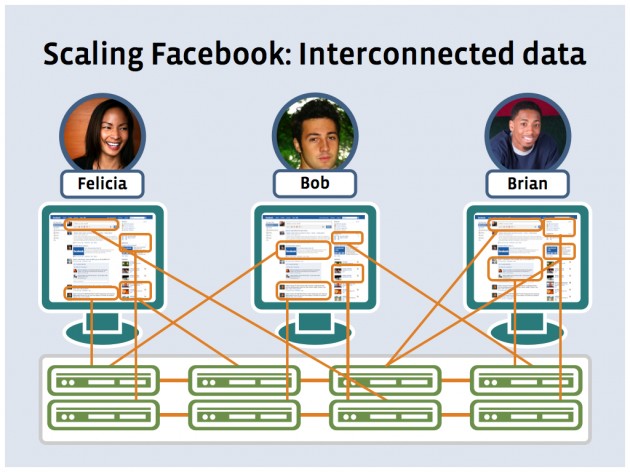
- It’s way bigger than a single database, so you have to spread this data out.
- Rendering a homepage on Facebook, which do it a couple billion times a day, in a couple of seconds.
- We use something we built which we call “multifeed” which we use along with memcache to get data in milliseconds.
- 50 million operations a second via memcache
- We scaled memcache 5 X its original performance – we rewrote it
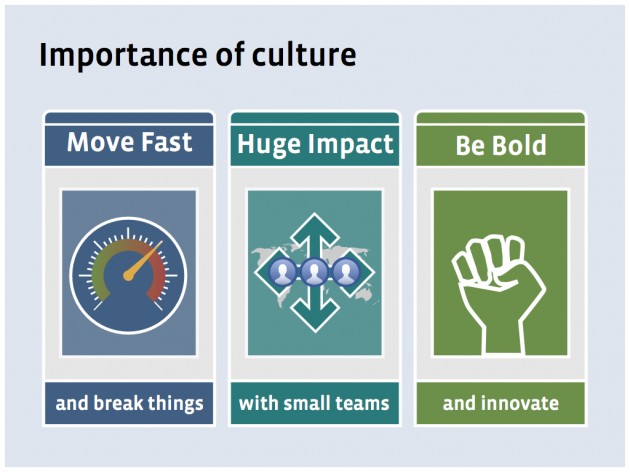
- Importance of our culture:
- Move Fast – sometimes we push bugs, but that’s innovation
- Huge impact – 1.2 million users for every engineer at Facebook
- Be Bold – change something if we need to.


Impressive feat to say the least!
awesome
Scalability :O) “Move Fast – sometimes we push bugs, but that’s innovation”
It certainly is a case study for cloud computing.
Holy Macro!
If only there were 8 billion minutes in a day.
Even though there have been more hiccups than usual the past few months, the scale of Facebook is truly impressive
Twitter should be ashamed
impressive.. facebook sucks, its slow, had a ton of scalability issues a year ago… and still is a dog.
Quite frankly google has that game figured out, facebook not.. just because you are trying and doing all kinds of stuff, doesnt mean it actually gets the job done.
If the user feels it, it’s FAIL, pretty simple. So I am not impressed.
fool.
Very impressive! Keeping the site up is quite an achievement in itself. And I am remembering the launch day of Sony PS2 and how their website went down due to overload, and how far we have come since then. Scalability.
oh and rewriting your stuff.. sorry what he is outlining are bandaids patch technology. Spreading out data etc… quite frankly their technology sucks and it starts with the database.
I am not sure with the details, but if they are using a relational database, which my guess is they do from his statements.. then that just shows how little they know.
Google is probably reading this article and going “these guys are amateurs” and anyone with a bit of common sense can see that.
Really, maybe you should do some fact checking on Google.
that’s sergey’s alter ego
No guys… the problem with Tech is the Half-Know it alls. You think you know everything.. but in reality you don’t know SHIT.
You can’t tell the difference between a crappy startup thats built on garbage and kept going with bandaids and fixes, compared to a rock solid one. It all starts with the basic architecture, or lets call it EFFECTIVENESS….
Facebook is slow, down many times, non secure, and can’t even handle a few ddos, so pleeeeease… don’t tell me they know shit, or hold em up as an example to follow…
There are a few companies who know what they are doing.. that make it first effective, then efficient, google is one of them. If you look at their architecture, their database, their cloud it rocks. TWITTER SUCKS, FACEBOOK SUCKS in that regard, SALESFORCE ROCKS.
So do your homework before writing crap articles like that… anyone in the biz (and I don’t mean the MBA dudes) I mean the guys running the shows at the cmopanies that rock can tell you that.
What do you do and where do you work?
Don’t feed it.
Facebook and their numbers are really impressive.
There are now 8 billion minutes in a day? Isn’t this something the UN should oversee, and not a Social Network…I haven’t noticed time slowing down when I use the FB. What’s up with this..Is each minute now a fraction of what it used to be?
Now let’s add up those minutes with all the other internet minutes from all sites in the world. That is some serious online time
Too bad you don’t know the difference between “everyday” and “every day.”
It’s really amazing that web spend 8 billion minutes Online everyday using facebook. This count is amazing and the most amazing thing is more than 20 billion photos are on facebook now.
That is the really nice and Facebook is also deserve it. Facebook is the name of big thing
Amazing statistics. I think in coming days people will spend more time. If you look at India, broadband penetration is going up, service providers are making it more cheap, SaaS applications are getting more popular
Well to carry the name ‘Facebook’ i won’t be surprised with the stats presented. It is bound to be like that and yes it is an acheivement for the fb engineers to keep it up and live.
Gr8 Job!
Sam
Has anyone noticed it’s asking for twitter id only
ummmm