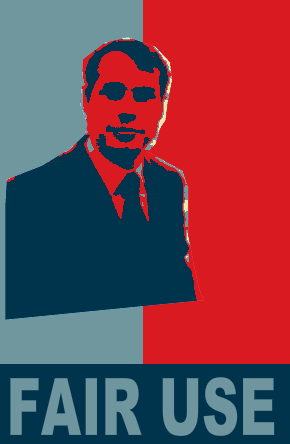
We reached out to Shepard Fairey about the AP’s release this evening claiming that he had admitted lying about which image he used as the source image for his iconic Hope poster. He sent us a response (reproduced below), which effectively confirms what the AP says.
Tonight’s admission focuses on the photo that Fairey originally claimed to use during his creation of the ‘Hope’ poster — he claimed to use an image other than the one the AP claims to own, and then lied and deleted evidence when he realized he was wrong. Both were taken at the same press event. The one Fairey originally said he used showed Obama next to George Clooney, the one he really used was a close-up. The AP has succeeded in character assassination (perhaps rightfully so given Fairey’s actions), but Fairey may still have a case arguing that his image is protected under fair use. Regardless of which photo he used, by painting the image and turning it into a national icon he may have transformed it enough to render the AP’s claims invalid.
STATEMENT BY SHEPARD FAIREY ON ASSOCIATED PRESS FAIR USE CASE
OCTOBER 16, 2009
In an effort to keep everyone up to date on my legal battle to uphold the principle of fair use in copyright laws, I wanted to notify you of a recent development in my case against The Associated Press (AP). On October 9, 2009, my lawyers sent a letter to the AP and to the photographer Mannie Garcia, through their lawyers, notifying them that I intend to amend my court pleadings. Throughout the case, there has been a question as to which Mannie Garcia photo I used as a reference to design the HOPE image. The AP claimed it was one photo, and I claimed it was another. The new filings state for the record that the AP is correct about which photo I used as a reference and that I was mistaken. While I initially believed that the photo I referenced was a different one, I discovered early on in the case that I was wrong. In an attempt to conceal my mistake I submitted false images and deleted other images. I sincerely apologize for my lapse in judgment and I take full responsibility for my actions which were mine alone. I am taking every step to correct the information and I regret I did not come forward sooner.I am very sorry to have hurt and disappointed colleagues, friends, and family who have supported me in this difficult case and trying time in my life. I am also sorry because my actions may distract from what should be the real focus of my case – the right to fair use so that all artists can create freely. Regardless of which of the two images was used, the fair use issue should be the same.


It’s a shame we’re stuck with someone like Fairey as a poster boy for fair use.
Oh so true… don’t we have other options?
Totally agree – Fairey not only screwed his own case, he handed the anti-fair use crowd the perfect poster boy for piracy. Even if the courts rule in his favor on fair use, he’s still going to owe damages for causing AP’s lawyers to jump through extra hoops to prove their case.
+1
Ohh goody! I love fair use challenges.
Also he didn’t say “He lied”. He was just mistaken. Misleading title.
ahh wait. I didn’t read his apology clearly before commenting. I just didn’t see the word “lie” in there. I failed.
I don’t see where he admits he lied. Conceal; false images; lapse in judgment. Yes, he lied, but technically he did not say he lied. So, the header is misleading – but, it sells better.
Stealing… Lies… and then making bad look good through attempted legal justification? It makes me sick.
Utah: the state that gave us “Donnie and Marie”! Sir have you no shame?
The issue relates to “derivative works” and is somewhat murky. Copyright law generally prevents people from making unauthorized copies of the copyrighted works. A derivative is not a copy, but “includes major, copyright-protected portions of the copyrighted work”. It depends on how much protected expression as taken. The fair use defense is also complicated.
However, intentionally destroying evidence is hardly ever complicated.
Copyright law isn’t murky. Fair use has well-defined constraints…
1. The use is for primarily educational, artistic, and/or scientific interests.
2. It’s non-commercial in nature; meaning, whoever is using the material isn’t trying to make a buck.
3. It must be an excerpt, not the entire work. For example, you can’t copy an entire book. But you can provide passages to a class.
Fairey’s use of the AP photograph passes test #1 but fails both #2 and #3. Regardless of his intentions, he made a fairly significant amount of money from the derivative work, and he used the entire work. Consequently, he’s going to get his head handed to him in court. He’s going to have to pay the AP and/or the original photographer.
Anybody who thinks this is going to turn out differently is naive or self-delusional.
You really think it’s cut and dry that the poster is a recreation of the “entire work”? Wouldn’t a reproduction of an “entire” photograph be, literally, a copy of said photograph? In this light, the poster doesn’t even come close.
Fairey made a poster in which Obama’s pose from the photograph is basically copied. In other words, he excerpted a specific piece of information, and used that excerpt to produce something that is far from a substitute for the original work.
Meanwhile, blogs and news organizations excerpt material all the time for both commercial and noncommercial purposes. How is this obviously different? (I’m seriously asking, not trying to be argumentative)
Once upon a time in New York City there were these stores where you could buy CDs with music on them. The industry that produced those items focused their time on suing students instead of trying to figure out how to transition to a digital age. So instead of creating a Hulu, they let other parties figure out their future. As I walk by what was Tower Records and Virgin Megastore I can’t help but think of the AP and the newspaper biz. The strongest of the heard will survive, but AP should be spending their energy on that fight instead of slagging Shepard Fairey.
BS. This is a clear case of copyright violation. Fairey can’t use other peoples’ work in order to make money, and then claim some kind of fair use exemption. It’s ridiculous, and you would think differently if he was pimping your photograph.
Not reading TC lately because of these kind of absolutely irrelevant articles. Now, we love Obama and stuff, but how does this fit the format???
Voice of the readers
fair use is relevant issue for many tech startups.
wake up.
@Dave – I completely agree with you.
Ooof… whatever the merits of the fair use defense, you don’t get away with lying in court. He now deserves to lose. Too bad they didn’t have someone with more integrity carry the fair use flag here.
And this has to do with tech news how?
Fair Use applies to artists and businesses alike.
And of course, artists are often business persons in their own right, too.
Correct, this is not tech news. Over the past 90 days, this blog has morphed into a techno-leaning blog, where personal bloggers opinions can be shed – as long as they have a slight bit of technology spin.
This article is about alteration of digital media and free speech. So, yes it is inclusive – albeit, outer ring.
Personally, I’m cool with this as it adds more flavor to this sphere.
Newspaper Industry will be back,
When its all rolled over to subscription based services and the plebs will have to buy their media again.
Unbeleivable with the current generation how they still keep assuming they can steal from the real production all the time and assume the moral high ground as they do on this blog.
We will all look back soon and remember when content was pursuing this silly path and how value less it all became where any idiot could call themselves a journalist alike,
Techcrunch being no acception, it all was a rather silly fad that got out of hand.
Ridiculous. How does he expect to hide some photo in the internet age? Geeez
I guess he felt invincible with his OBEY counterculture wannabe upswing, oops
Shepard Fairey is clearly a little kid who got caught stealing. And now after the fact, his lawyer(s) will do their best to stretch his usage so that it complies w/ fair use — AFTER THE FACT. Is he serious? He stole first. But he stole and then changed the image. So in his mind, he should get away with the fact that he stole another’s copyrighted image, and lied and covered it up. No two ways about, as in most IP infringement cases, Fair Use is the kitchen sink and spaghetti legal argument for anybody who steals IP. If nothing else works, throw in Fair Use and see if it sticks. I don’t like his odds, but if his letter above is sincere, at least he is coming clean. Let’s hope he takes his legal medicine and is better for it.
How did he steal anything? Seriously, what was stolen? He is an artist, who used a photo as the base of a derivative work. That might not make him Picasso, but it doesn’t make him a thief either. I am quite sure that the work was different enough from the original that no one would mistake the two, and that is really all the law has to say about it. There is no law saying an artist can’t use an uncredited source.
This is EXACTLY the kind of case that fair use was created to cover. Forget stupid BS about backup copies and music sharing sites, they don’t actually have anything to do with fair use. THIS is precisely what fair use is all about. If you are going to claim that what he did is theft, then you might as well claim that AP stole Obama’s IP when they took the picture of him to begin with, since I’m quite sure they don’t have a signed release for that picture. Of course they don’t really need one, because of fair use.
Lee, it’s fine to create a derivative work from an existing copyrighted work for artistic purposes. But you can’t do it for COMMERCIAL PURPOSES. Which is precisely what Fairey did. He was making money from posters and T-shirts and other stuff, he never licensed or attributed the original photograph, so he’s going to lose in court. Fair use is very clear about these points.
There is no law saying that an artist must credit, or license a photograph they use as reference for a drawing. It is as simple as that. The very act of changing the photograph to a drawing is more than enough to clear any copyright hurdle. Obama is not a character of the AP’s creation, he is a person. The AP does not have Obama’s likeness trademarked. Fairey’s picture of Obama could not be mistaken for the AP picture, and does not compete with the AP’s picture.
Sorry, as much as you WANT to nail him to the wall for STEALING (which is perfectly understandable, because he does it quite often), this particular example is not a case of him doing anything wrong.
My thoughts exactly. It’s as if he’s being sued because he didn’t actually have Obama personally pose for an exclusive source image for him to use. Every artist is taught to use a source image and not to rely on memory or best guess. He wanted to get Obama’s likeness right, so he used :gasp: a picture of Obama. It doesn’t matter who took the picture. The work of art is sufficiently different from the photo.
Actually the landmark case of Rogers v. Koons specifically says that taking a photograph and making an illustration out of it is NOT fair use. Fairey’s only possible argument here is that he increased the value of the original work to the point that he should overcome losing on the other fair use factors.
It’s just not true that you can only invoke “fair use” when you are creating non-COMMERCIAL works. Many fine media outlets, in a brazen attempt to make money by providing news to people, reproduce copyrighted text and images all the time.
It’s not the first time Fairey has reproduced other’s images or artwork for his own profitable gain without crediting the original source or artist…
http://www.art-.../Obey/index.htm
Great article you link there by the way! Still, I think a hack has every bit as much right to fair use of pre-existing works as does a brilliant artist. Yes Fairey as made exact copies of people’s art, but this doesn’t happen to be one of those times. The Obama poster is clearly FROM the AP photo, but it is NOT the AP photo. I would rather let a hack like Fairey get away with this, than see a real artist get sued out of existence for a more creative use of an existing work.
Then change Fair Use provisions in copyright law. Because as it stands — and regardless of where you stand on the issue — Fairey is in violation of the law and deserves to be held accountable.
I hate the AP. They take possession of images they had no part in originating, sit on a huge trove of archival material, and charge you an arm and leg to reproduce a snapshot your uncle took when he was a stringer for the (now defunct) Duckpond Gazette in 1942. Their main business is hunting down presumed instances of “copyright infringement.” Screw ‘em.
Like it or not, the AP paid the photographer for his work and for the images. That means they own it. The artist didn’t have to sell it to them.
“I hate the AP. They take possession of images they had no part in originating”
Huh? The AP doesn’t simply declare images theirs. They either buy or license them.
Disappointed in Shep Fairey. He had the chance to have a meaningful day in court on the concept of fair-use and transformation, and he blew it.
Fairey is a scam artist and a fraud. He’s been stealing from other artists his whole career. The article linked below outlines in great detail (and photos) no fewer than 14 instances of plagerism by Fairey. Not including the Obama poster. It’s pretty shocking that this guy still has any legitimate standing in the art world.
http://www.art-.../Obey/index.htm
Agree. Fairey is riding on the backs of other people, and not compensating them for their hard work; fortunately, the legal system will correct his malfeasance…
hogwash, gimme a break
Fair use is relevant, but that AP has made an unremarkable press photo of the president into a case for copyright infringement is laughable, except for Fairey of course.
I think Fairey would have had a strong fair use argument no matter which AP photo he used. But by lying he just made his defense enormously harder. He should settle and go away, assuming the AP is in a mood to settle.
The poster “Tom” above is incorrect about fair use excluding derivative works for commercial purposes. Tom, you should research the Blanch v. Koons case, among others. If a use is sufficiently transformative, it falls under fair use, no matter how much profit the appropriator may make, or how much of the original work is appropriated. Mr. Fairey should have had more confidence in the transformative nature of his work.
Fairey and the AP can suck it! I’m sick of hearing about both of them.
Two things Fairey COULD have done in the very beginning:
1) Provide a bit of credit to the photographer and AP (regardless of legal obligation) to demonstrate his acknowledgement of the creative contribution of others. This would demonstrate simple respect for the creative work of others – his peers – that generate visual media.
2) Make a commitment to never earn a bit of money without sharing the revenue with others that contribute to the work or a notable charity.
With zero effort toward these two actions Fairey demonstrates no respect for the creative work of others and no desire to help improve his own reputation and the legitimacy of his work.
This isn’t the first time that he is caught lying and stealing images by other artists. He is notoriously known to steal images from the clothing line Fuct. I find it funny how he talks about the real issue being “artists being able to create freely”, because he uses others artists rights to create freely and STEALS them! I hope he the rule against him and he finally puts him in his spot.