
Snapixel Lets You Share, Sell Photos
by Robin Wauters on October 8, 2009

Snapixel is a relatively new photo sharing service combined with a straight-forward buying and selling platform for stock photography. It’s almost like Flickr got married to iStockphoto and they had a love child!

Yes, it’s yet another photo sharing service. And yes, it’s yet another stock photography marketplace. But both of the services rolled into one website results in a pretty decent combined offering, especially considering the fact that the whole thing was built by a completely bootstrapped venture based out of San Francisco.

Update: the company gave us some free coupons for TC readers! (see below where we discuss account types)

So what gives? On the photo sharing side, users get a bunch of features and storage for free. There’s no maximum file size (although the only format you can upload is JPEG for now), and you can store up to 5GB of photos without paying a dime. You get multiple upload options, geo-tagging and mapping features, easy organization and management tools and multiple ways to share images with your friends on other social networks in just a few clicks.
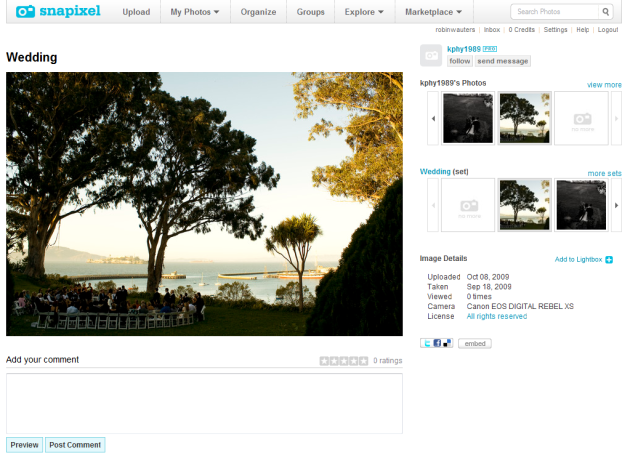
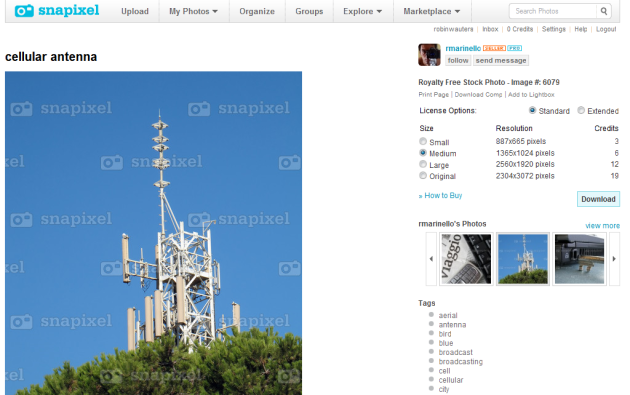
If you feel like you’ve seen this type of design before, it’s probably because you have. The screenshots below show that the whole look and feel of the Snapixel website was heavily inspired by Flickr, but frankly I see it as as a good thing because it works. Like Flickr, there’s a community aspect to the site, and the service lets you easily organize uploaded images into groups and sets, with the added ability of assigning the appropriate Creative Commons license to them. You can add tags, edit descriptions and titles, assign geo-information to photos and interact with other members.

But what Flickr lacks, Snapixel offers: a marketplace where users can go to buy and sell photos. Sure, Yahoo-owned Flickr once had serious plans for such an embedded service – it made, and still makes a lot of sense – and has a partnership with Getty Images in place that allows the latter company to market select images that Flickr users upload online.

Snapixel offers several account types: Free, Pro and Seller. The Pro account (currently $9.95/year) has all the features of the free offering but removes any advertising and comes with unlimited storage and bandwidth. When you sign up as a Seller, you get a Pro account with the extra ability to participate in the Snapixel Marketplace.

(The startup is giving away free one-year Pro subscriptions to the first 200 TC readers to sign up here – you can also simply enter the coupon code “TechCrunch” on the registration form)

When you apply and get activated as a Seller after screening, you can earn 60% from every photo sale – an extraordinarily high commission compared to competitors – and you get a couple of extra features such as watermarking, IPTC keyword support, flexible licensing options and unlimited storage.

All in all, Snapixel offers a great user experience combined with a service that’s packed with features, and again it’s impressive to see both of the core services of the platform so well aligned with each other in just one interface. The startup’s biggest challenge is going to be marketing; spreading the word to enough photographers who’d be interested in signing up to make the service viable.
Advertisement

Comments rss icon

  • It’s like a happy marriage of istockphoto and flickr… I am still not sure why flickr didn’t move forward with their plans to sell photos; it would have been huge!

    Next time I am in the market for a photo, I will definitely have to give this a try!

    • I agree with you… what’s the holdup flickr? They have a huge user base, billions of photos… they could steamroll their way through the marketplace!

      Jon @ WoodMarvels.com

  • it is a great idea! share your photos and maybe someone will buy it. Thanks TC guys for share the invitations!

  • Wonderful and all except that you forget to mention one small detail.

    This is microstock, i.e. a scam.

    Why would anyone in their right mind choose to get paid 1/50th of a normal license fee when you can send your images to a regular website/agency like Alamy (http://www.alamy.com/) and get paid what the market wants to pay you. You might as well just give you images away rather than go the microstock way. At least no-one will be laughing at you.

    Microstock hurts photographers – amateurs and pro alike – advertisers who end up with the same images as their competitors and the entire photo industry as it commoditizes imagery.

    And please don’t kid yourself that you will make any real money. You can with an ‘agency’ like Alamy.

    • Microstock is a different beast from conventional stock photography. Most small websites won’t pay what Alamy charges. They need immediate photos, that are small, and convey a concept.

      Old-school stock photographers need to learn about microstock, and not call it a scam. Agencys are not inclusive by any means, either. I have sold everything from pics for books, to websites, to sales brochures through people contacting me on Flickr. I hope to expand that, here.

      • No true.

        Microstock is not about small money for small usage (which would be fair).

        It is about normal usage for small money.

        FYI, a) Alamy is open to anyone and b) all conventional agencies are developing small usage pricing.

        When people contact you to use one of your Flickr images do you charge them $1.50?

  • Will this be as good as the flickr and does it makes uploading as easy as flickr?

    Thanks

    Jay

  • The concept is good, but the photos suck. What’s wrong with people who upload bad snapshot of private family dinners?

  • hat’s wrong with people who upload bad snapshot of private family dinners?

  • I fail to understand that when and why would people buy photos, when so many images might be available free on internet?

    • Another internet scam, wonderful. How many idiots have to be duped before somebody calls time on this? And maybe flickr haven’t done this yet because they’d have to get a critical number of their subscribers to agree to be ripped off.

      Micro-payment sites are not a business model for professionals, hobbyists, or anyone except the aggregators who set up the sites, and even they struggle to make returns.

      And when will somebody say “enough” to hosting this kind of cack photography on servers that use up valuable energy to host and run? It’s turning into an environmental disaster. What happened to taking a cack photo and leaving it to its fate in a shoebox in the attic? Why must everyone share EVERYTHING?

    • Because a lot of those images probably aren’t free. Just because something is available to take and use doesn’t mean your legally allowed to. Some people prefer to pay others for work they do *GASP* I know, shocking concept.

    • Why would people buy a car, when there are many parked waiting to be stolen? And why would anyone spend a great deal of time and money producing photos of quality, when they are not going to be paid for their work? So many questions….

  • Very cool, I will have to pass this along to my sister Lauren, a huge flickr photographer.

    Awesome name though. Good combination of words to make its very own word.

  • Not sure if I’m missing something, but are the images in the marketplace screened for copyright infringement? If you’re a seller, do you have to upload property/model releases? That would kind of seem to be a deal-breaker…

    • It’s pretty obvious from the site that images are screened for copyright infringement. It appears that both, property and model releases are required for sellers.

  • Another “website business” with no business model – sorry, “licence photos” is not a business model, its just two words. These folks will quickly learn that it takes more than a sketch on a napkin and a stolen Flickr design to maintain even a sustenance existence. You’re reviewing photos? Industry rate is 10 cents per photo. Without an editorial strategy you will swamped by people uploading pictures of their feet and be out of business in weeks. Have fun then paying staff to argue with amateurs all day about why some photos are accepted and some not.

    The agencies that have been doing this from Eastern europe have been at this for years and even they can barely stay in business – and in reality only doing so by consistently lowering commissions to photographers and in general devaluing all imagery everywhere by selling at rock-bottom prices. Good luck paying for rent in San fran – or are they trustafarians?

    Corbis is well onto failing in their second attempt at this racket (”Snap” village was the first one, sound familiar?) – all Bills money and they still cant keep things afloat. Move along, this is not the industry you are looking for.

Leave Comment

Commenting Options

Enter your personal information to the left, or sign in with your Facebook account by clicking the button below.

Alternatively, you can create an avatar that will appear whenever you leave a comment on a Gravatar-enabled blog.

Trackback URL
Short URL
bugbugbugbug
Techcrunch on Facebook