R.I.P. Good Times: One Year Later
by Michael Arrington on October 6, 2009

It’s been one year exactly since Silicon Valley venture capitalists decided to call an end to the funding party. Sequoia Capital started things off with a 56 slide presentation to portfolio CEOs titled R.I.P. Good Times. In it they warned “it’s different this time” and said that “survival of the quickest” mandated deep cost cutting.

Benchmark Capital also communicated with their CEOs, telling them to “Be calm, but pragmatic” and “You don’t realize how fast things spin out of control.” Super angel Ron Conway likewise warned his companies, saying of the spreading financial crisis, “we will not be “immune” to its drastic effects.”

So it’s been a year of massive layoffs (we’ve tracked more than 340,000 since August 2008). When you’re cutting costs, people are usually the first to go.

But one thing we didn’t see over the last year is a complete drying up of new funding, or large scale deadpooling of startups. Either the advice was off target in the first place, or the buckling down and cost cuts worked.

It’s probably a little of both.

Earlier today I spoke with Ron Conway and asked him what he thought of the last year and how things worked out. He said “We’ve seen an explosion of real time data startups which has helped offset the downturn in Silicon Valley. We still see 5-6 deals a day, which tells me the market is very vibrant. I feel like we’ve weathered the storm very nicely. Also, a lot of companies that needed money last year raised money quickly or cut costs and survived, so we had a lower failure rate than we thought we would.”

I also spoke with Pete Flint from Sequoia and Conway backed Trulia today (so he was hit from two investors a year ago). Trulia, a real estate startup, had 80 employees a year ago. They did not lay anyone off, says Flint, and have 90 employees today. They are now approaching breakeven as well, he says. Revenue has grown significantly over the last 12 months, he says. And while he won’t disclose revenue, 90 employees suggests payroll in the range of $1 million per month alone. The real estate market has gotten tougher in the last 12 months, and Trulia makes money from real estate professionals and companies via subscriptions and advertising. But they’ve found a way to struggle through and are at the threshold of profitability. One strategic choice the company made a year ago, says Flint, was to diversify revenue away from few big advertisers to lots of smaller ones. Trulia has raised $33 million to date, and the last time they raised money was Q2 2008.

Certainly there have been some hard times. We tracked a steep decline in venture investments and liquidity events earlier this year, particularly when tracked against the peaks of Q4 2007.

But Silicon Valley certainly seems stable right now, particularly when you compare 2009 to 2008. We track venture funding and acquisitions on CrunchBase, and we are just now preparing to publish Q3 data for download (it should be up later this week or next). I’ve taken a look at the data, and it’s surprising.

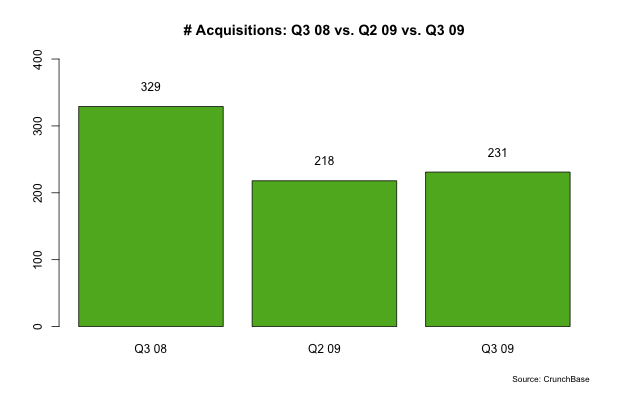
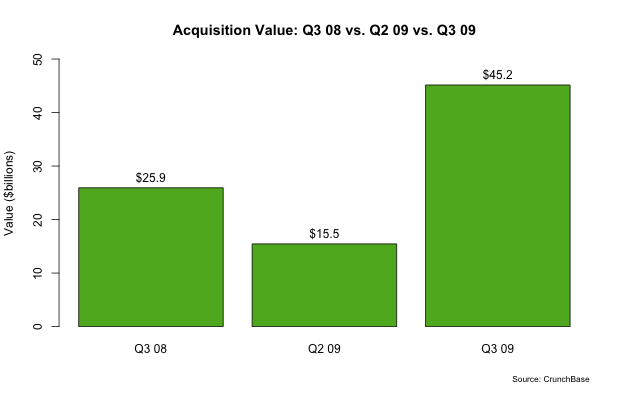
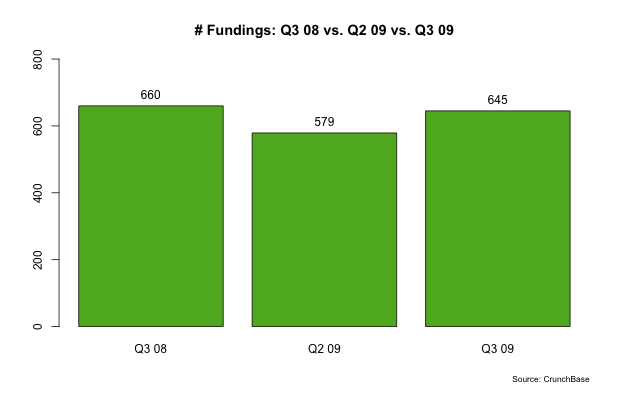
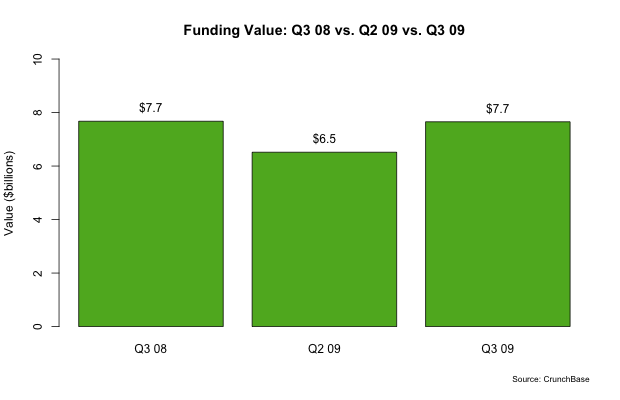
There were 645 venture financings for a total of $7.7 billion in Q3 2009, v. 660 and $7.7 billion in Q3 2008 (basically flat, but not down at all). Acquisitions have become less common, but the average price is way up. There were 231 acquisitions in Q3 2009 for an aggregate of $45.2 billion. In Q3 2008, there were 329 acquisitions for $25.9 billion in aggregate.

Charts are below for all of these, and we’ll have a deeper dive on the data shortly. But for now at least, the sky has yet to fall.
BAR_3Q_FUND

BAR_3Q_FUND_VAL

BAR_3Q_AQ

BAR_3Q_AQ_VAL

Advertisement

Comments rss icon

  • you’re right. it is a little of both

  • this is a good article. tech is on the up because the proliferation of the internet as a platform and increase usage. telecom, commercial email and other categories i believe also had very solid year this past year. makes sense.

    what’s nice is that the overhead and startup costs of web companies stayed low. this’ll change in the next three years but it played a factor in the steadiness of the market in my opinion.

  • How sad that I’m sitting in my living room watching the History Channel talking about crumbling bridges, roads, and sewer systems.

    Fresh water is at risk, because the pipes that transport were built during the infrastructure boom in the 50’s and 60’s.

    [Watch the show - its coming on history channel until 3 pm.]

    One true thing that can’t be overlooked, the interstate system is what made America a superpower. Now with the economic crises, and governments’ hardly having ANY financing to fix issues, let alone build new infrastructure, I get the feeling that America is going the way of the Romans.

    Something to think about, California, with a huge economy and suffering the same infrastructural issues and California being essentially bankrupt.

  • I heard on the radio yesterday that 60% of New Yorkers are out of work. This is hitting across all boards.

  • I think this realtime web is little overblown. Everyone thinks that realtime is going to be the next Google. I don’t totally buy it. Some of these companies will make it, but most I think will not. Even the realtime pioneer Twitter is not making money.

  • Mike,
    This was a fantastic piece, and another example of why TC is a daily staple.

  • yes, this was an interesting story. I think Silicon Valley has weathered this downturn in fine fashion. Companies are still growing. The risk is that it becomes frothy again too quickly.

  • There has been much more deadpooling than you are aware of. Its just in smaller startups that the press doesn’t really notice have collapsed.

    Many entrepreneurs are just very savvy about PR now and how to keep the information away from Techcrunch so they can save face. Publicizing a “big splat” isn’t exactly what a lot of employees, stakeholders etc are exactly proud of, so most deadpools are very quiet.

    The economy has just dealt sad crushing blows to so many little startups as opposed to the grandiose big pops of the dotcom era…

    In a lot of cases a website is still alive even after the company is dead, it just gets liquidated to a new owner who keeps the servers alive until they figure out what to do with it. Servers are cheap nowadays so you can keep a site in “zombie” mode indefinitely.

    Many of the startups you’ve covered and think are still alive and kicking have in fact been dead (or in limbo) for months…

  • In the spirit of transparency, “stable” is what we are seeing right now, with perhaps small signs of recovery/growth. We founded a small family of companies in late 2005 (http://hawkinso...ofile.com/about), did >1M in our first year and then grew by 2-3x in years 2-3. When the financial market collapsed last fall, we saw a lot of business dry up, with the scariest period being January – March of 2009. It just seemed like everyone was worried about an apocalypse and was holding off to see what would happen.

    During the Spring-Summer 2009, we then saw most core revenue streams stabilize, but actually proactively walked away from some business lines. The recession had taught us to be more focused.

    Now we’re seeing stability, and each month the numbers are starting to be a little easier to hit. My gut says growth is returning.

    Knock on wood, but I for one am hopeful.

  • Sky isn’t falling, but then we aren’t rebounding much from Q308, either. And Q308 pretty much sucked.

    It is sad that we are going to blow hundreds of billions on govt spending with only a fraction of that to show in real value.

  • Good piece Mike.

    It was both. The VCs way over-reacted. The Sequoia memo became VC mantra with 24 hours of posting on TechCrunch. They should have known better — as we had just had a tech recession 4-5 years before then between Web 1.0 and Web 2.0, and huge profits were made by those who invested in the right companies during that transition.

    The entrepeneurs in many cases did know what to do. Many had been there before, and with no portfolio to ‘manage’ and prune — just one company — they simply cut back and modulated, and focused on what mattered and stopped what didn’t. And came out better for it.

  • This was not a tech recession, as 2001 was. This was a finance, insurance and real estate (FIRE) recession.

    It makes sense that the implosion has been in finance and real estate, primarily, with collateral damage for the economy and tech.

    Learn more here: http://www.fireeconomy.com/

    I’m not spamming for the site — it’s just a very interesting perspective. One of the originators of the term predicted the 2008 crash in February 2008, in Harper’s magazine: http://www.harp...2008/02/0081908

  • bullshit. it’s not a “little of both”.

    pure & simple: Sequoia overreacted, and damaged their own brand in the process.

    Ron at least about-faced quickly, and actually even accelerated his pace of investment.

    in the past year, smart investors & entrepreneurs pressed on the accelerator.

    the companies that Sequoia got to downsize were largely not working, and cutting capex by 10-30% probably did little to stop the bleeding.

    Sequoia got it wrong. or at least their public statements were wrong.

  • I’d be curious to see if there are big changes in how deals are structured TY vs LY, and if there’s a 2009 risk premium.

  • “Bullshit”?

    Hardly.

    The first half of 2009 was pretty rough for a lot of companies, and making some deep cuts initially was definitely the right call for many companies.

    It is also pretty clear that Sequoia actually showed quite a bit of leadership here for Silicon Valley.

    Far from damaging their brand, this did a lot to show who gets listened to in the Valley.

    (And, it’s not the capex that they were telling people to cut, Dave, it was the opex. 30% off of opex is a pretty big deal.)

  • With respect to the citation of Ron Conway: has anyone a good definition on what “real time data startups” are?

  • I agree with Dave McClure.

    If anything this shows herd mentality prevalent among investors.

    It is not leadership to play chicken little and shout sky is falling. Nor is to harp on the latest buzzword real time web.

    Tell us something that we don’t know.

  • I’d say sequoia got it right – at least for them and their investors. They got their bottom tier companies in their portfolio to cut costs (which probably needed to happen anyway) and give them some chance to survive and produce some sort of return and they got their best companies, the ones they like the most, to panic and raise capital at lower valuations on terms that were much more friendly for investors. Since they were able to whip the whole market into a frenzy, they were also able to exert pressure in new investments as well. Very savvy move from the most savvy group out there – and one I am sure they have used in these moments before.

  • I write this comment even before reading the post – great topic, someone had to write about this. One of those moments I think Techcrunch is so, so good. Thanks !

Leave Comment

Commenting Options

Enter your personal information to the left, or sign in with your Facebook account by clicking the button below.

Alternatively, you can create an avatar that will appear whenever you leave a comment on a Gravatar-enabled blog.

Trackback URL
Short URL
bugbugbug