Google Health Adds Two More Insurers, Only Has 267 To Go
by Robin Wauters on October 6, 2009

Google announced today the addition of two new health insurance companies to its Google Health platform at the Health 2.0 – original naming FTW – event in San Francisco. The fact that the company is touting this addition on its main blog is telling because it cuts to the heart of the product’s main challenge.

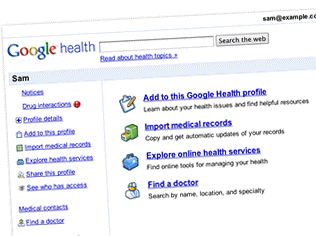
You see, Google Health – which enables you to store and manage all your health information in one place on the Web – can be a great service but it only becomes truly useful when your own health insurer and health care providers sign on to participate, since they are the ones who generate and keep your personal health data.

And flocking to it, they ain’t.

With today’s addition of both Harvard Pilgrim Health Care and the American Postal Workers Union Health Plan to the program, the current count of participating insurers is three (Blue Cross Blue Shield of MA joined late last year). Needless to say, there are hundreds more health insurance providers in the United States, so it’s going to be a long haul for Google to include the majority of them in the program.

And even then it’s going to be a challenge for them to provide a seamless service to users; Google in the past has admitted that wrong or incomplete data can cause Google Health to be more of a nuisance than an added value.

Amusing enough, today is the same day that sees the public launch of Keas, a VC-funded startup headed by former Google Health head Adam Bosworth. The fledgling company was profiled in the NY Times this morning and aims to combine personal data with general health information to deliver tailored health plans for individuals, designed by wellness experts. Bosworth has set up partnerships with both his former team and their biggest rival, Microsoft HealthVault.

Apart from the two new insurers, Google has also teamed up with more data providers, namely MDLiveCare and Hello Health.

Advertisement

Comments rss icon

  • Once the flood gates open, I’m sure Google will add plenty more health insurers.

  • The practice management and EMR systems that reside in doctor’s offices and hospitals need to open up there data before this can work properly. ARRA opens this up a bit with the introduction of Health Information Exchanges (HIE). Initially, there was no real plan to include the consumer in this exchange; however, it seems that the HHS does want help push forward patient facing tools. Chilmark research explains it well here: http://chilmark...ealth-internet/.

  • If there’s any area of health reform that the gov’t can dive in and provide support and encouragement (but please don’t “own”), it’s electronic records. The attached article outlines the problem from the doctor’s perspective:

    http://www.east...FICE/tabid/9848...

    It’s a huge nut to crack, but electronic med records still a “must have” high priority item for a variety of reasons (less mistakes, cost savings, portability, accessibility, etc.) but huge tech hurdles particularly relating to interoperability and compatibility.

    Jean Barmash (NYC) highlighted another of interest indicating they open sourced the VA’s records system, which is nation-wide:

    http://news.cne...tag=mncol;title

    The advantages of electronic medical records is huge, though, even apart from lower costs by reducing rework and inefficiency.

  • None of this works without the need to define ownership of identity and correlated data uses.

    The Internet is a fad-to-fad experience until this occurs. Smart people keep as much of their personal data obscured from the net as possible.

    Local market economies are staging a war against the globalization of data and commodities. Food is going to lead the movement, education will follow, health is on its heels, and transactional methodologies will succumb eventually.

    Opt-out until you are the owner of your socio-economic identity at birth. We are talking about reconstituting the way nations are formed, and how they derive their power to govern from “We the People…”.

    And don’t confuse this with any BS communist idea… its about preserving the power of the marketplace by giving human beings the powers of corporate entities so that there is no form of life on this planet more empowered than the individual human being. Think up people!

  • How is MS fairing in their venture?

  • This will be yet another failed Google project. They need to get back to selling clicks and preventing gfail from failing even more and stop trying to get into industries they have no right being in like health.

  • Insurance companies, hospitals and doctors guard most of our medical records with tight controls. Getting them to give it up is a tall order. Google is in for a long road to getting all the insurance companies on board. I am in the healthcare industry and I find it hard to get my own personal health records. Good luck to the average person.

  • There is sooooo much potential here, too bad health insurance and medical providers are slow to partner up.

  • Why not go the entrepreneurial route and people build core apps for the smaller guy – IE, the doctor offices, that allow them to upload directly to Google Health. I just spoke to my doc and he’d love to have a way to store blood labs virtually that patients can reference and trend. I’m no health-field/policy expert though. Possible?

  • This was written with some very good insight here. I am a healthcare blogger that works directly with end users, meaning doctors and patients. The technology side is only one side of healthcare reform and one thing to be wary of is to be focused on one entity only and miss the rest, this is happening all over.

    I cover healthcare business in many areas to include insurance, genomics, medical devices and the PHR Health 2.0 is only one small side of the entire scenario, and important side by all means as far as having information, but don’t get so side tracked in one aspect that we lose focus of the entire ball game.

    I have an entire section on Google Health and HealthVault and use them myself, great products but when another aggregation source comes in do you stop what you are doing and run to the new software? If I did that I would a daily menu of distractions and lose the ability to focus, and this is some of what I am seeing today, based on comments made in different places, no focus, just running for the latest and greatest without a thought process in place.

    Have any of these folks met with a very non tech group of doctors and tried to show them what is out there and available? I have and it’s not a pretty picture, you have confused and scared doctors that throw in the towel and stay with what they know, and no progress is made, it is what it is. On the other hand you want to share all your health information and don’t get what he’s not getting, and there’s more to this than meets the eye, they have a world of complicated billing, working to get your claims and referrals approved, etc. so this goes down to the bottom of the priority list, as they are human and only have so much time. Have you ever seen how an office visit is billed and how complicated the process is, I have and I do some billing, it’s not simple.

    The main focus today is the insurance side and without that, none of the rest of this takes place. Words of warning, don’t get so distracted that you can’t see the forest for the trees. I use the word algorithms on my blog, to acquaint those who are not familiar with this term, as 99% of all our business and healthcare decisions are revolving around technology created information to help us, and many have a hard time understanding this process, and it’s not going away any time soon and will continue to grow

    At best if that small mountain of information can be delivered to patients and doctors so they know how this is working, that is one undertaking. After the concept is understand, then there’s room for growth and working with software and algorithms to help improve lives and healthcare.

    Again, I like and work and try many new technologies, but when we are scattered beyond the main focus, things just don’t come together very well and everyone is looking out for their own personal interest area, but again, healthcare is much more than that and the entire picture needs to be seen as a whole and not enable distraction to take away from successful implementations of services and processes that will improve life for all.

    That’s my 2 cents for the day and thanks for letting me have a say and maybe perhaps I may have provoked some thought processes that perhaps get buried at times. I know I have that problem at times too.

  • Like millions and millions of others, I use Google products for many things in my life. I’m a fan of “cloud” services like Gmail, and Google Analytics, and of course Google search.
    Having Google partner with Healthcare companies for health records gives me an uneasy feeling though. Maybe I’m being too paranoid, I don’t know.

  • It would seem like ObamaCare release candidate 1.0 would have made this product absolutely useless. (Unless it was ported for the public option.) Hmm. Here’s a company whose employees donated generously to Obama. What gives? Is Google hoping to be a premier partner for ObamaCare, or are they willing to scuttle a project in deference to the policy of their favored candidate?

  • For the last time, gmail hardly constitutes as “cloud service”. Get that right!

Leave Comment

Commenting Options

Enter your personal information to the left, or sign in with your Facebook account by clicking the button below.

Alternatively, you can create an avatar that will appear whenever you leave a comment on a Gravatar-enabled blog.

Trackback URL
Short URL
bugbugbugbug
Techcrunch on Facebook