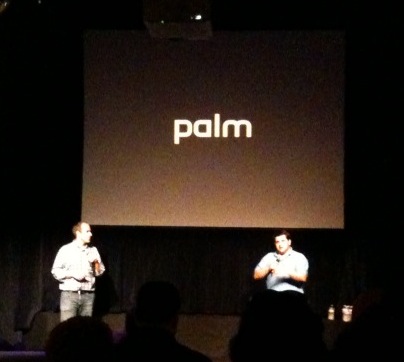
I’m here in San Francisco for a meeting Palm has called to give its newest employees, Ben Galbraith and Dion Almaer, who both came over from Mozilla, a chance to talk a bit about the state of the webOS platform.
The two, along with Palm CEO Jon Rubinstein and some other executives spoke at length about the hardware, the platform, and the plan going forward. The message was pretty clear: Web development is the future, and openness is the way. They also made a few big announcements.
The first is that they’re allowing developers to fully distribute their apps via the web. What this means is that developers can simply submit their apps to Palm, and Palm will return to them a URL that they can then blog, tweet, do whatever they want to share it. When a person then clicks on that URL they can easily install the app, bypassing any kind of store. And while Palm is providing the URL, it is not going to be reviewing the apps in any way — a clear dig at Apple’s approval process.
Palm did note that they will still offer their App Catalog (their app store) for developers who want that too. Presumably, any app developer who wants to charge for their app will still have to go through the store. And for those developers, Palm will charge $50 for the apps to go into the Catalog.
The next announcement is that Palm is waiving the $99 yearly fee it normally charges to developers to make webOS apps if those apps are going to be open source. Galbraith and Almaer with their Mozilla backgrounds are big proponents of open source, as are many that were in the audience tonight, so this move drew cheers.
On top of that, Palm is opening up all of its analytical data to any developer who wants to access it. Again, this is different from Apple which keeps much of the analytical data for itself, and shares little.
And finally, in an effort to spur development for the platform, Palm announced that it is giving to every developer in the audience a free Pre, and its new wireless charger. On top of these, everyone will get a month free of Sprint service to use the device and tinker with developing for it. “Just hack on it,” Galbraith said.
So now Palm has had its “Oprah moment,” just as Google did a few months ago at Google I/O where they gave a G2 to everyone in the audience. That was a much bigger audience, but the gesture is still a good one from Palm. Here’s the takeaway from tonight: Galbraith and Almaer are the new sheriffs in town and they want to open things up and get you developing for webOS.


This is awesome.
It’s not surpassing knowing Palm and their history. Historically, they have always distributed applications this way. However, with the new webOS platform being a direct competitor with Apple, this is a bold move!
Go Palm.
I want a Pre (but I wan’t to keep my iPhone too!)
should it be free press?
Does Steve Jobs wear iglasses
ok that is better
apple didn’t have to do this to get 80k+ apps and 1B+ downloads in just over a year… palm should learn that there is something more than these gimmicks…
It’s not about Palm vs. Apple. It’s about transparency vs. opaque. I use a MacBook, but Apple has gone the way of Microsoft with the iPhone. They’ve got huge market share and now they want to build a moat around it. Palm’s webOS is to the smartphone as Mac OS X is to the Desktop.
+1
+1
Depends on how you define “huge market share.” What is iPhone now, 2-3% of the global cellphone market? And how is the Apple app store a moat while Palm’s is not? Palm just relieved itself of the expense of distributing free software, including the expense of certifying free apps for use on Palm hardware. I don’t see how allowing potentially buggy apps, trojan horses etc. onto a smart phone is a good thing. On the other hand, it’s great that they’re passing some of the savings on to developers. Unless you look at tech from a simplistic good vs. evil pov, Apple is no Microsoft — far from it — but Palm aspires to be very much like Apple, these announcements notwithstanding.
Can’t hurt to try though. Anything that helps them get more developers on board is a “power move” imo. Do you have any suggestions?
Yeah, but it won’t hurt them. Also, it’s nice to see other companies being creative instead of just copying Apple. Palm has already done a great job being creative with the Pre. This is another step in the right direction. It’s probably not the complete solution yet, but they’re doing the right thing.
Also, Apple was so successful with their App Store because, well, they’re Apple. Palm isn’t Apple (obviously) so they need to try harder to be even half as good.
Seems a little desperate really. Devs where begging for Apple to let them on the bandwagon, what’s up Palm?
gimmicks…? it’s called marketing and being the underdog dude.. tell me Jim, how would you do it??
“Also, it’s nice to see other companies being creative instead of just copying Apple.”
Simply doing the opposite isn’t being creative, which is exactly what they’ve done.
“gimmicks…? it’s called marketing and being the underdog dude.. tell me Jim, how would you do it??”
Of course it’s a gimmick. You want to actually compete with apple? Have a library of solid apps and finally create a way to sync with a mac without hacking into itunes every few months.
Marketing, in many instances, is comprised of gimmicks. It might help, but it’s only the beginning.
Jim would time travel back to the 80s and assassinate Steve Jobs, of course. Then he’d make a remote controlled robot duplicate, infiltrate Apple Headquarters, and become the world’s next Software Giant.
in the early stage, its not all about the number of apps, its about innovation and the quality of the platform (hardware, software and services) … nothing like iphone existing prior to iphone – phones, music players, internet devices, mobile oses, all existing but the integration and innovation made iphone unique, which is why people bought it in the first place…
i doubt jobs and co thought about the app store in the way it exists today much less predicted its huge success…
my basic point is that app store didn’t make or break iphone, in my opinion its an evolution of the platform…
palm needs to stop copying and coming up with these silly gimmicks (there is already another company in redmond that makes its living out of it) and start innovating… pre is a great platform but nothing in there is innovative…
Seriously, only a troll would make this type of nonsensical argument about a company that JUST MADE IT’S PLATFORM THIS BONEHEAD SIMPLE TO DEVELOP FOR AND DISTRIBUTE ON.
Apple also had an established user base of 10 million iPhones when it launched its store. If it had launched it at the same time as the iPhone, uptake and app count would have gone much, much slower.
EXACTLY… apple didn’t need apps or app store to do that… they established the use base entirely based on the innovation in the hardware and software…
which is what Palm, Msft should do to compete with Apple, not just copy iphone…
i don’t think the concept is difficult to understand (probably only for Ballmer), but i think execution is really difficult…
I think Palm’s championing of open source will help. There are many developers who love open source and what it stands for and I think there could be some cool things done with it. (i.e. a terminal to talk to WebOS directly), etc.
Developers love open source but customers don’t care about it. The only way Palm can survive is by selling more Phones. They have to make a GSM version and offer it worldwide. Choosing Sprint, ‘hacking’ iTunes, and making the ‘iPhone Killer’ with cheap hardware were all stupid decisions – if they don’t focus on selling more phones on more carriers ASAP they won’t exist for much longer.
yeah developers love open source which equals more devs on webos which hopefully (in Palm’s plan) will compete with the iphones app store which equals more customers.
“Developers love open source but customers don’t care about it. The only way Palm can survive is by selling more Phones.”
And developers will buy those phones strictly for hacking. Look at Nokia with the N800 series tablets. It was nothing by itself, but with Maemo, people would buy them strictly for hacking the OS and porting code.
Also, Palm has some requirements to be open source. Since some of WebOS is inevitably based on open source technology, under the GPL license, they must open it up. It would be hypocritical to use Open Source but not champion it for the end-users and developers.
You’re right, Apple never pulled a gimmick like this. http://bit.ly/100MM_USD
Where is John Biggs to weigh in on this development. Surely this somehow signals the end of Palm!
Now if only Palm hadn’t pulled *all* the paid apps down from the Pre store mere hours after posting them…
I’m so jealous…I wish I could be there.
I almost bought a Pre today, but the fact they don’t have nearly as many Apps as the iPhone is the only reason I’m holding out.
I wouldn’t turn that down!
Although I’m extremely jealous of everyone in the audience who got a free Pre
this had to be done. but more importantly, this should be done.
apple benefitted from being the first real smart phone and were able to create and hold onto great momentum and bank the app store phenomena. but this should not be the template to follow going forward. the mobile WEB is the way. apple just slowed down that inevitable reality. good for Apple. and they will milk this as long as they can.
but now with Nokia and Palm forging ahead with the more open approach, we’ll see some interesting innovation and more independence.
Jim, you mention this move being a gimmick. but i see apple’s app store as a gimmick. it just so happens to be a hugely successful gimmick.
whatever works.
Even if other companies go the “open” route Apple’s entire existence is based on the opposite. I don’t see their competitors as being open being much of an advantage.
Being open is an advantage for Palm because it lets developers forego the App Catalog approval process, whereby a developer submits an app for inclusion to the catalog, and then has to wait for Palm to load it. It cuts a lot of time off of the application cycle.
It also takes the “geek” out of off-catalog app distribution (aka “homebrew”). It means that come December, there won’t be the same bright line between homebrew and App Catalog apps. They’ll essentially be the same.
What it will really mean is an explosion of apps. Without an approval process, devs will be able to pump out apps for WebOS like there’s no tomorrow.
Of course, without an approval process, the quality of such apps might not be up to snuff, when compared to the App Catalog, but anyone who installs from a URL should know what they’re getting into.
“you mention this move being a gimmick. but i see apple’s app store as a gimmick. it just so happens to be a hugely successful gimmick.”
You see it as a gimmick, but you don’t say how, or why. Just because you SEE it as a gimmick doesn’t make it so.
A gimmick means there’s no real reason to do ‘it’.
There are many reasons for an apple store, especially when just starting out. You might not agree with them, but that doesn’t make it a gimmick.
Screw Jim. Just a hack for Apple and throw stones at Palm. Doesn’t even deserve a response. The WebOS is a stout platform and this is a great move all the way around for Palm, the developer community and Pre customers, of which I am one.
The announcements seem incredibly interesting. Looks like bringing in those Mozilla dudes was a smart move.
what about THE ANNOUNCEMENT is INCREDIBLY interesting? have they said or done anything thats has not been done before?
NOTHING about this will change the market share of Pre… its simply is a “second hand” device… people who don’t want ATT or cant afford TCO of iphone would go for Pre (or any other “smartphones”)…
It’s not interesting because it hasn’t been done before. Palm did this way before the iPhone was a gleam in Steve Jobs’ eye. In ye olden days, Palm apps would get distributed on PalmGear and PalmInfocenter and a host of other sites besides Palm’s official site.
It’s interesting because it bucks the current conventional wisdom of how to distribute apps (i.e., through a centralized store). Palm is embracing the off-catalog community, rather than trying to convince people that apps distributed outside of their app store will make their phones and/or cell towers explode (thereby causing the demise of human civilization, no doubt).
Palm is gleefully giving the finger to the carriers. Without an approval process, expect to see an explosion of tethering apps, video streaming apps, etc., etc. Just the sort of thing Apple came down hard on in the beginning with their app store.
And finally, this changes what kinds of apps can be distributed openly. One of the areas where Palm seemed to clamp down (in terms of the App Catalog) was excluding any app that took advantage of an undocumented service. That’s gone now, and that means that there will be a lot of people writing services to exploit uncharted areas of the hardware (e.g., video recording, OpenGL, etc.).
In short, open vs. closed makes a big difference. This isn’t some minor bone being thrown to developers. It’ll make a large difference in how the platform develops.
+1
my dog ate my homework. yeah!
Why would a developer waste time developing for Palm’s 400,000 Pre users when they can develop for Apple’s 50 million iPhone & iPod touch users?
I doubt this event will change anything unless Palm starts selling phones in the millions – instead of the thousands that they are selling now-which will never happen.
What up, lowball?
Umm… because not everyone wants to be part of Apple’s closed, consumerist, restrictive machine? Because it took Pandora 1/10th the time to develop a working shell for webOS compared to for iPhone’s OS? Because Palm offers a much more open system?
Newsflash, little iSheep… Apple no longer makes the best products.
“Consumerist”?
Man, showing one is not consumerist by buying one product instead of another is like making out with your mom because she isn’t your sister.
I can’t stop laughing at this.
Beats trying to get your sister to adopt you to replace your mother…
Why would a developer “waste time”? Because there are tens of millions of more developers familiar with the HTML/CSS/JavaScript platform the Pre is built on than the Cocoa/Objective-C platform of the iPhone/Touch. Anyone familiar with building a webpage can build a Pre app as opposed to buying a Mac, then cracking open a book and studying for a few weeks to learn how to build an iPhone app.
“Apple no longer makes the best products.”
I agree with the rest of your statement, aside from that sentence.
I own a Mac, a Touch, a Pre, and have done development for both platforms. The iPhone is capable of far better quality, however producing that quality is much more difficult in comparison.
Your post is 100% right. +1
@Derek and Chieze,
Both of you are morons in a hurry.
How do you plan to make 3D games with the response and sophistication on an iPhone on a Pre?
With HTML/JS/CSS?
Slow down and take a look.
LOL, nice. Because the only good apps are 3D games.
Anyway, Let’s skip the part where Derek already makes your point above (and it’s self-obvious — no one argues that point, EVER). Let’s instead look at the fact that you completely ignored the part (actually the crux) of Derek’s argument where there are orders of magnitude more people adept at JS/CSS/HTML development than obscure single-platform C-variant development.
And the other part where he states it’s just WAY easier to develop a working application.
This should definitely help out Palm in the long run. Get open source Devs into the phone creating some killer apps (by killer I mean useful, efficient, intuitive), and so long as they (and Sprint) can advertise the fact that the phone is and open, have it your way, type of platform, people will begin to eat it up. Having a service plan that allows all access for one fee, and a phone that hasn’t had every feature locked out *Cough*Verizon*Cough* should be enough to attract a nice consumer base. This phone hasn’t had the technical problems the iPhone has had. If Palms marketing team can capitalize on some of these facts they should do well. Give the apps time to be built and distributed, then we’ll see the potential it has. Open Source, Open Phone, Open network. It’s a beautiful step in the right direction. Let the users decide how they want their device set up.
You must not know many developers, Vinod. There are certainly some developers who build things after putting together a careful business plan. But there are a lot more of them who build things just for fun, or because it’s something they want. I doubt 1 in 50 PalmOS apps ever made a decent profit, but there were thousands of those.
Further, Palm’s WebOS is much nicer to develop for. As a test, I built identical simple apps for the iPhone, the Pre, and the Android G1. The Pre was by far the quickest and most pleasant experience. You just a knowledge of HTML, CSS, and JavaScript for the Pre, while the iPhone requires you to learn an obscure C variant.
The low install base is somewhat of a problem, but if Palm plays their cards right, including getting a decent developer hardware program together, I imagine they’ll have plenty of apps.
“Further, Palm’s WebOS is much nicer to develop for. As a test, I built identical simple apps for the iPhone, the Pre, and the Android G1. The Pre was by far the quickest and most pleasant experience. You just a knowledge of HTML, CSS, and JavaScript for the Pre, while the iPhone requires you to learn an obscure C variant.”
This is not much of an argument for Android having Java and a bunch of scripting languages.
Also i doubt that html/css/javascript is the right way for any “serious” application.
Has nobody else notice this change of heart is almost certainly due to the JWZ fiasco?
It’s not. Ben & Dion came on before jwz started to raise a stink, and from what I’ve heard, this philosophical shift was exactly *why* they were brought on.
I think we have to give JWZ credit. Maybe Palm was headed in the right general direction, but I think the PR fiasco pushed them over the edge. Given how many homebrew people were waiting on this, the delay was not helping Palm, and I think that without a doubt this would not have happened as quickly without the boot in the backside JWZ provided.
No, you don’t have to give him credit for anything. What you (and probably the whole JWZ fanclub) are doing is a classic case of Post Hoc Ergo Propter Hoc, which is a logical fallacy.
What do you think that Palm was arranging this developer meeting (which I guarantee they were planning well before they had heard anything from JWZ) for in the first place? To hand out cookies?
Awesome…
I’m all pro for the Pre (as well as open source), but unless there’s something i don’t get here, it seems to me that they’re getting at it the wrong way.
If anyone who wants to develop for the webOS can just push their app via a URL, but people who want to CHARGE for their app have to submit it (and pay for it) and be confined to the realms of of the store, wouldn’t it push developers AWAY from the platform?
It is now both cheaper and MUCH easier to distribute free apps then to charge for them, which means devs will have a hard time making money out of it and many of them might just give it up.
That may leave the webOS to the “giants” who want to give away stupid promosion apps for free…
Unless palm comes up with a very clever way of making money out of free apps (or charge for them outside the store), this seems like the wrong way to go.
Is it still true that palm wants to be the exclusive distributor for any palm app meaning that you either can’t install apps from other sources or if apps are offered at other sources they don’t let them into the app catalog?
I don’t like this idea since it gives palm the opportunity to restrict access to apps they don’t like (like gvoice on the iphone).
in that case WiMo and Android are my preferred choices.
There’s already a Google Voice client for Palm. Palm knows that they can’t act like Apple if they want to make this a success. Good business would say that they are less restrictive and will let the developers play a lot more with the internals than Apple allows.
Honestly, from a security standpoint and with Palm’s willingness, I could see WebOS devices (which are Linux based) turn into mobile pen testing machines. Call it crazy, but the technology is there to do so. Same with Apple.
Is the $99 yearly free really to “make” webOS apps or to distribute them? Or are they really so closely coupled?
Good luck to Ben, Dion and Palm, hope they can go as open as Mozilla is.
Who pays for free? Why, somebody must, because these people somehow still have houses and cars and i-Phones, and I guess the answer is: they sell consulting and somebody pays for their consulting.
So, they “liberate” all the code and the apps and tell everyone they can get them for free with no stores and whatnot, and harvest everybody’s free labour and their idea that if they only have free web and free stores they will get people to get their free apps and…wait. So then how do those people get paid? Do they hope their “consulting” will get paid too?
Someday, the free web will collapse of its own weightlessness.
Apple should not be worried this season by Palm, becoz WebOS sucks big time. It misses out on everything an apps developer needs to make things fly right out of the screen – even in 2D. For example, battery drain issues, missing syntax support and no code security, makes WebOS a developers hellhole. For the apps community, WebOS is light years behind the competition and, unless Palm releases WebOS with Flash, will stay light years behind. Personally, when seeing a Pre next to a G3, at a very similar price, there is *no* competition.
Free apps? Moot point. No apps.