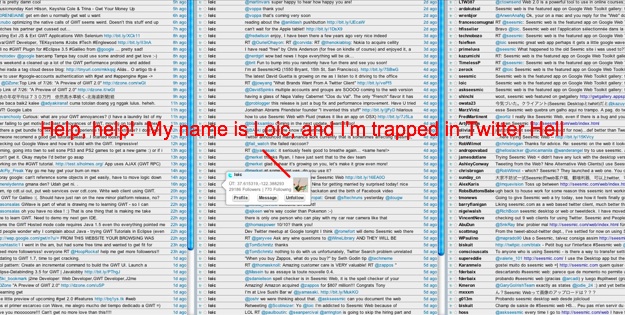
A few days ago, Seesmic CEO Loic Le Meur (@Loic) sent out a retweet with a link to a screenshot of his CTO’s Seesmic Web client showing 1,200 Tweets across nearly 20 columns. The joke was that his CTO was trying to achieve a “world record” for how many Tweets could be loaded up into a Twitter client at one time. (It’s not a world record. Competitor TweetDeck can display an unlimited number of Tweets and columns as well). If you click on the screenshot and pan across the enlarged version of it, there you’ll find a dialog box with Loic’s old avatar doing a hang-10 while kite surfing. The juxtaposition is comical, if a little sad—poor @Loic lost in the overflowing stream of Tweets his company is trying to tame.
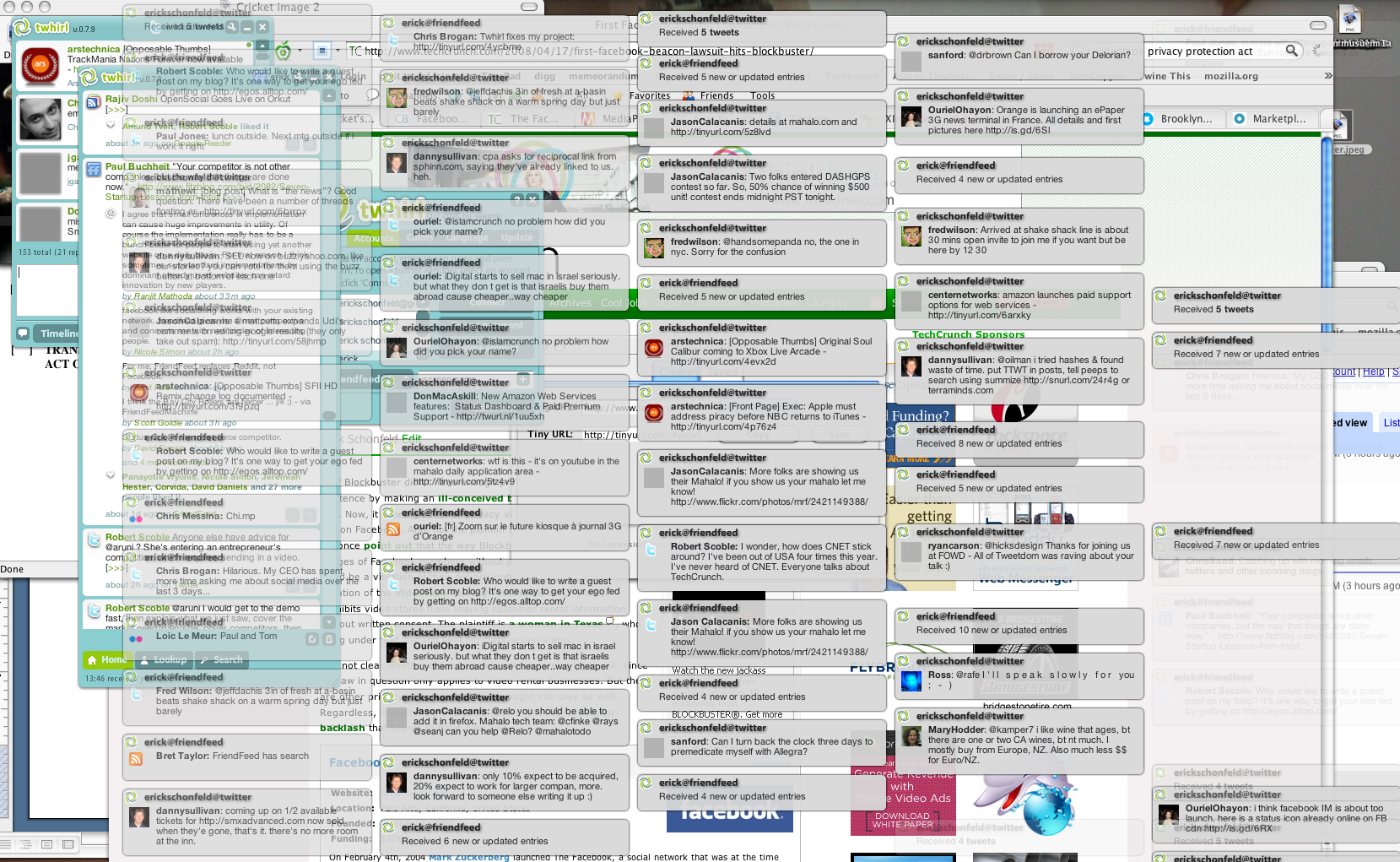
The image reminded me of another screenshot (see below, click to enlarge) that I once took of an earlier Twitter client called Twhirl, which Seesmic bought before developing its current product. About a year and a half ago, I complained that Twhirl took over my desktop when I first installed it with a constant stream of pop-up messages. I wrote in that post:
This highlights a bigger problem with the Web today. There is too much to pay attention to and not enough ways to reduce the noise.
It’s 18 months later and the problem hasn’t been solved. The screenshot I took back then still resonates because the noise is worse than ever. Indeed, it is being magnified every day as more people pile onto Twitter and Facebook and new apps yet to crest like Google Wave. The data stream is growing stronger, but so too is the danger of drowning in all that information.
This is not to say that there hasn’t been considerable progress in stream readers since that time. Containing 1,200 Tweets within neatly defined columns is definitely better than 1,200 separate dialog boxes taking over my screen, and these apps today are much more able to handle massive amount of messages. But the fact that Seesmic or TweetDeck or any of these apps can display 1,200 Tweets at once is not a feature, it’s a bug. Again, what I said 18 months ago is just as true today:
I need less data, not more data. I need to know what is important, and I don’t have time to sift through thousands of Tweets and Friendfeed messages and blog posts and emails and IMs a day to find the five things that I really need to know.
One the main methods emerging to cut down noise in your personal stream is to set up different groups of people or keywords (via search) to follow. Twitter is going to tackle this problem with its new “lists” feature. Seesmic and TweetDeck already address this problem by creating a new column for every group or category you want to follow.
But as the image above makes clear, that strategy breaks down fairly quickly. I have ten columns in my TweetDeck, for instance—one for my personal Twitter account, one for the TechCrunch account, one for my Facebook stream, one for mentions of “techcrunch”, another for mentions of my name (so I can respond to people trying to talk to me whom I don’t follow), another two columns for direct messages, and so on. I rarely look at more than two columns. It’s just not an efficient way keep track of all my different interests in the stream.
And if you think Twitter is noisy, wait until you see Google Wave, which doesn’t hide anything at all. Imagine that Twhirl image below with a million dialog boxes on your screen, except you see as other people type in their messages and add new files and images to the conversation, all at once as it is happening. It’s enough to make your brain explode.
What these services should strive to do instead is hide the noise, keep it simple. Letting me sort through the stream by creating different groups and lists and columns of things and people I want to pay attention to is great, but it hardly solves the problem. Finding that one great Tweet from @Loic or anyone else I follow shouldn’t be a game of Where’s Waldo?
Really, all I need is two columns: the most recent Tweets from everyone I follow (the standard) and the the most interesting tweets I need to pay attention to. Recent and Interesting. This second column is the tricky one. It needs to be automatically generated and personalized to my interests at that moment.
It would definitely include the most retweeted messages from people I follow over the past 24 to 48 hours because I miss these things during those hours when I am not staring at the stream. (And I stare at my stream more than most people). It would also prioritize tweets from people I follow based on who I pay attention to the most, based on my past history of retweeting, replying to people, or simply lingering over a Tweet while I’m reading. Look at my behavior, and then create a favorites list of sorts out of that.
And if those two columns aren’t enough, then there’s always search. Except search is broken on Twitter. Unless you know the exact word you are looking for, Tweets with related terms won’t show up. And there is no way to sort searches by relevance, it is just sorted by chronology. Maybe Twitter can use some of its $100 million in new funding to fix that, and solve the noise problem while it’s at it.


Absolutely agree Erick! We need relevant tweets that cut through the noise and unfortunately, a lot of these tools simply make it easier to create and consume more noise.
Sounds like Twitter needs to partner with Digg to get some of their recommendation algorithm code for you Erick.
I think eventually Twitter will be seen as a passing fad. Sorry everyone…
You wouldn’t fly a plane looking through a peep hole. I think of my Twitter client as my cockpit. More tweets on a page is a good idea if you are good at scanning.
At TuneIn, we believe that the media shared in tweets is among the most valuable content. And, we think that people are the ultimate filter. So we build a channel of media shared by people you’re paying attention to. You can search your channel, and you can explore others’ channels. If you’re feeling overwhelmed by the noise, and if you value media shared by people you follow, give TuneIn a try.
Very true !!!
Twitter search is broken
Noise is everywhere…
Even techmeme is noisy…
There should be a very easy way to catch with “TOP weekly tech news” without reading 2 hours of blogs, tweets, etc.
I still use twhirl because I have 30 or so twitter accts i monitor, tweet in, or are my main two accts for myself: http://www.flic...der/3709836809/
Right now, just in my main two windows, I have a total of 17,000 tweets that i could scroll back to, plus the smaller amts in the other 28 windows.
I don’t want to upgrade to seesmic desktop or other tools because right now, this is the best way for me to monitor very occasionally what is going on from each of those twitter acct perspectives and within each of those “publics.”
However, it would be great if twitter tools did allow some exhaust from collected tweets to scroll out and no longer be contained within each window.
Unfortunately, seesmic desktop, which is currently suppported (twhirl isnt) doesn’t support anything but columns nor does it have colors.
mary
A feature like Itunes Genius for “Information consumption” would be nice also
Recommended stories….
Yes, bring the semantic web into these desktop apps, so that tweets are auto-filtered based on our past behavior. That’s the future, man.
DestroyTwitter FTW!
The biggest problem to me is the spammers, both in mentions and in hashtag usage. Ironically, it’s easy to automatically determine who is a spammer. They usually fit an easy to match profile:
- following many, not followed by many
- not a lot of tweets yet
- @replying more than average
- using more hashtags than average users
- (sometimes) no user icon
However, in order for a Twitter client to determine what is spam and what isn’t by the above rules it would need to perform multiple API calls to ‘investigate’ the sender of every individual tweet. At least once anyway.
It would definitely result in way too many calls and pretty much make it impossible to do within a Twitter client, even though in theory it would be rather easy to do so.
So…. the only one who can solve this problem is …. Twitter itself. For example by attaching some sort of ‘credibility score’ to each tweet which clients can use to decide on the interestingness of any particular tweet.
this is why companies like http://swarmforce.com are going to be important. They built a prototype twitter app called http://swattr.com that did a great job of only surfacing the best tweets in any category. Hopefully they’ll get some VC soon to really enhance their swarm technology.
Some days I switch off 24/7 media and read a newspaper instead. I forgot how calming that is.
Well said, Steve.
So, about the screenshot (http://www.rome...reenshot_51.jpg), how big is this dude’s screen.
Twitter’s raison d’etre is noise. If you’re not personally close enough to be someone’s friend or even fan on Facebook, then subscribe to their blog’s RSS feed. Everything else is a distraction.
Good post– the evergreen problem of finding information in a sea of data. This is definitively the next challenge of the real time web.
How about this: don’t follow so many fucking people.
word up, homie! RSS is hard enough to keep up with, i don’t need a separate box for everything somebody feels like pooping out.
This was my initial thought as well. There really is no way to follow more that 200 or so people on Twitter and NOT take root in your chair.
Instead of looking for software solutions to cure our natural tendency towards excess, how about just having one beer instead of slamming the entire six-pack? Maybe exert a bit of personal control that would naturally result in simplicity.
Who has 200 friends in real life call them ten times a day? You’d shoot yourself before you could load the gun.
I completely agree, JV.
The need to ‘bookmark’ everything in sight is curious. I’m reminded of people who add as many ‘friends’ as they can to Facebook because it boosts their egos. Is something similar at work with Twitter?
Quality is more important than quantity, particularly as few of us have the luxury of spending all day tracking Twitter and the like.
This is not about inventing new algorithms to cut through the crap: this is about becoming more self-aware about what is most important to you.
Learn to be ruthless about what you want to track online.
Get some balance people! Algorithms don’t live your life.
+1
Have you checked Mixero out? It definitely helps filtering out the noise. For instance, I love how you can look at a group named “News” where I’ve added @ABC and @nytimes among others and filter what I see there related to “Google Wave”, for example.
Mixero is definitely cool. IMHO better solutions are comong, using semantic analysis and AI. Check out Titema client for iPhone http://www.titema.com , this is a good example: it uses machine learning to select the most relevant messages for you from your network and from outside of it, which is totally the future. I wish more startups will work on this problem of automaticaly find interesting topics out of your network.
Anyone know of a good guide to twitter clients? Currently, I’m migrating from Twhirl to http://hootsuite.com/ …fewer bugs, cuts out the noise better.
First you have to think about Information.
Simplified version:
Information = Data in Context
Context = Organized Data
Learning = Self Organization of Data ( builds Context)
Now there are shared context by People with the same education and cultural environment they live in, for example. Google is kinda good at indexing that, they do not organize information. Since that is done via links by people.
To your problem, to cut the noise out. You would need a system which can learn from you. Otherwise you end up with system which never feels quite right, but that might be good enough for most cases.
In either case the system will have to be able to build it’s own organization around context to keep up with ever changing relevancy. And relevancy is a feedback loop of what you know, without it you have no clue what to look for nor does any system. Or again you can go for what everybody “knows”, kinda stupid system.
Or all information is local, only when you put data into your contexts becomes it information to you.
Just saying it’s not that easy, but from Brain research we know a lot on how to do it.
ronald,
Excellent synopsis. Agree with everything except the tone. Yes, let’s go back to first principles in CS – even in philosophy. I have a perspective on this, seemingly much in line with your own.
My conclusion is a systematic solution applicable to extant systems under current usage patterns. Not merely an excuse (just sayin’).
To what research do you allude? Can you show a link?
- henchan
Ronald and Henchan, you did make me chuckle. Why all this talk of AI when all it takes to deal with data is to identify what is most important to you as an individual?
I’m sure AI can be very useful in helping to identify useful information, but algorithms don’t make us any less human. This is a cultural problem, not a computer science one.
Learn to balance your life to the point where you don’t need to track everything in sight. AI is contributory, I’m sure, but cannot be the full answer.
The web, while still a CS project for a few people, has become for many no less significant to human culture than all of literature.
Quality of information is what we are talking about. If I prioritise only two items it would be helpful that my past preference be taken into consideration when the system supports me in categorising a third item relative the other two. Of course it would help the fire-hose drinkers if the solution scales up. Yet one thing remains true at any scale of personal consumption: the vast and growing quantity of information available makes filtering increasingly important.
Having said this I do agree that “identifying what is most important to you as an individual” needs to be part of the systematic solution.
@Delacroix
“Learn to balance your life to the point where you don’t need to track everything in sight. AI is contributory, I’m sure, but cannot be the full answer.”
I don’t track everything, I’m just lazy.
All of it has nothing to do with AI either. While we have a pretty good understanding what consciousness is, mathematically speaking. I still have no clue what Intelligence is, without an equation how to build it and verify it?
@Henchan
Start with:
http://psych-ww...o.edu/~oreilly/
We are not working on the same “page” anymore, I use a none numerical time based approach, to be able to simulate neuro transmitters and ….
But his papers are a very good starting point.
I’m also in the process of having some of my work independently verified by animal studies, will take a while. On a site note. I did a top down design, from
consciousness down to how neurons should work to make it happen. Now we have to find out if neurons do what I think they should do, which mostly is about self organization. Or certain behavior require a specific organization which should be reflected in brains from animals with that behavior. Full circle. NO AI
We do not need to know what intelligence is, as long as it is servant to our own minds rather than the machine’s.
I follow less than 100 people and I’ve had a hard time keeping up with the stream. I can’t imagine how to handle thousands or 10’s of thousands. How could any sane person make any sense of that?
Something tells me this will all evolve to a point where Twitter and Facebook meet somewhere in the middle. It’s ironic that Twitter is becoming more Facebooky (lists, i.e. friend lists) and Facebook is becoming more Twittery (i.e. Facebook lite).
Or maybe as we’re all watching those two duke it out, a surprising third Raptor will pop out of the jungle..
Why would any sane person even attempt or desire to track thousands of tweeters? There is a malfunction in someone’s life if they have any need or desire to track so much data in their personal life. My suggestion: ‘know thyself’.
Daniel DiRico: do you find yourself genuinely interested in the people you currently follow? You say you are having ‘a hard time keeping up with the stream’, but surely that is not a problem with Twitter itself, but with something missing in your own life?
By next weekend, I suggest doing some ruthless editing of your contacts list! Simplify your life and stop expecting software to solve your problems.
What you talking about is using your communication habits to filter your stream, in other words, your filter is what you what you do, not just who you follow. I did something like that with twittFilter.com Basically it scores people based on who you interact with and other scoring measures. People you interact with a lot are scored higher. You can then filter based on scores. This also keeps spam away.
Hmm I should put in a proper link. http://www.twittFilter.com
I also use it to filter new follower notices. http://www.twit....com/signup.php
This sort of filtering will not get *really* useful until we have near human-level AI. Simple keyword-based lexical analysis is way, way too primitive. We need software that can look for /meaning/, that’s trainable to show you want you want, and only what you want (well, or MIGHT want).
Everything can be solved with software except the human being itself. Learn to balance your own life and you won’t need an algorithm to tell you what is important.
My personal opinion is that “noise level” must ultimately be controlled by the user.
If you are getting to many msgs per hour, perhaps you should follow less people/unfollow noisy people.
If you are getting a lot of msgs the first time you load your client (like your twhirl screen grab) maybe you should load your client more often and not let messages stack up. That’s a bit like saying “I’ve not opened my email client all day and now I have a gazillion emails!”.
The other way of looking at it, especially for a journalist/blogger, is that it’s your job to process large amounts of information. That’s your value – you do the processing, analyze and report it, so that your readership gets a value cos they don’t have to. That’s what makes you valuable.
Having worked on and off in the online news world for most of my professional career, it pains me to hear journalists and pro bloggers complaining that they get too much noise.
IMHO you should be filtering and processing it, not blocking it out.
That’s precisely the problem I’m trying to fix with TweetMiner
Erick-
Do you know the expression, “no one likes a know-it-all?”
Stop writing stories about how everyone is doing it wrong, and how your idea is better. It’s unpleasant.
Thank you,
A concerned reader
Internet has always been all about NOISE. If it wasn’t, mainstream media would’ve been dead by now. But mainstream media is where the money and spins are. So expect NOISE to remain synonymous with the NET.
I agree. The Internet is substantially bigger than each of us. We will never harness it all. We have to decide for ourselves what the cut-off point is. Know what is important to you, not what’s important to an algorithm. Software cannot solve this for us. This is a cultural problem not a technical one.
SocialToo (my service) is helping you with this by removing spammy and malicious DMs. Expect more from us on this front. If I can help it, it won’t matter what client you use, we’ll help remove the spam before it even gets to your client of choice.
follow less people.
I agree. Follow fewer people.
Sounds like you want to apply product management principles to social media. So far, social media has been hyped as “digital democracy,” where everyone has a voice.
As you suggest, however, everything said by everyone is not equally important!
This is a great post that scratches the surface of a growing problem. The primary criticisms of Google Wave (http://bit.ly/zP6tz) share a similar theme – the most important signals get lost in the noise.
Simply following fewer people or some of the other suggestions in the comments here is NOT the answer. Doing so would undermine one of the core strengths of things like Twitter – exposing you to new and interesting information.
What needs to happen is filtering according to intelligent algorithms, both for things that are obviously relevant (e.g. from a special list of people) and ALSO for things from the beyond your peripheral vision which are a fit for your primary interests.
We’re about a month away from releasing some updates to the Engagement Stream in CloudProfile to try to address this issue from the standpoint of a small business, but this is a big, hairy, complex problem. In the near term simple rules based systems could help a lot, but the ultimate answers will come from systems that leverage machine learning (http://bit.ly/vYfam).
Alex, following fewer people, in the context of Twitter in the here and now, is exactly the right answer. Stop thinking software can do everything for us. We have to think for ourselves.
Do you really think there is that much interesting information on Twitter? There may be a billion messages on there, and I suspect very few would be relevant. And what happens if we did miss relevant information?
I suggest nothing would happen: after all, if it’s true that we are already overwhelmed, then it stands to reason we are currently missing a great deal of relevant information. And yet life carries on as normal because we’re too busy following up the relevant information that we did manage to find.
Just like we can’t read all the interesting books about Hamlet in one lifetime, we have to except our personal limitations as human beings.
There’s a jumble of points in your comments, so I’ll touch on them from a few angles. First, I disagree with having to accept our limitations as some sort of axiom. The source of innovation and forward progress is often the rejection of having to accept things the way they are at any given point. The web is interconnecting the world, and a cacophony of noise is emerging. Rather than reject the benefits of a global connection, it’s time to invent mechanisms that help us to sift through the noise.
I do think there is that much interesting information on Twitter and in the minds and activities of people around the world. There is too much noise, including a bunch of spam, and it’s going to get worse. But amongst that noise, for any given person there are going to be thoughts, insights, threats, and opportunities that are out there amongst the people that you don’t yet have a connection with and who aren’t yet on your “short list”. What I’m talking about are mechanisms to draw more of those things out of the noise, and I think it’s critical.
Would love to hear how you define “software”, but there are nearly endless examples in your everyday life that you rely on and yet still “think for yourself”. Problem indicators in your car tell you when it’s unsafe to drive so that you can just enjoy the benefits of getting where you need to go and thinking higher level stuff at all times except when those indicators come on. You want to reject tools like those? Where do you draw the arbitrary line?
In terms of missing lots of information and life going on, of course that will still happen. The mechanisms that are invented in this space don’t need to be perfect to add significant value and help people and companies to be better informed and more competitive.
Yeh, very interesting I’m sure, but, like a true geek, you’ve missed the point that I’m arguing against your remedies for the specific problem outlined in the article not ‘noise’ in general, for which all this talk of AI is deeply absurd and heavy-handed, like using a hammer to crack a nut.
I’m not suggesting that we merely ‘accept our limitations’, I am saying that for the conceivable future we are as humans limited to dealing with a finite number of phenomena at any given time. No ’software’ (and yes I think we all know what software is you exasperating lunatic) will leapfrog those human limitations, unless you wish for computers to think for us to a much greater extent than they currently do, thereby debasing our humanity and depressing our ability to think as individuals.
Comparing indicators in a car with full-blown AI is a worthless point, given that AI is computing that works at an order of magnitude far beyond automobile electronics. A simple car indicator is no threat to basic human creativity and one’s critical faculties as AI may become.
In addition, in saying that “it’s time to invent mechanisms that help us to sift through the noise” you seem to think you are proposing something radical when, clearly, companies like Google have been attempting that for over a decade. It is arrogant to assume that we have yet to start such sifting.
Hah – whatever. Enjoy the soapbox, Luddite.
Cheap rhetoric, Alex. Tut tut! I assume you’re attacking me personally because you do not have the intellectual fibre to tackle what I’m saying and debate with me. Oh well.
And Luddite? Re-read your history books. I am not against new technology, and I am attempting to promote balance in a world in which the geeks think software can solve everything, rather than taking a broader approach that is as cultural as it is technical.
Software is only part of the answer, Mr Hawkinson.
Delacroix, your performance in this thread is indicative of the kind of problem we are talking about. You have made the same point multiple times with increasing length and detail. It may be human nature to want to shout out and to believe that people with different views are not understanding you. Yet right here you are crowding out the very ‘finite’ channel of attention that you strongly espouse.
Channel filtering is the problem we are addressing in this thread. Your remarks (mine too) are subject to diminishing returns, but the channel cannot yet present me with a Delacroix or a ‘human limitation’ filter. Not to say that your view is valueless, just that it’s getting noisy.
How is this … Expna follower list instead of following!
Or maybe this issue is just a symptom of the bigger problem: that tens or hundreds of millions of individuals have so little to do, that they spend their time subscribing to countless tweets, that for the most part are the text equivalent of sound bites.
Do the Chinese and Indians spend their time tweeting and facebooking? Or do they spend their time working their asses off because they aren’t coddled enough to think that an endless (but crashing) stream of credit is no substitute for spending time productively and doing the work of the world?
still not good enough to sort through all the junk.
seems like more noise to me, rather than a noise reduction.
“real-time is for machines” not humans. I wrote a short post about how the real-time social web is anti-social but how it doesn’t have to be. http://martinru...-is-anti-social
I borrow some ideas from my experience developing real-time financial applications.
Real-time financial applications have experienced many of these issues before… traders went from managing a dozen securities to thousands. That can get really noisy. Compound that with having to react/trade ‘instantaneously’ to changes in price etc.
The solution of course was automation… algorithms. We can start to imagine Twitter bots and automated algos helping us manage the noise. We move from managing every simple tweet to managing more “complex events” like
* show me a conversation that more than 2 friends are having.
* show me a friends tweet that been retweeted several times.
* automatically answer a question i’ve answered before.
* let me know when half of my friends are online
* notify me if I’m followed by more than 5 people over the course of an hour.
etc…
On the UI side… We continue to cut out ’stuff’. No UI is perhaps nirvana in finance but maybe not for social apps. I try to stick to functions that add value to the user or allow the user to add value to the process.
Much like the real-time sonet client apps, including gwave, In finance we began solving many problems by providing ‘infinite’ flexibility to the user… it didn’t work. It just made things ‘noisier’.
Will you geeks stop ignoring the human being in all this? You are so tied up with ideas about AI that you forget that the human being itself is finite.
This is much more a cultural issue than a software one; as much as software may aid us, it cannot replace us.
Even if AI brought back 500 relevant tweets, I STILL cannot deal with that level of information. If an extra-picky algorithm brings back just a manageable handful of useful tweets for me, then I have to accept that there are still many tweets out there that may be relevant but that I will never see.
Given that I can already find a handful of useful tweets on my own, without the aid of AI, I am no better off by having AI helping me out.
Sorry, but I can’t tell whether you agree with me or not. I am a geek *and* I agree with your comment about not being able or wanting to replace humans. That’s part of my point about the real-time social web being anti-social.
If you re-read my comment carefully you’ll see I’m not trying to replace humans, but assist them.
I bet when you research something, you use a search engine like google… it uses algos to help us sort out the information. Normally this beats the pants off walking down to the local library. And sure, it *doesn’t capture* everything, but it does help a great deal.
I occasionally use twitter search. It’s also artificial and software assisted — albeit not that intelligent yet.
so maybe we do disagree.
Proactive searching using Google’s algorithm is quite different from relying on AI to sift our world. I read your comment more carefully this time and find myself disagreeing with you much more than on my first reading. Now go back to your AI text books and leave the real world alone.
So, now we’re running into the limits of the human filter.
And by “human filter” I mean using people’s judgment as the primary filtering and ranking mechanism for data. Google does it (PageRank/etc), and it’s been applied by every Web 2.0 site in existence (I’d argue it’s one of the defining characteristics of Web 2.0 – using human filtering).
The problem is that the amount of attention and judgement people can devote is finite. And the amount of content and data being generated is increasing at an exponential rate.
In other words, we can’t reply on “other people” to filter the important stuff for us.
Incidentally, I’d wager that’s why people like Tim Berners-Lee keep harping on about the Semantic Web – because it allows computer-based filter.
Hell, just take easily available technology today – throw some entity extraction and sentiment detection text analytics in a Twitter client, run every variable you can get your hands on through a neural net backpropogated by the tweets you (1) read and (2) retweet, perhaps with a rating ability, and in the course of a few weeks you’d have a completely personalized Twitter filtering engine that would cut down, oh say at worst 40% of the noise. Easy to implement at the client level, since most of the pieces are open-source (but bloody hard at the server level, because that kind of stuff is seriously resource intensive).
And that doesn’t even take into account any of the “innovations” we’re waiting for in the Semantic Web.
Call me old fashioned but I still use email as my central “important stuff” point. I follow FaceBook because we use it a lot to promote http://www.AVIF.org.uk but rarely even run Tweetdeck to listen to the noise.
How about introducing ratings at TC (just as Slashdot did) to hide the Noise? I don’t want to read 1001 comments below a certain score, insightful/entertaining/interesting etc.
The problem for me is that some of the tech community’s ‘thought leaders’ have endless Twitter streams with perhaps only one or two tweets a day that are of interest to me.
Similarly, the same 100 people tweeting about the same plane crash or Emmy winner is pretty pointless. A filter that could exclude tweets about the same URL (or shortened URL) would be handy.
I’d like all the tweets from my close friends and colleagues, the ‘best of’ from the thought leaders, and the occasional TechMeme-style “here’s what you haven’t seen lately” tweet.
Sounds difficult
Indeed the second column is the most difficult, and the one I care most about. But please, please don’t rely on the number of retweets. Retweets re the source of the problem and should be replaced by “I like”, ratings or diggs. I’d like to see all posts from some of my friends, only the “interesting” ones from that friend who tweets his every move, or only the memes from the tech pundits.
This is the exact problem we are trying to solve with http://JournoTwit.com
Tweets are filtered into columns – Statuses, ReTweets, News, Visual, Audio, Chatter
Custom searches can be run globally or locally for multiple search terms
Tag clouds can be used to represent any column, by default your whole Feed is turned into one
If you want interesting tweets, follow interesting people. It is that simple.
The problem seems to be bigger than just Twitter and streams. It’s a problem with social media overall. There’s too much data to digest at one time, on any given subject, rendering much of the data useless. There’s not enough time in the day to sift through it all. Desktop clients don’t help with digestion, they just help with organization. Digestion will be the new thing, inevitably. There has to be a way to make all of this data worth something (outside of the tweets that come from spam bots), because people and their opinions are worth something, and it’s real people tweeting and participating. We haven’t cracked the code yet.
How did you get such as wide screenshot?
I think a personalized twitscoop buzzin cloud would be a great way to do this.. it could track all the people in my network + their network and people in my geographic area.. that way it is focused on my local buzz and my network.
The problem of noise is not tractable because it’s cause doesn’t lie in the medium itself but rather in our insatiable appetite for more News, our irrepressible addiction for being informed, preferably first.
The only way to solve this is to reverse the problem. The solution is not into displaying always more but in choosing more astutely what should be displayed and when.
Red Panda’s browser does just that.