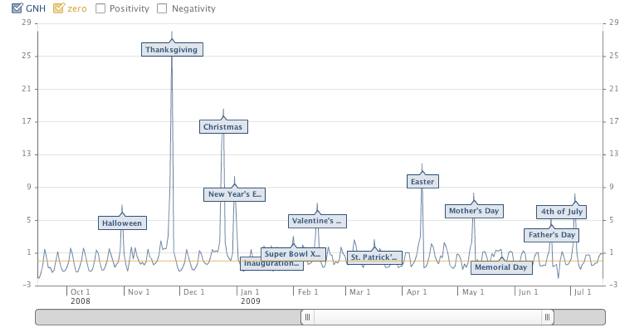
With over 300 million users and 40 million daily status updates, Facebook has an immense amount of data that could potentially be used to gauge any number of things, from the hottest up-and-coming bands to the most discussed political issues. Earlier this week some of the site’s engineers decided to use this dataset to measure something a bit more fundamental: happiness. Dubbed Gross National Happiness, this new prototype application does its best to determine if Facebook users in the United States are happy or sad.
Here’s how the application’s developers describe it:
…Grouped together, the status updates of millions of Facebook users from every demographic in the nation can work together to say something about how we as a nation are doing. Measuring how well-off, happy or satisfied with life the citizens of a nation are is part of the Gross National Happiness movement. This graph represents how “happy” the nation is doing from day to day, by looking at how many positive and negative words people are using when they update their status: When people are using more positive words (or fewer negative words) in their status updates than usual, that day is happier than usual!
Data is collected from “public and semi-public forums” on Facebook, which is all anonymized before its analyzed. To determine if a particular status message is happy or sad (or neither), the app searches for popular phrases and words that the engineers have associated with each sentiment.
You can adjust the graph by sliding the bar at the bottom of the screen. You can also adjust the zoom by dragging the handlebars on the slider, and can actually watch happiness jump hour-to-hour, though it’s a bit difficult to navigate when you’re zoomed in that far. It’s fun to play around with, but you aren’t going to find many surprises: happiness generally hits a low on Mondays, then gradually grows up through the weekend when it drops again as the work-week begins. Peaks are all found around holidays, with Thanksgiving drawing the most happiness. Also worth nothing: this year there was an abrupt drop in happiness in late June, which is likely associated with the tragic death of Michael Jackson.
The app is part of Facebook’s recently released Prototypes section, which gives Facebook engineers a chance to show off the projects they’ve built before they’re ready for prime-time.


One should also consider that most people self-broadcast only the most positive sides of their doings. So this measure will be biased towards “happiness”
“When I’m being sad, I stop being sad and be awesome instead” – Barney, HIMYM
better make sure they’re not just measuring the words with happy in them: “happy new years” maybe.
I’m more interested in the background pulsing of the graph. Why’s that there?
I’m sorry I’ll have to disagree Johan. People love attention and broadcasting that they are having a crappy day.. Gets them more attention from there friends than “wow my life is awesome!” Either my friends are all very depressed or you just assumed that most people like talking about the good things. I don’t see this favoring happy or sad I just see it as another example of the power and knowledge that Facebook holds. Think of Facebook as the people that watched Jim Carey in the Truman show. They know more the we think. Some hate that and some don’t. I think from a marketing side it’s going to be unreal to be able to tape into that information. I also think it will prove useful to people who want to know and understand more about one another.
That’s irrelevent. You can infer sadness, indirectly, from
lack of positive status updates.
And besides, it’s gross national HAPPINESS anyway, so of course you want to measure happiness!
Where on the Internet have you seen a bias toward positive commentary?
Facebook may be less cynical than some other sites as a whole, but I see plenty of “I wish it was Friday…why can team x ever win?…some people just take, take, take and you know who you are… and boy do I have a headache” gripes in my news feed.
….. Looks like someone has a case of the Mondays…. Did you get that memo Peter, Mkay?
hilarious office space reference
If they’re using keywords then the chart is suspect.
Just because you write “Merry Christmas” or “Happy New Year everybody!” doesn’t mean that you’re happy.
Happy republican posts negative comments about gov’t. Hmmm.
Such data can be very useful when applied to specific cases rather than generalizations . We all hate mondays and we dont need facebook to say so. On the other hand it would be valuable to know how teens in a geographic region respond to a specific event or so.
I remember somebody did this for Blogs… it was very cool. don’t remember the name..
It was actually the same somebody. (He’s a friend of mine.)
I wonder if this takes into account the differences in the number of posts total for each day. They would find many more “happy” words on a day with more posts.
Twitter gives a good measure of Happiness because you can search for happy
smileys or unhappy
smileys in tweets.
According to GeoMeme which measures local twitter trends,
is winning against
in New York (see http://www.geome.me/u86hp) however
is sadly winning in LA – see http://www.geome.me/zmvP1
well considering alot of college students & workers keep nagging about school or work.. im not suprised facebook recognized mondays as the worst day…
i dont think it would take any internet company to confirm that lol
Any idea why nothing is reflected for Obama’s election and then inauguration? I find that very strange…
I believe this is because the happiest holidays are the ones where people are home to make Facebook updates. Notice – Thanksgiving happier than Christmas, Easter happier than Halloween.
Why else would this be the case? Too many people were out on inauguration day to make Facebook updates. It will be interesting to see whether this changes if more people start using mobile updates.
I think this is a serious discussion, it’s not a joke.
Government need to pay atention in what things to do happy to the people.
Looks like people could do with a good dose of http://www.thew...tohappiness.org especially on Mondays!
This is a very interesting project and really begins to demonstrate the types of high level data on our country/world and society that is available to advertisers, political candidates, governments, product developers, etc., etc. With Facebook Lexicon available to the public, this deep societal data becomes a valuable resource to anyone willing to pay for it.
Hey I thought happiness was measured in utils.
This is an excellent article. The first and only truly semantic search engine that currently works on Twitter data is TipTop now available in a beta version at http://FeelTipTop.com This engine understands each and every message on Twitter just like a human being would.
As a result, it can discover from within the data the very best tweets organized nicely along a
variety of categories and concepts learned dynamically. In fact, the entire platform learns from data as data flows through the engine. You can now see in real time the sentiment associated
with anything in the world that people are talking about. Please give it a try.
I would like to see Facebook introduce trending topics based on this data. Also the ability to select Everyone, Country specific and social graph. Some of my friends have intriguing status updates and I’m sure the topic of today will either be X Factor or how quickly the weekend has passed!! I checked the Prototype and it’s very basic but it serves it’s purpose!
I’m guessing that “happy” is a positive word, but “merry” is not. There is no way in hell people say “merry Christmas” less often than “happy Thanksgiving”.
# people in the US > # of christians in the US
This is wild. It’s just a the tip of the iceberg too for what FB data could give us.
This is wild. It’s just the tip of the iceberg for what FB data could give us.
Techcrunch you comment form is so whacked. Sometimes it lets me comment and sometimes not.
Facebook to launch a new redesign? Screenshots say yes! http://www.yous....php?newsID=538
If you’re interested in a new approach to boost your happiness – and the GNH – based on the latest positive psychology research, check out our iPhone app: Live Happy; it’s based on the work of Dr. Sonja Lyubomirsky, author of “The How of Happiness” and provides a unique method to create a personalized program to increase your happiness.
You can also learn more about the iPhone app on our Facebook page.
In case of humans such a mechanical and graph making approach cannot work. The Management books have shattered all that was natural in humans. Uncalled for smiles, suppressing your anger or dismay, not expressing yourself in plain language, using diplomatic communications have become the order of the day. I think all the studies of human behaviour fail in the end to explain the frustration esp in the Corpote sector which the humans follow upto their inside homes. So such an attempt leads us nowhere.