We haven’t written about StickK, the company that allows you to put a contract on yourself in order to help you commit to improving your lifestyle, since the service was launched back in February 2008. Good thing the company got in touch with us and pointed out they’re doing quite nicely, which gives us a good excuse for an update on them.
StickK was founded by three Yale economists (two professors and a graduate student) and basically allows you to accomplish a goal by setting up a contract against yourself, whether it’s about losing weight, stop biting your nails, writing a novel or whatever else you feel you need to achieve in life. The site takes credit card information up front and charges it on a weekly basis should you fail to meet your self-submitted goal(s). You can designate someone to be your referee — a friend, co-worker or spouse, for example — but in the end, if they fail to do their jobs, StickK.com will take your word for it. The concept is similar to what HealthyWage recently presented on stage at the TechCrunch50 conference.
StickK has been busy raising more funding for the development of the web service. After the founders put in $150,000 of their own cash to get started, the New York-based company went on to raise two rounds totaling an amount north of $2 million from a pool of investors. That brings the total investment in the company to about $2.2 million to date.
User numbers are trending upwards too, fortunately for the upstart (I’m sure it was one of their own goals). When the company launched in February 2008, it grew to 4,000 users by the end of the month and now counts 42,000 registered members. Users so far have entered into 28,000 contracts, and put almost $3 million on the line for their commitments. StickK claims the system is working, too: users are said to be 80% successful when financial stakes, a Referee, and Anti-Charity are utilized.
StickK is now thinking of ways to monetize the service with a B2B offering. The freshly launched stickK.com Corporate Portal offers companies, schools, gyms, health insurance agencies etc. a chance to set up a co-branded version of stickK where customized goals can be designed to achieve wellness and corporate performance-related initiatives. The idea is that corporations could use the platform to drive down healthcare costs while at the same time increasing worker productivity.
As I said, the concept reminds me a lot of HealthyWage, which was one of the startups I was most impressed with at TechCrunch50. I really think it’s a model that works – I like the idea of financial incentives for achievements that have a positive effect on people’s lifestyle and ultimately, society – and I’m very curious to see how much growth these and other companies in this space have in them.
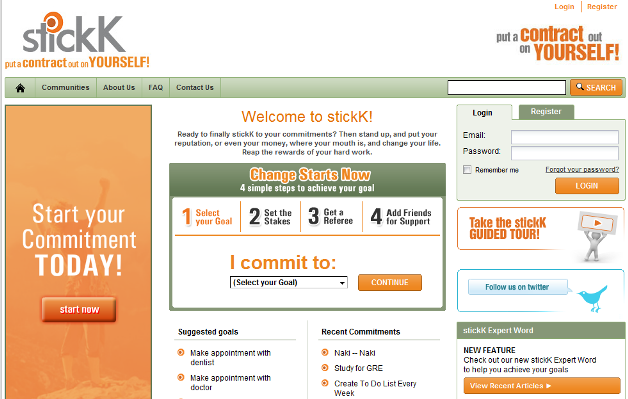


It seems silly to create a website like this and not support data portability… almost an insult to internet users. IF they don’t care enough to make it easy for me to sign up by allowing me to use my twitter or FB info… then why should I care enough to use their services? It should be industry standard to use data portability these days… nobody wants to fill out more forms… I have a contract with myself and my sanity to never try out a website that does not use data port…
Real Time Micro B2B: cnties.com
Hi Gebadia,
You couldn’t be more right. We have been working diligently to incorporate data portability into our system, and we are close to having it ready. We currently allow you to post you stickK activity to facebook and twitter, but we know there is a lot more functionality that needs to be available. I assure you, it’s coming…
When I first saw this post heading and saw the logo I thought this was a subsidiary of Stickam.com. The logo/name is very similar and so too are the colors used.
I thought exactly the same thing!
I run a similar website, Promise Aid.
http://www.promiseaid.com
Rather than financial incentives, we focus on social incentives and the sharing each other’s inspiring stories.
Stickk have done well though with getting funding and a userbase. Interesting to see whether there will be much demand for their B2B offering.
Nice concept but nothing has been mentioned about the money and what wil happen if someone is not able to complete this goal.
hey freaky -
To answer your question, there are lots of options that allow you to personalize your Commitment. If you decide to put money on the line, for example, you can choose where that money will go should you happen to be unsuccessful. The current options are:
1. Anti-Charity: We provide a list of organizations on both sides of 5 controversial issues. You pick the one you despise most.
2. Charity: A bit more philanthropic, but you don’t get to pick the specific organization. We wouldn’t want to give you a silver lining for not reaching your goal.
3. Friend/Foe: You can pick anybody you want to get your money. Simply invite them to join and we send them 100% of your forfeited money via PayPal, or a check in the mail.
Hope this clarifies. I’d be happy to answer any other questions….
Great concept. I quit smoking 3 1/2 years ago by making a bet with a friend. Whoever smokes first has to pay the other person $100. It’s less about the money and more about pride. The few times I’ve almost fallen off the wagon I say to myself, “that cigarette will cost you $100 and he’ll bring it up every time you see him for the rest of your life.”
Any idea of the valuation?
From the Stickk FAQ page:
“Years of rigorous academic research conducted by the founders of stickK have proven that using Commitment Contracts can more than triple your chances of success!”
Where might one find this published research?
One of the more notable studies:
http://karlan.y...CARES_dec08.pdf
Thanks.
Out of the 75%+ who report success with Stickk, I wonder how many actually failed but claimed success, so that they wouldn’t lose their money.
The reality could be something closer to 30%.
Or the goals are so damn easy to achieve that it’s unlikely that they’ll fail. Does putting money on the line make it more likely they’ll set an easier goal?
Great questions. You are right to assume that some users are likely to fudge the truth, maybe more so if large amounts of money are at stake. However, we have found (based on detailed internal data) that this number is much smaller than you would imagine, for a multitude of reasons. To name a few:
1. stickK’s system of accountability. By adding elements like the Referee and Supporters, users are accountable to third parties that often have intimate or tangible knowledge of that person’s behavior. For example, if you committed to lose 10 lbs, and added your roommate as a Ref, it’s a lot harder to lie knowing he is going to watch you step on the scale. Even harder if he is also your Recipient, and gets your money if you fail!
2. Reporting. Just having to click a button that says “Successful” provides a substantial element of responsibility and integrity. You’d be surprised, but it’s a lot harder to officially document a lie than it is to lie to yourself (although that isn’t always easy either).
3. Why bother. Many people who come to the site are very serious about reaching their goal, and putting money on the line further advances their incentive to succeed. That type of commitment and motivation is inherently powerful. After all, if they really wanted to lie, there are much easier (and less public) ways to do it.
4. Measurable results. Dean and Ian’s research involved taking urine samples to validate smoking cessation. That proof was biological. For the average stickK user of course, reporting is (usually) less scrutinized. However, that doesn’t deny the conclusive evidence that fundamental theory works.
5. People aren’t always successful. In 2008, user’s forfeited over $70,000. Although this is a very small percentage of the overall amount put at stake, it is indicative of the fact that people are willing to be honest.
However even still, we know that people make decisions in the short term that they regret later.
We can’t control how far someone will go to fudge the truth, but we can put as many obstacles in the way to anticipate that urge to retract, and make it as hard (or awkward) as possible to do so. We think our strategy is working.
And just to be clear, the 80%+ success rates are applicable to Contracts that have money on the line, involve a Referee, and use an Anti-Charity as the Recipient of Stakes. Using fewer elements (no money, no ref, etc) reduces the likelihood of success by predictable margins. This correlation alone indicates that our success rates are attributable to increased layers accountability and incentives, more so than the fibbing factor.
And to leave no question unanswered, you are spot on in guessing that some goals are much easier to achieve than others. That being said, there is no direct correlation between “easy” goals and putting money on the line.
To boot, we have had users write in to tell us that they have lost over 50, 60, 70+ lbs, others that they have quit using hard core drugs after many years, and dozens more that have achieved similarly difficult goals.
Hope this helps!
IPO IPO IPO …
Seriously … this is gay. $2.2 million for this craptastic website???
Was this written about in the book Nudge? Sounds like something from the first chapter… I don’t have the book next to me at the moment.
Hey Andre,
You’re right. stickK is mentioned in Richard Thaler’s book Nudge, in one of the later chapters.