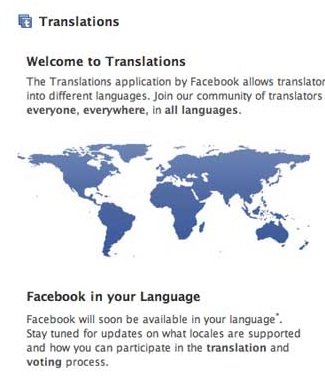
Facebook has long relied on its own users to help translate the site into more than 65 different languages. Now, Facebook wants to unleash its army of volunteer translators on other sites and apps across the Web. Any site or app that use Facebook Connect can now tap into the Facebook community to get help translating their site into any language that Facebook Translations supports.
As Facebook strives to cement itself as the social glue of the Web, offering free translation tools gives developers yet one more reason to choose Facebook Connect over Google Friend Connect or other competing platforms. It gives them access to new markets extremely quickly. Facebook thinks its crowdsourced translation tools are so good that it’s patented them.
The Internet is a global platform, which makes translation a must for sites both large and small. But the effort it takes to translate a site into many languages is expensive and time-consuming. Getting users to do the heavy lifting is appealing. Even if the translations aren’t top-notch off the bat, they will improve over time if enough people who speak a particular language care enough about a site to fix it.


Facebook people are sucking more now than ever with my facebook account changed to lite version and I am not able to revert back to the original…..I have never seen such s***t before.
What is Facebook Lite? I have never seen or heard of this.
http://www.tech...of-the-service/
This is exactly why Facebook is leading in almost every continent. Great feature for developers. The way Facebook is becoming that “glue” is quite amazing. Apart from having a website, it is propagating everywhere, becoming a sort of dashboard. Imagine CNN.com, Digg using this translation. It is free work. Much easier than having interns work for you for free. Facebook just made it easier for companies.
It is not just Facebook volunteers but aso Twitter volunteers who have helped people bring useful web services to different countries.
For example, Yauba has plenty of foreign versions like http://de.yauba.com and http://fr.yauba.com that were created entirely by twitter volunteers.
Agreed with your comments Abi, my concern however as a developer and a web site owner currently using Facebook Connect is that the translations will be served by Facebook and in the end be their property. This is what concerns me with this process.
Does anyone have any thoughts on this potential issue?
well, you can use their platform to make the translations, but then export them to your own translation memory, where you’d have total control over them.
that, of course, provided that FB allows you to export the translation to your own system, and connect your translation memory to their tecnology, which is the only way I would even consider using their solution.
Actually, the translations are not owned by Facebook, nor by the user who submitted them, but by the developer. This lets you download translations and store them indefinitely, unlike user-specific data which is only retainable for 24 hours.
The translations are, I believe, exportable, as they are not considered user data.
I love facebook
No.
It wasn’t a question.
This is huge. I always was hoping for a good startup or Google to provide this type of service. Facebook is definitely becoming an integral part of the web ecosystem. It is an amazing web/social hub for developers and users. Congrats to the team and the vision to go beyond their walled boundaries.
Brilliant on so many fronts, and even though this relies on Platform, this is much bigger than Platform.
For Facebook: Increased evangelism, user/publisher dependence, FB Connect distribution (which should eventually be an indirect revenue stream).
For everyone else: Easy internationalization!
Facebook has been such a pain in the ass for the past few weeks.
People say, well dont complain about a free service…well it isn’t free when you run a page with 200k+ fans and you pay facebook ads to direct traffic to FACEBOOK.
Wish there was some sort of bandwidth priority to pages like this that count on facebook to be up to do their job
/rant
This new feature is a must for Facebook since they are becoming the #1 social site in the world!
Good idea!
Translation Crowdsourcing is great when you have a small well organized content and a big audience.
So it only applies to a small subset of the web.
A large, API enabled, translation memory like MyMemory ( http://mymemory.translated.net ) would be a major help to the crowd.
Facebook Connect + MyMemory = higher quality + quicker translations = more websites translated.
Marco
Translated
Sweet.
The human-powered approach is a must when it comes to translations. I hope that following Facebook’ step, more and more website owners will discover the benefits of multi-lingual websites. But you should learn a lesson from Facebook too: if too many people translate your website you face a serious problem of consistency in the translations. You can see it easily in any local version of Facebook. I recommend – whenever it is possible – to use few translators, and also to make a thorough checkup of the translations by an integrator. I know that the idea in crowd-sourcing is to do all those things free of charge, but believe me – a good local version worth the money. Personally, I use a service called OneHourTranslation.com to translate my website content to other languages. Their pricing is affordable and you get a high-quality, consistent translations – good value for your money. I don’t think the approach Facebook shows juxtaposes Google’s approach. They are simply intended for different purposes. Google’s machine translation approach is good mainly for general understanding of texts meaning. It mustn’t be used for website content translation, and may harm the website image and reputation.
If they similarly crowdsourced their marketing, accounting and even web development service needs, they could reduce their cost base across the board! They could offer crowdsourced services to anyone who needs them anywhere at any time and no-one would have to pay anything…
Sounds like they found a way to get an army of free workers. It’s cheap & tawdry but effective.
I even saw FB translating in my mother tongue, Tamil,
:)
This is great PR, but the reality is that most websites do not have a large enough audience to get consistent coverage across languages and will need to pay professional translators to insure that it gets done. Crowdsourcing works, if you have a crowd, and the crowd is motivated to do free work for you. This is a fairly special case that does not apply for small and medium sized sites.
I work on an open source translation project that enables human/machine translation and have seen how this works and doesn’t work across a variety of sites.
If you are interested in localizing your web app, my advice is to look at open source tools, as well as on demand professional translation services such as Speak Like. With tools like WWL, Speak Like, etc, you can build a highly automated solution for translation, and still have professionals in the loop to make sure work gets done and gets done right.
Even facebook uses a translation vendor to review their crowd sourced translations at least for their most important languages and legal documents translations.
I would like to translate Facebook to “LUHYA” a language in western kenya so that i can get to my granny.
I’m desperate, now ! We are thousand of potential translators, and we want a Facebook in Occitan.
Facebook is now in Latin (a dead language), and still not in Occitan. We ask Facebook to open the translation mode in Occitan for a long time, but without any answer…
I find this is a shame, and I know now that I will never see Facebook in Occitan !
TANK YOU FACEBOOK !!!