Squidoo founder and author Seth Godin has backed down on creating company pages by default as part of their new ‘Brands In Public’ service that launched a few days ago. The idea behind the new service is that brands are able to track feedback from customers on a public ‘lens’ (aka. a web page).
Feedback is aggregated from multiple sources, but mostly twitter and mostly by matching against the brand name. The concept itself is not an evil one, but Squidoo setup feedback pages for over 200 brands at launch without the express permission from the vast majority of them. The hitch was that if a brand wanted to control the lens and the feedback, they would have to pay Squidoo $400 a month – and it was that part of the deal that made a large number of people rightfully angry.
Godin says in a blog post today that they will remove the brands they created by default, and instead make the program opt-in. This is a big step back from yesterday where he left a comment on an excellent blog post by Lisa Barone, who criticized the product as being ‘brandjacking’, by saying:
I’m not sure it’s brandjacking any more than a Google search or a Twitter search is brandjacking. I guess the difference is that we’re making it really easy for the brand to show up next to the stream of comments.
Godin has built a reputation, on the back of his books, as being a marketing and community guru. He must have read some of his own work overnight because today on his blog he says the policy has changed to:
When a brand wants a page, we’ll build it, they’ll run it and we’ll both have achieved our goals.
Godin opens his post today with:
The response from the brands we’ve shared it with has been terrific, but other people didn’t like elements of it. And they were direct in letting me know.
Well we know he didn’t hear that ‘direct feedback’ using Squidoo’s own ‘Brands in Public’ page, which during the storm yesterday conspicuously didn’t mention a single point of negative feedback about the campaign.
Godin also does not have comments enabled on his blog, but the launch of the new Squidoo service just happen to time with the launch of Google Sidewiki – which allows users to leave notes on a website. Many flocked to Sidewiki out of frustration, including SearchEngineLand editor Danny Sullivan, and left constructive and well thought out arguments against ‘Brands In Public’. It is ironic that the ‘customer feedback’ for a product that is meant to aggregate just that all came from other sources such as sidewiki, blog posts, twitter and comments on blogs.
We were going to reach out to Godin yesterday, but instead figured we could write this story by aggregating what everybody in the world thinks of Squidoo, and then asking him to pay us $400 to remove the parts he may not agree with.


It seemed very odd that Godin would set up what appeared to be an extortion scheme given his emphasis on permission marketing. Now it’s equally odd that he didn’t see that people would consider it to BE an extortion scheme. We should all be allowed our mistakes, and he has acknowledged this one. His blog is still a great daily read.
I don’t think Seth Godin knows what to do with Squidoo. I also don’t think he expected it to be used by scammy marketers the way it was. They seemed to have cracked down on those guys lately, but man, there is a ton of garbage on Squidoo.
Personally, I think its a good move on Seth’s part. He launches a commercial service, gets some negative feedback on it and acts on it asap. Definitely, he gained some credibility in my eyes, hopefully, some other people running similar services will learn from him.
On the post he said:
“I apologize if anyone was confused by my original post, and we’re looking forward to having major brands and non-profits using this tool the way we intended–to join in to the conversation that’s already happening all around us.”
That’s a fairly weak apology. Better: “I apologize– my post was confusing and I clearly didn’t consider how people would react to this. We screwed up and we’re fixing it.”
Here’s a preview of Godin’s new business card: http://bit.ly/1KbsJA
Does anyone actually use Squidoo?
google does
rotflol
I thought Brands in Public was a great idea, he shouldn’t back down from the media.
It looks like the marketing blogger community has a very LOUD mouth. It’s interesting that Seth Godin decided to change his entire business plan based on this collective voice against it.
Social Media has more than proved her democratic roots. I’m glad Godin reconsidered. Business ideas need to stay ethical and practical.
I do think it was kind of a good idea…and I wouldn’t have backed down at all. Let it get launched and see how many companies really do sign up.
Hmm, it wasn’t treated as a terrible idea when Yahoo was planning to roll out a Brand Universe of 100 or so brands that was essentially an aggregate of all of the content within the Yahoo universe.
I, for one, thought that the Yahoo idea was a great one (one of the many seed they planted that they forgot to water, but that’s another story), and you can be sure that the brand engagement side of the puzzle would have cost brands a lot more that $400/month so I think that this is one of those cases where the marketing guru (Godin) turned free lemonade into lemons buy touting fee at the time of free, which unfortunately is fodder for the blogosphere.
I am sure that good marketer that he is, Godin, will turn this into a chapter in a book or convert it into a conversation starter with brands.
Mark
There is a fantastically large distance between aggregating content for public consumption and aggregating content that can be selectively stricken from that record by interested parties for a fee.
But yeah, Godin will survive it. It’s no worse a black eye to his reputation than Squidoo in general.
I may not be the biggest Godin fan in the world. But how is aggregating information and making it available a shakedown? It is the control of the feedback and flow of info that makes it a “funny” deal.
Truly a good idea turned FAIL!
Very clever post.
It is highly ironic that his blog does not allow for commenting while he wants to create an aggregator for what people are saying about other brands.
Where is the Seth Godin brand page???
You’re on it.
Seth Godin is brilliant but I think the whole BIP thing went a whole way against the very idea he has advocated for a long time: permission marketing.
Boy, you Techcrunch guys must not be subscribed to any of the non-profit blogs, where Seth’s arrogance has been getting a roasting for weeks now after a blanket statement that non-profits were all social-media ignorant for not pairing up with Squidoo. I’m not sure just why this guy gets talked about in the first place–I tried reading “Tribes” (I’m a bit of a internet tribe builder) but found it pretty thin and sped-skimmed it in about half an hour. Clever guy, but he might do well thinking through his ideas and test his hunches against real data before opening his mouth.
The last sentence is classic…
Mr. GODIN I have all you’re books and for squidoo you really messed it up.
Uh, what was the name of that one site that set up “community tech support” pages for companies, which appeared to be semi-authentic? i forget, but they deserve a mention as brandjacking trailblazers.
That was GetSatisfaction
Was? GetSatisfaction is still around. Have they changed the way they do things?
The ’shakedown’ part of this shenanigan seems pretty misguided. I’ve got nothing to add to that part of this discourse. But what amazes me is that anybody should think that a brand needs to grant its permission to have feedback aggregated on the web for public consumption. To me, having a brand is like running for public office. As soon as you’re out there selling, you’re at the mercy of the people you’re selling to. The idea of ‘control’ is absurd at least, evil at worst. I hope that someone ends up doing what Godin set out to do, but with integrity. Brands are supposed to be about accountability.
I will just do that, not that expensive and very simple. A fully WIN-WIN situation. It’s a good Idea, but just with a very very bad implementation. At least he’s back off from the “Brandjacking”
I’d be very interested in following your progress, if you’re serious. I blogged about this a week or two back, before this story erupted. My next book has a lot to do with this accountability theme.
Purple OW.
I just thought I’d point out that I do happen to use Squidoo, I’ve created over 100 pages there most of them being abuse and advocacy related.
Those of us who do use Squidoo usually cite the community as the #1 reason we enjoy it there. There are so many great people there, compassionate, supportive, helpful…
Brands in Public aside, most people don’t seem to realize that Squidoo was founded as a place to raise money for charities that are important to us, Squidoo generates thousands of dollars a year for these charities.
I am proud to be part of a community based on helping others and that’s why of all of the places I write Squidoo is my favorite.
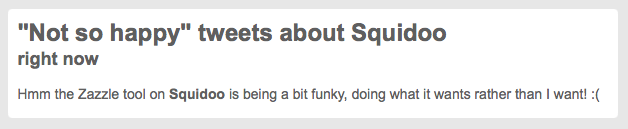
Oh and the reason no “Not so happy” tweets about Squidoo aren’t showing? See the sad face at the end? That is how it locates “not so happy” people…
So if you want it to show up in their list, add the sad face… they aren’t censoring it, that’s just how the system works.
Anyhow, so this idea didn’t work out… but Squidoo itself is a great place, and I am proud to be a part of it.
Most commenters have put the huge backlash against this down to Godin’s reputation but I think there’s something deeper behind our reaction. Internets may be starting to realise that when Twitter or Brands in Public or a popular blog takes down a company it may seem cool, like David beating Goliath, but what does the consumer actually end up with. The companies that employ tens of thousands of people, which actually manufacturer products, which are going to export goods and services and get us out of debt, provide us with services like flying us from A to B, keeping us healthy, making the car we drive and so on, those companies are damaged. And in their place our economy is made up of companies like Twitter, worth whatever and saying we’re probably never going to employ more than a few hundred people, or Godin, how many people does he employ, what does he manufacturer?
this is such a non issue, because no one will use squidoo anyways.. the only brilliant thing about it is, all the media coverage he got, for something no one will remember a year from now
I am a user of Squidoo and great fan of the supportive community base out there. People who haven’t been there haven’t really seen the power of these lenses (or pages) and their ability to cut through the clutter to land up on the front pages of google. I have almost all my lenses on page 1 of google for my keywords – plus I have got more than an education on Internet marketing through it’s community.
Having said that though – I didn’t totally subscribe to the BIP initiative and perhaps thought it a bit unjustified – blackmail or whatever. For Brands who choose to partner in this initiative, perhaps it will only be time which will tell us the true power of this medium or the lack thereof.
Being Criticised is good. It mean the world is sitting up and taking notice. Squidoo is here to stay and for those who aren’t harnessing its features – so be it. For those who are – good for them.
cheers!
This is why it’s wise not to get too community focused. tons of startups make this mistake. audience is great, community is great, but at the end of the day if you give the villagers all the power, you’re going to find a revolt eventually.
Focussed on the wrong customers too, the ones tweeting complaints, sometimes unfounded, before they even contact the company concerned and give it a chance to provide customer service. The whole basis of social media as revenge on corporations assumes big companies are bad and consumers are honest, upstanding, always right neither of which are true. Social media needs to be left to go its own way, companies should not seek to control it in any way but focus 100% on serving good customers that genuinely want straight dealings. Let social media take care of itself.
I have no respect for Seth Godin, well, he reacted relatively fast and jep he probably reacted the right way but excuse me?! Why this move from somebody who always pretends the fair and open-minded prophet?!?!?!??!?! -
Seth Godin – you are definitely not the godfather of WOM, Social Media, or the new marketing and you proved like all other traditional marketers – once they become big they become money making machines!
Seth – you are the liar you talked about in your precious books which are useless to me right now and definitely find their to the trash can!
In the end it only matters how this goes down with the brands. If they like it, its good, else its a fail.
But then that would be Seth’s problem. He could loose some of his standing in his area of expertise if this fails. Does it matter?
If you looked at the ideas rather than at the man, analyzed and picked what was good and left what you did not agree with, then, his success or failure don’t matter at all.
If you have idolized him so far, it will be a big disappointment for you.
If you don’t like him, it might make you feel good to watch him fail.
What I don’t get is why Brands in Public was so different than a well organized link to a search on Google or any number of other sites. It demonstrated that “the conversations are out there whether you are part of them or not”, and rather than being extortion, my reaction to the $400 for brands to take ownership of the column on the left was that it’s a simple ask that they can choose to do or not do. The site cost some money to build and more to operate, so what the heck is the problem. Corporate brands buy advertising alongside searches with their brand name in them all the time on Google…
What about “claim your listing” programs in places like Yelp, SuperPages, Merchant Circle, etc.? Is that extortion also.
If I were Seth, I would have left the site up and told people to “deal with it”. Since I doubt he’s weak willed, it must have been other economic interests with a number of the big brands that drove the shift in strategy.
As for any inconsistencies (if there are any) in terms of not enabling comments or showing negative flow around his own brands…those do need to be corrected as I’m sure they played a part in shaping the virulence of the backlash.
I couldn’t agree more. The brands themselves have missed out on a great opportunity to jump into the conversation about them without having to go through the hoops of creating a page, appointing a manager, etc, etc, etc…
I’m working on a similar project http://www.brandiki.com.
Let’s see if this uproar will define some guidelines for Brands in the aggregated (social) media landscape.
Really interesting. Hope you don’t mind if I tweet this. As I said to Charly, I’ll follow this with great interest. If it picks up some steam, I might request an interview, if you’re up for that. Good luck!
Just goes to show that even a marketing genius like Seth can learn from community feedback. He’s human and like most of us, sometimes doesn’t get it right the first time. I wish him the best of luck.
it seems very similar to bzzagents’ bzzscapes service
http://www.bzza...t.com/bzzscapes
Maybe the Brands were worried it would turn into a free for all mob fest of slagging off – which is great when companies are in the wrong, but potentially damaging when you have competitors that can write bullshit quicker than you can reply to it – a negative campaign of information being spread virally across multiple social networks and google – a marketing nightmare. Brands already have a place for consumer to rant their rants on http://www.ripoffreport.com/ – the benefit of this place is you take it with a pinch of salt – people are angry at every company on here – so it’s not such a threat as one hosted by a top web guru who ‘professional’ people (with deeper pockets) might place more trust in. If the site hadn’t been run by Seth the brands might not have felt so threatened by the potential impact.
Start ignoring Seth Godin: he’s not important.
He’s from another era as you cannot comment on his blog.
His business ideas are failing (previous business too) thus his writings are based on nothing but hot air.