
Measy Helps You Pick Gadgets With A Quiz (Private Beta Invites)
by Erick Schonfeld on September 25, 2009

Picking out the right gadget to buy is so difficult that an entire publishing industry (Cnet, Engagdet, CrunchGear, GDGT) has grown around helping people sort through the process.  A new site in private beta called Measy is taking a different approach.  You take a quiz answering questions about what you are looking for in a digital camera, flat-screen TV, or netbook, and it comes up with the gadgets that match your requirements.

We have invites for the first 200 people who redeem them here with the promotion code “techcrunchfriends.”

Measy’s CEO Ian Manheimer is the creator of Glassbooth, a site which helped voters pick candidates based on taking a quiz about their political views and then matching those up with candidates’ positions. Measy takes a similar approach to helping people make decisions about what gadgets they should buy.

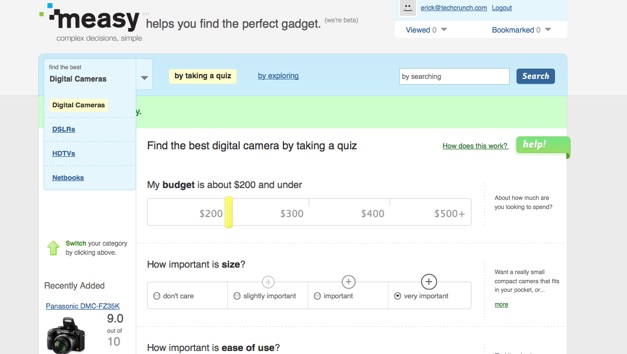
Visitors set their budget and answer questions, pick brand preferences, and answer questions about what features, specs, and size they are looking for. For instance, the digital camera quiz asks how important is brand, picture quality, recording videos. The HDTV quiz asks about viewing angles and sound quality.

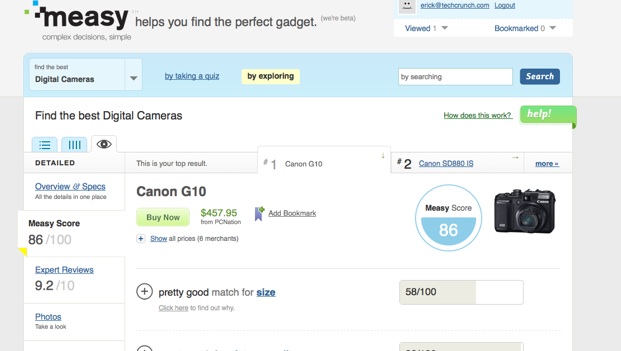
After you answer all the questions, it presents you with the single best match, and you can also browse other close matches. (Contrast this to the crowdsourced wiki approach at GDGT). While all of this sounds great in theory, the truth is that there are always a couple of factors that are more important than others to any given consumer. Measy seems to weight all the factors roughly the same. It is not going to eliminate the research you need to do before you buy your next gadget, but at least it gives you a starting point and helps cut down the overwhelming number of initial choices.

When it comes to finding the best digital camera or TV, there never is one right answer, as much as we all wish that there was.
Advertisement

Comments rss icon

  • Tried Measy after using your code, I am really impressed with the options that I was asked. Actually they took care of all my feature set for DSLR. But sadly it throws an error whenever I try to get results.

    If the results match the camera i had in my mind, i will be very happy with the service :)

  • tried to find a digital camera. did go through the questions and ended up with decent results but that was tiring.

  • Always wanted to buy a DSLR sometime, so I gave Measy a shot. Worked out pretty well, lots of choice criteria to choose from based on your pet peeves. Now I have a nice ranked list of DSLRs to that I can keep in my when shopping.

    The only issue I had with it is that it doesn’t play well with my Opera browser. Well, that an the silly name :-P

    Hopefully, they’ll include things like cellphones/cellphone plans, something I’ve always been terrible at picking.

  • such a simple and good idea…amazed no one did this earlier.

  • Went through the entire process and was impressed by the scope of questions. Ended up purchasing a HDTV through one of their vendors and got FREE SHIPPING!

    Everyone should check this out.

  • Measy sounds great, but I’m holding out for the app that requires a 100-question exam, followed by a 1000-word essay before suggesting which camera to buy.

  • I was actually looking for a digital camera when this posted. Great execution. Thanks!

  • Brilliant, Sunstein and Thaler spoke specifically about the process of purchasing a cellular phone and service in their book Nudge and this idea is one of the first few step in truly adopting smart choice architecture in a way that helps consumers make smarter decisions when confronted with complex purchasing decisions.

  • This idea is not new at all. In fact, it was introduced back in the late ’90s by Online Insight and Active Decisions. Maybe it’s time has come but we (OI) learned that customers’ patience with long, survey-like product finders is extremely limited.

  • Lots of price comparison sites have done this in the past. It’s very trivial – a few hours coding. Instead of the filters, take the visitor through a survey/quiz.

    One big problem – for most people, it sucks. They’re using questions, when a filter/sort (with tooltips) is quicker.

    Example from the screenshot:

    “My budget is $200 and under”

    Use a select box.

    “How important is size?”

    Use a select box.

    Erick

    “but at least it gives you a starting point and helps cut down the overwhelming number of initial choices.”

    And so does every other price comparison site. They’re called filters.

    • Andy – It sounds like you haven’t used Measy yet; you should give it a shot before grouping us in with the other services out there. You’re right that there are a number of sites that allow you to filter through products. CNET, About.com, gdgt, the NYTimes, etc. all have some version of a product finder. But ultimately all of these quizzes do what you say: they add some basic Q&A on top of filters, and the filters rely on specs.

      Measy’s approach is quite different, and more reflective of how most of us actually make decisions. Instead of asking users questions about specs (like memory or processor speed) and then filtering, our service is built around use cases and questions everyone can relate to: Will you be watching this TV in a room with lots of sunlight? Will you use this netbook for video chatting? Will you be taking lots of action shots with this camera?

      We rarely use filters or specs in the quizzes. Instead, we score each product across the most important aspects of their performance based on hand-picked quotes from credible expert reviews. We also let users who care about customer service or social responsibility factor a company’s reputation in these areas into their decision. In the end, you’re matched with products that perform the best in the areas you indicated as most important. Everything is backed up by a ton of research that you can dig into when you get your results.

      You’ll have to try it for yourself and see what you think. Send us an email (contact@measy.com) if you’d like a login.

  • wow. simple. easy. ridiculously meticulous. i guess the canon g10 is the camera for me.

  • A variant of this approach to decision-making was first described by Daniel Bernoulli in 1738 (http://en.wikip...ulli#Statistics), and has been tried many times since, without much traction. The problem with this approach is right in the body of Erick’s post, in that it’s impossible for a tool based on this idea to weigh the importance of each feature the same way that a person would. As Erick also pointed out, it also does a bad job of adapting product recommendations to a specific user’s situation.

    My company has developed a fundamentally different, patent-pending approach to the product selection problem. Happy to discuss with Erick, or anyone else who reads this.

    ndesbarats gmail com

  • The problem with this is that it is going in the opposite direction of most of what we are learning about the way the brain makes decisions.

    You might think this is a good thing, but it will make you less happy with the results.

    More here: http://bit.ly/TZ3I3

    • Just realized that last sentence wasn’t very clear. Here’s what I meant to write:

      You might think it’s a good thing to eliminate emotionality from decision making, but the research shows that making only rational decisions will make you unhappy with those decisions in the long-run.

  • Didn’t even load for me. There goes their one chance to convert me

Leave Comment

Commenting Options

Enter your personal information to the left, or sign in with your Facebook account by clicking the button below.

Alternatively, you can create an avatar that will appear whenever you leave a comment on a Gravatar-enabled blog.

Trackback URL
Short URL
bugbugbugbug
Techcrunch on Facebook