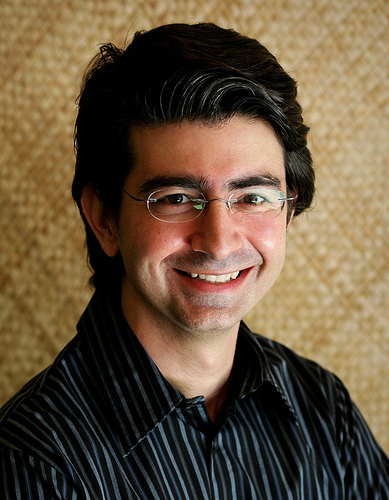
So at Least Pierre Omidyar Is Trying to Change the World
by Sarah Lacy on September 24, 2009

Pierre-OmidyarGiven my recent rants about Silicon Valley’s ratio of stinginess-to-wealth and the current trend against “changing the world,” it’s not a huge surprise that more blog posts and tweets were coming from Demo or the B-list-celebrity-studded 140-The Twitter Conference than at the Clinton Global Initiative summit that was also held this week in New York.

Techies who did follow the conference likely did so through the tweets and TwitPics of eBay founder Pierre Omidyar. After founding one of the biggest successes in Silicon Valley history Omidyar bucked the serial entrepreneur trend and turned to angel investing and do-gooding. At the conference he announced another big move: His philanthropic investment firm, The Omidyar Network, is committing  $30 million towards backing high-impact entrepreneurs in emerging markets, specifically Sub-Saharan Africa and India.

It’s an interesting fill-the-gap strategy between mainstream venture capitalists looking to benefit from the emerging world’s booming demographics but frequently stymied by cultural and logistical challenges and micro-loans, which the Omidyar Network has already done a good deal of in these regions.

VCs look for companies that could be worth hundred of millions or even billions of dollars and a lot of the infrastructure for that kind of growth like management teams, attorneys and the like are still lacking in many emerging economies. The result is the bulk of  US investments for emerging markets goes to China, and a smaller but still substantial amount to India and not a lot in the rest of the world. On the other end of the scale, micro-loans are frequently aimed at lifting individuals out of poverty by funding a trade, not an entrepreneur building a business that could serve hundreds of thousands or millions of the world’s poor.

Omidyar’s $30 million investment is a step in between. These will be investments, loans and sometimes grants for entrepreneurs looking to build high-growth, high-impact ventures that can have an out-sized affect on the poverty stricken region where some 10 million people live on $2 or $3 a day.

I grabbed Omidyar and managing partner Matt Bannick  for a quick call in between their elevator rides with the former President of Nigeria and hitting up Ted Turner for business advice. I asked them the question that would-be-backers of my own book on global entrepreneurship asked me when I was selling it: Why should we care about entrepreneurship in Africa and India, when we can’t even fix poverty-stricken areas of the United States like Detroit?

“We think while everyone may have been born equal they don’t have access to equal opportunities and the greatest disparity is in the developing world,” Omidyar said. “That’s also the most vastly growing population and the place where we can have the greatest impact.”

And certainly $30 million goes a lot farther in the poorest areas of Africa and India than it does in the U.S. But the core point Omidyar added last: “This will have a huge impact on humanity overall. If you’re an American, you’re going to benefit from this.”

Let’s ignore altruism for a minute. There’s the self-interested humanitarian case that the more stable emerging economies with exploding populations become, the greater the likelihood they’ll form stable governments, or even adopt free-market economies. But there’s also the self-interested business case: The reality is the world’s economic growth is no longer happening in the U.S.. It’s happening in India, China, Africa, Russia, Indonesia, Brazil and a host of other smaller countries. There is innovation and entrepreneurship already there. Billion dollar companies will be formed. The question is, does America and the Valley want to play a role in that?

Advertisement

Comments rss icon

  • Social entrepreneurs have very audacious goals and are trying to change the world! It’s great to see the coverage here on TechCrunch.

  • Great post. Good to see this kind of thing covered by TC.

  • This laudable effort seems to have the carrying capacity to address gaps in more ways than one. Providing investments in tools as mechanisms to do the most good for developing third-world economies and the nationals themselves requires just this kind of rethinking of the traditional agricultural and industrial development models. Indeed broadening access to both the high-tech (information, intellectual property and knowledge) and embracing the high-touch of cultural, learning and spiritual influences will help serve to catalyze markets ensuring that there are not just developed products and services but developed, available and eager customers too.

  • I agree with the previous author.

  • No unsolicited proposals? When are organizations like this going to realize that their network misses opportunites?

  • Sarah,

    I enjoyed your T50 video-interviews and I have followed your recent thread concerning aiming high. Maybe the following doesn’t fit the bill because it isn’t IT but I wonder, given your international research, if you can help answer the question: “Why hasn’t investment in Dean Kamen’s water-purification system (see 2nd page of TheStreet’s http://bit.ly/RJBit) been funded?”. I have Googled around, and I haven’t seen any reason this good cause isn’t more widely implemented (e.g. “Kamen’s invention is too expensive.” or “There isn’t really a huge water problem.”).

    Keep up the great writing!

    Simon Smith

  • “Why should we care about entrepreneurship in Africa and India, when we can’t even fix poverty-stricken areas of the United States like Detroit?”

    I think the definition of poverty is relative. Most truly impoverished people in these countries don’t have food kitchens, shelters, mobile phones, free clinics and televisions (more than 95% of US households have at least one television).

  • “poverty stricken region where some 10 million people live on $2 or $3 a day.”

    In India, more than 25% people survive on lesser than 1$ a day, that’s more than 300 million people!

  • “We think while everyone may have been born equal they don’t have access to equal opportunities and the greatest disparity is in the developing world,” Omidyar said. “That’s also the most vastly growing population and the place where we can have the greatest impact.”

    You do not help anyone until you help your fellow countrymen first. None of these other places we are so quick to help never do ANYTHING to help the starving people here. Why are you wealthy people waking up in the morning feeling earthy and then want to save the world, but you pay your maids and servants $4.00 an hour.

    Cut the crap guys, if Silicon Valley are so wanting to help, then why don’t you guys join Buffet and team up with http://www.glide.org/

    I am sorry if that isn’t as newsworthy.

    • You’re correct William. That isn’t newsworthy. Ever been to Glide? A majority of these people are victims of their own substance abuse. And they get money, food, shelter and health services already. Comparing the “poor” in America to people living in squalor, and dying of starvation and of bacterial infection from drinking unclean water is absurd.

  • re: “You do not help anyone until you help your fellow countrymen first.” This presumes that you see humanity as a defined by political boundaries. Why stop at country? How about state, county, or zip code? I call this “OIMBY” giving: “Only in My BackYard.”

    I think that Pierre Omidyar’s global vision is (nearly) spot-on, and its wonderful to see him (and his wife Pam) devote so much of their time and money to better world activities. Hopefully, he’s inspiring others to do the same.

  • This is a silly argument. Give to the local poor or give to the remote poor whichever you feel more comfortable, just give.
    And while you’re at it, encourage other people to give rather than going after the people who give differently.

    Give, give, give.

Leave Comment

Commenting Options

Enter your personal information to the left, or sign in with your Facebook account by clicking the button below.

Alternatively, you can create an avatar that will appear whenever you leave a comment on a Gravatar-enabled blog.

Trackback URL
Short URL
bugbugbugbug
Techcrunch on Facebook