By 2001 web startup Third Voice, which let people annotate websites via a browser plugin, was done. Website owners just didn’t like the idea of people “defacing” their websites with comments they couldn’t control.
But the idea has lingered (really), and now Google is taking a shot at their own version of the service. It’s called Sidewiki, and it just launched.
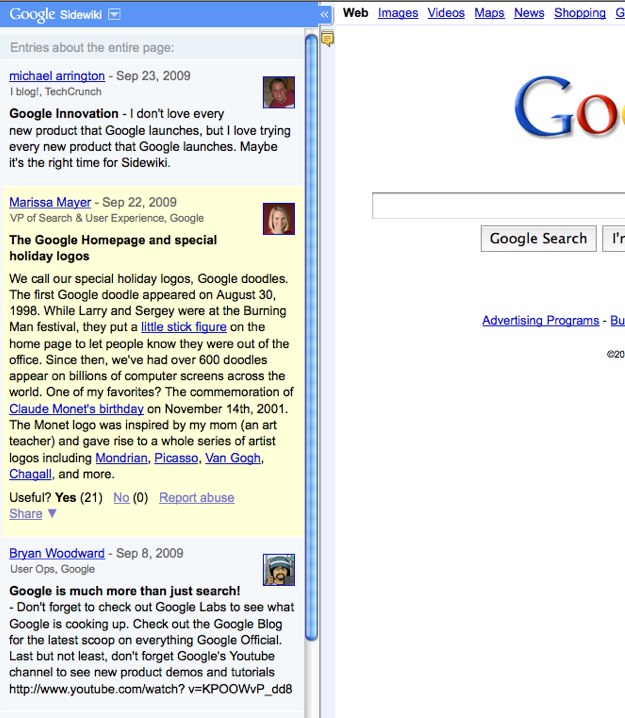
Sidewiki is part of Google Toolbar (and it will be built directly into Google’s Chrome browser). Users activate the service by clicking on a button and a sidebar appears to the left of whatever website is being viewed. The user can then leave a comment on the entire page or a selected piece of text, and share the URL via email, Twitter or Facebook (stalwart Google partner MySpace is left off for now, but Google says they’ll add more partners later). Users can also embed videos into the Sidewiki.
Other users can read and vote comments up or down. All those votes will create a user ranking for each individual that will determine where their comments fall on the Sidewiki. The higher the ranking, the higher comments appear. The goal, Google says, is to help move better content up and move spammy stuff to the bottom where it won’t be seen. Website owners who have claimed their sites always have the right to the first comment on any URL they control.
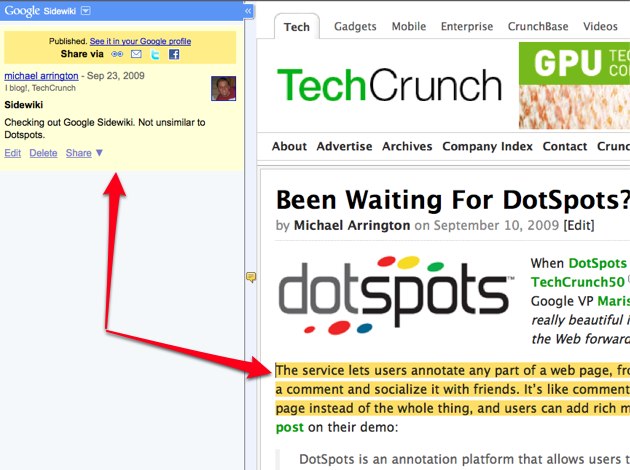
Google says Sidewiki is absolutely separate from last year’s SearchWiki, and comments/votes won’t be aggregated.
Besides the sites I listed above, TechCrunch50 startup DotSpots, which launched publicly last week, is very similar to Sidewiki. Its no surpise, then, that Google VP Marissa Mayer liked Dotspots so much when it first demo’d in 2008: “It’s a really beautiful idea and I really like anything that pushes the web forward in that way.”
Will this work? It’s unlikely that websites will have the same visceral reaction today that they did to Third Voice a decade ago. And Google solves the chicken-and-egg problem nicely by building this into Toolbar. The real question is whether they can control spam, which has plagued SearchWiki. And I guess the other real question is, how long until they put ads in it?
Google Toolbar users will be upgraded over the next several weeks automatically and offered the use of Sidewiki. Those of you who want to try it immediately can find the download link here. Google is also making an API available for developers to access and use the data.


Poor DotSpots. I just hope that they out-innovate Google.
Don`t worry about DotSpots. Farhad knows what he is doing. He has done it twice before successfully.
It’s great to see Google getting into this game with such a cool product.
We have some pretty big differences in our product, namely that we only allow our dots to live at a paragraph level (vs. the free-selection model here). This lets us distribute them around the web to other relevant articles using our engine, generally ‘magnifying’ every user’s contribution by an order of magnitude.
We’re also focusing on making it easier for creators of high-quality third-party information to link it with the news, as well as allowing users to “curate” information found elsewhere into the relevant news. We aren’t trying to get original content like SiteWiki, but rather helping get existing, high-quality content linked everywhere.
Lastly, we are going to be bringing these user dots to publishers with our script-tag version that’s coming soon. The highest-ranked dots appear as a small dot icon inline in the articles themselves (with full control by the publisher), giving readers access to additional media and sources without having to open a sidebar or leaving the article.
Anyways, looks like Google’s done a great job here with their product. Best of luck to their team!
Matt [co-founder, DotSpots]
It seems like you are trying to put a good face on things.
Here’s what is says when trying to use with Google Chrome…. ironic isnt it??
“Sidewiki is currently a feature in Google Toolbar (in Internet Explorer and Firefox), but when Google Chrome supports extensions, we will work on building it for Google Chrome, too.”
“Its no surpise, then, that Google VP Marissa Mayer liked Dotspots so much when it first demo’d in 2008: “It’s a really beautiful idea and I really like anything that pushes the web forward in that way.”
This is just very unfortunate events are recorded in this way.
TC50, Demo and the others… besides the few people there looking to make some real moves, these events are nothing more than a thief-fest.
We need to stop believing that these big companies are out to acquire, but be more cautious that they consult their legal teams after every event to see just what they can keep after convention looting.
Right .. this is no surprise .. infact Google chrome … doesn’t support Google tool bar … for now use it as a browser only for surfing through website .. dnt expect it to do many things just at a click ..the way firefox does it .. I wonder why google removed the beta tag from frm google chrome in the matter of few months .. and it kept the Beta tag for gmail for 3 years (and still it crashes) .. well … For now bear with it …
Best,
Daina
This sounds similar to a number of other startups, including Blerp (http://www.blerp.com)
They all seem to be doing the same thing.
Jesse
I find these annotation services too distracting and always end up shutting them off.
But won’t webmaster paranoia help kick start this SideWiki? If some 3rd party tool for web page annotations, no matter how excellent it is, is allowing users to post possibly negative comment about my site’s pages then I’m not too worried about the impact. But if it’s Google with its #1 search status, I’d be checking daily. So distracting or not, wouldn’t you be checking your TechCrunch articles to see what people are saying about you?
I agree with Erick, annotations = annoying.
Fleck was another one that hit the deadpool.
http://www.crun...m/company/fleck
I tried fleck and i agree, it’s quite the same idea here. I guess the real issue with this kind of services is that actually few people spend their time commenting or writing reviews about products etc.. cause there’s no real incentive in doing it. As everybody knows , 1% of Wikipedia users are responsible for half of the site’s edits, paidcontent.org (http://bit.ly/qyf74) pointed out the same is going on for imdb, Amazon and similar services. These crowds aren’t so crowded.
Very good point about the 1% and who knows how much marketing muscle they’ll put behind SideWiki. But if they put a link to the tool on the Google Search home page then 1% of many millions of people could end up being a huge crowd.
You’re totally right…infact if someone can succeed in this challenge this is definetely google.
By the way, the link I posted earlier come from readwriteweb not from paidcontent…sorry.
I’d love to try it, too bad I use Google Chrome
+1
+1
+1
I definitely don’t understand why Google would come out with a product that its own browser won’t support.
Of course I think sidewiki is a great idea in concept. But, after this week, I doubt we will ever hear about it again. It’s unfortunate as I would love the service, but first they need to put it on their OWN browser, and second they need to make sure people are constantly using it; and this can’t always be guaranteed.
+1
This is another Google service that will probably end up like Knol – useless and unused.
The one I hate the most is the YouTube version….where all the little popup boxes show up….you can’t even see the video sometimes.
I thought you could turn off annotations?
I dont get it. Why arent they building it on wave?
It seems like wave provides almost all of the infrastructure you would need
Google may be losing their touch.
You are correct they are. Too stiff, can’t change after beginning projects. The wind will blow down their saplings because they grew up being too stiff. Too data driven, and not enough balance with intuition and guts…………
anyhow.
wouldn’t people use this to attack competitor’s website?
For political sites, some people (like me) might use it to point out how an article is lying or misleading. The problem is that most of the visitors to that site will support that site’s POV and will vote down comments that show how the site is misleading. And, if someone (like me) has a habit of showing how sites are misleading, their sidewiki ranking will suffer and their comments will show up last.
IOW, instead of this helping show how various articles are misleading, it will simply enforce the POV of the majority of the site’s visitors. (And, I don’t care what Google says about different factors working into ranking, it will work much as described).
For a tangible example, see this inaccurate Digg story with over 2000 diggs: peekURL.com/zymbwoq
The comment I left (choose earliest first) in which I pointed out that the story is inaccurate has -111 diggs. Meanwhile, the first comment that loads on that page is worthless and has over 600 diggs.
For other examples, see:
http://24ahead....-voting-systems
“it will simply enforce the POV of the majority of the site’s visitors”
Or enforce the opinion of the best script bot writer until adequate anti-bot measures are added to the software. When YouTube first started merely refreshing the page upped your video view count (no unique IP address checking, etc.) For a long time many of the videos on the most important promotional page (most viewed) belonged to people that simply wrote a script that refreshed the page a zillion times.
Absolutely. And spam it, and every other major problem that crowd editable sites face (and deface).
Just wait for all the seemingly innocuous comments on Acme widget pages like:
“Great article! That’s just like the NotAcme widget except the NotAcme widget has four bugabas not only 3, and …”
And unlike blog comments you can’t delete them or change them and who determines what is spam and how to eliminate it (if you can at all)?
Ouch DotSpots. The tough question you’re asked as a startup – “What if Google/Microsoft/(FILL IN BEHEMOTH COMPANY HERE) decide to do this?” – is not something you expect to happen this quickly.
when I was building BizRate / Shopzilla, Google launched Froogle… that didn’t turn out so badly for us.
Best,
Farhad.
Having Google go in this direction is confirmation for DotSpots and other annotation companies.
Personally, annotating on a paragraph level like DotSpots is doing is the way to go. Google is going to have problems with free form selection. Sure they have a ton of money to burn, but the reality is that when they see the mess that they are creating, they will pack it up.
FYI, at Third Voice we did free form selection too. Hmmm! I wonder if those 2 Sr. engineers that went over to Google got involved with this product…
“Having Google go in this direction is confirmation for DotSpots and other annotation companies. ”
Yes, confirmation that they’re onto a looser.
Remember when Google Chrome was about keeping the browsing experience unobtrusive?
I think “unobtrusive” died when the AdSense profit motive came into play. Ads and unobtrusive are inherently contradictory.
I tried this with Diigo and hated it. I’m not sure anyone can do this right.
I like Reframe It. You should check that out http://reframeit.com
And I heard they’re coming out with a newer and better version soon, too.
I hate browser toolbars, Google or otherwise. So this a no-go for me.
Though maybe its presentation/integration in Chrome will be worthwhile. We’ll see.
I hope Third Voice got a patent for this, another example of a big company raping an idea from a smaller less successful company.
But I am sure many of you here applaud this as it’s the Silicon Valley way of doing things
Hi PayPal.
Patent on what? They didn’t invent web annotation. So what did Google “rape” exactly?
I, for one, am glad that companies 1-up each other (assuming that’s what you meant by “Silicon Valley way of doing things”), otherwise just about everything would.. _suck shit_
Google 1-uped search, Amazon.. ah hell you get the point.
Some one did it first. In America you get awarded for such.
Also Robby, Google themselves own a ton of patents.
The “1-upping” Google did (very well I may add) was patentable.
Amazon holds a “1-click” patent that gives them an unfair advantage.
I don’t believe anyone should develop anything without the chance of patenting for protection.
Any development team that feel otherwise should release products as open source (GNU). And why not, it’s open season on ideas without patent protection in the first place. Trade secrets only work mostly for Cocoa Cola.
I would use this in Chrome if the sidebar was collapsed by default and simply told me how many comments there were available.
However I use Firefox (waiting until Chrome gets the extensions I need) and I don’t want to have to install an entire toolbar which duplicates a lot of the functions I already have (yikes, I sound like Apple talking to Google).
I really like the idea, as long as the comments provide useful info, insights, links, etc. I think this would work far better for a Wikipedia article than a TechCrunch article, which already has a whole comments section (albeit an overcrowded and bitter one).
You can customize your toolbars and just take the parts from the Google toolbar that you want.
I’ve had the page rank bar displayed between the address bar and my Firefox search box for at least a year, and I’ve just added the icon for Sidewiki while I try it out.
I think it is a good idea, there is also a startup that makes something similar plus few more stuff like chatting, web-widgets etc etc.
http://www.sachaworld.com
Just loaded up and installed the toolbar. There are 3 annotations on this article already.
Congrats Google… Hey peeps take a look at this. If only we had the Google name.
http://www.tiseme.com (Take a look at “what is tiseme”).
Hi Brandon,
I unlike many others feel that using the comments section at TechCrunch to place links to their endeavors is what you are supposed to do if you are really passionate about your idea.
My problem is that what you chose to share is something that is a carbon copy of this: http://develope...ok.com/toolbar/
Their unit already have ofer 300 million users attached to it, so my question to you is:
1) Did you get funding for your company, like are you really pitching this to someone?
2) You must be from Silicon Valley, I think many there think this is the “in thing” to do judging on the many Twitter clones actually making TC lately.
3) Do you realize that competing against Facebook with a toolbar is something that even Google or Microsoft can not beat them at, how well do you think a start-up would fair?
4) I must believe you have other ideas, I would wish you the best with them as that toolbar lane is already consumed by a tank.
google needs to be ready to be sued
Blerp is another one (http://www.blerp.com).
The idea has always seemed potentially useful to me, but difficult to successfully develop for a number of reasons. For one thing, it never made sense to layer commenting on top of an already-comment-enabled page. How do users decide where to put their comment? I suppose the main difference would be presentation, and control (TC gets to control comments here, google rank gets to control comments there).
Maybe if the system is designed well enough it could replace commenting web-wide, but until that happens it seems like an extra layer of confusion more than a layer of utility.
Google avanza sin frenos.
I fail to see how this is any different than StumbleUpon.
???
I can’t be very enthusiastic about a service that is just another way of Google putting up its ads and extending its monopoly.
I’d love to see DotSpots beat Google at this
This is fantastic! a startups dream. With one move Google just solidified the business potential of DotSpots.
my money is on the underdog
Annotation has great potential but if people are looking to make graffiti spaces out there, that’s besides the point.
The greatest impact these technologies might have are among self-segregating circles or workgroups that add a non-impact layer atop existing sites. Say, a study group for that Media 101 class @ X University or something – completely unobtrusive and no one’s business other than the group’s. Dotspots is particularly powerful right now in this regard.
Another way I’d like to see this technology move forward is in the arena of developer bug tracking for web developers. There’s a lot of potential to built this as a front-end to existing trackers and make the process much more efficient and pull in more less technical (VzD, IxD, clients) involvement w/o the usual dev/client pain.
Ok, let’s face it – it will be hard to compete with Google. But – SumtnSumtn.com works with every browser and there is no need of a plugin. The same publicity as Google gets would be fine
I’d love to see this integrated with Facebook or Twitter, filtered to show comments from my network.
Google nice move.
I see danger here:
http://www.buzz...idewiki-danger/
It bifurcates conversations. It takes control of comments away from sites yet it adds a new opportunity for spammers, trolls, and hate-mongers to deface sites. It centralizes the conversation rather than serving it at the source. It is anti-edge.
And mind you, I’m a Google fanboy. I wrote the book. But I don’t think Google thought through the implications for sites and for its own mission and PR.
Job security for Google’s Matt Cutts so it’s a good thing.
+100. Totally agree with Jeff. They don’t see the power change consequences. I explained my opinion below.
What idiot still installs Google Desktop?
So, who needs a “comments” section on a web site anymore with Sidewiki?
I’m a big Google fan. But I think, in this case, they may have been overly excited about releasing some (admittedly very cool) new technology and overlooked some of its implications.
I wrote about why I think so:
Google Sidewiki: Do [No?] Evil
http://faseidl....lic/item/241498
Getting Chrome right now . . .
oh no! after installing chrome:
“Sidewiki is a feature of Google Toolbar, which is only available for Internet Explorer and Firefox.”
This is awesome! I often think to myself, when navigating through the torrential spam, both ad-based and opinion-based, that now accompanies every single major site on the web, that it would be wonderful if there could be another framework with which to spam the spam. My only concern is that I won’t be able to comment on the the comments that people associated with the comments on the comment that I originally posted, unless I actually used the original comment section to comment on the comments… Comments anyone?
(This brought to you by Opinions(tm), they’re what’s for dinner!)
Justin replied: EXACTLY WHAT I WAS THINKING!
–AnotherUser: Stupid comment. Freaking liberals…
Farhad is a good dude but it took him a year to get it right. Google will eat his lunch here. The Internet gives you one shot and a few months to get a good idea right and scaled. Farhad? What is next?
well, at least I’m a good dude…
Seriously though… as I mentioned in a previous comment, early in the “few months” — actually 12 years — it took us to build and scale BizRate and Shopzilla, Google released Froogle, which was supposed to eat our lunch too.
Of course, it turns out that they didn’t quite manage to do that… they did however get everyone excited about price search engines.
Maybe sidewiki will do the same and get people excited about page annotation services.
I mean, here we are now with someone trying to “eat our lunch” when last week’s comments on our “DotSpots launches” TC article were all about “annotations have been tried before, and how’s DotSpots any different, etc.”
I like this new discussion better… at least now there is a “lunch” to be eaten…
best,
Farhad (co-founder DotSpots).
Yeah, Froogle was awful. It was like they let the kitchen staff have a crack at it.
thats great to hear google s fighting bing by introducing more new products but their white background is still old fashioned to bings imaged background
Wikis are fine as long as nobody can erase what others write. When special interests can hire someone to erase things, Wikis become evil. Wikipedia has that problem
cool, cool, cool
I agree with Erick, annotations = annoying.
OH! You’re my new favorite blogger fyi
We tried the same with zpeech.com – that did not work out!
http://news.cne...-9689577-2.html
Google also tried “Notebook”, which is almost the same:
http://www.goog...e.com/notebook/
BR, Tim
Great !
While everyone’s plugging their – here’s an open source variant I’ve been working on.
http://scrumptious.tv
Beware that it’s at an early and tender stage in its lifecycle, and not ready for serious production use. But it serves as a proof-of-concept and any feedback would be appreciated.
Being open source, you can host your own private conversations, which is useful for companies on their intranet, or just for small groups of individuals to communicate and collaborate.
From my Blog post..
Google caught being EVIL?
Today the Google I had come to know changed..
The “Do no Evil” slogan crumbles as Google blatantly berried a great Web idea only to bring out their own version of it.
Recently Google launched Google Sidewiki. An idea in that anyone can comment on a web page outside the control of the website itself. This is a firefox (and internet explorer) plugin.
Back in Febuary (7 months ago) some friends of mind (www.sharpsushi.com) launched FeedBackLoop (www.feedbackloop.com.au). Strangely enough “Google SideWiki” is exactly the same idea and implementation.
When they launched feedback loop, the Firefox plugin went into what is called “Experimental” plugins. Thats OK, as it is what all pluggins have to go through. However, today, the pluggin is no longer even listed on the Firefox extension site. It had been removed.
Obviously Google has added its “Back End Majic” to some of the features it has, but still. This is obviously not an original idea and has been copied from feedbackloop.com.au
This is an example of a big company taking advantage of its position. A every day occurrence in reality. However, Google is not a typical company. Any company that dominates an industry needs to be held accountable to much higher values.
Is the weight of Google dominance and power starting to escape from the clenched fist that holds it to the slogan “Do No EVIL”?
I can’t help but think this is just a way for Google to create a wiki data-set that they can use to test and improve their base technology.
I wrote up my thoughts here. I agree with most commenters here that Sidewiki is ill-conceived; however, I think it would be valuable for sites that do not have comments enabled, such as government sites or databases.
Diigo already does this right. I hate seeing everyone elses notes but it’s great to have the ability to leave private and group notes.
e.g. – for my family site I have a note that only my wife and I can see. We keep track of design and functionality ideas. It never gets lost and is a reminder every time we visit the page.
Am I the only one to find this REALLY intrusive, and pointless ?
Honestly, on so many websites, most comments are just irrelevant or, even worse, racist / sexist (esp. on news websites, where I imagine people would use this widely to bypass moderation)
Personnaly I don’t think I would use it, I don’t need another visual pollution.
And like other people here I imagine webmasters will have need to monitor it closely, so it would end up being useless anyway.
However, I think there are several ways this could easily turn into a good idea:
- either they give site admins the possibility to monitor this, which would make webmasters choose it as the easiest comments tool (free and no development). Google could very well keep record of erased comments for their SEO purposes!
- or they make it simpler, and give the possibility to RATE any website. If I had, like, 5 stars I can fill anytime in my Google toolbar, I would use it.
But this, no thanks.
Well, Google can’t always hit the right spot!
By the way, I don’t think this will help them keep the so-called “goodwill” image they wanna stick to, esp. in the webmastering community. Just my opinion.
Google grabbed idea Yousticker.com
http://yousticker.com – it’s social utility tool for commenting everything everywhere on the web
Without toolbar and support all browsers!
Have support signup from twitter, google, openid account
Crosspost in your twitter
Followers, Following, Groups, Privacy
Just think about the brand implications of Google Sidewiki and the competitive impact this might have on hotel-review websites like TripAdvisor. I wrote a post about these issues here http://bit.ly/JbuKA for Tnooz. Take Priceline, for example. Priceline requires travelers to book a hotel on Priceline and to complete the stay before writing a review of the hotel for Priceline. But, with Google Sidewiki, anyone can write anything they want about a hotel next to its display on Priceline. Google Sidewiki users have carte blanche to write whatever they want — even if they have never set eyes on the hotel. Competitors of that hotel can trash it at will. Will we soon be hearing about the hotel industry gaming the system through Google SideWiki? Somewhere, a public relations team is probably already getting the gears in motion.