
Study: Mobile (And Particularly iPhone) Users Not Keen On Clicking Ads
by Robin Wauters on September 12, 2009

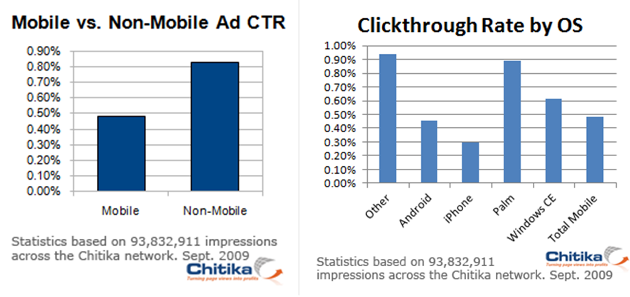
New research performed by online search advertising company Chitika suggests mobile users are far less likely to click on ads than non-mobile Internet users. In fact, they’re about half as likely, the study shows based on a sample of 92 million impressions.

Could that be true? Wasn’t it the other way around?

First, we should note right off the bat that Chitika is an Internet advertising company that’s decidedly not into mobile advertising according to its own website, so that brings along a large truck carrying bags filled with grains of salt. That said, it’s worth taking a look at how they got to the conclusion, so we can reach our own.

Chitika claims to power advertising for over 55,000 sites, serving ads based on 2 billion monthly impressions. Of the 92 million impressions cited in the study, approximately 1.3 million or 1.5% of the lot came from mobile browsing. The ads that were shown on mobile devices were exactly the same as the ones displayed to non-mobile users, rather than comparing standard online advertising with mobile-oriented ads.

Ad click-through of mobile as a whole pulled only 0.48% according to analysis of the sample, with non-mobile holding steady with a 0.83% clickthrough rate. That would mean mobile commanded just over half of the average.

Of the five major smartphone operating systems – Android, iPhone OS, Windows Mobile, Palm OS and BlackBerry OS – Apple’s iPhone ranked worst for ad click-throughs representing a mere 0.30% rate. The “Other” group, comprised mainly of BlackBerry users and a handful of other operating systems (including Symbian, Nokia, and HTC) saw the highest ad click-through rate.
Personally, I’m a bit hesitant to believe the outcome of the study – much like Chitika’s earlier one about Bing ads’ click-through rate being twice as big as Google ads – considering the self-serving aspect and the apparent desire to come to controversial conclusions in order to draw attention.

On the flip side, there hasn’t been that much independent research for mobile ad click-through rates yet, and I’m equally keen not to blatantly believe studies that show mobile advertising commands spectacularly high click-through rates compared to web advertising. In my opinion it’s conceivable that click-through rates would be rather similar and largely dependent on context, type of advertising, how well the message fits the medium etc.

In short: more neutral research wanted.

Advertisement

Responses

Comments rss icon

  • Might depend on the device as well. If you are browsing on something other than a iphone you might be wary of clicking on a ad if it would completely derail your browsing session and make it near impossible to get back to the original page.

    • I agree. With a smaller screen and slower (for now) bandwidth on mobile phones, it would make sense that people avoid clicking on Ads. Granted my sample group is just me, myself and common sense.

        • There is a reason for why guys don’t click on ads, especially on the iPhone… there is no mouse button to click on :)

          ok, on a rather serious note, the iphone isnt capable of showing ads, the real estate is way too less as compared to the other competition. take for instance Nokia 5800 XM and others..

          On screen real estate, they outdo iphone by a scale of 1:1.5 i.e. 50% more screen estate.

          more over, most ads are in flash which iPhone does not support.

          people tend to click flash ads more as compared to boring text / gif ads. other browsers such as S60 and opera support flash in browser.

      • Basically mobiles are far different from web. Event though all the features in the web are available in mobile versions, mobiles don’t provide that much impressions to ads. Whatever be the mobile device, the screen size, the network, the access speed is slower than the web. The access speed creates a major difference there. Also picture quality is low when compared to web.

        • Nowadays mainly not only iPhone users but all the network users also likely to have more advertisements in their mobiles. But strange, why iPhone users alone hate ads?

          • First, I agree that independent research is warranted. Sencondly, I believe that people are essentially tuned out of advertising on mobile because they tend to be accomplishing something or wasting time in a specific manner — Facebook… Advertising that mimics the web is simply not interesting in the context, but more involved advertising may very well be desired.

            Making better customers of your users is the goal in mobile, not digging for new ones.

    • does anybody click on ads?

  • Should also consider the device-related persona focus: Smartphone users (in general) = upper-class, educated, web-savvy = generally less likely to click ads.

    • Agree, also, less likely to click on ads that says “click here to win a free ipod”

    • Agreed. I remember a study done a while back that seems to have been forgotten (”lost”? for you tin-foilers out there) about who actually clicks ads. It found the majority are 18-22 males whose income was less than about $25k/year. And they clicked mostly on sex-related and “free” ads.
      The numbers here are off the top of my head, so wrong I am sure, but are in the general area.

      In the case of iPhone, I agree with GregOne, and I’d guess that demographic is generally more mature/sophisticated. So, of course, there will be fewer click-throughs.

      Even if your ad did get umpteen-trillion clicks, it boils down to whose your demographic? If it’s 18-22 $25k males (who have no money to buy anything but “Girls Gone Wildl!” videos), then you’re great, otherwise no.

      And, I just don’t like banner-ads slapped on a site I’m visiting…so am biased.

  • I’m dubious of any claim regarding the effectiveness of ads in general. Until there is a larger shift in thinking in regards to content and delivery I see whatever effectiveness exists now declining further.

    I can personally say I have never clicked on an iPhone ad so we can add that to the data.

  • To click on ads on the iPhone is opening a new site and this is on ’s small screen disturbing. You often close the ad site cause iphone No. 1 is just
    allowing 8 sites :-)

    Try our site http://www.spirofrog.de on a mobile device! Nice Design but the ads are not at high click rates.

  • I set up Darwin’s Finance with a mobile plugin and as you’ll see if visiting on a mobile, it’s not ad friendly at all. My sidebars are gone and it’s really just about providing a better experience for the readers. If they’re hitting my site more because they see that I’m not a blogging dinosaur and continue to evolve with the going technology, they’ll be more loyal readers, retweet my content etc. Remember, just having more traffic even if not clicking on ads means higher ad placement rates and other indirect benefits. I welcome mobile visitors – stop on by!

  • @ Dan Blake – Did you even read the article? iPhone had the worst click-through rates. So apparently it’s iPhone users that are “wary of clicking on a ad if it would completely derail your browsing session and make it near impossible to get back to the original session.” Yet another Apple fanboy rushing to defend heresy against their god.

  • I’ve actually clicked on ads and bought stuff from within other apps, so I think it can be an effective advertising channel.

    The golden rule for advertisers is to not be obnoxious about it.

  • It may be coincidental but when using my WinMo device and searching Bing the ads I get seem to have some relation with my position occasionally giving me discounts… like I say this may just be chance.

    Perhaps with restaurant and product searching the tide for mobile advertising will change, I am not opposed to spending a couple of seconds waiting for a page to load if it saves me cash or effort.

  • I agree with others, it seems silly to take a relatively slow mobile browser, and spend the time for it to load another page, which would be a pain to buy anything through a mobile phone anyway.

    Besides, I feel like if you’re on your mobile phone internet, MOST of the time you’re looking for something in particular. Not just browsing Internets. A lot less reason to click on ads.

    They should just be image ads without a click through measure anyway. IMO.

  • While comparing metrics straight-up is tempting to gauge efficacy of one medium versus another, it completely ignores the difference in experience.

    On a computer, pretty much all ads come through a browser. On mobile devices, the experiences varies widely. It could be on mobile web vs mobile apps. And then there are smartphones vs the pure text mobile browsing.

    As an avid app user, I especially avoid ads in apps because I believe it will make me exit my app and I don’t want that poor user experience.

    Also, are these search ads or contextual ones? (I’m guessing purely the latter.) Think about how many times you conduct a search on your computer vs your mobile device. Search ads will always have a much greater click through rate than contextual ones.

  • I guess it may be related to the fact that those ads comes back to what the old days of Ads was, banner, fixed location, un-informative, etc. Also if you are not using unlimited plan you won’t waste your bandwidth for ads, right? (except free ipods)

    • Exactly. It’s like mobile advertisers are operating on the standards of almost a decade ago. Intrusive banner ads with zero relevance. Of course we’re in the early stages here, but you figure they would have done a little more research and found that this type of advertising is ineffective except with people who have no idea what the internet is…none of which would own a smartphone…

  • François Pérennès - September 12th, 2009 at 9:58 am PDT

    Intrusive advertising doesn’t work, it’s that simple

  • Personally I never click on ads when using my iPhone. First off, my connection speed is usually so slow (thanks, AT&T) that it would take way too long to load the page it directs me to. Secondly, whether I’m using an app or browsing it’s usually for just a short amount of time with a specific goal in mind. I’m not looking to click on something that has nothing to do with what I’m trying to accomplish. And lastly, most of the ads I’ve seen have been intrusive and annoying. The iPhone screen is small enough as it is (compared to a proper computer)…I don’t need some banner ad taking up 1/6 of an app display to sell me Bud Light (see ESPN’s fantasy football app, which, mind you costs $4.99 and still has ads – greedy much?)

    So I guess with that said I’m not exactly what mobile advertisers would consider their target audience, but people like me should be taken into consideration as the mobile ad strategy evolves. I’m not categorically against clicking on ads…they just need to be executed better.

  • When you pinch-and-spread to make the tiny type legible, the ad bars are gone, gone, gone. My theory is that this is a big reason they’re rushing out the iPad.

  • Dynamic Logic, insightExpress, Performics, iCrossing and a bunch of traditional ad agencies, amongl others, have done independent research confirming the value and efficacy of mobile markrting and advertising.

  • This is not a surprise since mobile Internet is more task focused. Who has time for an ad mid-task? It is however interesting to see that ads from iPhone applications are clicked on more frequently than mobile ads and potentially more than terrestrial Internet ads. http://www.mich...-new-web-part-2

    Until advertising becomes much smarter (contextual, behavioral & situational via things like Twitter) it will be as worthless as it is today. Agencies like Crispin Bogusky only exist because they create “destination advertising” – the ad itself is sought out on some level. Smaller brands usually can’t afford this and would be better off spending their money on social media (depending on their business model.

  • I saw this press release last night. Quite interesting that iPhone users don’t bother with ads at all. But with the limited space to read and do other things on the screen, I can understand not wanting to browse advertisers sites often.

  • I was honestly surprised at the data we discovered – I expected our study to support the idea that mobile ads are more effective than non-mobile. But the data doesn’t lie… when you do an apples-to-apples comparison (the same ads across the same network) without incorporating specialized mobile-oriented ads, mobile users just don’t have the interest in ads that non-mobile users do.

    Dan Ruby
    Chitika

  • Just ask yourself this question: Do I ever click or pay attention to these types of ads?” The answer is probably no.

    I know I completely ignore them on my iphone. Its not how there placed or the size. Its just that it’s mostly a con and a waste of time.

  • Two things about iPhone users:

    1) In safari on the iPhone we have this cool ability to zoom into a column. For sites that aren’t specifically formatted for iPhone it’s almost mandatory. Zooming into a column generally moves all the ads – side and top – out of view.

    2) I wouldn’t be at all surprised that they’re tracking views on flash ads which don’t even appear on iPhones. The tracking bug would work and count the view but the user will see a typical flash missing plugin icon.

  • They needed a study for that?

  • There is some catch in this discussion, since the typical crowd of TechCrunch are exactly the type of people who avoid clicking ads – on iPhone as much as on PC. Many of us are closely familiar with the technology and business behind ads, and so it is impossible to have an objective discussion here.,,

  • I can personally say I have never clicked on an iPhone ad so we can add that to the data.

  • Duhh, users of a small device that is often used on the go, don’t want to be distracted by ads–no surprise.

    However, that changes when the ad become content or a promotion. While i’m searching for a wine bar in San Francisco, show me a promotion for a buy one get one glass of wine for free at a nearby location and I’ll bite.

    Even better, give me discounts at my local grocery store (coupons) or coffeeshop and I’ll never know it was advertising. The consumer packaged goods companies actually view their coupons as ads (both for branding, changing consumer behavior, and direct response–the just don’t ever refer to them as ads to the public…

    At the end of the day, right time, right place, right offer always makes sense.

  • I agree with many of the comments here and add that advertisers need to be more creative in general but also more immediate in how that click through will add value there and then but then i guess this will involve much more ‘proximity’ based offers.

  • I am sure the data is correct.
    Why would anybody click on a mobile ad anyway. You usually know what you want and taking the time to open a new browser or App to see the ad is not in store for most people. Also, don’t forget that IPhone users usually only read the text in a table and don’t bother on looking at the whole page inl. ads.

  • We have not noticed this to be true. Our iPhone app ads get clicked on twice as much as our website ads. Perhaps this is the case for AdMob-esque ads, but I blame the more broad ranged content, not the format or presentation.

  • It’s an entirely different use case if I access a website via my iPhone – hence the difference in CTR.

  • i use to develop three d generation mp4 core profile it was great

  • Very useful post, very good statistics, unfortunately it is not good for the Ads publishers like me in chitka. Thanks!

  • I agree, in safari you double tap the region and get to focus on the content you want to read. Display ads will hardly catch attention. However would like to know how well text ads or inline ads work.

    Ads in Iphone apps or games are irritants and get in the way of usage and hence may get more clicks.

  • Personally I’ll sometimes click on ads in mobile applications just to see if the company has rigged up something clever geared towards mobile phones. Know what I mean?

    In one of my droid applications I kept seeing ads for Jaguar cars…I finally clicked it and sure enough there was a nicely produced mobile-friendly video for a car I couldn’t possibly afford.

    So that’s why I personally sometimes click on mobile ads.

  • It’s obvious that the Ads not attract users.

  • The trick is in the targeting. When I use my iPhone I am interested in a lot of stuff I would not be interested in when I would be behind my PC. Give me apps for spiffy new iPhone Apps and services. That works. Use the location-based info you have from me. Sales execs just need to work harder to make mobile advertising work.

    Don’t give me IQ tests, don’t give me contests, in fact don’t give me any ads that are not suited to the mobile web. I see that happening all too often with many of the mobile ads I see, and it just doesn’t work that way.

  • I totally disagree with the methodology here. Of course clickthrough rates are lower when clicking on “non mobile-specific” ads on an iphone. If the ad doesn’t match the medium, this is hardly surprising.

    However, our experiences at the FT have been that mobile campaigns specifically designed for the medium generate clickthroughs several-fold higher than those seen on our website.

    What we don’t see yet is how this ties into a purchase / call to action journey. Moving people on from a click to calling a call centre/purchasing something etc on their device is the real challenge for mobile marketers rather than obsessing about CTR.

  • There is another study which is exactly opposite
    http://www.exch...1703&pict=8

  • We found the opposite results. Our mobile CTR’s and conversions were higher then web. Our belief was that the CTR was higher for mobile because there were less ads compared to our website.

    After re-designing our website with less ads the CTR and conversions are at par with mobile.

    More importantly, we are asking the wrong question. It isn’t about web versus mobile, but about what needs to be done in both mediums to create contextually relevant advertising as a service and not a distraction. Chitka’s test does not answer this question because they used web creative in a mobile environment.

    TC, I hope readers click-thru from the headline of the article to your own skepticism of the results so they are not mislead

  • The entire premise of the study is flawed for two reasons:

    1) There is no way to fairly compare mobile CTR to web CTR. The most fair way to do it would be to compare ad CTR on mobile web pages (read: web pages optimized for mobile devices), viewed from mobile devices, to ad CTR on web pages viewed from web browsers. This study appears to have not controlled for whether the content was optimized for the device. Even then, it’s flawed, since most web pages are laid out to have multiple ad banners or links within view, whereas most mobile web banners are individually the only ad media on the viewable page at any given time. Conducting the study properly will yield the opposite result, but even then it’s a flawed comparison.

    2) Advertising in mobile takes, and must take, a variety of different forms. For every iPhone user who didn’t click a mobile web banner, I’d bet 99% of them have at least 1 promotional, advertising oriented or branded application. For every mobile user in general, I’d bet 90% of them have interacted with an SMS promotion in some way.

    Long story short, flawed study, but achieved it’s goal in getting some attention.

  • I disagree with some results, in the traditional “results are not typical sense”. I believe that people do click on ads depending on the device.
    Being an iPhone and Nokia user myself, I find it hard to surf in the two different browsers when I click on certain ads. Of course mobile Safari does a better job in some cases when compared with Opera mini, IE Mobile or even OpenMoko and Android, however, to me it comes down to how well developers integrate ads in their apps, or a marketer has targeted the ads for a specific demographic. Also lets face it, developers still haven’t done much to create mobile versions for all the popular sites out there. In fact there are not even any serious scripts to do this automatically. I would suggest for you coders out there to create scripts for automatic conversions. Site owners are missing alot, not to mention that lots of problems derive from the fact that many pages use Flash, something that is a major turnoff. There is a very detailed tutorial of how you can avoid the pitfalls and increase ad conversions I’ve found here from Twitter: http://bit.ly/35V7p

Leave Comment

Commenting Options

Enter your personal information to the left, or sign in with your Facebook account by clicking the button below.

Alternatively, you can create an avatar that will appear whenever you leave a comment on a Gravatar-enabled blog.

Trackback URL
Short URL
bugbugbugbug
Techcrunch on Facebook