Charts: IBM’s Software-Led Margin Expansion
by Erick Schonfeld on September 8, 2009

Many people still think of IBM as the company that sells Big Iron—mainframes and its enterprise server descendants.  Of course, the engine of the company’s profits long ago shifted to consulting and software.  In a financial slide presentation IBM released today to the SEC as an 8K document, however, you really get a sense of how much IBM has continued to shift its business towards software and services over the past eight years.

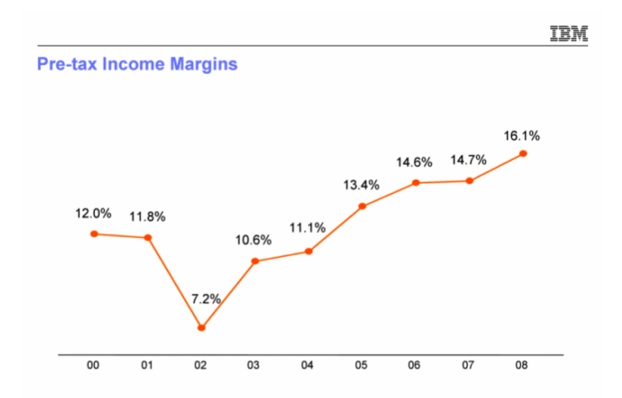
The result has been a very healthy expansion in its profit margins.  As can be seen in the chart above, IBM’s pre-tax income margins have more than doubled from a low of 7.2 percent in 2002 to 16.1 percent in 2008.  And the slide presentation suggests that IBM has further to go.  It cites data showing that the top quartile of companies in the S&P 500, and 30 percent of tech companies, have pre-tax income margins of above 20 percent.  IBM makes $90 billion in revenues per year, so each percentage gain in pre-tax profit margins adds up to nearly $1 billion.
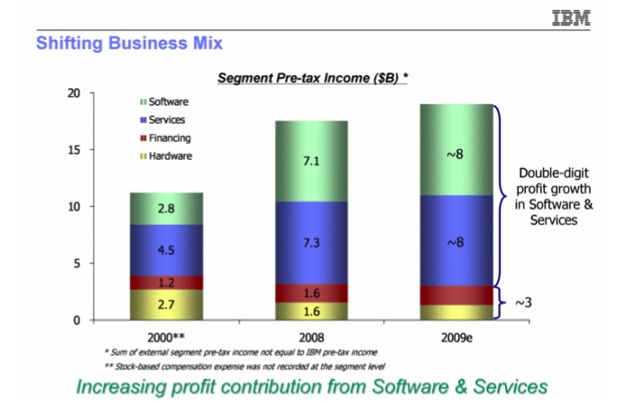
The reason for IBM’s margin expansion is that the pre-tax profits in its  software and services businesses are growing at double-digit rates.  Both segments will make an estimated $8 billion in pre-tax profits this year, compared to about $1.5 billion for hardware.  Eight years ago, the software business brought in only $2.8 billion in pre-tax profits and the services business produced $4.5 billion.

IBM has made big investments in middleware, database software, virtualization, cloud computing, and business analytics, to name a few areas. It sounds like these are paying off big-time.

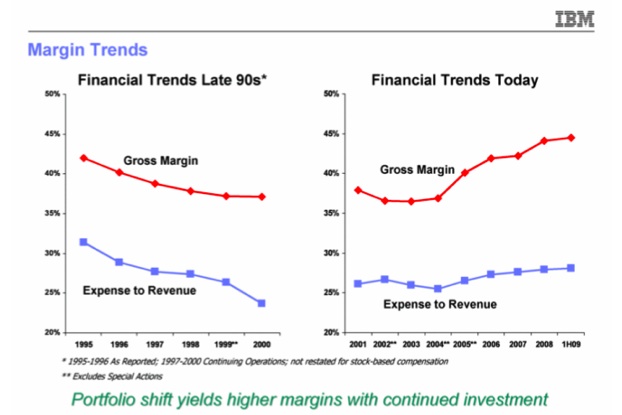
Contrast IBM’s financial condition today to that of the late 1990s.  Back then, gross margins were declining every year, even as it was cutting expenses to compensate.  Today, expenses as a percentage of revenues are actually going up as it continues to plow more money back into the business in the form of investments and R&D.  Over the past five years, IBM spent $30 billion on R&D, second only to Microsoft’s $36 billion (Google spent only $7 billion, which also is less than Cisco, HP, and Oracle).
Information provided by CrunchBase
Advertisement

Comments rss icon

  • Another Great post Eric.

    IBM has the habit of poking it’s nose into almost everything. But it’s recent move of jumping into consulting services and offering more software services has infact paid off well.

    The important question is how long can they keep these numbers up.

  • yeah, not so much.

    Don’t let the labels fool you.

    IBM made two strategic moves that DECREASE their hardware margins and INCREASE their software and services margin on paper — but which don’t really do anything for Svcs or SW.

    To wit:

    1) They moved the lucrative (e.g. 90% plus margins) derived solely from IBM hardware maintenance agreements for installed hardware, out of the hardware group and into the services group. The “logic” was services did the work for any actual repairs so they should “book” the revenue and profit. The truth is IBM’s iron is so damn strong that there is virtually no redemption of the services agreements. They are literally printing money for services and hardly ever going in for repairs! This move was a HUGE benefit to Global Services. If you back out the maintenance revenue from services then you would see service margins plummet to the low-single digit numbers and some service lines would show negative profits. Likewise, if you properly applied the maintenance revenue to hardware — where it justifiably SHOULD GO — you would see hardware profit margins LEAP. Also, you should ask about services contracts in Asia. IBM dominates that market for all its products and even for competitor products. An interesting case study on how to fly under the anti-trust radar.

    The second reason:

    2) Operating systems (OS) revenue derived soley with the sale of hardware – have also been moved out of the HW division and moved into the software group. Anyone ever heard of a small company called Microsoft? Anyone consider Microsoft’s profit for its operating systems? OK then. The very same is true for the operating systems on IBM hardware. The single largest contributor to IBM profits in the entire company comes from licensing the Z-system OS. By my estimation, it accounts for nearly 25% of IBM’s profits. By the way, guess where the “maintenance” contract revenue for the operating software goes? Yes, Services.

    So, let’s recap: If you were to ADD back the maintenance revenue now hidden in services and the operating system software revenue (solely driven by hardware) — back into HW group, you would see that IBM’s hardware is amazingly, amazingly profitable.

    If you follow the logic, you may be asking why IBM moved these revenue and profit margins out of HW and into Svcs and Sw group.

    Two simple words:

    Monopoly power.

    IBM holds the single most dominant position in the tech industry in its big-iron. That’s a dirty little secret they don’t want publicly bandied about.

    By moving the revenue and profits out of the HW group, IBM masks its dominance and creates the best defense against a real threat from the FTC on its hardware monopoly. It can claim, at least for accounting standards, that HW is a dog-of-a-business.

    It ain’t.

    If I could buy IBM’s hardware division only — and I could keep the maintenance contracts and operating system revenue — it would be worth far more than the software and services business combined.

    No — I don’t work for a competitor. But I did stay at a Holiday Inn last night.

  • I remember when IBM switched from hardware to services and the income jumped. Now they’ve made the next leap in operating profits.

  • Steve,

    Income = operating profit.

    You might mean services? If so, most of that was acquired services.

  • Is RICO Calling at IBM ???

    Visit — ibmTheWidowMaker com

  • IBM really promotes very standard software. It has been years since it jumped in to software consulting area. The growth seems good and I feel it would keep up the stats with its standard service.

  • And we all said software would be for free.
    It’s not if you know how to sell it.

Leave Comment

Commenting Options

Enter your personal information to the left, or sign in with your Facebook account by clicking the button below.

Alternatively, you can create an avatar that will appear whenever you leave a comment on a Gravatar-enabled blog.

Trackback URL
Short URL
bugbugbugbug
Techcrunch on Facebook