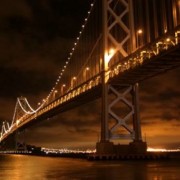
Residents of San Francisco are a bit put off by the temporary closure of the Bay Bridge this holiday weekend. For the next 2+ days, the short bridge commute between the city and the East bay is closed, forcing people to take 30 mile detours through Marin County to get to Oakland, Berkeley and beyond.
This is a perfect opportunity to test the map products on the major Internet portals. Who noted the temporary closure and helped users figure out the next best route?
The short answer – Google wins. Yahoo a close second, and Microsoft Bing fails in this particular test.
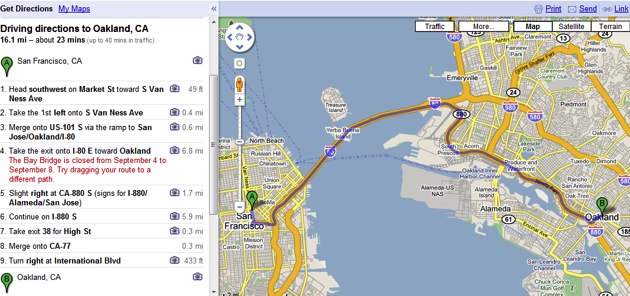
Google Maps notes the closure, telling users “The Bay Bridge is closed from September 4 to September 8. Try dragging your route to a different path.”
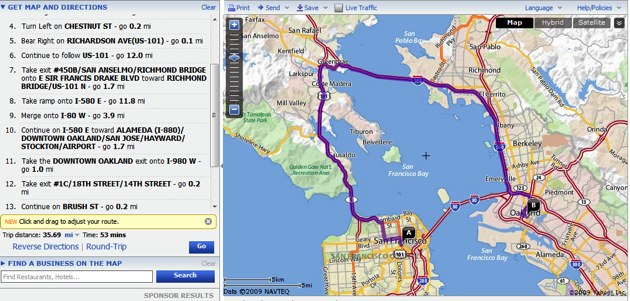
Yahoo also seems to know about the closure, but doesn’t mention it to users. Instead, it routes you 35 miles through Marin county and over two other bridges to get to your destination. This is useful, but without pointing out that the Bay Bridge is closed, most people will likely think it’s a glitch and simply try the easier route (and be disappointed).
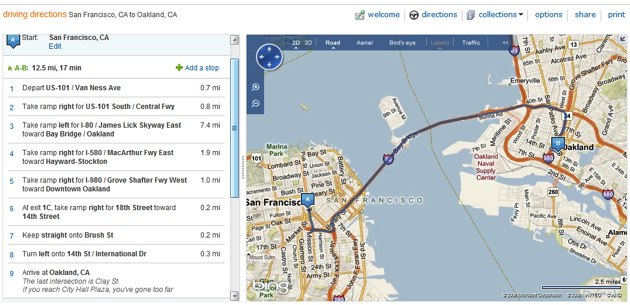
Microsoft Bing fails this test completely. Oblivious to the current road conditions, it blithely tells users to use the Bay Bridge to zip on over to Oakland.
Thanks to Noah Veltman for the tip, and the stunning image of the Bay Bridge above was taken by Thomas Hawk.


… which goes to show, even bridges hate MS
here’s a very true comment.
California. The Entire state. Is a dumpster.
Google Maps show the company’s powerful monetization in geo-location system. Yahoo is doing better and it seems have actually figured the route. So for sure its aware of its closure and even its system is working fine. Looks like Bing is yet to even start.
The Best Auto Short News WebSite: Breaking News, Car Reviews, Spy Photos, Green Cars, Car Videos, Present Your Car, All Auto Brands News.
Click on my nick name to enter the site…
There’s a gathering point for vista7 launch party’s at the beginning of the bridge!!
Google does it best since you might be planning a trip for another day. It does what you tell it to and alerts you to a possible problem if you’re traveling on the closure day.
It would be nice if, with a click, it would reroute you around the bridge instead of having to figure out the next best path.
well I suppose Yahoo was much better as it actually figured the route . So for sure its aware of its closure and even its system is working fine. Technically speaking YAhoo did performed better then Google as if its closed then there is no road hence it was giving the correct direction. Techcrunch can put it in whatever way they want but technically yahoo performed better
You just totally missed what Michael said when you replied to him, you might be looking up directions ahead of time for a trip after the bridge is open back up again and you don’t want it to tell you to go the long way when you know the bridge will be open that day, Google wins.
As the author pointed out, since Yahoo doesn’t tell you the Bridge is out, you would assume the alternate route is a mistake and attempt the usual route.
Just because you assume the map is wrong and foolishly ignore it’s advice and head towards the bridge isn’t a reason to mark down the fact that it did get the route right!
It got the route right but the interface wrong, if it said why the route was going round there then I think we’d have a different winner
Michael, you raise a good point. I didn’t even take into account the fact that you might want to travel the route on a different day. From that perspective, Google’s method might be preferable to Yahoo’s.
The Map wars prove Google’s powerful monetization in Geo-location system. Google’s services continues to grow more and the competition is getting tougher. Yahoo services were too up to the level of Google. Will Bing’s failure bring out immediate effects in the near future?
to be fair, both google and yahoo are based around the bay area while microsoft is up in redmond. the true test lies in a bridge closure that is not near any of these companies.
that has absolutely nothing to do with this at all. Microsoft is just minus a relevant data provider.
Lol that’s good Mike
That does matter. employees who are working on maps ,if they are aware of the closure they will make sure that it gets reflected in their map engine.
yeah that scales.
Just curious, do you think that Google and Yahoo have some superior data provider that is in their algorithm? I suspect it is what you dismissed from the posters — someone “hand rolled” this one. Yes, you’re right it won’t scale for Yahoo or Google. Unless they have a magic bridge closure data provider
Yes, Mike, you’re right. It doesn’t scale.
But you don’t have evidence that Google gets it right when a bridge in Topeka closes, or even when a bridge in Chicago or New York closes.
If you showed that, then you’d prove that Google has access to “relevant data providers”. In this specific case there have been signs up and down the 101 for weeks letting people know about this change. This has all the hallmarks of a specific hack for this specific change.
@Mark: As far as I know they get their data from the DOT, or some company that gets their data from the DOT.
Michael, did you read the comments? This was obviously a hand hack job by Google and Yahoo. In light of this, your sarcastic comment is quite ironic. Do you ever admit you made a mistake?
Does anyone recall how quickly Google, Yahoo and MS Maps made changed to deal with the bridge that went down in Minnesota?
i disagree. there are bridge closures all the time across the country, giving any number of opportunities “to test the map products on the major Internet portals.” how do they compare *in general*?
right now, for example, the hart bridge in jacksonville, florida is closed (and will be through spring of 2011 – except during rush hours). when asked for a route between destinations on opposite sides of St. Johns river, all 3 of your subject sites “blithely tell users to use” the hart bridge to “zip on over”… as does mapquest.
if bay bridge is the only closure google and yahoo note, then one can reasonably wonder if the bay bridge notice is a matter of it being close to home. your one data point isn’t enough to draw a meaningful conclusion.
the most frustrating thing about this was having to use bing for the first time just to investigate. i had managed to avoid it until now. thanks a ton.
I was wondering about this. How Google and Yahoo handle a big closing that effects their actual headquarters employees says nothing about their REAL service. Jacksonville is a much better test case.
And as much as I hate to defend MS… it’s not a fair test for them.
One possible solution is crowdsourcing, in which users can report closures to their favorite map service and the map service can re-route people accordingly. In such a case, users in Jacksonville or Lansing or wherever have as much influence as people in Palo Alto or Seattle. The danger, of course, is that someone or ones could game the system by flooding it with fake traffic tie-up data.
Nice Mike.
Google and Yahoo updated the data by hand for this bridge closure. This has nothing to do with the data providers.
Keep up the journalistic excellence. I think FOX News will have an opening after Glenn Beck looses the last of his advertisers.
Great post. In Dublin, there is a road that is now illegal to drive down at certain points in the day – to avoid traffic congestion.
Google fails to note this. I didn’t try the other services because I know they will fail too. Things like this have to be added into these services manually. They can’t just click a button.
MapQuest does not even know where San Francisco or Oakland are:
http://www.mapq...&2a=Oakland
I thought driving directions is the one thing that they do half-decently? I guess I was wrong.
MapQuest is a total joke, I am actually really shocked to see they are still around.
Their directions are down right awful. Back when they were really the only option, every time I used them it would get me severely lost.
To test you don’t even put in the state? There are lots of cities named “oakland” in the US…
Any clever geocoder would use many clues to disambiguate Oakland and San Francisco — one for example would be your current location, and second one would be that there is really not that many states which has both a Oakland and San Francisco — so for MapQuest not getting this with being told which state is a FAIL.
For comparison;
yahoo — worked
google — worked
bing — worked
it did when i searched for it but i was just like bing.
http://www.mapq...kland&2s=ca
so this tells you that you should use Google then, well thanks for the great information!
Well, Bing Maps doesn’t fail completely, if you scroll to the bottom of the driving directions you can click on “Use Clearflow to route based on traffic”, this in fact routes you a different way. However, since this is not done by default, it is still a fail.
Additionally, you can see there is a bridge closure by enabling Traffic (shows a red map pin with the closure information), but this also has to be done manually.
I think that’s actually somewhat worse.
Also – if you select “Shortest Distance” and “Use Clearflow” it has you go over the bridge
I think that’s actually somewhat worse.
Also – if you select “Shortest Distance” and “Use Clearflow” it has you go over the bridge BUT tells you that the bridge is closed.
Which is… well, odd.
so….just like how Google Maps does it?
So google have you think for yourself — if you could really think for yourself you wouldn’t need to use a maps routing engine for this short distance
I would argue that Bing have the _potential_ for being the best solution, all they have to do is move the “Clear flow to the top of the page and have it selected by default.
What a strangely biased article. Yahoo is the only one that gives you the correct route on the first try.
and yet never explains why you are driving 35 miles to get to a city 7 miles away.
I understand the argument, but I think they are ex-æquo.
Google was able to give the warning, but provides a wrong map knowingly.
I live in St. Louis where a major highway has been closed for over a year. Both Google and Yahoo re-route me around the closure, but neither give a reason why I’m being re-routed.
same. highway forty – what a bitch thats one been.
The problem with Google is that many people only apply cursory attention to the textual steps.
By way of comparison, the Beebe Bridge in East Wenatchee, WA, is currently closed (and will be for up to two weeks) following an accident in which the bridge was damaged. Story here: http://bit.ly/a5VWO
I went on Google, Bing and Yahoo and asked for directions from Holcomb Lane, East Wenatchee, WA (a road that is right near the bridge) to downtown Seattle (1st Ave, Seattle, WA 98101). All three search engines sent me right over the closed bridge.
This is the correct test, and it makes clear that the Bay Area results are not generalizeable. I agree this was probably a manual hack rather than a systematic update based on a “relevant data provider.”
Michael is correct. It can be possible to ‘hack’ a temporary closure into a routing engine, but this is a difficult and error prone approach. In the long run the only workable solution is to have a traffic incident system that takes incident type and duration into account and that is tied intelligently into the routing algorithms.
This kind of thing is one of the biggest challenges in doing traffic based routing.
Getting it into a user interface gets complex quickly. If Yahoo! had managed to provide some kind of alert that the route given was due to a closure their approach would be the best. But in this case I would agree that Google wins.
This is why cities that have traffic incident systems and feeds will have the most up-to-date information in maps that chose to tie into them. For example, Houston has Houston TranStar, and I am sure other major cities have their versions of it which report incidents (such as traffic flow, accidents & closures). Google already taps into Houston TranStar and other systems like it, which I am sure helped them discover that the bridge would be closed. I am looking forward to more collaboration in that department to make the maps from all of the providers much more accurate and up-to-date.
Navteq covers many US cities and has a pretty robust system that does this. It’s interesting because NT is Microsoft’s provider and in theory they could handle it just fine, but their site Traffic.com had basically the same results as Yahoo. They routed you through Marin without any explanation of why. This stuff isn’t easy though, and getting it to scale is indeed the hard part.
curious, why you chose to use Yahoo and Bing but not MapQuest, which is #1, or #2 depending on the month…
Just tried my test above (East Wenatchee to Seattle) on MapQuest. It also directs people over the closed bridge there.
Yea — AOL (who owns Mapquest) has some real catch up to do in terms of mindshare among the Silicon Valley tech crowd ..
In any case, Mapquest does not seem to know/help with the route – even though you specifically check the “Seasonally Closed Roads” check box
From a personal statistic point of view though, I never trust Google Maps which has failed me numerous times with wrong directions on local (silicon valley) roads
I would fair to say readers of this blog by majority use google products then yahoo n microsoft.
Mapquest to me is the geocities map svc of the net. Though no doubt non techies say just mapquest it.
sure, but market stats put Yahoo Maps at a very distant #4, and is rarely mentioned in any industry articles about maps (except here). Not mentioning the service still tied for #1, and used by over 40 million UV’s, seems like very incomplete to the real world. Of course, your point is, this ain’t the real world, I get that…
I have the test on an exact same situation in Italy.
Pretty far from every competitor.
The path in the following link is completely impossible since the bridge fell 6 months ago for flooding:
http://maps.goo...mp;t=h&z=13
I havn’t tested the other services but Google in this case doesn’t notice that this road is impossible in EVERY possible way: Foot or Car…
Maybe with a lil swim… LOL
this is the worst article on tech crunch yet.
try clicking the “avoid traffic” check box on Bing.
http://www.bing...nJ0b3A9MCU3ZTE=
it’ll route you around your bridge. does google even come up with a route for you?
You forgot the part where you sacrifice a goat.
Mike, this article also does a huge disservice to public transportation. No one is “forced” to take a 30 mile detour, one can take BART directly to Oakland or Berkeley and skirt this whole issue.
not sure why you’d be looking up driving directions when you’re getting on a train.
Google Maps can give you transit information, too. I use it to check MUNI and Bart times and routes fairly often. The navigation controls have been scrolled out of the way in the screenshot above, but it’s simply an extra click. It not only gives me a good idea of timing but also lets me choose from multiple routes/times.
I don’t yet see public transit directions on Yahoo! Maps or Bing maps. I didn’t try MapQuest.
NO doubt Google rocks . Google Maps and Google Earth are amazing products. No one comes even near to them.
Will -
I think this article is specifically about how the providers handle point-to-point driving directions when there is a major detour along the route. It’s got nothing to do with public transit at all.
If I wanted to plan this trip, and I put in the info and the site said to me, “Hey, the bridge is closed, but you can always take the commuter rail,” I would consider that a major fail. If I wanted to take public transit I wouldn’t be searching point-to-point driving directions.
Agreed about the point of the article, but the preamble before any tech discussion is what states people are forced to take a 30 mile detour, which isn’t really true.
And there are plenty of use cases for using Google maps for public transit. When I was at Stanford I used it for planning a trip from Stanford to Berkeley. Google integrates the schedules from Caltrain -> BART -> last couple of blocks walking way better than going to each site individually.
In the example from the article, I can definitely imagine tourists to SF wanting to visit Berkeley and not even knowing about BART. Yours and Mike’s fallacy is assuming people only use Google/Yahoo/MSFT for driving directions, when in fact many people (myself included) use it to answer the question “How can I most easily get to my destination?” Occasionally the answer doesn’t require a car, even in the US.
“we’re tourist here, can you tell us how to get to Berkely?”
“oh, just check techcrunch, they’re the best place for that.”
Only people who live in the Bay Area think that it’s the center of the universe.
True. Most people think their part of the world is the center of the universe.
LOL
Funny discussion. Public transport on renewables is The future solution
I am curious why MapQuest was not included. I don’t use it, but there are plenty of people who do. It would have made a nice comparison, and also include a map provider that is large in its category (i.e. maps), but not a diversified company like Google, Yahoo! or Microsoft who are huge because they do a ton of other stuff too. An article about map providers should include all the big map providers since that is what you are comparing.
For the record, MapQuest is a fail also, Makes no mention of the closure and routes you over the closed bridge.
You FAIL !!! MapQuest is owned by AOL.
Hold the presses! Maybe you are correct, AOL doesn’t do much that is considered useful these days.
Good point. I did not realize it was bought by AOL. But, notice that it is still marketed as MapQuest instead of AOL Maps, unlike Yahoo! Maps and Google Maps, although Microsoft took an interesting detour with Bing Maps which is part of their search engine Bing.
I remember the day Google Maps told me to drive over Atlantic Ocean for my little trip.
I want to see that!
Go GOOGLE !
Bridges don’t scale.
Actually…
http://www.bridgescale.com/
game, set, match!
so basically yahoo did the hard part, but forgot to do the easy part. it knew about the problem, figured out the answer to the problem, but just choose not to tell people what the question was.
sounds like they should be thrilled about their technology but banging their collective heads against a wall at the same time.
The answer is 42. But we will have to build an even more powerful computer to figure out what the question is.
Its amazing to see that google, being a new company when compared to others can be so powerful that even the world’s most powerful companies such as Microsoft and Yahoo combined together can’t take Google on, lol. GO GOOGLE!
computer repairs bradford and business it support
http://www.york...businesses.html
Ok, I thought the point was: How mapping systems behave in case of fault of road/bridge. But instead looks like a debate on quality of article on Tc (?!), and local discussion about bay area. I peronally studied and love Berkeley, but I really think that the matter should be a little refocused.
Not so crucial, BTW
Actually u r right ..ppl need to refoucus .. and Go Google for the reason and yahoo for Another route and Bing for nothing …
Best,
Daina
Wow. Actually Yahoo wins since it is the only one that got the routing correct. The argument that Google wins because it is telling you to try to drag is bs… The routing engine did not have data / take in consideration that the bridge was an invalid path. If I try this on my iPhone, I get the same result… a wrong path (i.e. through the bay bridge). If I try a routing app in my iPhone that uses Yahoo data, I get the right result.
Picking Google as a winner is lame favoritism…
Google maps isn’t great all the time. Note for those who have been to Maui, it recommends a difficult single lane route that no one advises taking to go from Maui airport to e.g. the Ritz-Carlton (see http://tinyurl.com/nkkopn). Meanwhile Yahoo maps and Bing recommend the appropriate route.
Oh Bing! come on! No doubt Yahoo is pulling their socks hard
oh, come on, bing is a decision engine, not for map search
Oh! So bing is quite different!
Here in Columbus, OH there are two different highways to get from north to south columbus. One is on the west side (315) and the other highway in on the east side (I-71). Currently parts of 315 are closed for construction (in particular the parts around the ohio state university and the 315 exit for worthington) As a result, I-71 has had an increase in traffic. I put the 4 different map programs to the test to see if they know the several 315 exits are closed. Google, yahoo, and bing both tell me to “Merge onto OH-315 N via the ramp to Worthington” even though it is currently CLOSED. Believe it or not , but mapquest is the winner because it gives me a longer (but open) route to reach my destination. It tells me to “Merge onto I-670 W.” “Merge onto OH-315 N via EXIT 2B.”
If you want to try the test yourself:
Starting location: Columbus, OH 43201
Destination: 4522 Kenny Rd, Columbus, OH 43220
Starting location is the one of the zip codes for Ohio State University and the destination is a bar I was going to…
damn, 315 is still closed for construction? it was 10 years ago when I lived there…..
This article is total crap and misleading. If you’re traveling to SF, you are going to have Traffic flow enabled and if you do this with Bing, you get a clear warning that the Bay Bridge is closed and to use an alternative route. You guys again take a cheap shot at Microsoft without a legitimate reason!
And another thing. Google Maps reports that the bridge will be closed from Sept 4-8. This is actually inaccurate as the closure started Sept. 3 at 8pm, which is correctly reported by Bing in their Traffic mode. So folks relying Google Maps coming home the evening of Sept. 3 would have gotten burned.
Google wins. No surprise there.
Did they give the option to swim?
@ryanve lol
Mapping is the way to move forward,so no wonder biggies are the finding ways to increase their presence
http://www.indy....php?uid=754812
Yes Google is God. It is the greatest of all wonders and the most powerful search engines of the world. Many times I have also tested similar trends and found out Google to be wining every game
Reading the comments for this obviously biased and inaccurate article was funny.
Very early on in the comments, it was established that the article is flawed but Mike never acknowledges it..?? He replies to other comments in sarcastic tone but never acknowledges that may be he rushed to conclusion too quickly…not good enough mate!
How did Google do it? Is it because they are in the area and happened to hear about it? Or are they in a position to integrate public information and would deliver the same about some bridge in, say, Nevada?
Makes sense. Yahoo and google have employees affected by the Bay Bridge outage. I don’t know where Bing has their headquarters.
Also, they have enough devoted people that they were probably emailed tenfold to make note of the closure.
I find it hilarious that the three companies mentioned who are fighting for search market are all rated based on one small function to their sites & during non ordinary weekend. If you want a fair input do this for 30 days and see which holds true the most when it comes to daily & sudden events. I get that most of the big tudo is because this was an event not only large & affecting several days but that it was also well announced ahead of time & not just some sudden accident. So being announced ahead you would think that microsoft or the others could find a way to imput said data details in which all three did however limited some may be. Again though this one issue or Hiccup is hardly ordinary & hardly end all be all for any of the three companies. You can & should blame the indivuals for not planning better themselves as you can for these three sites failing to perfectly plan a trip.
So, a few months ago the Hood canal bridge was closed in western WA state and Bing recognized this and rerouted the directions to take alternative routes and ferries.. So what did google do? Routed me straight to the closed bridge. Whooptee doo..
Awesome job Google, i appreciated the fact that the company thought that my car was like James bond’s; i.e. can dive underwater, and probably thinks it can fly too.. next time maybe it can give me the airline route. …. So for you all nay sayers Google can suck sometimes also.. There isn’t as much press about those times thats all..
Hi Michael
Fantastic post really interesting,I will be visiting more often.
Cheers
Derek Overington
Bing Maps traffic data comes from Navteq, which provides real-time traffic flow data on highways and major roads. On top of this flow data, using the Clearflow technology from Microsoft Research,
Bing can infer speeds on EVERY road segment in North America. Bing knows exactly what is happening on those roads. With Clearflow, Bing maps one-up Google by allowing for traffic-based routing, and provides a route that takes traffic information, both on highways as well as surface streets, into account when determining the best route.
I get traffic data on my local roads in google, and it’s worthless. I checked out Bing and after googling for their map site I couldn’t figure out how to display traffic data. For example, Bing has no speed information for El Camino Real, while google does.
But that doesn’t matter. Until they figure out how to tell the difference between waiting for a stoplight and waiting for slow traffic showing data for local roads won’t do you any good.
Yahoo is the winner here. Google gives you the wrong route with an error message and you have to manually find a detour. Yahoo automatically finds you the correct route like the system is supposed to, although having a message like Google had would have been a nice touch.
The idea that Yahoo! wins because it gives you the “correct” route is ridiculous. It’s only the “correct” route if you’re traveling over Labor Day weekend, and you can’t just make that assumption. People often get directions well in advance of when their actual trip would be.
Re: Bing, it’s true that enabling the Clearflow option gets you the information about the closure, but I suspect most users don’t notice that feature, and I don’t really understand why something like a notice about a road closure wouldn’t be included by default.
Google the winner? You’re joking right?
Google told you that there was a problem, but didn’t actually present you with a route that worked. Yahoo presented you with a route that worked, but didn’t tell you why it wasn’t taking you over the bridge.
Ideally, we should have been presented with a route and told that the bridge was out.
However at least Yahoo gave you a route that worked – which, after all, is the whole point of the routing functionality!
Its clear the Google is the winner…its fast, responsive and everyone loves it.
(http://www.yorkshirepc.com)
(http://www.york.../blog/index.php)
I am not sure how google is winner here…. if you see http://maps.goo...ge&resnum=1 carlton avenue bridge is closed long period. However Google is still ask you to jump from the bridge.
Here is a mapquest: http://www.mapq...1:::::f:EN:M:/e its avoiding carlton avenue bridge. here is a proof of bridge close: http://britinbr...fic-street.html
here is a correct google map link: http://maps.goo...011362&z=17