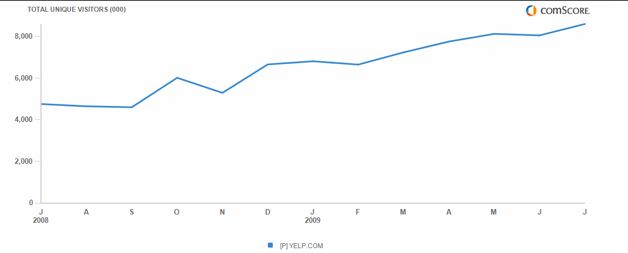
Say what you will about the quality of the reviews on Yelp or the lengths it will go to get verboten features into its iPhone app, it has made the jump from Web 2.0 darling to a mainstream service. Over the past year, Yelp has nearly doubled its U.S. audience, while incumbent CitySearch has remained flat. In July, Yelp had 8.6 million unique U.S. visitors, up 80 percent from a year ago. Citysearch, on the other hand, literally had zero growth, staying at 15.4 million uniques, although it bottomed at 13 million in April and has come back up since then (comScore).
Yelp also has the No. 1 travel app on the iPhone (it is No. 26 overall). Whereas Citysearch’s similar iPhone app is not even in the top 20 travel apps.
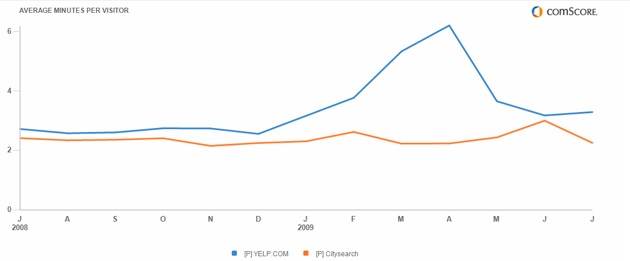
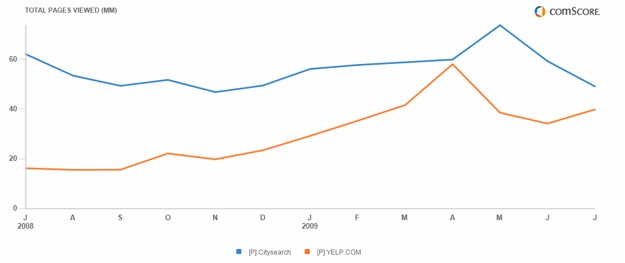
Yelp’s pageviews and average time spent per user on the site are also up 150 percent and 22 percent, respectively. In fact, the 3.3 average minutes per visitor on Yelp is above Citysearch’s 2.3 minute average. But comScore shows a steep drop in both pageviews and average time spent starting in May, with a leveling off in July. Citysearch experienced similar drops. (See charts below). It’s hard to say what is causing these drops. It could be that people are not finding what they are looking for, or the opposite, that they are finding what they need faster due to better site design. I suspect it has something to do with the latter. For instance, a much-improved Citysearch redesign went site-wide in March and Yelp is constantly tweaking its site. Update: Kara Nortman, the executive who runs Citysearch, says that the pageview numbers are down slightly, but not as much as comScore suggests. Part of this has to do with Citysearch actually going through the site and “pulling out pages that are not great consumer experiences,” which hurts SEO, but improves the site overall. Citysearch is also trying to reduce the number of searches it takes ti get to what you want, which also causes pageviews to drop.
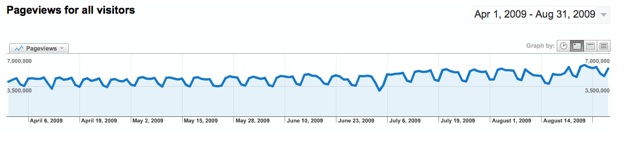
I asked Yelp CEO Jeremy Stoppelman about the pageview situation, and he sent me an internal Google Analytics chart pasted at bottom of this post). “As you can see we’ve continued to grow pageviews smoothly throughout the summer,” he says, “so it looks like the effect Comscore is reporting is spurious.” There is definitely a discrepancy there. Stoppleman also says that worldwide Yelp did 157 million pageviews in August (although he thinks that is becoming a less a meaningful metric as Ajax redesigns reduce the need for page refreshes) and more than 25 million unique visitors. (The comScore numbers cited above are only for the U.S.)
Yelp came out with a major update for its iPhone app in April, right about the time the pageviews started to allegedly decline. But Stoppelman doesn’t think that is it either. There might be some shift over to mobile, but he’s seeing the following trends:
Mobile usage for us is lowest early in the week and climbs throughout, peaking on Saturday. Desktop web usage (especially contributions) tends to be highest on Monday or Tuesday (though Yelp.com reader traffic sometimes peaks on Fridays as people plan their weekend in the office
.
No matter which way you cut the numbers, though, Yelp is gaining fast on Citysearch. Update “I worry about everyone,” says Citysearch’s Nortman. “I think you’ll start to see some pretty strategic initiatives roll out across the web and mobile. We have this new neighborhood platform in place. We have to fill it up with trusted content.” That is how Citysearch will try to stand apart, by having reviews and other content that is more trustworthy than Yelp’s. Which site do you trust more?
Average Minutes Per Visitor
Total Pageviews
Yelp’s Daily Pageviews (Google Analytics)


and the winner is…none of the above. people are still using google to find local stuff, and they’ll take whatever reviews etc end up near the top of the results. sometimes that is yelp, sometimes its something else
the real question is when does yelp become viable. they’ve been around for years now, with no buyouts, no ipo, no anything. is this thing just a money sink? and are they still playing slimeball with businesses?
That is true, but Yelp ranks VERY well in organic searches, which yields to good traffic for them…that also turn into users.
Yelp is touching greater heights and also has the No. 1 travel app on the iPhone.As per comscore metrics ,Yelp has come out with a major update for its iPhone app but the Citysearch experienced similar drops at the sametime. So, with this metrics we can’t come to the conclusion because for sometime Yelp yields to good traffic which also turns into users and sometime it is non-profitable too.
We have to wait for both Yelp’s and Citysearch’s growth!!
Depends on where you live I would say…
When I lived in NYC I was used Google, Menupages, or CitySearch. But now I live in the Bay Area, Yelp is my first destination for local reviews because nothing else even comes close.
Yelp is still not profitable while Citysearch is.
Are either of these statements true?
In comment club, all statements are true.
I don’t know why. But everytime I was trying to search something using Google, Yelp always came on the top. I don’t even have a chance to scroll down to enter the CitySearch site. Just thought this could contribute to Yelp’s growth.
You mean Google may be manipulating its search results to favor smaller sites over big players that could eventually be competitors to Google itself? Nooooooo….
yelp is all about SEO and showing up in google. that’s where the growth is coming from.. duh!
Sorry, but every time i hear someone complaining about the quality of reviews on yelp i always think that they are complete idiots.
Yes, they are random opinions, take them for what they are. It’s not a professor discussing physics. Use them to get a feel for what the place is like, try it (or not), and come to your own conclusions.
I’ve been watching Merchantcircle’s progress with interest. Seems to me this could be the next big thing in the US when it comes to local search.
Merchantcircle is dreadful. All ads and virtually no content.
Does anyone know if Yelp is profitable? I’m curious to know how they go about selecting which destination to add….
Jazz Poulin
Founder
Tripulu
Citysearch allows so many obviously fake reviews and BS it is ridiculous. They cater to the advertisers not the users. Yelp, on the other hand, caters to users. Result: Yelp rocks and Citysearch sucks
Yea, but what’s 100 times zero? When you have no traffic (400 visitors per month?) it is a lot easier to grow.
well its a trade off as to how you want to become profitable ….by no of users or by adv and paid links.
Citysearch is mainly driven by paid links and for the informed visitor it wont take time to figure out whats going on and where
what about menupages? does it not even come close to yelp? i always find menupages more helpful, especially when it comes to ranking prices…yelp tends to under measure…like $$ on yelp = $$$ on menupages…i guess thats all a matter of personal finances…yea, i’m poor…
yawn
As it stands today, I find it hard to see anyone beating Google in local search. They scrape the best of Yelp + Citysearch + TripAdvisor +++ and aggregate/package all the scraped content together into increasingly useful summaries. Ultimately, whoever provides the most complete/comprehensive info for users wins. And right now that looks like it’ll be Google for local search.
I also wonder how much money Yelp makes. Traffic is great if you can monetize it, otherwise it’s a money pit.
I agree that Google is a tough one to beat but at the end of the day most of these websites are simply aggregating the same data….
I think boutique website like Oyster, (mine on a small scale…) are important because we’re generating new content that you can’t always find.
Who’s more valuable long term…the aggregater or the original content?
Value is in the eye of the beholder
Yelp has a lot of great data but does not do a good job for specific categories & searches. For example, I want to find dog parks that are fenced or beaches that allow dogs.
If you’re looking for dog friendly locations check out the Fido Factor website & iPhone app. The site is Bay Area focused right now but rapidly expanding to new cities including Boston and New York. http://www.fidofactor.com.
Clearly Yelp Rocks and Citysearch/IAC sucks, which stands for I AM CONFUSED!
and the winner is foursquare!
Yelp needs to do more on the lines of http://www.offeretti.com for special deals.
When one’s entire business model is based on trust, transparency is the only viable practice. Does anyone know if Yelp has addressed this rigging allegation yet?
http://www.east...tent?oid=927491
That’s all a load of baloney parroted by idiotic business owners.
This response is similar to Yelp’s answer back then, which was completely useless in addressing people’s concern.
Either sue the EastBay paper for slander, or fess up & repent. Either way, the answer is transparency… not name-calling.
Yelp’s business model is extortion, good luck with that model!
Transparency is a joke at Yelp.. Just look at the CEO’s Jeremy Stoppelman blog you can’t even comment on it.. that about sums it.
Both Yelp and Citysearch suck. Didn’t Citysearch hook up with Myspace earlier this year? I think I remember getting a good laugh out of that. Wonder how that’s working out for them? LOL. I guess they deserve one another.
Citysearch is the dominant business when it comes to local search. Of course Google is the 800 lb gorilla in the room, but the daily budgeting of adword campaigns and the dissapearance of your ad if you reach that budget is absurd. If you pay to be on a site, as a merchant, you should appear, no matter what.
Citysearch/ IAC owns MerchantCircle too I think, so lookout for that partnership. Yelp is just teenagers complaining about bad spicy tuna rolls and why they couldn’t get into a bar with their fake ID. It’s jibberish. At least you get to see what the business says about themselves on Citysearch.
I’d say about 6 or 7 years ago, something changed at Citysearch and it became just another online yellow pages. Bascially, it jumped the shark around that time from something cool and useful to a big list of addresses.
Yelp has been a good replacement. On a recent trip to NY, I used it often. In some cases, however, I got the odd feeling (upon visiting the establishment) that some reviews for particular businesses just had to be the product of the business owners, their friends, and family.
Sorry about the dupe (then edited post) below. The server claimed it was “out of nodes” in when I clicked Add Comment. So, I made some edits and re-submitted.
I’d say about 6 or 7 years ago, something changed at Citysearch and I feel it became just another online yellow pages. Basically, I think it jumped the shark around that time from something cool and useful to a big list of addresses.
Yelp has been a good replacement. On a recent trip to NY, I used it often and with good results. I found my time on Yelp became shorter as I more often relied on sorting search results by “Most Reviewed”, then just sticking to the places that had the most reviews. Otherwise, you could read reviews all night and never go out.
In some rare cases on Yelp, however, I got the odd feeling (upon visiting the business under review) that some reviews just had to be the product of the business owner(s), their friends, and family.
Yelp is getting participation and traffic which sets them apart from thousands of other local/social startups, so worth paying attention to what they are doing right. But they aren’t making money and Citysearch is. Will be interesting to see what happens to Yelp when the pressure is really on to turn a profit.
This article also misses the fact that a lot of Citysearch’s growth has come from syndication. Seems like an incomplete story without that.
The math does not look correct.
According to the comScore graph, Yelp had almost 38MM pageviews in June 2009. However, according to the Google Analytics screenshot, it looks like yelp was averaging between 4-5MM pageviews per day –> that would mean total pageviews would be between 120-150MM pageviews. comScore is nowhere near that figure.
prob a combination of the Comscore pageview count being lower than reality (very commonplace) and the Goog Analytics count including non-US visitors (tho one would expect most of yelp’s traffic to be US visits being a local site)
I think “reviews” are more relevant from your friends or people like you. Yelp is great to get a feel for a restaurant but if your friends aren’t the ones writing the reviews, it’s still a bunch of chatter from random strangers who probably have different tastes than you.
Aggregators of reviews and information from different sites (i.e. Google) are no better.
“Yelp is great to get a feel for a restaurant but if your friends aren’t the ones writing the reviews, it’s still a bunch of chatter from random strangers who probably have different tastes than you.”
uhh yeah that is why the reviews are not anonymous – so you can associate them with an individual, and follow/befriend your favorite reviewers
What?
Nearly all Yelp users are anonymous.
Just like you, “jerm”. This is one of many, many reasons Yelp is untrustworthy and not useful.