Have you nominated someone for a Crunchie today? »
The Mobile Payments Rivalry Heats Up
by Leena Rao on September 1, 2009

Mobile payments for micro-transactions on the web are catching wind and there are several players in the space vying for the top spot in the field. Today, Boku, a recently launched mobile payments conglomorate of sorts, is announcing a slew of new customer acquisitions as well as details of its international expansion.

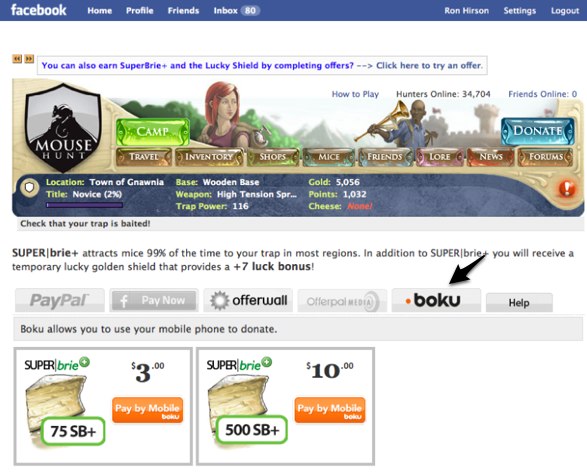
Boku, which acquired competitors Paymo and Mobillcash and raised $13 million in Series A funding back in June, doesn’t require users to have a credit card or bank account to make a micropayment. Users enter their cell phone number on the site, reply to a text message and then all virtual charges are automatically charged to the user’s monthly cell phone bill. As we’ve said in the past, it’s ridiculously easy.

Because of its acquisition of Paymo and Mobillcash, systems that had significant international reach, BOKU gained a strong base of users around the world. Today’s announcement adds availability of the payment service in Finland, Indonesia, Slovenia and Taiwan, bringing the company’s global reach to 56 countries. Boku’s marketing chief Ron Hirson tell us that they are seeing a strong foothold in Southeast Asia and will be expanding to the Phillipines within a few weeks.

Boku has also added a number of online gaming sites, social network applications and the social networks themselves over the past few months, including Playfish, HitGrab and Gambit. Boku says that currently they have over 1000 customers that use its mobile payments platform. So far, Boku has powered 6.5 million online mobile transactions.

But competition is stiff in this field and one competitor in particular, Zong, has also witnessed strong growth over the past few months. Most recently, Zong was chosen to test a pilot program for mobile payments for Facebook’s virtual currency, Credits. While Zong may not have had the organic international base that Boku has (Zong is available in 19 countries), this partnership is sure to help Zong’s global reach thanks to Facebook’s ever growing presence and popularity around the world. Zong also reached a big milestone a few weeks after processing mobile payments for 10 million unique users in 2009.

However, the potential obstacle to Boku, Zong and other mobile payments platforms are the high fees that mobile carriers charge to the payment systems (which are then passed on to the consumer). Boku told us on June that different cell phone carriers charge varying fees that range between 10% to 50% of the purchase price, which is a hefty amount in transaction fees.

But if mobile carriers lower their fees, mobile payments have the potential to be the go-to way to pay for microtransactions. David Marcus, CEO of Zong, says that many U.S. and European carriers that Zong works with are contemplating reducing these fees by building large-scale models to process payments that would in turn lessen the pressure on startups like Zong and Boku as well as the applications and social networks using the systems. Marcus feels confident that if this does happen, the sky is the limit with mobile payments.

Regardless, as shown by growth witnessed by both Boku and Zong, mobile payments are catching on and attracting the attention of some of technology’s giants, like Facebook. And of course the rivalry and ensuing competition between the two companies could continue to spur further innovation and growth. It will certainly be fascinating to see which startup comes out ahead.

Advertisement

Comments rss icon

  • Everything that is ‘ridiculously easy’ is ridiculously easy to abuse. Sorry to say that.
    The potential of abuse (well proven during the ‘ring tone craze’) is just tremendous, especially on the web-sites that allow vaguely defined ‘third parties’ to receive payments through the channel (FB and the like).

  • I think its going to be tough for these carrier dependent mobile payments to go beyond selling virtual gifts. Real products cannot afford such high commission fees.

  • “…European carriers that Zong works with are contemplating reducing these fees.”
    Sorry to say this is not going to happen anytime soon. For someone who is in the industry he should know that MNO internal costs to charge a mobile payment to the user’s monthly cell phone bill are just too high to reduce these fees.

  • What motivation do the cell phone carriers have i) to lower fees – they have monopoly power; or, ii) to increase the size of payments – they would become credit card companies?

    They have little motivation, and there is nothing that stops them from cutting the Zongs & Bokus off and doing it themselves.

    In the meantime, merchants selling goods with real costs, i.e. non-virtual goods have little motivation to add these payment methods.

  • 1) The credit card industry is huge and profitable- why wouldn’t the carriers want a piece?

    2) The benefit of a BOKU of Zong is that 1 integration gets a publisher many carriers – setting up a deal with each carrier (and then ensuring compliance going forward) would be quite difficult and far from a publisher’s core business.

    3) True, the fee structure today poses a challenge for physical-goods sales. However, see point #1 above! The fees will fall over time; South Korea and the UK demonstrate this.

  • Like I’d mentioned in a reent blog post, Zong does make a convincing argument that, despite high transaction costs, their 10X conversion rates can result in greater net revenues for the merchant as compared to credit card based payments. But, it remains to be seen how many merchants rigorously measure shopping cart abandonments in the first place; and, even amongst those that do, it is questionable how many will attribute abandonments solely to the lack of convenience and / or security inherent in other payment methods that cost them much less than GYMPS – Generation Y Mobile Payments, a term I coined to differentiate Boku, Zong, and others in their genre, from conventional mobile wallet providers who merely link the mobile phone to a credit / debit card account.

  • It’s an interesting concept / idea. It appears the wireless companies are ready to carry the debt and create revolving payment plans? I must have missed that part of the solution. Have they reduced merchant interchange fee’s due to CP or pined Debit transactions, I must have missed that part as well. Do the transaction scenario’s interface with any brick and mortar merchants in any way? Do they allow the user to carry a monthly revolving payment with a nominal interest rate, missed that part as well. However, it is an interesting concept/idea, just thankful it’s not my money they invested.

  • it’s a ploy – kiddies play, mommies/daddies pay. that’s where the conversion rate jump.

    carriers won’t lower fees.

  • because of the risk of abuse of ridiculously easy payment and subsequent refunds the carriers e.g. In usa require each zong or boku submerchant to be separately approved so the idea of just turning on payment is rather over hyped by zong and their ilk. nevertheless with right controls like payforit in uk things can work.

  • @dw2 makes a good point. enabling “on bill payment” in the USA is a nightmare. Because of the litigation culture (my opinion, not fact) of the states carriers are terrified of potential class action lawsuit type scenarios. For that reason as a content distributor you are made to jump through many hurdles before payment is enabled.

    I speak only from my experiences based on Bango. Strange that Bango are not mentioned in this post anywhere. Perhaps not such big players in the states?

  • The payment system below is the best I’ve ever come across. Real time payment where cash is immediately available through any ATM or EFTPOS.

    South Australian software development and electronic payment services company, txt2,
    has developed what can only be described as a ‘revolution in the mobile commerce
    arena’.

    While most mobile content developers have concentrated on developing premium
    SMS services for such things as competitions, bus schedules, horoscopes, sports results,
    etc., txt2 has been busy bringing to market the first real-time mobile commerce platform
    built around its ‘world first’ virtual banking and payment system.

    Unlike other mobile commerce platforms which only deliver relatively inexpensive
    content because of an inability to process a debit card transaction, txt2’s platform with its
    real-time payment component gives organisations a direct conduit to a customer’s hip
    pocket.

    In essence, the customers’ mobile phone becomes your shop front; a shop where
    even the largest purchase can be ordered and paid for via a simple SMS transaction.

    A major component of txt2’s technology is their Stored Value Debit Card branded
    txt2Pay.

    Similar to a standard bank debit card but without the need for a traditional bank
    account, txt2Pay cardholders load their cards with cash and then have access to their
    funds through the international ATM and EFTPOS infrastructure.

    More importantly, cardholders can purchase goods or services over txt2’s mobile commerce
    platform without the need for store accounts or credit cards.

Leave Comment

Commenting Options

Enter your personal information to the left, or sign in with your Facebook account by clicking the button below.

Alternatively, you can create an avatar that will appear whenever you leave a comment on a Gravatar-enabled blog.

Trackback URL
Short URL
bugbugbugbug
Techcrunch on Facebook