Twitter’s Golden Ratio (That No One Likes To Talk About)
by MG Siegler on August 26, 2009

golden-ratio-livioIf you’re new to Twitter, life is easy. A notification comes in that someone is following you, and you probably follow them back. After all, you’re going to want some tweets in your stream. After a couple dozen of those, you may start using more discretion, looking over the person’s profile and their most recent tweets. But that gets old quickly as well, and inevitably you turn to using the secret ratio that nearly everyone knows (whether they realize it or not) to determine who is worth following back: “Followers” versus “following”.

If a person has more followers than they are following, they’re probably a good person to at least consider following. If they are following more than they have more followers, the opposite may be true. The greater the discrepancy between the two numbers, the more likely each of those is true — to a certain point, since celebrities like Oprah throw this system out of whack. But for regular, non-Hollywood celebrities, the system works remarkably well as a filter.

One reason why this works so well is that the email notifications you receive now every time you get a new follower put this information front and center. Next to their profile image, these emails list:

1 – number of followers the user has

2 – number of tweets they’ve made

3 – the number of people that user is following

If 1 is greater than 3 (let’s call it a “positive ratio”), it could be worth clicking through to that person’s profile. If 1 is much greater than 3, they most certainly are at least worth looking at. If 3 is greater than 1 (the “negative ratio”) by a large margin, the likelihood that they’re a spammer or marketer is pretty good (and as such, probably someone you don’t want to follow). If they’re ratio is close to even, they may be worth looking at on a case-by-case basis.
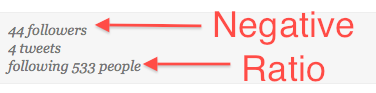
screen-shot-2009-08-26-at-12608-amObviously, there are always exceptions. On a user-by-user basis, people will have friends that have negative ratios, but they’ll obviously follow them regardless of the ratio. But on a large scale, when you’re getting multiple requests that you need to filter through, the system works pretty well.

That said, this post will undoubtedly piss a lot of people off.

The fact is that while most people do on some level realize this ratio is true, a lot of people don’t like talking about it. The reason is that it goes up against a fundamental belief of social networking: The idea that if you follow someone, whether you admit it or not, you want them to follow you back. But the reality is that on Twitter, thanks to its asymmetric social graph, that quite often doesn’t happen.

And so we have a Twitter ecosystem that has more negative ratio users than the other way around. And no one likes being told that they’re not a beautiful and unique snowflake, so I’ll understand if this upsets some of you. But it doesn’t make it any less true.
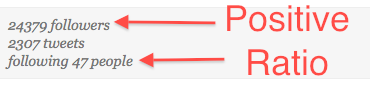
screen-shot-2009-08-26-at-12801-amSince the beginning of Twitter, people have been complaining about hugely positive ratios: “He only follows 10 people,” and the like. The implication being made is that if a lot of people follow you, but you don’t follow a lot of people, you aren’t a “true” Twitter user. That talk has lessened a bit with some of the celebrities now on Twitter who can’t possibly be expected to follow millions of people, but plenty of users still bitch about followers/following inequalities.

But the fact of the matter is that a person can only follow so many people on Twitter before the idea of following starts to become meaningless. Because Twitter doesn’t have built-in relationship filters or the ability to search only those people you are following (both of which FriendFeed and some other services with Twitter-functionality offer), if you are following thousands of people, the likelihood that you’re going to get a meaningful experience from any single follower is pretty small.

But if you’re only following say 20 people, and you’re active on Twitter, you probably see just about everything each of those 20 people say. That’s the reason people have started setting up separate accounts just to follow the people they really want to follow. It’s a filter work-around, of sorts.

The idea of following thousands of people is just ridiculous. From what I’ve seen, as I mention above, the people who do this most often are either spammers or it’s someone trying to promote something. The idea is that the more people you follow, the more are likely to follow you back, the more reach you get for whatever it is you’re promoting (even if that’s yourself).

Now, again, before everyone starts screaming in the comments, I know there are exceptions to this rule. Certainly for newer users trying to get a sense of using Twitter and build up their followers, the ratio won’t apply. But when we start getting into the hundreds and thousands of followers, the ratio starts to work.

And besides, I’m just pointing out a system you probably already use whether you realize it (or will admit to) or not.

Advertisement

Responses

Comments rss icon

  • I personally have more followers than I follow, but that’s because about half of my followers are people I’ve never heard of and I can assume are the exact types of people mentioned here.

    However, on the Twitter account I run for my university, I followed a large number of people who mentioned the university in their tweets. This… “targeted following” actually resulted in about 50% of those that I followed following me, because it was the account for the university they had recently tweeted about.

    A side note… About 10% of those I followed as the university blocked me. :P

    • Ditto. I follow about 285 people. I am followed by about 505 people. Following new people is largely based on the following:

      1. Obviously shared interests.
      2. Ratio of follows/followers.
      3. Total number of followers.
      4. Willingness to respond when I DM them with a @ reply with why the followed me.

      The last one for me is the important one. There is an account that followed me. It was out of the blue. It followed 67,000 people and was followed by 64,000 people. We had no shared interests. They didn’t @ reply with why they followed me. They and one of their “friends” replied with scorn and derision when I implied they were fishing for autofollows. (Which, you know, really is a bad brand decision. Boys and girls, tell your friends not to do that.) I had no keywords that matched. They could offer me no reasons why they followed me. Dumb dumb dumb. There is no reason that any business could articulate for me as to why they would need to follow 67,000 people. Following people with no shared interests like that? That’s spam following. But I digress.

      I do agree with the golden ratio to a degree. I wish people gaming for autofollows would look at my follows/followers ratio would go “This is really unbalanced. No autofollow here.” Or better yet, knowing about the golden ratio, build a better script so that they take that into account when gaming for autofollowers. (Those who follow more are likely to follow everyone.)

      I could believe a 10% block.

    • Does golden ratio helps to know whether a twitter is active or not??

      >> But the number of followers and following will vary according to the profession/social media habit of a twitter user. So, I feel the ratio and proportion as per the golden ratio might not determine the effectiveness and role of twitter exactly.

      • True. I know a lot of fangirls and fanboys on Twitter who use the service to follow celebs. They might be following 100 people and be followed only by 10 people in return: Their friends. If you are a casual user using Twitter to keep up with celebrity news and gossip, then that is a legit balance.

  • This is why I unfollowed everyone. http://scobleiz...-so-unfollowed/ now I’m following 2,400 and getting really great quality in bound. It doesn’t really matter who follows you, just who you are following. By the way, I looked at thousands of Twitterers’ accounts and found that almost to a rule the best Tweets came from people who were following fewer than 2,000 people.

    • you realize you are saying then that your tweets aren’t good then since you’re 400 over your limit :) but yes, agreed.

    • Crappy, that post was deleted. My wordpress was hacked and I think that got caught! Anyway, I unfollowed 106,000 on Twitter and refollowed only 2,400 by hand. Took more than 40 hours worth of work to do, too.

    • who looks at their inbound stream anyway? it’s all about RSSing search keywords.

      the follower/following ratio is one indicator, number of tweets is another.

      also you have to look at whether the person is engaging with others, are the @ replies and RTs in their stream – if not, don’t follow.

      • I look at mine. You should see http://twitter....eizer/favorites to see what having a great inbound means to the outbound.

        • I just learned about Jolicloud from your favorites, thanks!

        • frustrated 'thought follower' - August 26th, 2009 at 11:52 am PDT

          I don’t know why Robert, but it really bothers me that you used to be all about following everyone, even evangelizing that others do the same and simply use smart filtration mechanisms and surf habits to discern signal from noise.

          Now you’re all about the this idea of the top 2000, and “you are who you follow” (?)

          So you know, I’m an early adopter who’s been following you, your blog, commenting on , and even submitting some of your posts to social media sites *for years* and even I was evidently one of the unclean masses not worthy of your mutual respect.

          I don’t say this out of hurt feelings, hell my wife unhooked my tweet stream from her SMS ;-p

          It’s just all this high school clique shit is not thought leadership. You are *NOT* ‘who you follow’ on these social media sites.

          …In other news, there’s a massive XSS hole on the site, but lets talk about the golden follower ratio(no offense, MG) and how social media makes grown-ups act like kids again.

      • Surely most Twitter users read their inbound stream?

        I’m following about 400, and while I like the search feature when I’m doing something specific (playing with a hashtag, watching some TV event, or whatever) for day-to-day use I want to know what my 350 favourite users and 50 obsolete feeds I haven’t bothered deleting are up to. It’s a good way to get a selection of things on no particular topic that are likely to interest me.

    • Personally I don’t follow most anyone that follows more than 500 people. I understand the differing values of watching the stream vs. swimming within it, but in my quest for more signal, less noise I find it helpful.

      Similarly I find I don’t trust anyone that posts more than 5x a day. It’s very rarely that people have more than 5 insights or shares that are meaningful to me in a day.

      This is just me. Sometimes I wish active posters had a second account for just the nuggets and not the conversation.

  • Some ppl just follow so many ppls to increase the following number and to take the chance if they follow back or from some twitter follower increase sites/service. but in reality its impossible/boring to follow so many ppls. so a good twitter guy should have less follower, many following and reasonable tweet frequency.

    • yep, pretty much agree with everything there.

    • I agree. I have been on twitter since sometime in 2007, and just recently got around 300ish followers and people being followed. I have interacted with 100 or so of those friends for years. When they tweet something, I am more than likely interested in it. We have bonded.

      I have to admit though that when I see someone who has been on twitter for only a few months with like 1000 followers, I do feel like I am missing out at times, because there are a lot of great people to follow on twitter.

  • I CANT WAIT WHEN TWITTER DIES OUT AND I CAN LAUGH AT MG SIEGLER MY WHOLE LIFE…

  • why so concerned that people will scream? i thought this was obvious to people who understand twitter.. and certainly to techcrunch readers. its very simple.. the greater your positive ratio.. the cooler you are and more girls you’re likely to get in your lifetime.

  • My rule of thumb is that I follow people smell good

  • That actually works but again the ratios of followers to following sometimes gets skewed by the Twitter spammers following an account.

  • Totally agree. While spammers try to disguise themselves better (by having a better ratio) the “golden” ratio is still one of the best ways to spot them.

    [Shameless promotion]That’s why in Topify notifications, we put this numbers in the subject line – saving you from even opening the email notification.[/Shameless promotion] :)

    • The bots are getting damn good. Twitter is the ultimate touring test. AI will emerge out of twitter, not Cyberdyne ;)

      • Yes, bots will take over Twitter, both for good and evil. It’s the perfect platform for them.

        Take a look at some of the #artificialintelligence topics and work already circulating. The irony is that “social media” will become a place where humans interact with machines, not each other, because machines will give them what they need (and maybe what they want).

    • @Arik, Yes Topify is very practical. It is really nice to get this ratio. And if you remember, I suggested to @topify a few months ago to add a filter based on this ratio. The user would set up bounds to eliminate alerts from users outside these bounds. You told me you were already working on it. So, will the feature be released soon?
      It is becoming a hot topic thx to MG.

  • Seems interesting to compare my ratio to others ..
    if it would be rules .. may we can play a little with code and make a script for deciding whether user has positive or negative ratio ;)

  • I kind of hit on this in a recent post. I tend to look at the whole ratio thing a little differently. I hardly ever follow anyone that follows tons of people, but have barely any followers. They more than likely spam. People with a realistic amount of followers, say 1000, and are only following 100 ish people, I tend to avoid. These people generally don’t interact, and the idea is to “listen” to these people. I am only a fan of about 2 people, and 1 of them is 5 years old and loves dinosaurs.

    People with even ratios are the people that I care to follow. They more than likely will share quality stuff, and they are more likely to interact with others. Some of my best friends on twitter have even ratios.

    I do follow a few people that have tons of followers and barely follow anyone. Like I follow that Scoble guy because everyone else does, but I still have no clue who he is. I followed Shaq also. I guess I followed those 2 and a few others, just to see what people got out of listening but no interaction. I haven’t got much thus far.

    • The follows/er ratio of one to ten is kind of unbalanced, yes. But some? The social media people seem to place an overly large emphasis on the number of Twitter followers a person has. Given that, it can be … hard to block people who are legitimate tweet sources, people with radically different political views or obvious spammers. So that can skew ratios. :(

  • This has actually been my rule for over a couple of months now, and after trying it out it sure helps me weed out the spammers and marketers.

    Now I don’t even check out a persons profile if that person has following over 1000.

    But I’ve become more annoyed by people who flood my twitter page and I’m unable to see anybody else (kinda). Please tell me I’m not the only one that does that?

  • f/f-ratio is bullshit. get a life.

  • Wait … someone pays you to write this crap?

  • Its all so simple??? I am not a numbers person, wrong or right I just don’t know (maybe I am jealous because I would like to see more followers interested in my humble opinion). What I do know is that unless there is something interesting/relevant to say then don’t say it!

    Over tweeting turns people right off – who cares if its raining outside, or if you have eaten an egg sandwich. We are all still learning and no harm in learning together…

  • Worrying about numbers must be pure vanity.

    If you want to talk to someone, follow them. If you don’t, don’t.

    Unfortunately this angst is fed by the info you get from Twitter, feeding the myth that numbers matter. Somewhere someone has to be out of kilter. It’s maths!

    I follow lots of news feeds (it’s my job) they don’t follow back and I don’t want them to – I’ll speak to journalists not a feed.

    Am having to consider a separate ‘following’ Twitter account just to redress the balance. An awful lot of work for no really good reason. I can amanage my account through the wonderful tools available free on Twitter.

    But it’s looking more necessary by the day if I am to maintain any kind of reputation. Ah me!

  • I think the one thing that’s hard to really quantify is the high number of people who have started using twitter as little more than a manual RSS feed, both on the publishing and reading end of the spectrum since it “blew up” a few months ago. This applies to both real-world celebrities, twitter celebs, and social-network savvy content providers.

    That said, this whole article makes my long-neglected math brain happy.

  • I’m not going to scream at this article. I think it’s completely valid, and ratios are one way to get an instant idea of someone’s credentials and motives.

    I tend to follow only people who are genuinly interested in conversation, the exchange of ideas and what Twitter has to offer, whether they are famous or not. People in this category are characterized by having any number of followers (from 40 to 40,000), while usually only following 250 people or less. Because, as you point out, if you follow a large number of other Twitter users, it’s impossible to do any actual networking and the whole idea is pointless.

    I block all spam bots and over-the-top marketing gurus (who are obviously not the least bit interested in what I might be able to contribute aside from being a number in their following count). I’m sure that my follower ratio (while still “positive”) suffers from this no-nonsense approach, but I don’t care. I’m not interested in having a lot of followers just to boost my numbers. I want real exchange with real people. When someone follows me, I will follow back if it’s clear to me that this person added me because of a mutual interest or a mutual friend, regardless of how low their following count is. I want quality in my Twitter feed, it’s as simple as that.

  • That is such a Twitter.com-centric way of looking at follows.

    Mutually following people is just plain nice. Not following a follower is like refusing to shake an outstretched hand at a conference — it makes you look like a snob.

    The trick to following everyone is to never again use the Twitter.com interface to read tweets. Instead, go build your small, super-quality groups in Tweetdeck or something similar. Build as many different groups as you want. Sort people you really like to follow.

    Group them in ways that suit you. Maybe have an A-lsit, B-list, C-list. Or maybe create “Tech gurus”, “Media Mavens”, “Business Leaders”. Whatever works for you.

    Turn off the “everybody” column. You won’t miss it.

    What would really help, is a standard for sharing groups — something akin to OPML for rss feeds. My most recently added group is the Top30Under30 (#t30u30)–wish I could share them with you.

    But the power of groups just keeps getting better.
    With tools like Tweetdeck, you can then apply further filters within each group (like only displaying tweets with links by filtering for “http”) to keep the signal to noise ratio even higher.

    You can even see what keywords are trending within each group — which is a far cry more valuable than Twitter’s trending topics.

    So, if you’ve got the right tools, there is no need to be a Twitter snob.

    Go ahead, follow back and make some new user’s day.

    • I agree with @jayoatway – I follow most people but then filter using Tweetdeck. I must admit though that I try my best to unfollow the spammers and those that don’t provide any meaningful value at all.

    • If you’re not interested in what they have to say, why follow them? I have to repeatedly block people who follow me just for the sake of it, if they follow me I expect them to be interested in what I say, otherwise they can piss off. I can guess from your comment you’re some sort of “social media expert” or some heap of wank like that… yep, what a surprise.

      How do you legitimately take an interest in what 70,000 people say? You can’t.

      • There is no binding contract as to what my interest levels need to be.

        Nor must we commit to reading every tweet.

        Following is just a word used by Twitter to connote a connection between users.

        We give the word “following” at lot more meaning than it deserves. We don’t need to make it so precious.

        We are not Messiah’s leading flocks to the promised land, 140 characters at a time. Twitter followings are nothing so grand.

        Usually, followers are simply other users who found you, maybe read you once, and thought you didn’t totally stink.

        Consider another user following you as a compliment. Nothing more.

        • So when you’re pitching your “social media” skills do you tell everyone that you think your network numbers are meaningless?

        • >>>Nor must we commit to reading every tweet.

          That is a matter of perspective. And a dangerous perspective at that as it has the potential to damage the brand you are trying to build. If I were looking to hire some one to do tweeting for me, you would not be hired as a result.

          Why? You obviously don’t understand politics, how people relate to things, the potential to cause offense with your follow, etc.

          Example: Let’s say I am building a brand for Fictional Atheists of America who Want to Ban the Pledge of Allegiance. If I decide to follow everyone who tweets “atheists,” then I could end up following some militant Christians who think I am trying to end their quality of life. They could be extremely offended that I followed them and blow it up into a big media disaster for the brand I am representing. Why would I not be more selective in who I follow to prevent that? If I feel I need to monitor the “opposition,” there are better ways to do it than following them on Twitter.

    • I have to say I agree here. This article is shallow in its perspective. This comment is far more valuable. I follow people that I am interested in. I had 300 people on my list in a matter of days. I was happy to find as many interesting people using Twitter as I did. I dont really care who follows me. I have blocked users from following me because I just dont want my tweets flowing in their direction. If that makes me less cool at MG’s Twitter High School… so be it.

      That said, there is some truth to the statement that one can discern the point of a Twitter user very quickly by just perusing a few stats and a listing of their recent tweets. But the ratio alone is not something I go by. If that mattered, I’d be following Brittany Spears. And in the most condescending tone possible, I say ‘Please!’.

    • >>>Mutually following people is just plain nice. Not following a follower is like refusing to shake an outstretched hand at a conference — it makes you look like a snob.

      I disagree.

      “Hello. I’m a porn star. I would love to tell you all about my career, and provide you links to where you can get my porn on discount.”

      “Hi! I know you’re an ardent gun control person (okay. so not really as I didn’t check out your feed and you never tweeted about this but who cares right? we can still be friends!) but I’m a card carrying member of the NRA. I will be tweeting about how great the NRA is. I will also be talking about my guns.”

      “Yo fo shizzle my dudette! I’m a totally awesome SEO guru! The bestest one in the whole wide world. You love SEO too! Read my tweets (that are all from twitterfeed.) and become a client of mine! It will be a match made in heaven. Quit your own SEO work! I can do it for you!”

      “Dear potential constituent who lives in a county/state/district different than the one I represent from a party that you are not member of and have not historically voted for, please follow me. We share many interests: Politics. I would love for you to vote for me and help me enact real political change in the county I represent.”

      No, sorry. It isn’t rude to block, not follow, unfollow those people. The rude ones? Those are the above examples who followed me in the first place. Your whole model is backwards.

      • I’d nuance that.
        It’s ok not to follow bots or illegitimate users. But if a person is interested in what you have to say, and follows you, then it’s rude not to follow back. And not in your interest. It’s ok to unfollow or block users though.

        and, if you are planning to follow or to be followed by more than a few hundred people, then your account needs professional attention anyway, so the excuse of there’s too much to read doesn’t hold.

        • The original statement didn’t have conditionals. And obviously those people were interested enough to follow me even though they don’t state why and don’t @ reply to me. I DMed a few of them, thanked them for the follow and asked for an @ reply with why they followed me so I could make a better decision whether to follow them. I’ve only had one person do that since I started that.

          But back to point: It is rude to follow people in many cases. “Hi! You tweeted a vacation spot that you are visiting. I am going to follow you.” That is rude to follow me. When I am done with my vacation, I will likely be less interested in your travel advice for people there. A handshake, like the original post said, would involve an @ reply saying “Hi! You’re in Seattle? Let me know if you need help with your travels there.” Then I can chose to follow them because I know they might have useful content for me. That’s more of a handshake. The following because I mentioned vacation spot, where you don’t interact with me beyond the follow, is more like forcing a relationship.

          >>>so the excuse of there’s too much to read doesn’t hold.

          It holds true more than ever. My time is valuable. Your time apparently is not valuable as you’re willing to force relationships on others who may not be sharing targeted content to help your business grow. What’s in my best business interest? Developing relationships with 200 people on Twitter who can help me, who are interested in my service, who might say things that are pertinent to my business interest… or following 20,000 people, where my stream is random, the content unlikely to match my business interests, where things move so quickly that I can’t develop relationships, where I @ reply to a small clique of people, showing to the other 19,950 people that they are not being read? The first one is obviously more professional and in my best business interests.

          Though maybe I can be convinced. Give me your Twitter metrics for how many visits you get to your site as a result of Twitter. I have an account with 4,500 follows/4,000 followers. I can show you how few referrers we get for it. It is pretty damned meaningless. The account with 290 follows/505 followers has proven more valuable in terms of business contacts and traffic. Show me your meaningful metrics that don’t include followers and how they correlate to the total number of followers.

          >>>then your account needs professional attention anyway

          And your not the professional I would hire to do it because you are obsessed with a meaningless number that you haven’t demonstrated has a good ROI.

        • “It’s ok not to follow bots or illegitimate users. But if a person is interested in what you have to say, and follows you, then it’s rude not to follow back. And not in your interest. It’s ok to unfollow or block users though.”

          how does it logically follow if someone finds what you said to be interesting then what they say is/should be interesting to you? If I am a chemist and I say something about chemistry that a poet finds interesting enough to follow, unless I really like poetry and find their comments interesting enough to follow, I shouldn’t follow them. Fake interest/courtesy following is not communication, networking, or even polite – it is misleading at best and condescending at worst.

    • “Not following a follower is like refusing to shake an outstretched hand at a conference — it makes you look like a snob.”

      Actually, it’s more like shaking an outstretched hand and then not letting go for the rest of the conference.

      My question is this: why go through the hassle of finding the right Twitter client and setting up all these neatly organized groups when you can just choose to only follow people you’re actually interested in hearing from? When I follow someone I find interesting I don’t get offended when they don’t follow me back. I could care less, I’m more interested in hearing their thoughts than I am in having their ear.

      The sad fact is that as long as people continue to think it’s proper Twitter etiquette to automatically follow everybody back then these damn auto-follow spam scripts will continue to prevail. Part of the appeal of Twitter is that you can easily control the amount of spam you get by simply not following or un-following people.

      I don’t see any compelling arguments in your post other than not hurting other people’s feelings.

    • “Mutually following people is just plain nice. Not following a follower is like refusing to shake an outstretched hand at a conference — it makes you look like a snob.”

      LOL, don’t let Michael Arrington see that.

  • Honestly, I’ve stopped looking at “X is following you” emails altogether. I only let it keep sending them at all in case someone I actually know joins and adds me.
    Otherwise, if they’re a real person, they’re bound to @reply me at some point, in which time I’ll likely have a look at their profile, and if they seem nice/funny/interesting/whatever I’ll follow them back. You’re probably right about the ratio thing, but srsly, who gives a shit.

    • Same here. I follow people when they have a positive contribution in a discussion with someone I’m already following or when they interact with me with a @reply The mails are automagically archived with some label I cannot even remember.

  • Wow, this is so True!

    The Same Should go for Facebook!..

    People with over 3,000 friends, and haven’t done anything (games/status update/apps/wall post) on Facebook within the past 4 months!

  • I agree with the post: accounts with a high negative ratio are almost always spammers or pushers. But I would also contend that anyone with an extremely high positive ratio — especially if their following number is in the single digits — Is not engaging in the community and you should think twice about encouraging that behavior by following them.

    For extremelu popular users like Scoble it’s impossible not to have a high positive ratio. But, if he were following say only five, ten or even 100 people I’d probably cry foul.

    At the end of the day you’re only truly useful if you’re engaging in the community.

    • Screw that borg shit. If you are providing engaging content to the community *free of charge*, you do not need to subscribe to feeds you are not interested in (and will never read) to be “useful”, whatever that means.

  • Its funny how you are breaking this down like it’s statistics. Twitter is a site not real life get over it. Having friends are better than having “followers”.

  • Agreed totally. I’ve been using this system since I started.

    The ones with negative ratios are also less likely to ever read what you twitter. They are only there so YOU could hear THEM.

  • I follow around 90 people and get followed by some 95-100 but the point is my I follow you- you follow me thing is very rare.
    It depends for me. I am looking to buy a Blackberry 8900, i tend to follow the actual users or the ones who throw some “gyan” on that.
    But yes, my feeds are good enough to follow and manage.
    I can’t manage 2500 “following” ;)

  • I truly only follow the people that I find interesting and have something to contribute to the conversation. I think that one of the huge problems with Twitter is the people who automatically follow anyone who follows them. Some people would say that this is “being social,” but I disagree. For instance, I have no interest in “having my teeth whitened” or “guaranteeing myself 10,000 followers” and I definitely don’t want to invite a virus into my computer by “clicking to see her latest pics.” I will probably never connect with these people, and some of them want to do me harm, why should I follow them? I don’t see this as being anti-social, I see it as me doing my (very small part) to not perpetuate a spammers environment. So my community is small, and yes I do have a slightly negative ratio, but each person that I follow does have something to contribute to a conversation.

  • You shouldn’t project your understanding of Twitter on to every other users. I think your “golden ratio” is more like a rule of thumb. I follow plenty of people with 1:1 ratios who have just as interesting (or more) Tweets than those with a 1:100 or 1:10,000 ratio.

    It’s about content, not how many people someone has chosen to follow.

  • That’s bollocks, respectfully. Whenever I unexpectedly get a new follower I check if they’re a spammer. They always are. I click block. Who actually thinks about ratios?!

  • I follow 40 people and even that is difficult, I can’t imagine following what thousands, if not hundreds of people are doing.

  • look at this one http://twitter.com/renewabill
    has like 24′000 followers but only 4 tweets.
    following/follower ratio can be gamed BIG TIME!

  • You actually wrote an article on that? Can’t stop laughing

  • Christ, you are putting WAY TOO MUCH thought into microblogging. Seriously.

    Your teenage daughter is laughing at you.

  • Using twitter only small period of time I find that for me numbers does`t matter . I usually look at profile and some tweets and if I see that I can learn something new from this content I follow people. And the only people who I blocked are the girls from `funny` sites and people with `black`mouth.

  • I wrote an article a few months ago about what happens when you follow tons of people and then stop.

    I wanted to know if they all stop following you or 50% stop, etc. This might be interesting given the context of this article and the (secret) hope of everyone to have a positive ratio.

    http://kylelibr...owing-everyone/

  • I already knew the positive ratio/negative ratio trick but it’s nice to see someone who knows it too and post it online. Great article there! =)

  • Just a note to the author: Using a number (1-3) to denote another number is generally a bad idea. It would have been much more clear to say: “If C is greater than A…” instead of “If 3 is greater than 1….”

  • People i follow are categorized acc. to reasons why ;-) – i followed because i wanted to tune into their world (celebrity, otherwise not possible w/o twitter); because they followed me first & got me interested after checking their profile; followed to assess if potential to follow, not a celeberity ;-) or found by chance via a follow/following or random search, ohmy … circle of people I know are not yet in twitter, maybe they are but not telling? I found that by making my account protected, screening is easier. I can’t quite kick out someone who followed me but whom I have 0 interest, so i let it be. I am comfortable zapping out one misbehavin’ or extreme fella. 51:64 (at some point 78) and 12 by my door. am just waiting for them to leave ;-(

  • I follow about 50-60 people who I trust and converse with on a regular basis. I guess there’s a reason why over 3000 other people are following me, I am still trying to figure it out.

    Nonetheless, I have talked to clients that have reached the limit (they cannot follow any more people) and unfollowing people always helps.

    Why are you following them, anyway? Just so they will follow you back?

  • Good to know. I have a positive ratio :-)

  • it´s already built in into this website..check it out at http://www.tweetpromote.com

  • This post is pretty unhelpful. Since many of the recommendations include “on a case-by-case basis,” you’re basically saying we’re on our own for the most part, which we already knew.

    There are plenty of Twitter users with lots of followers who talk about things that aren’t relevant to me, so that should be the first filter.

    Then there are celebrities with “great” ratios who are just broadcasting their lives, which may be interesting for some people and utterly useless to others, myself included.

    As to the others, who seem to have good ratios and may be following or followed by people I know and who are interesting, it’s absolutely on a case-by-case basis.

    The title of this article should be: We Can’t Help You.

  • Thanks for the honesty. I’ve been ranting about this stuff for a while at The Noisy Channel:

    http://thenoisy...n-ponzi-scheme/

    http://thenoisy...e-real-twitter/

    http://thenoisy...og-to-pagerank/

    The last describes TunkRank, which you can try out here:

    http://tunkrank.com/

  • The Golden Ratio is about tech and math thousands of years ago. Most Music studios are made according to the “Golden Ratio”. Good Job MG alluding to deep, intelligent examples…

  • While I definitely consider this ratio it’s not an exact science. I mean if someone has way more followings than followers, then no, I’m probably not going to follow them because their tweets are likely nonsense. But there’s some wiggle room too—one must realize that a certain number of a tweeter’s followers are spammers anyway. I think I’ve blocked at least 100 spammers out of my followers list, which of course brings my count down. I will follow real people with a negative ratio unless it’s extreme—some people can handle more information than others. Obviously I don’t follow the spammers. And I do avoid following people with an extreme positive ratio too—unless they’re saying something damn interesting. By the way, in math the Golden Ratio is 1.62.

  • Your Golden Ratio is totally right. That’s a great way to decide who to follow. I wish there was a tool to use to cull your follow list that way.

    http://twitter.com/traderbots <- Positive Ratio

  • Nice write up MG. I propose that there is a missing equation. Relevant Niche Followers. I am increasingly convinced that this can be as low as 1/10th of your total followers. And the only number that really matters.
    With that in mind, Robert probably had about 10,000 really good followers he should not have dropped, me being one of them ;-) That said, I get his updates in FriendFeed still….

  • Whenever I receive a new follower notification, I always click through to the profile page and take a look at their counts, but also the frequency and content of their tweets.

    If they’re tweeting every six seconds, I don’t want to pollute my timeline. If they’re tweeting links or their timeline is all RT’s, I don’t want to pollute my timeline with that either.

    • I unfollowed someone I knew once, just because they were tweeting more than everyone else I was following combined. He/she (dunno which) accounted for probably two-thirds of the tweets in my timeline, maybe more.

  • Remember Zig’s Gold Digger story: the prospector in search of gold must move a lot of dirt to get to the gold. Moving the dirt doesn’t bother him, discourage him, or cause him to complain to his fan base. Instead, he stays focused on finding value, even if it is sometimes buried.

    In the Twitter world, yep, there’s a lot of dirt (as CBNC broke the news a week after we all discussed it on Twitter, 40% of tweets are “useless babble”). So what. If 60% ISN’T that’s fantastic.

    Yes, I follow a lot of people. I interact with everyone who wants to interact with me. Out of the 32K I’m following have come 500+ real life friends in my LOCAL COMMUNITY (Robert, I DO know the neighbor across the street. We actually look out for each other even.)

    Out of 32K followers have come a choice handful of friends in the UK (”friends” means I traveled to see them and we all met at a restaurant in Exeter and had a great time face-to-face. They’ve asked me to return and I’m going to see them again 10/16/09.)

    This whole article skews the 40% useless babble ratio closer to 90%. Would everyone just stop it already with the discussion and comparison on size. Really DOES SIZE MATTER in Twitter? Does it matter in real life?

    If you had to invest time to cultivate 10 new friendships in your local market (without social media, that is), would it be worth it?

    Please. Enough. Who cares if Scoble’s following 104K or 1K or even no K? It is NOT news.

  • “Negative ratios” only exist if one of the numbers is negative. Since you can’t have a negative number of followers/following, you “theory” needs adjusting. Ratios are either high, or low.

    Pay a little more attention before you make a post.

Leave Comment

Commenting Options

Enter your personal information to the left, or sign in with your Facebook account by clicking the button below.

Alternatively, you can create an avatar that will appear whenever you leave a comment on a Gravatar-enabled blog.

Trackback URL
Short URL

RealTime CrunchUp Sponsors:

bugbugbugbug
Techcrunch on Facebook