
Last night, I wrote about the largely unstated but well known rule-of-thumb for Twitter: That people with more followers than the number of people they are following tend to be better people to follow. Such a ratio cannot exist on Facebook because unlike Twitter, it has a symmetric social graph — if you friend someone, they have to accept your friend request or else there is absolutely no connection (not including Fan pages). This puts additional pressure on you to accept all friend requests. It can be a burden.
And I think Facebook realizes that, which is why we’re getting a post today on its blog basically explaining that it’s okay not to accept all requests.
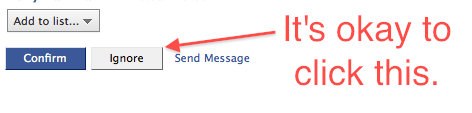
Specifically, the post notes that if you click the button to ignore a friend request, the person who requested you will not be notified about it. Likewise, if you accept someone as a friend, but then later un-friend them, they will not be notified (though they will no longer be able to see your information, nor will you be able to see their’s). And if you don’t want to accept them, but don’t want them to be able to attempt to friend you again, Facebook recommends simply leaving their request pending in your queue.
It’s interesting that Facebook felt the need to go over this again. That seems to speak to confusion over the symmetric nature of its social graph in a world of Twitter and other social services in which the “follower” is more common than the “friend.” Of course, there are benefits to this type of network, the key one being privacy.
But the problem is that as Facebook continues to grow and evolve, we’re getting more and more requests from random people that we don’t actually know. But many of us are using Facebook to spread information just as we do with Twitter (status updates, sharing links, etc), and there is some desire to allow these random people to be able to see some of what you are doing on Facebook. This is why Facebook created the “Everyone Button” and Fan Pages, but both of those seem to complicate the social graph, rather than simplify it.
The solution that I employ is to accept all Facebook friend requests but limit the people I do not actually know to a very basic profile using Facebook’s filters. I then hide many of these people from my main News Feed. The problem is that they still show up when I do things like search for something. It’s a less than ideal solution. Plus, many users of Facebook probably still aren’t using filters (or at least not using them well).
It will be interesting to see how Facebook deals with this issue going forward. Remember that they just purchased FriendFeed, which features a combination of an asymmetric social graph with great filters. I can’t help but wonder if Facebook won’t eventually switch to something like that.
Of course, we’re also hearing that they’re very close to launching their location functionality (just like Twitter recently did), which will once again highlight the importance of privacy. Almost all location-based services are currently symmetric, because while it’s one thing for random people to read your words or see what links you’re sharing, it’s another for them to know where you are. Because of that, on services like Loopt and Foursquare I stick pretty firmly to only accepting users that I actually know.
As they approach 300 million users, Facebook continually has the tough situation of having to deal with these issues while figuring out how to educate all their current users if they intend to make a change. Of course, having 300 million users is a problem a lot of social networks would like to have.
Update: Former TechCrunch writer Mark Hendrickson also shared some great thoughts about Facebook’s social graph on his personal blog recently. Here’s one particularly interesting paragraph:
The main problem is that people’s real-world social graphs change often and automatically, while their virtual representations on Facebook change mostly uni-directionally and manually. In other words, friends come and go in real life; but on Facebook, they usually just come. Friend lists tend to get bloated over time because users have a harder time defriending each other virtually than in real life. And even if they are going to defriend each other virtually, it has to be a deliberative effort, unlike in real-life when you just stop seeing certain people.


Confirm and ignore should not be that close to each other.
Agreed. I demand a divorce. This was obviously an arranged marriage. Human rights now! Also for buttons!
With internet, we can manage MORE friends than in real life. That is advantage, not disadvantage. Also it is like bookmarking good friends.
Facebook should make a list of friends with whom we least interacted recently, or not interacted at all in last month. Like friends with whom we havent commented or messaged or chatted. So that we can remove those friends easily.
And one more thing to blame.. the crew games like mob wars in which you have to add 501 friends to be strongest aaarggh…
This article is hurting my grammar radar.
Usually these aren’t bad, but this one HURTS.
Seriously.
Normally I hate Grammar Nazis but in this case, “their’s” is . . . well, wrong.
http://www.elea...ies/theirs.html
Let me ignore your request…and that’s all I need.
This is actually a good move because you can reject those random junk requests and also requests from your friend turned foes..
a hidden flaw I found is when you accept a person as a friend, then later remove them. Later Facebook will suggest you as a recommended friend and they then realize they had been removed.
true story…
haha. I remember when things like this would happen in college when FB started – back then we just shrugged it off and did not pay that close attention to this.
I had to accept some people removed me as their friends and I found that ok.
This is, indeed, a huge flaw in the system. You’d think they would have fixed it a long time ago, as it affects students most drastically. Just because you had someone first semester last year doesn’t mean you’re friends forever.
That people will more followers than the number of people they are following, tend to be better people to follow.
?????? What’s up with the structure of this sentence?
will=with
fixed.
I deed it
Abort/Ignore/Retry would accurately describe my social network quite accurately. Slow news day?
how about accept the friend request and put them in limited profile list! =P
that’s not a bad idea, have a default limited profile with just something like status updates, and have a ‘accept follower’ button to just give them those. that’s kind of like my filter, but would be easier to understand.
The purgatory button
Ya that’s what I’ve been doing. Just letting them see Basic information but cutting off access to the Wall, Photos etc.
I’m overwhelmed.
Feelings, feelings.
But what about the user that needs to send the extra painful sting of a brutal red-stamped rejection? What button is there for them? How can they appropriately advertise the exclusivity of their clique?
The bigger problem is that “not all friends are created equal”. I have family, personal friends, work friends, old school friends, college friends – many are very tangential. In the modern social network, everyone is at the same “level”.
There should be a “Picking out a thermos for you” button.
MG, you hint at this implication but don’t quite finish the thought… If the architecture of Facebook leads to an unwieldy, polluted dynamic between friend and friended, at what point do people leave for simpler, more private social nets yet to be created?
what about the ‘block’ option? I wonder how many people actually use that
I do. I blocked a stalker.
You know, MG, not everyone wants to use Facebook like they use Twitter. Some of us enjoy the symmetric nature of the “friend” relationship in Facebook. Twitter is where I read anonymous news posts and share links. Facebook is where I connect with my friends and just my friends. That’s why a symmetric relationship make sense in Facebook. Most people do different things on Facebook versus Twitter. Why would anyone on Facebook want people to follow them on Facebook if you’re not gonna friend them? Girls would love the idea of sharing their photos with strangers!
However, I do agree that Fan pages should follow Twitter’s “follow” method.
I use Windows 7 exclusively at work and I use Windows Vista at home. When I’m home, there are so many things I miss about the Windows 7 operating system. I can’t wait until it comes out!
oh yea? really?!
Seriously, I want the feature where I can tell people why I don’t want to be their friends!
Here would be my top 5 in no particular order:
Kevin declined your friendship request! Reason:
Kevin doesn’t like you at all in real life, so he doubts he will like you in the virtual one either.
Kevin has no fucking clue who you are and is strangely comfortable with that status.
Kevin does not want you to be able to read his status updates when he is poking your wife!
Kevin actually meant to click “accept friendship”, but clicked on “reject” instead, so sorry.
Kevin married you, wasn’t that enough? Now fuck-off and leave him alone!
That would be awesome, I would pay for that shit right there.
Bravo… I second the need for this. Would pay cash as well.
Whilst this isn’t rocket science to a lot of users, I have to give credit to Facebook for at least being aware of the fact people exist who don’t want every friend they can get their hands on…
The real world needs to be fixed.
Theres two really simple things for Facebook:
A. Keep two profiles – one for professional relationships/acquaintances/etc. and one for people who would tag you hanging upside down on stage in a bar (aka your close friends).
B. Facebook should create add a default “limited” button where the person is added but automatically restricted to the most strict privacy settings.
Apparently, telling someone “no” is an impossible act of will that demands this much kvetching.
Seriously… why is “ignore” such a f*cking problem?
One thing that a person might notice, though, is that if you request a person to be a friend that person is immediately listed under the “All Connections” in your friends list which says “Friend Request Pending” near their name. If that person ignores your request that person will disappear from the All Connections option. Pretty obvious.
Filters does pretty good job. Only they don’t work in iphone app. Hopefully will get fixed in 3.0 version which is still status pending in app store
One thing I also don’t understand, or would like to see more use related to this area are the Lists. I did a list for my friends who smoke pot so every pot related post I could limited to just that list, then to find that this function was not available in any sort of way, not for posts, links, status, videos or others.
Using lists to filter who’s stream you see or who can see your posts should be the way to fix this issue, then u can have like a list for ppl u know and ppl u don’t or others
I think we all need to move to the point where we accept that defriending will take place. I’m not sure fb trying to hide it is particularly useful or sustainable.
Ultimately, if *you* own that social graph, then it should be very easy for you to see if you’ve been “defriended” by somebody. However, fb makes this pretty hard to do except manually. Apps which would automate this are banned. Once we move away from fb controlling the graph (which is bound to happen eventually), we will have to face the reality of the process
Why did anybody need this blog post? If you can’t tell which people you want to be on your friends list and which people you don’t, and you actually consider this a “burden,” then the problem is with you, not with Facebook.
Wow, techcrunch used to be a nice place for a variety of light technical news. Now it’s just become a haven for writers that think there is such a thing as a twitter or facebook ‘power user’. I’m all for letting writers have a voice, but lets apply *some* editorial controls here – the quality is dropping like a stone…
Maybe it’s being of that dreaded older generation, but I reactivated my FB acct to drum up online business, and it’s just one huge time waster. Not only does it eat up more time than Twitter, most of it is rejecting “friends” that I haven’t wanted to know since high school.
The whole friend pick or reject is time that could have been spent figuring out how to create jobs in a depression, or come up with a real solution for universal health care.
Alas, there goes FB back into “deactivation”!
All that wasted energy and creativity.
this is an interesting post on the facebook problem.
http://www.dail...09/04/16/23413/