Wanna extend your existing IT infrastructure to the cloud? Amazon can help.
Amazon Web Services is today announcing the limited public beta of Virtual Private Cloud (aka Amazon VPC), a service that essentially makes it possible for customers to create their own logically isolated set of Amazon EC2 instances to connect to their existing network over a secured VPN connection. That means Amazon Web Services is taking a major step in making its cloud computing services even more enterprise-friendly than they already were.
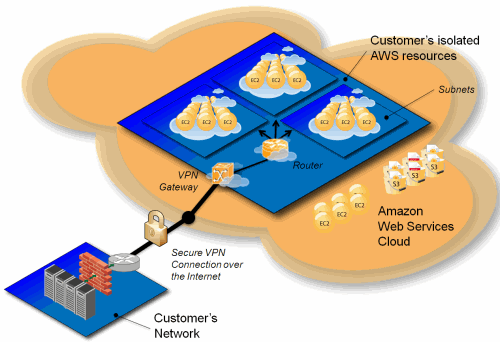
Amazon CTO Werner Vogels has published a lengthy but read-worthy blog post for the occasion, in which he acknowledges that enterprises tend to find it challenging to transition applications and services to the cloud when they have often invested years of resources and tons of money setting up their own IT infrastructure (datacenters, networks, etc.). He also says ‘private clouds’, which are basically emulations of cloud computing inside private networks, are not true clouds as far as he’s concerned and that Amazon VPC adequately fills the void.
To further his point, he lists what you can do with Amazon VPC:
- Create a Virtual Private Cloud and assign an IP address block to the VPC. The address block needs to be CIDR block such that it will be easy for your internal networking to route traffic to and from the VPC instance. These are addresses you own and control, most likely as part of your current datacenter addressing practice.
- Divide the VPC addressing up into subnets in a manner that is convenient for managing the applications and services you want run in the VPC.
- Create a VPN connection between the VPN Gateway that is part of the VPC instance and an IPSec-based VPN router on your own premises. Configure your internal routers such that traffic for the VPC address block will flow over the VPN.
- Start adding AWS cloud resources to your VPC. These resources are fully isolated and can only communicate to other resources in the same VPC and with those resources accessible via the VPN router. Accessibility of other resources, including those on the public internet, is subject to the standard enterprise routing and firewall policies.
A more detailed, technical outline of the offering can be found on the Amazon developer blog.
The Amazon Virtual Private Cloud is currently limited to the EC2 cloud compute service, though Amazon said it will include other web services (e.g. S3) in the future. Pricing, as usual, is based on usage.


Boy, everything old is new again. Ross Perot was doing a rudimentary form of this in the 1960s.
Its really nice to have someone openly addressed the drawbacks of cloud.I suppose this would help cloud computing to reach to new highs.
The major drawback from the Enterprise point of view – the data storage is out of their control. And it still there.
This is like Corio for realz.
http://news.cne..._3-5549359.html
They had an outage some weeks back. Even google app engine was down.
Enterprise customers do not have bandwidth for this kind of downtime.
Still to early for big customers to let everything be outsourced. May be small , non core services
The question is not whether the cloud infrastructure goes down, or whether enterprise IT departments tolerate its downtime, it is whether the enterprise IT department can provide better levels of uptime. In my old company, our network went down far more often than Amazon EC2 did.
Springsource after the acquisition of cloud foundry is offering cloud services on Amazon EC2.
http://www.skil...ise-java-cloud/
Just trying to catch up to Savvis
@Skillguru – enterprises have outages in their own data centers as well.
Amazon will no doubt have some growing pains in this venture, but it will only succeed if they can demonstrate that it has more up-time than internal data centers… and so I believe they will be able to do so in the long run,
check it http://www.sizl...e.blogspot.com/
Cloud vendors starting to realize there is not going to be wholesale migration of datacenters to clouds due to major hurdles (customer control and security) and actually doing something about it is impressive. Enter the Cloud Connectivity Market. As Robin says Amazon’s VPC is an EC2 Connectivity Solution that validates a subset of work we have put into the market for the last year. We at CohesiveFT have focused on customer control of a common connectivity abstraction across multiple cloud or private infrastructures with our VPN-Cubed solution http://www.cohe...d_IPsec_to_EC2/
The Amazon CTO’s blog post is very interesting.
Amazon moves further ahead, leaving the rest behind:
- Google: the one you would have expected to lead in this market but isn’t at all.
- Microsoft: the leader of SME market software
- IBM: where are you ? Agreed to use AWS EC2
- SUN (Oracle): will loose time with integration caused by acquisition
- EMC (VMWare): nowhere close
- HP: seems not wanting to play in this field
Amazon EC2 was cutting edge when it came out, it is cutting edge today.