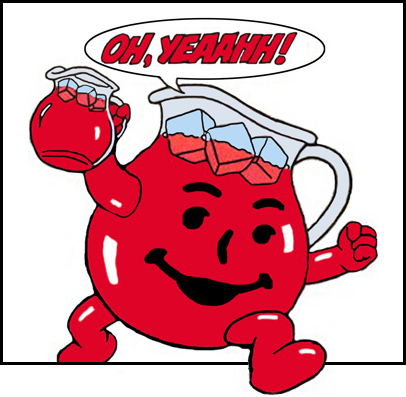
Say what you like about the Google Books Kool-Aid, but it tastes much better than Microsoft’s sour grapes
by Paul Carr on August 22, 2009

koolIf this were a column about religious affairs, I would undoubtedly focus this week on the shocking news that Beelzebub himself has joined a coalition opposing child abuse in the Catholic church.

I’d remark upon the sheer chutzpah of El Diablo, and his glaring hypocrisy in funding a law school to investigate his sworn enemy’s practices. An investigation which, thanks to his involvement, now reeks of self-interest. Self-interest and sulphur.

But this isn’t a column about religious affairs, so I’m not going to discuss that. Instead, as this is a column (broadly) about technology, I’ll confine myself to the entirely unrelated news that Microsoft is joining a coalition to oppose Google’s settlement with the US publishing industry over Book Search. I’ll also touch on the totally unanalogous fact that they’re funding a New York Law School investigation into their biggest rival’s anti-competitive behaviour.

Avid TechCrunch readers would be forgiven for having missed this latest development in the Google Book Search saga. After all, in recent weeks this once-fiercely bipartisan publication has thrust itself headlong into an orgy of Google adulation – a veritable golden shower of fanboyism – apparently triggered by Arrington’s discovery that his Android phone is a bit better than the iPhone.

Nary a day goes by without the Dear Leader splurging more praise over his precious new handset and the undeniably paradigm-shifting fact that it allows him to use Google Voice. In that context, writing a negative story about anything happening in Mountain View might be considered at best inadvisable, at worst sacrilegious.

But as usual I’m not afraid to be the voice in the wilderness. To risk ostracism by asking the questions that need asking: namely, doesn’t Microsoft actually have a point? I mean, where the hell does Google get off criticising Apple for anti-competitive practices when they’re about to be investigated by the Department of Justice for the exact same thing?

Some background, if you need it. Back in 2005, the US book industry – as represented mainly by The Authors Guild and the Association of American Publishers – launched a class-action suit against Google over the Search God’s plans to scan the world’s books and make them searchable through Google Books.

Late last year, after millions of dollars in lawyers fees had changed hands, a settlement was agreed between the parties. Much of it was uncontroversial – a win-win, even: Google would pay a token $60 scanning fee to authors of in-copyright (US) works in return for being allowed to display short extracts of the books as part of their search results. For out-of-print books, users could also pay to download digital copies of the entire work, with a reasonably decent commission being paid to the publisher or author for each download. For in-print books, users would be referred to online retailers or libraries to buy or rent. So far, so fair.

But one aspect of the settlement wasn’t so uncontroversial, and that was the issue of so-called ‘orphan works’ – books which are still in copyright but where the identity of the copyright owner is, for one reason or another, unclear. As part of the settlement, the book industry agreed that, with certain restrictions, Google could scan orphan works without being held liable for breach of copyright claims if the rights owner subsequently came forward. In return Google agreed to create an independent (and open to all) rights registry letting authors of orphaned stake their copyright claim.

At first glance, the deal over orphaned works seems as reasonable as the rest of the settlement – these are books for which no-one is being paid and which otherwise would be hidden away in libraries and second hand bookstores. But still Google’s competitors are crying foul.

The Internet Archive is particularly annoyed, arguing that they too are scanning millions of books for the public good, but without any blanket copyright protection for orphaned works. And so, through a group they call Open Content Alliance, they hope to pressure the Department of Justice to extend the terms of the settlement to everyone, not just Google.

For the other companies joining the Alliance – including Microsoft, Yahoo and Amazon – there are more obvious and nakedly commercial reasons to oppose the settlement. But that doesn’t make their objections less valid. Back in April, Erick Schonfeld wrote a passionate – and compelling – argument for the immunity to apply to everyone so that Google wouldn’t have a monopoly position where they could effectively charge whatever they like for downloading digital copies of orphaned works.

So, yeah, Google love-in be damned – let’s ask the tough quesions. If Google really does care about making the world’s information free, surely bringing rivals into the orphaned works party is the very least they can do? Whatever happened to ‘don’t be evil’?

Yeah.

No.

Erick may be dead right in demanding the orphans be freed, but the Open Content Alliance is dead wrong in both their method and motives for making that happen. Let’s take a quick look at some of the loudest Alliance members, shall we?

First there’s Microsoft – the kings of the anti-trust violation, the monarchs of monopoly. This is a company that gave the Internet Archive ten million dollars to scan books, only to pull the plug when they realised that they couldn’t make any money from their own book search service. The truth is, Microsoft couldn’t give a damn about making information free – remember Encarta? -but they’ll stop at nothing to prevent Google from succeeding where they failed. If Google Genocide launched tomorrow, you can be sure there’d be a lawyer from Redmond whining to a judge that they should be allowed a piece of the action.

At least Amazon wears its biases on its sleeve – in March, Google signed a deal with Sony to put 500,000 public domain titles, scanned by the former, on to the latter’s e-reader device. At a stroke, Sony’s library of ebooks overtook Amazon’s (then) 250,000-strong database. And unlike Sony, which uses the open ePub standard for its titles, Amazon still insists on using its own ridiculous proprietary format. If they really were serious about making books more widely available, they could start by fixing the crappy PDF support for the Kindle.

And then there’s Yahoo. Poor old bandwagon-jumping Yahoo. Nothing to see here; let’s move on.

And yet if you look past the most vocal members of the Alliance, there are countless member organisations with bags of credibility, including thousands of libraries and universities. And there’s the Internet Archive itself, and their legal expert, Gary Reback. Both boast solid credentials – the Internet Archive has worked tirelessly, and non-commercially, to digitise out-of-copyright books, while Reback is probably the valley’s most high-profile anti-monopoly activist.

(If Reback’s name sounds familiar it’s because in the 90s he was instrumental in persuading the DoJ to investigate Microsoft for anti-trust violations – and also because in a recent interview with Michael Arrington he said that, he doesn’t think Microsoft should have been split in two because the investigation itself was enough to make the company change its ways. Apparently in Reback welcoming Microsoft into the Alliance, the enemy of his enemy is now his friend.)

All of which leads me to the real question that needs to be asked this week: what on earth are the Internet Archive and Gary Reback and the libraries, universities and other legitimate members of the Open Content Alliance thinking?

The stated aims of the Alliance – to ‘build a permanent archive of multilingual digitized text and multimedia material’ – are solid, and their position that Google’s legal immunity over orphaned works should be extended to all is laudable. But by palling around with anti-trust terrorists, self-interested champions of DRM and conflict-funded law schools, they’re undermining all of that by making themselves look like corporate shills.

If I were the Alliance’s legal advisor, I’d recommend that they leave the anti-trust nonsense to Google’s conflicted rivals and instead focus their efforts on lobbying for a change to the US Copyright Act. Google has already said that they would support a change in the law to shore up the status of their searchable rights registry and to protect all users of unregistered orphan works from breach of copyright claims.

The Alliance should be working with Google to make that change happen – and that includes Amazon who really has no business siding with a bunch of sour-grapes-fuelled anti-trust cheerleaders.

Beyond that, if I were advising the Alliance, I’d tell them to shut up about extending the settlement to all comers. Google has spent millions of dollars being forced into the deal they now have with publishers and it’s frankly ludicrous to expect them to share those hard-fought spoils with their biggest competitors.

Google Books may be a commercial enterprise, and it may be establishing a position where it can dictate terms to authors and publishers. But it also happens to be the best book search product the world has ever seen. Really, it’s incredible. And if the likes of Amazon and the Internet Archive started working with it rather than against it, it could also be the answer to rewarding book authors in a digital age, tidying up the mess of orphaned works, making books accessible to a new generation of readers and – hell – shifting a few million more e-books and e-book readers. And with a change in the law to allow everyone to exploit orphaned works, many of the anti-trust issues that Reback hates so much would vanish too. That really would be a win-win.

But of course I’m not anyone’s legal advisor; I’m just a guy who writes a technology column for money. And, as I may have mentioned before, an author. And a former co-founder of a publishing company. I mean, really this isn’t my field. I’m just glad that once again Google is in the right, and their rivals are in the wrong. The TechCrunch/Google circle jerk can continue for another week.

Awesome. Someone pass me the Gool-aid.

Advertisement

Responses

Comments rss icon

  • Isn’t Google asking to file a brief in the EU case against Microsoft? “Interested Party” I believe they call themselves or was it “friend of the court”? Anyway, both sides seem intent to use anti-trust regulators and lobby groups in a commercial proxy war. Saying one side is “el diablo” over the other is ridiculous. They are as bad as each other. Microsoft are a monopolist and Google are hypocrits.

    Who cares? Doesn’t make me stop using Google or Microsoft Word.

    • Try OpenOffice instead of Word. Awesome.

      No alternative to Google yet, however.

    • Microsoft a Monopoly?!?! Yea right..
      I dont get how..
      Why because of their OS? Mac/Windows/Linux (choices)
      Their Programs? Which everyone has choices.
      Gaming consoles? theres PS3/Nintendo
      Services? GOOGLE virtually has Everything M$ has…

      and your right its all BS… Google has to see their not the good guys anymore. Their just like the other large corporations, evil in almost every aspect.

    • “I’m just glad that once again Google is in the right, and their rivals are in the wrong.” That’s a ridiculous statement, especially when the ENTIRE premise of the article is that the rivals are these selfish bastards solely interested in protecting their own “self interests”, a phrase you vilify with your sensationalist writing. Please. Every company acts in their own self interest. Google included! (See first comment)

      Fine, say that you would like information free, and your interests align with Google’s business model. But don’t pitter patter around with this self interest bs – it’s in google’s self interest to have information free. They don’t actually give a damn about altruism unless it helps their bottom line.

      Really Paul. Terrible article. No reasoning, no logic, and no thought put into it. If Microsoft had won the original settlement, Google would be doing the same thing. Doubt you’d be writing an article accusing them of being “el diablo”. Any more gool-aide and we’ll have to put you on suicide watch.

      • Copyright law ignores intermediaries and focuses only on the end-users and the
        rights of these users, and it is in this regard that the Google Book Project cannot co-exist under current law unless the rights of these end-users are obtained. Realistically, to suggest otherwise would destabilise the very core of copyright legislation, and the fundamental purpose it was created. Copyrights fundamental structure is in facilitating the protection over an authors work, and ensuring that only the owner of the copyright has control in its distribution and licensing.

        If anything, Google is helping to advocate reform of copyright law, so that all society can benefit from technological advancements and projects such as this one. But that doesn’t mean in any way that Microsoft or Amazon don’t have a right to dispute the settlement. Google needs some commercial incentive to publish information – granted – but why should it have a right over any other company or entity wanting to do this ?

        “Google has spent millions of dollars being forced into the deal they now have with publishers and it’s frankly ludicrous to expect them to share those hard-fought spoils with their biggest competitors.” – This would have to be the biggest advocation of monopolistic tendencies I have ever seen on TechCrunch.

        If you believe that logic, then you agree with Microsoft saying

        “We have worked hard to file patents across every type of user-interface, operating system and browser in the last three decades – why should we have to share or license this to anyone. Lets shut everyone down” – Such that linux and firefox would no longer exist – yet they do – and wouldnt if the world took your logic.

        Under your rationale Paul – welcome to the new world of monopolistic, closed-doors, proprietary, non-sharing, non-open, non-data agreements.

        • Maybe Microsoft/Yahoo/Amazon should’ve spent millions scanning millions of books, got sued by authors and publishers who disagree about “Fair Use”, and then worked toward a legal settlement.

          I’m not a lawyer so I can’t speak to Tom’s points about copyright law. What I do know is that law is far from perfect, law evolves, law differs in each country, and that many legal experts vehemently defend Google’s actions as Fair Use under copyright law. This means that if Microsoft/whoever also (re-)started scanning books, this could already be fair use.

          A law professor and fair use advocate recently wondered whether we were smarter about copyright law 100 years ago: http://www.thep...-100-years-ago/

          RE: “Such that linux and firefox would no longer exist – yet they do – and wouldnt if the world took [Paul's] logic.”

          This makes no sense to me. Alternative operating systems and web browsers existed before Microsoft came on the scene and will continue to exist until these technologies become the Sony Walkmans of the past.

          By the way, everyone loves to hate on Microsoft, but I don’t think the company achieved dominance without actually building some products people want. I believe there’re plenty of non-evil reasons why Google Apps hasn’t made a huge dent over Microsoft Office in businesses, and why the mainstream still prefer Windows. And yes, why Google is the dominant search engine.

          There’s plenty of shady stuff going on in the world, but when there’s technology that promotes progress and liked by the majority, I find it unfortunate that the minority tend to throw down the evil card so readily. If you hate the fact that [CompanyX] is so dominant, figure out a way to create a better product that people will gravitate toward! Don’t go sending lawyers to block progress on something you didn’t care about before your competitors started making waves through hard work and innovation.

          I thought Paul did an excellent job at ferreting out the hypocrisies, at the risk of being a Google fanboy. :)

      • It turns out, that Google has defined their model of producing a bottom line, as something that benefits everyone, at least well over leading any competing product.

        The way that they have lead search in freeing information, and building an economy of abundance as opposed to an economy of scarcity is fundamentally different to every other developer or major technology vendor out there.

        There are fundamental rights, and our copyright law certainly does those no justice. Paul makes a damn good point, that the effort to extend rights, lies there in changing the law, not in some selfish effort to add rights to some Alliance, that then tries to jealously defend itself as the Gatekeeper and Keymaster, while the public ends up cut from access yet again.

    • Don’t forget that lawyers also need to make money. And the way they make money is the same way tech companies also do, by being creative and innovative!

  • “Beelzebub”? hahahaha

  • Your graphic wins. I’m reading the text now but… yes! Again, yes!

  • I know I’ll incur the wrath of the masses for pointing this out but:

    includes Amazon who really have no business

    should be

    includes Amazon who really HAS no business

    otherwise, I’m glad you wrote this. I had no idea and the article makes complete sense.

    • Screw the masses – you’re right. Well spotted. Thanks.

      -P

      • Oh don’t give up and become an American, Paul. Most of us have learned that a company is plural elsewhere.

        • “Most of us have learned that A company is plural…” LOL. A company is singular as you obviously pointed out using the singular form “a” instead of the plural form “are”.

          People can’t seem to get that clear, that the company is indeed a group of many people but it’s name is singular.

          • People can’t seem to get it clear that “it’s” means “it is” and “its” is a possessive adjective.

          • And I even know that it should have been its, in contrast to those plural versus singular people who don’t and will continue to argue it.

          • Actually, “a” and “an” have only to do with the phonetic sound that comes after for fluent speech.

            “a” goes before consonants sounds
            “an” goes before vowel sounds

            As for the plural/singular of a company, I agree that it sounds most proper for a group to be treated as an entity unto itself and the singular form used for it. However, that’s not the way it is with the Brits and in other areas (often thanks to the Brits), so it’s not wrong for them. It is, however, wrong for a US audience.

          • Wow. This conversation got really nerdy. Really Fast.

      • Seriously, Paul. Great work as usual. Arrington was wise to bring you into the fold.

    • Both are right. Collective nouns can have singular or plural verb forms depending on the emphasis.

      see:
      http://en.wikip...ional_agreement

  • LOL..very well said..At the beginning I thought u wer another anti MS evangilist..F! enough…who pays the bill…yeah free shit…Linux distros free…nice house..oh yeah paid by Oracle…UNIX…oh shit…10 Gs a copy…MS…150 buck…they monopolize…what idiots.LOL. OK so now others are complaining about Google monopolizing a section of the industry…Whoa…can’t do that …they rnt MS..LOL. U dumb asses. MS finally has a chance to fight back but nooooooooooo fn way…they are MS and they are filthy rich…I eat the rich…U DUMB FN ASSES…They r the ones that but the bacon in the bacon. UNIX was so prohibitive that only the FN rich of the rich could afford their OS… Blame the rail system…all of sudden all could travel cheaply without buying slaves to take them accross the country/world…U R such dumb fn turds without a brain cell to see that without paying…we would all be poor…no fn jobs no food….nada..FFFF!!! U r such brain washed idiots…
    Good article by the way. U r quite knowledgeable but obviously slightly biased.. previous comment r not toward u but those who M$…they r religious dumb fantaticts who obviously wouldn’t have jobs right now if it wasn’t for M$..U dumb ignorant stupid fn idiots.. btw: I’m a linux support technician without a job… but no one is paying to buy a linux distro so my family is starving…booohoooo boooohoooo. DF!

  • Seminal cool aid references aside, you present several good points. The history lesson on the conflicted nature of the recently added sides to this conflict is helpful when put in the context of prior behavior and market conditions.

    I’ve wondered where a compendium as a body of work will find a protected footing for an author. All of the great content (yes, an assumption) produced in so many places online rarely has a way to make it to print. Sure, there is Lulu and other self-publishing houses but vampire fan fiction aside, what would it be like to see TechCrunch turned into “The Crest and Fall of Silicon Valley: 2006-2008″ as a hard bound edition for all those coffee tables across the US?

    Won’t authors want to control the online addendum and extras that depart from a stand alone novel or work in print?

    Consider a recent post on VentureBeat covering the open text book from Flat World. Who makes the distinction on what can be scanned and be made an immortal digital asset?

    Google? Some consortium of voting entities?

    Is the vampire fan fiction less telling in terms of a measure of the actual social conditions than a book on militant gardening clubs or the TechCrunch Old Testament?

    Also, what do you expect to see as an author from either side winning, if winning is even the right term?

  • I have a question, is it responsibility of the author to select graphics at Techcrunch? I am not sure I like that red kettle, it doesn’t look like Kool-aid, MSFT or Google?

    And btw, one thing you cant say about Microsoft is that their core business model is buying content one cent on a dollar and selling it for two dollars.

  • what’s the connection of the kool-aid?

  • Speaking of Arrington, this IS occasionally a column about religious affairs, at least when Arrington gets a bee in his bonnet about somebody dissing the “Jewish agenda” (as some commenters have called it). But yes, it should NOT be. Carry on.

  • “this once-fiercely bipartisan publication has thrust itself headlong into an orgy of Google adulation – a veritable golden shower of fanboyism – apparently triggered by Arrington’s discovery that his Android phone is a bit better than the iPhone.”

    fired.

    • For real or not? Do we have to wait until next Saturday to see how this episode of the Arrington and Carr show goes?

      Do I need to bring popcorn or will I be hopelessly disappointed?

  • “Nary a day goes by without the Dear Leader splurging more praise over his precious new handset and the undeniably paradigm-shifting fact that it allows him to use Google Voice. ”

    your techcrunch credentials have been deleted.

  • wait… I have a question about one aspect.

    If the product is OOP (out of print) does google have the right to sell a copy regardless? What choices does the author have? Must they make it not OOP?

    So if there is a book that a publisher has taken down, and google puts it up, will they sell it? Against the authors desires?

    • No, being OOP doesn’t affect copyright at all, except that some authors have a clause in their contract that reverts the publishing rights to them once a book goes OOP.

      Saying that, publishers and authors are more likely to allow Google to digitise an OOP book as it’s just sitting gathering dust and not earning anyone any money.

  • “If Google Genocide launched tomorrow, you can be sure there’d be a lawyer from Redmond whining to a judge that they should be allowed a piece of the action.”

    calling my lawyer.

  • Just because the Open Content Alliance has “Open” in there naime, doesn’t make them “Open”.

    That seems to be the trend among various corporate interest. Using “Free”, “Open”, and “Grass-roots” when they clearly are not. Chances are if it has anything to do with Microsoft, AT&T, or the Republican Party, you can just FORGET IT!

    Finally, remove the CJ reference in the second to last paragraph to make this article SFW.

  • Has it been three weeks yet?

  • Paul Carr has got to be my favorite writer at TechCrunch!

  • I want a t shirt with:

    “I took part in the 2009 TechCrunch/Google circle jerk”

  • Kudos on the brilliantly writeup. Count me in as a new fan. TechCrunch is lucky to have you!

    You’re not perfect though. Please fix the broken link in the sentence, “Google has already said that they would support a change in the law to shore up the status of their searchable rights registry and to protect all users of unregistered orphan works from breach of copyright claims.”

    As the Washington Post said of Google, “do better”: http://www.wash...9080703382.html

  • When google started scanning books, they did so without asking for permission. The fact they spent millions on it is their own problem. This has nothing to do with that. It is true that practically all parties have an agenda, but from where I stand, it seems to be working in everyone’s interests.
    People don’t read as much these days. If digitzing books will make a difference, I say go for it. I think it’s best if all parties including MSFT, Yahoo and many more have a chance to compete. We as readers will be the winners.

    • Don’t you see though. Google took the initiative to lead the way on this one, by risking both its money and its reputation (hello, original lawsuit that now has a pending legal settlement). I think it’s precisely because of this settlement that there has now been a renewed discussion on positive changes in copyright legislation (an area that’s almost as messed up as bible-toting politicians who cheat on their wives!). You really think that legislators have been paying that much attention to making books more accessible and untangling copyright law problems in this area? Maybe after they stop mud-slinging on health care and other civic improvements: http://www.theo...ked_over_how_to

      • You’re right, great things came out of google’s initiative. No, I don’t think legislators care about making books accessible at all. But that’s not the point. The point is Google chose to proceed without seeking legal permission before. My guess is that they wanted a head start. Taking a risk means you can either win or loose.

  • Google booksearch is very good, but purchase of ebooks still seems archaic — still left w/ Amazon as the only provider for so many titles, and they insisist on a proprietary US-only technology.
    Any information on whether Boarders, B&N or any other provider are likely to provide a reasonable level of competition in the near future?

  • I’m still waiting for a single proven incident where Google really abused its position – in contrast to Microsoft with its many cases of monopoly abuse and subsequent charges in several different countries, along with still ongoing investigations.

    Until any evidence is provided to me I welcome our (not that new anymore) overlord!

  • i am not sure i really understand the point of this article – other than to gin up some tech fanboys. i guess that makes sense since talk radio rather than real analysis unfortunately gets people to pay attention much like this article. i guess its working because i am responding.

    the author’s points are fairly irrelevant. the intention of the members of the open content alliance really don’t matter in this case. of course corporations are always going to act in their own best interest, google is probably the number 1 offender, but that has nothing to do with the validity of their position.

    google as a business offers many great services but as a corporation they always or lets say mostly take positions and actions that put them in a position to crush the competition – lets have no illusions about that.

    in this case and many have speculated in the youtube case google is not fighting for freedom of information but rather freedom for google to distribute information by making settlements and agreeing to terms that only they can afford and then couching it in their phony dont be evil mantra that we are the good guys.

    for example according to this very authors points/logic google should not have agreed to a settlement in this case and on their own challenged the copyright laws that he suggest everyone else do (not quite sure why this suggestion applies to every other company but google and i know he suggested they all band together but he does not criticize google for making a settlement). but doing that is not in google’s self interest. their self interest is to reach a settlement that only they can afford to pay. doing so creates a barrier to entry for google. for example no open source project that many on techcrunch always rave about could ever afford a $60mm payday to get equal access to scan orphan copyright books. even worse in this case if someone offered that money it appears this settlement only applies to google, just the way they like it.

    the bottom line is if google was so intent on doing good they would be challenging the copyright law and not acceding to this settlement. further if they cared about this they would at a minimum make sure this settlement agreement was available to other companies etc at the same terms, even though this settlement based upon the amount google paid, would eliminate the possiblities of any non-profits, universities or open source efforts to also create a knowledge base of orphan copyrighted books. (aren’t you concerned about only google having this knowledge base and controlling it?)

    it frightens me how people jump from one silicon valley company to the next, ie until a month ago apple could do no wrong. as though these companies were serving the greater good. the bottom line is these companies offer good products and services but in the end they are not movements or altruistic or serving the greater good of humanity. they are businesses that will always or primarily offer services to make a PROFIT! there is nothing wrong with that except for the people who confuse these companies as significant movements that are really changing the world. but of course people in the valley have to believe that otherwise what would make them special – when in fact and i will agree the projects are/can much more intellectually stimulating – they hold no greater moral value than a company that makes cars, vacuum cleaners or cleaning products.

  • First of all, hatred of self-interest is hatred of the self, and hatred of the self is hatred of life. There is -zero- excuse after Atlas Shrugged and other of Ayn Rand’s works to be promoting altruist ideas which led to the bloody slaughter of around 100 million individuals in the 20th century – by altruist/collectivist murderers ranging from the National Socialists (Nazis), the Soviets, the Fascists, and sundry other communist regimes such as the Khmer Rouge.

    With that prefatory philosophic remark made, on to the more specific issue. The fact of the matter is that Google blatantly violated copyright by scanning every book they could get their hands on and knowing full well that it was a total violation of the rights of the IP owners. What were they counting on? Simply that they could get away with it, and nothing more. So a legal settlement that cost them approximately zero relative to their market cap led to introducing a defacto legal monopoly on their illicit effort: a free pass to display the “orphan” works while other companies still risk absolutely enormous fines. Remember those articles on the courts supporting RIAA’s contention that an indigent woman who did some trivial amount of file sharing owes *millions* that she can never pay? Same copyright law. Google would be instantaneously bankrupt if the same standard had been applied to them.

    The whole “greater good” nonsense is simply that. Note that this settlement has not led to the ability for people to actually buy a subscription to get truly unfettered searchability and access to these books. A little snippet of a book is pointless and usually worthless. But those who could do it better are now legally locked out of competition with Google. Microsoft and Amazon and lots of universities don’t like it? Of course they don’t!! I don’t like it either.

    • > But those who could do it better are now legally locked out of competition with Google.

      I believe nothing will really be lost with an approval of the Settlement. In a world where the scanning of orphan works is a legal gray area, don’t you want to see at least **someone** be able to offer digital versions to the public?

      By the way, a bunch of people were disappointed that Google settled the lawsuit, because they believed that Google would’ve won it. Who knows really though; with lawyers and their fees, the lawsuit could’ve dragged on indefinitely.

      I’d like to see the public actually benefit here, not just corporate and private interests. Ironically, our best hope for public benefit may lie in a private entity. At least, until our legislators start fixing copyright law to work in the digital age.

  • Google is a necessity for me in a war against Microsoft :P

    Im going to put up with them.

  • A public libary model is fine if Google paying licence fees to authors, but they don’t per download/click.

    content is still King

  • It would seem we need a law change. If you even believe in “imaginary property”. (It seems absurd to call what the congress critters pass “a law”. Now the Law of Gravity; that’s a LAW!)

    When a book goes OOP or is otherwise “hidden” from the public, it should enter the public domain. Wasn’t the purpose of copyright law to encourage sharing of “intellectual (imaginary) property”? When that sharing ceases, shouldn’t the protection?

    Seems only fare to me.

  • Beelzebub is not the devile (El Diablo). Beelzebub is actually a senior demon in Hell, and very different from Satan himself.

  • Dear Paul,

    I implore you, go in search of another book deal. Your first offering was a delight. TechCrunch just doesn’t provide the right fuel for your Carr…boom tish.

    Michael Arrington and co weren’t brought up on Nora Batty’s knees, Spitting Image, Grange Hill and Eastenders. They don’t understand the finer points of chip butties, HP sauce or Southend on Sea. They never fell asleep reading the secret diary of Adrian Mole or tuned in to Timmy Mallett and Roland the Rat.

    That orange oasis of delight that was your local Happy Shopper will have completely passed them by. Raising two fingers in the air is a sign of peace to these gentlemen and gentlewomen, not to mention council estates, pebble-dashed terraced houses, whammy bars and lollypop ladies.

    The Guardian made more sense; despite holding all these things in scorn, at least it can identify with them. No, this is all wrong. TechCrunch is the place of cowboy hats, big cigars and bigger smiles. And that’s fine, there’s a market for that. Alright, so it does take the occasional stab at some polemic irreverence, and occasionally it rings true, but at its core this is a moralistic, almost Southern Baptist in its self-righteousness, publication.

    Go now Mr Carr, to the place where the sea meets the sky and bring something back to the table. You have much to offer, but I fear it’s being wasted here.

    Yours truly,

    Jimmy the Pinch

    P.s. I’m sure Mr A. was a choir boy, he has to have been.

  • I must say, your articles are all proving to be well written and I am enjoying them. I don’t even care about the topic at hand; yet I find myself reading every word. Well done.

  • Hmm, kool-aid tastes better really, specially if you put some ice cubes on it.. Cheers!

  • “For every moment of triumph, for every instance of beauty, many souls must be trampled.”

    Technology journalism going Gonzo; gone. Thanks again, Paul.

  • This article has no real arguments except Google Cool, Microsoft/Amazon/Yahoo Bad. Amusing how Techcrunch is a parody of itself.

  • I love the irony of Paul Carr. And about irony, I love that Microsoft is fighting Google’s monopoly in search. It is ironic as Microsoft is itself a monopoly.
    And btw Google is also preparing a fight against Microsoft monopoly on OS.

    The funny thing is I just talked about these things in this article:
    http://harrysel...worlds-troubles

    Notice that Google is not doing anything for free because any content produced on the net makes Google earning money through ads.
    Google does great things but forget about the for free part.

  • you guys are starting to talk like each other. “Yeah, no.”

  • The author wrote:

    “The Internet Archive is particularly annoyed, arguing that they too are scanning millions of books for the public good, but without any blanket copyright protection for orphaned works. And so, through a group they call Open Content Alliance, they hope to pressure the Department of Justice to extend the terms of the settlement to everyone, not just Google.”

    The Open Content Alliance is not the same as the group formed last week. That group, including Microsoft, Yahoo, Amazon, etc. is called the Open Book Alliance.

  • Digital books, digital music, digital movies. Are business practices fighting technology? Have been? Can’t wait for the dust to settle. Ease of use will prevail.

  • in THIS economy?!

  • i rather take kool aid over grapes any day!!

  • Typical boring google fanboy article. In 10 years time if google is allowed uninpeded to become the monopolistic monster it so craves it will simply become the Microsoft everyone hates now of tomorrow. And then everyone will cry but it will be too late by then.

  • Today I was looking for a book online .. itwas a novel by Jeffery Archor …. the reult provided by Google book was what I expected ..I got what I wanted.. hmm infew seconds .. otherwise it takes me sometime to get a book online … well .. its good .. if rivals are fighting for bettermnet ,.. at the ned of the day they are making things easy for us .. so Njoy

    Cheers,
    Daina

  • The orphaned works terms caused a huge uproar on many of the digital artists forums. The common theme of the discontent was the perception that Google could simply declare any work at any time to be orphaned, having made only a half-hearted attempt to find the copyright owner. Then the copyright owner would be forced to take costly legal action to regain control while Google was held harmless.

  • Paul I love your writing style

  • Ha Ha, you found a near title for your post!

  • Google is just as evil as Microsoft; it just isn’t as powerful yet. But it’s getting there. Why should it be given a monopoly just because it has spent a lot of money?

Leave Comment

Commenting Options

Enter your personal information to the left, or sign in with your Facebook account by clicking the button below.

Alternatively, you can create an avatar that will appear whenever you leave a comment on a Gravatar-enabled blog.

Trackback URL
Short URL
bugbugbugbug
Techcrunch on Facebook