Here we go again. The newspaper industry is blaming online news aggregators for its dwindling profits and inability to adapt to a world of links and truly-free flowing information. (They like it when information flows freely into their pages, but not so much when it flows out).
On Thursday, paidContent ran an essay by media consultant Arnon Mishkin called “The Fallacy Of The Link Economy” which was misguided on so many levels. Mishkin’s main argument is that:
The vast majority of the value gets captured by aggregators linking and scraping rather than by the news organizations that get linked and scraped.
It is not really clear whom he is calling an aggregator—actual news aggregators like Yahoo News, Google News, Digg, Techmeme and the Huffington Post, or anyone who links to a news story. After all, he equates the entire web to the blogosphere, which says more about his parochial industry view than about the web. In his mind, the web is the enemy and links are bad.
What really seems to concern him, however, are news aggregation sites. They threaten newspapers because they are emerging as the new front page which people skim every morning for headlines instead of going to any single newspaper site. Mishkin argues:
Historically, the value of those casual browsers was captured by the newspaper because the readers would have to buy a copy. Now all the value gets captured by the aggregator that scrapes the copy and creates a front page that a set of readers choose to scan.
Set aside for a second that ads on news aggregation sites are usually worth a lot less than ads on original content sites and thus they are not capturing the same value. More to the point, when I first read this my immediate response was that the value of news sites does not come from getting people to skim headlines, but to actually click through and read the actual stories. The newspaper industry wants to go back to the world before the Web, when each newspaper was a small media bundle packed with stories, 80 percent of which sucked. But it didn’t matter because you’d gladly pay a dollar to read the one or two stories that caught your eye on the front page, hoping there would be more inside.
Well, guess what? The media bundle is dead. News sites can no longer capture reader’s attention with 20 percent news, and 80 percent suck. Each story stands on its own in a world of atomized content where readers can come from anywhere on the Web, not just the front page. Now in addition to the front page, there are a million side doors. Reader lock-in is gone. The sooner newspapers get used to that concept, the sooner they can start to adapt and survive.
Which brings us back to the value of news aggregators. The newspaper industry is looking for someone to blame. Usually, it’s Google, but really anyone on the Web will do. Rather than blame the aggregators, news site should take advantage of them. On the Web, every side door can be a front page, whether it is Google News or search or Digg or Twitter or a feed reader or My Yahoo. I’ve said this before about Google, but it applies to any site that links to the news:
Google does not control the news, it exposes it. . . . It is incumbent upon each of us to attract an audience by having something original or interesting to say.
And if a news site or a blog can say enough interesting things enough times that news aggregators (or other sites) keep linking to them, then they can build up their brand and reader loyalty. Maybe readers will click on those links if they see it is coming from a trusted source, and then maybe some of those will start coming to the news site itself on a regular basis. But that loyalty must be earned every day, story by story, post by post. The more front pages (or side pages) which point to a news site’s stories, the more chances it has to gain that loyalty.
But the days of the media bundle when readers got all of the day’s news from one site are long gone. So too are gone the cushy days when newspapers could count “casual browsers” as real readers and sell them to advertisers. Newspapers had better get used to a world where links exist and can whisk readers away as quickly as they bring them. Those who don’t will learn that trying to recreate the past is a sure a path to an early grave.
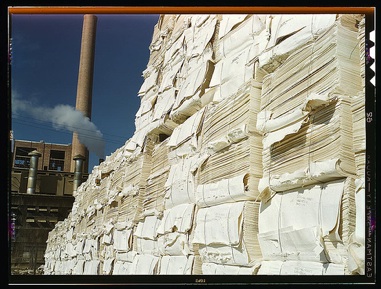
(Flickr Photo: John Vachon/Library of Congress)










FIRST TO HIT THE DECK… FINALLY!
getting first comment on techncrunch is like bedding a fat chick. Interpret that how you like.
“techncrunch”, ugh. Sounds like a cereal. Techcrunch*
Get a life!!
HS-
What are you doing here? You must be bored?
Or you are a professional and make your money from the net and reading techcrunch is important to you in order to stay up on all the latest and greatest.
But if you are just some guy who has a 9-5 corporate job then ummm “get a life” buddy ol’ pal!
Can I have a go at her?
If aggregators are taking away advertising revenue then why don’t the news papers create there own damn aggregatin’ front pages?
Oh yea. Dinosaurs do not have common sense.
God bless the drudgereport and craigslist.
Exactly, all comes under business tactics. Print media can develop front pages for news aggregation in future to catch up their modest losses.
we should have a black list of all the news media organizations that are out of touch so that we can have a week of not linking to them …
We should? Really?
That’s what we should do?
Why don’t you do it first, and then tell us how it turns out?
Ummm you are sooo cool! or is it funny?
“Should We” is not being nice
“Im telling on you!”
Print media I am sure will bounce back. I may sound like an oldie but you can no way replace the feeling of flipping through the newspaper early in the morning with a hot cup of coffee. Today news aggregators may be giving sort of verbose diarrhea. But I am sure print media will make a comeback. They only need to align themselves with present day marketing efforts. I believe there is still a dedicated readers for the print media. Be it US, EU or India.
The question is, should they? Print media is environmentally unsustainable. Everyone reading one copy of newspaper once everyday; then discarding them after 24 hours. That’s wasteful. I understand how readers like you stick to them; mostly nostalgia. But the next generation won’t have that same emotional attachment. We are in a transitional stage, digital media is the future.
“environmentally unsustainable”
Have you ever thought how many jobs are related to this?
How “environmentally unsustainable” is your laptops and phones battery for example?
Sorry to break it down for you but if the “environmentally unsustainable” part is only the chopping trees, using ink and fuels to carry them around then you are wrong.
Its more like paradigm shift…the coming generations will be exposed to gadgets like Kindle/ Smart Phones/iPhone at a younger age. Think about it then.. will they really miss reading news on a news paper
I think @DrifterTypeR is referring to the fact that with a traditional newspaper you pay the environmental cost of the 10% you want *and* the 90% suckage that you don’t. So the traditional model starts with a large disadvantage.
Can I have some of the Ganja your smoking? If you are on crack i dont want any!
Paper anything….books, newspapers, magazines are lame! As soon as tree pulp paper phases out we will have something much more sustainable!
Who are you? koo-koo????
Long time waiting paper is one of the big problems but its kind of hard to get rid of it what will food, and everything else be packaged in about 60 of all stuff is packaged in some type of tree product in some way and the stuff that isnt is packaged in plastic or metal which are also bad so its a lose lose situation for the environment no matter how you look at it.
There will never been a day when we will say goodbye to paper it is and always will be the backup solution to everything.
Sometimes our electronic things fail and paper is usually the back up solution; until we have always on everything that is extremely easy to use without break downs paper will not be out of business.
Plus paper is greater than any digital anything when it comes to us passing on history, you dont need electricity, or knowing what it is to serve a purpose with paper you can just look at it and figure it out as long as it has been protected from denigrating where as someone finding anything digital wont have a damn clue how to use it or what it is.
Then paper is also used in boxes for everything we cant get rid of boxes; the only thing that it can be replaced with is plastic and that carries its own problems.
The four main things we use in everything on earth are
1 trees/wood/pulp
2 cotton/flowers/grain,
3 plastic
4 water
if you get rid of one it will just shift to the other. Everything man made thing on Earth has atleast 2 of those things in it and many have 3.
sure, the digital media will swallow the print media. Next generation will get the news in a single button press.. print media is slowly vanishing
It will die soon. Sorry to bum you out. Digital will replace print media very very soon. Maybe in your life time…………
Ahhh hot-coffee and my laptop reading all the latest news
Newspapers make my fingers dirty! and the stories are lame!!!
“Print media I am sure will bounce back. I may sound like an oldie but you can no way replace the feeling of flipping through the newspaper early in the morning with a hot cup of coffee.”
My great uncle’s family said the same thing about the horse and carriage, and elected to keep running their carriage factory rather than sell it at the ideal moment to get out of the business. I am a news junkie–I even worked for a newspaper–but I haven’t had a newspaper in my house for quite a while.
That’s funny! I was just thinking there is no way anything can replace clicking links on the drudgereport with a cup of hot coffee to start my day at the office!
Eric;
Excellent point, and of course applies to any “bundled content/media provider”, not just newspapers: music labels, movie studios, even broadcast television, and cable
The web has not only balanced the playing field with regard to distribution, but as mentioned, the exposing of content at the “atomic level”, rather than padding one or two good pieces of content with lots of other mediocre content in order to give the appearance of “good value for money”, content providers now have to earn their value on EACH AND EVERY PIECE OF CONTENT PRODUCED, which can only be a good thing for consumers, but will be a huge sea change for providers, forcing them to work harder and longer for less dollars.
The real value that aggregators could really provide is the ability rank or otherwise “rate” the content, much like digg, so that not only is it providing access to a large quantity of content, but also ranking that content, so the best is quickly available to the highest number of people.
Nice article. Rather than compete with news aggregators, news sites should start to become affiliated with them – and maybe even offer a news aggregator of their own. This way they’ll attract customers who trust the news brand (because their news is unbiased and aggregated) and can also add another source of revenue via affiliates.
Travel media aggregator: tripONi
bit.ly/travelcenter
did you actually just say “unbiased” ???
CNN = liberal
FOX = conservative
just the way it is.
CNN is liberal? Someone better tell Lou Dobbs. Don’t forget that it was CNN’s sister station Headline News that gave the world the fungal growth known as Glenn Beck.
“(They like it when information flows freely into their pages, but not so much when it flows out).”
I’m not sure what exactly you mean by this. Other than solicited and unsolicited press releases that newspapers receive, none of the information in newspapers flows freely into the pages. It is gathered by paid staff. Even those free pieces received can’t be posted/published as-is and have to be processed by paid staff. AP stories that they pick up aren’t free, either. Maybe I’m misunderstanding your point.
If I follow your logic, you are saying that the air I breath does not flow freely into my lungs? Because I have to eat food and drink water to keep my lungs working so that my lungs can process the air? And thus the air is not free?
Are you making a joke or is your head really that far up your ass?
Information does NOT flow freely into newspapers like air does into our lungs. That’s exactly my point and a good contrast, in fact. Your analogy makes the opposite point than you intended.
No. Information does flow freely.
Yes and I’ll bury my head in the sand just because the other person is right and I don’t want to hear it
WTF are you saying, Indiana? You’re completely incoherent, while rimesparse is making a valid point.
The truth is that anybody can report the news. You don’t really need a press pass.
I think that irks them.
I think you’ve hit the nail on the head, Chris.
The Press Pass may assist in news gathering in certain instances but it is not essential.
Of course, there is the fact that you can get discounted travel and free entry to most events if you have one.
What is a music album but another kind of ‘media bundle’, and one that is also on its last legs. Most albums certainly follow the 20% interesting, 80% suck rule, at least if we’re lucky the ratio is that high.
Thing is, that’s not *always* the case: concept albums like Dark Side of the Moon are more than just a bag of discrete songs, and the iTunes-style marketplace doesn’t really leave room for longer works.
That’s not as much of a concern in print, because the print equivalent of concept albums are books: like Thomas Friedman’s “The World Is Flat” or “Dave Barry’s Complete Guide To Guys”, and that market doesn’t appear to be going away.
News aggregators are cool, like you say, I get a lot of hits to my blog from them.
Come on wake up media guys. When Radio came newspapers were thought to go extinct. Then came TV. Some feared the end of radio. Then Internet. But did the TV die. No. So how come anything die in here?
So the best news provider will win. And the mean time the losers has to rely on casual surfers for their reader base.
Just my 2 cents.
All newspapers are dead, they just don’t know it yet.
Whats that short story? A guy (Jim) runs into the death reaper at the bar they are both shocked to see each other. The guy freaks out gets on his horse and travels one town away. The Reaper tells the bartender, “funny seeing Jim here, I wasn’t suppose to take his life until tomorrow, in the next town over”.
Very well said. Their content is being exploded and disintegrated.
Smart aggregation + curation + semantic organization is a winning formula for consuming news where every article counts and has value. That’s our strategy- coming out of stealth
http://portal.eqentia.com . For e.g. check out the Future of News aggregator, http://portal.e....com/newsfuture it trumps any other aggregation out there on this topic.
hi there, I just looked at the http://portal.eqentia.com site and I don’t get it? Why don’t you have more topics of interest? And is it english only? I would love to see newstories on the same subject from around the world translated into my language…
Just checked it out. Looks like a lot of work went into this. I’m not sure I buy the “article gets bumped up based on popularity”. I think most sheeple want someone they respect to tell them what to read. There is still a role for an “editor”. but I wish you the best of luck!
In other news, I thought this article was awesome and spot – on!! Well done!
Speaking of ‘getting used to the fact that links exist…’
An interesting experience for me around that issue was when we recently launched our product commercially we got quite a bit of press in local and national newspapers and their online counterparts. And although in all cases their entire articles were completely focused on describing the ins and outs of a web application and the advantages of the product for their readers, they all missed to not just mention the web address in their printed version but also to place a link in their website version of the article!!!
I am sorry but that’s like covering a physical product (say a new car) without mentioning the brand model you are talking about.
I don’t know if it is a matter of pride, ignorance or simple lack of knowledge on the side of the journalists on how the web works but it is quite baffling to say the least.
Oh they understand alright they just want you to pay for the link.
all I know is that one day (very soon) they’ll pay for not putting the link – when readers prefer blogs to get their news / info because they get a better / more convenient service.
Whats the difference between a “news aggregator” and a newsagents shop? In a shop people could read all the headlines from the different news papers and skim through them without buying a copy so nothing has changed its just online.
Good point
It baffles me that most newspapers and so many others don’t understand this new universe. Quality journalism (Erick’s 20%) will win out in this new paradigm (well, sexy headlines will also, but you won’t get a reader to come back with tease headlines that don’t deliver). Quality journalism will always attract the most traffic, and links from aggregators will be sending them a valuable percentage of that traffic.
The best of the aggregators will capture a vertical audience and provide USEFUL categorization of headlines based on that audience. That’s at least what we’re trying to do at Tech Investor News.
Actually I think we’re entering a new era of intelligent news aggregation. But this is not the newspaper industry’s real problem. I’m a former AP radio reporter and feel real empathy for the industry, but unfortunately, they are the ice truck business in the era of the refrigerator.
This is all going down tomorrow as part of the Aspen Institute’s forum: ‘Of the Press: Models for Preserving American Journalism’. Publishers like Dean Singleton (MediaNews), Vivian Schiller (NPR), Marcus Brauchli (WashPost), Gordon Crovitz (Journalism Online) will convene to debate how to monetize and survive: http://www.grou...scuss-Future-of
Strongly encourage you all to join the live debate starting Monday: http://aspeninstitute.tv
brilliant
“80 percent of which sucked” Brilliant statement. Pat on back.
The newspaper industry needs to re-evaluate how they do business. Instead of embracing changes and providing readers with options and investing in new technologies to stay ahead of he curve, they waste money on lobbyists and lawyers trying to kill the competition.
Check out http://www.techfeed.com !
No RSS feed? Nice list of content providers.
I think your 80/20 rule applies to the old album model in the music industry. Because iTunes, etc. let you select only the content that you value, music artists now have to think in terms of writing 12 good songs instead of 2.
I keep seeing people bring that up, but what about the “single”? It’s not like before iTunes and other digital music stores came around, people couldn’t go out and by the hit singles without ever bothering with an album. Granted, a song had to be released as a single (so if you happened to really dig some obscure track from the album instead you weren’t likely to be able to buy it), but then again, it seems like most of the time the worthwhile songs did end up getting single releases anyway, and that’s what most people bought.
I actually don’t know much of the history, but did the music industry used to complain about how “singles” were destroying the album too? Presumably it seems like the practice of releasing hit singles would have had just as adverse effect on album sales.
I like this blog post. it fires me up!!!
I VERY MUCH DISLIKE NEWSPAPERS!!!!!!
Nasty-Dirty-Tree_Murdering Anti-American Industry!
Shut-up, ya’ lame tree-hugger!!
Warning: shameless plug below…
I find the move from newspapers to aggregators/search really interesting and actually have been building my own for sports. I think there is still value, though, in quality journalism from reliable sources. Sites like Techmeme, work because they give authority to sites and surface importance articles quickly.
My sports one is: http://www.grizlr.com/
Still in an early form, so not as good as others. We also only cover NFL now, but if you are diehard fan, check out our team pages, and help us make it better!
i constantly check this newspapers website, checkout their business model:
http://www.lun....p;dt=2009-05-14
I feel like Newspapers need to get with the times. It used to be when they whined about business, they got their way. But now no one is there to hear them whine.
In all seriousness I feel like if Newspapers were to modify the aggregator business model and make one of their own, they would be successful. It just doesn’t make sense for them to complain about something without taking action.
I agree with you completely. If they have a big enough staff they could produce enough content to run their own aggregator. And the actual URLs of the posts themselves could still be submitted to bigger (more widely read) aggregators like reddit and digg.
But that would take someone ripping apart their current business model and they get too nervous to do that.
So bitching about it is just much easier.
@ Matt Lawson
Disliking newspapers is like disliking books
It’s ignorant to dislike a whole medium
FYI! I dislike books too. They are a waste of resources. I can fit over 10Billion pages of books on the memory card in my cell phone. And I love it because it doesn’t way an “ass ton” and I have a search feature, book mark feature and a highlight feature and a note taking feature and …
Wait a minute! It’s ignorant to call newspapers or books a “whole medium”!
The only thing books and newspapers have in common is that they are printed.
Beyond that you’re dealing with two very different mediums… and two very different messages.
You know, “The Medium is the Message” bit from Marshal McLuhan? Just like that.
Took my 7 year old granddaughter to get family portraits done and learned why this article is TRUE.
She loves posing, and we got some terrific group pix. Then came the RITUAL of looking at the shots on a computer (I remember when you had to come back in 2 weeks, choose from proofs, wait another 2 weeks to get pix!).
We chose our shots, then they showed us the special effects you can have with a click.
They had B&W as an option!
Me and my daughers went OOOOOO!!!!
My granddaughter FLINCHED, yelled and objected. “NO I WANT COLOR!” B&W is ugly to her.
Later I showed her a clothing store with huge fashion shots in B&W for effect (gorgeous). She ran.
Her world is in color. Her world is on a computer screen, LIVE and interactive.
She reads 2 grades ahead of her age.
She has no use for news printed on paper and likely never will.
Can newspapers survive? Maybe until I die. But I doubt it. Classifieds were the BIG source of revenue, and LADDERS and Craigslist have destroyed that. I wouldn’t look for a job in a newspaper!
Page ads don’t work on paper either. Online, your ad is shown to those in your market, and you don’t pay for showing to those NOT in your market. Targeted.
Newspapers that manage to shift news-gathering to an economic footing allowing for reduced revenue from online ads will THRIVE because we are thirsty for reliable news.
But we increasingly don’t want ink on our fingers while we eat breakfast.
The problem is, the reduced revenue from online ads is insufficient to fund very much more than rehashing press releases and regurgitating agency reports.
Like the rest of us, journalists need to eat, and original reporting costs money.
Although we are happy to pay for the bundle and get ink on our fingers, we are less enamoured at the thought of having to pay for content online.
The fact is, news providers need to find new revenue sources online. The combination of cover price and advertising revenue proved sufficient for the atomic age. Not any more.
And any proposal that the aggregators should collect micropayments on behalf of publishers is again unlikely to succeed.
Some commentators have suggested one answer would be to charge for news apps on smartphones: http://www.revi...ave-to-pay.html
But unless someone comes up with a workable solution pretty soon, sources of reliable news will be increasingly threatened with extinction.
Doesnt TechCrunch Network fit into the bundle part; isn’t it a Blog Bundle.
Crunch Gear, Tech Crunch, Tech Crunch IT, Crunch Base, Mobile Crunch, Crunch Board, Tech Crunch France, Tech Crunch UK, Tech Crunch Europe
Hehe, yeah they kind of do. Except their bundles are intelligent and increase the revenue without taxing the editorial staffs and diluting the information.
So yes. lol.
Newspapers are here to stay. But they need to become more digital and move away from paper as it is hard on the environment. Technology needs to dramatically improve for newspapers to go fully digital. We still don’t have a decent digital screen which you can flip like a paper and does not hurt your eyes when you are reading. Some companies like e-ink have made a progress on this front, but a lot needs to be done to bring it to mainstream mass production stage.
well, I agree partly, but to be fair, newspaper do have in-depth analysis to which web news is no match either in expertise or knowledge
“newspaper do have in-depth analysis to which web news is no match either in expertise or knowledge”
what are you basing this on?
News enthusiasts across the world are tired of surfing through countless websites to keep abreast of the latest developments. Googling for news, blogs, information, analysis, especially from trustworthy sources has become extremely monotonous, dependant solely on keyword syntax, and doesn’t go down too well with the tech savvy generation who are thirsty for more convenience. We have written the best news aggregation service for Indian News (http://www.indiameme.com)
A lazy post.
The newspapers aren’t frustrated about free-flowing information, Erick. As I suspect you know well. Hopefully.
“Information” doesn’t “want” to be free, no matter how often someone says so. Because information doesn’t want anything. But reporters and editors do. They want to be paid.
WTF?
The news papers I read are F#$%ing pissed about free-flowing information. Every time I talk to the sales team they bitch about craigslist.com
And let me get this straight. You think Erick believes that “information” has needs and wants? And that the physical folded papers that make up a newspaper are feeling the frustration?
Get your head out of your ass you socialist!
lol…
Relax, there.
First of all, Socialism is the opposite of what I’m indicating.
Second, the idea that “information wants to be free” is widespread.
Third, my point is that the free-flow of information doesn’t threaten newspapers. They want to see information flow far and wide. What bothers newspapers is when the information is ripped from their sites; that is, from their advertising, which pays reporters and editors to collect all that lovely information.
Hope that clears things up.
yep.
All you will get now is even more sensationalized headlines in order to generate clicks through from aggregators to the news site. I am seeing it more and more in the online news sites I read – The headline has little truth or relevance to the actual story. They seem to become more tabloid styled by the day.
I agree the cushy days of eyeballs being the key stat to sell overpriced banner ads are over.
These guys need to hire some smart young Entrepreneurs and Tech start-up addicts and change their old school approach.
And you need to start reading more reputable aggregators.
I am talking about the links from the News sites not the aggregators. The News sites are the ones that make the link titles.
Here’s the problem with online newspapers. Today I was reading a very good story in the NYtimes about Harvey Weinstein. Long, well written, informative 6 page article. And I get ads for The Economist and a TV show called “MadMen” Where’s the relevance? No one’s clicking through to that, and when its that irrelevant, its annoying spam. It’s insane.
Online ads ought to be more valuable than mass media ads. I mean you can click through, for God’s sake, and go straight to the advertisers site. How much better can it get than that? All they got to do is put relevant ads next to their content. As it is, even good content, like the story I read today, doesn’t get monetized.
I am waiting for the destruction in Asia… wanna see the trees up and green again
Awesome post TC* …:)
right. I tried to make these points a few times already in conversations; your description hits the spot
Earth to news aggregators! Someone has to write the shit first.
If we bankrupt all news agencies in the world then all we’ll have left are amateur bloggers, and although I love bloggers, sometimes you need expert opinions.
gregsmithsays:
I hate Newspapers that can’t keep their feeds fresh !
Aggregators or news feed readers come in all shapes and sizes … choosing YOUR favorite RSS aggregator is a personal decision. Read my thoughts on Opera Portal (Beta) here>>
BE MORE, SEEM LESS – Opera Portal
http://my.opera...l-in-a-nutshell
What’s funny is that this post shows us how dependent (in an odd way) new media and TechCrunch are on newspapers.
It’s a fact that posts about the fate of newspapers generally get strong amounts of comments and page views.
Why else write about an industry that isn’t that technology forward as most written about on TC, irrelevant and according to you, 80-percent sucks?
Why care/write about what this consultant wrote? It’s not like he’s a newspaper exec or even representing them on this issue. It’s not like we haven’t seen several versions of this post on here before.
Enjoy the easy page views Erick. You could end up missing them one day…
Newspapers, like books will be around because they will always provide a good service for someone.
With the internet, they will need to branch out in order to expand readership and take part of the online audience.
The problem with these companies lies beyond their inability to adapt to the way media is handled. Very much like Viacom and Time Warner, they have trouble adapting to the fact that they cannot put the lid on our mouths (so to speak). Nor can they control how any type of news is shared. Congratulations to us! The only question is, how long will our freedom and the right to the 1st Amendment last?
That’s all very well, but what you’re ignoring is that someone somewhere has to creates the news/music/film before all these ‘wonderful aggregators’ can use other people’s material to make money. i love good well written content and try to ensure that all the content we create is good accurate, well written and researched, and is unbiased editorial rather than advertorial. But that takes money. As an aggregator Peter you’re using my copyrighted content to make money, without paying anything to towards the cost of creation. if all the traditional media didnt create anything you would have nothing to collate… shit as i continue my argument i begin to sound like a record company…
When the traditional News Media start hiring
well educated, articulate, knowledgeable reporters, We will start reading their stories again.
Incompetent people reporting on events they know nothing about do not endear people to the print or tv media.
Printed Media should open up more. I have a true belief in quality. If the content is good people will read it and share it. If its just one more news, millions of sites will have the same content then don’t expect 1 million visitors to see the exact same article AP or Reuters has released.
In my opinion, Newspapers will always be there, for the old schoolers, people that actually like to read the physical paper and for people who are not that computer literate. They will decrease in sales and in # of publications but I still emphasize that if the content is good and different from what other million papers write about it will stand out and it will get noticed.
I guess we are now entering an age where things that stand out are going to be noticed and shared, regardless, if its on a news aggregator site or its own site, people will notice the author and the site and come back. Pretty much why I come back to Tech Crunch and dont just go into google tech news. They add a different perspective and info on tech things I dont get anywhere else.
Content is King.
My $0.02 cents.
Future obviously belong to online Newspapers.
Online Newspapers are uptodated and easy to access.Online papers has more features.Paper Newspapers require more resources to serve the same purpose.
If any new startup broke some barriers and make online newspapers accessable to common public too,paper newspapers will finish
Paper Newspapers can be finished if
1)If some startup somehow manage to offer newspapers through SMS with the same quality.
2)SMS newspaper deliver same amount of data
3)People get Incentives to forward these SMS
4)People get some features to discuss news too.
5)No barriers to transfer SMS from one country to another country
The news organizations aren’t complaining about links! Otherwise, they wouldn’t have “Share This” next to every article. They’re complaining about heavy quoting and paraphrasing of articles that they had to pay journalists to research. That’s a legit complaint.
How do you feel about all the aggregator sites that are copying or heavily quoting TechCrunch posts and making money off them — even if the money they make is “usually worth a lot less than ads” on TechCrunch? The amount of money a thief makes is irrelevant to the fact that theft is wrong.
Everyone should start ripping TechCrunch articles and posting them on their own sites without attribution or links back.
It’s amazing how callous TechCrunch is about other people’s intellectual property.
I never understood the legalities of aggregating and scraping content from other sites. Guy K.’s alltop.com does this from a variety of news outlets but doesn’t the newspaper’s TOU say you cant use their content on another site? How do they get around this? Is it because they only use a headline or because they link to the original article?
Mark Cuban has an interesting take on news sites blocking aggregators. It’s a pretty compelling read – http://blogmave...nt-yes-you-can/.