Poor Google Knol Has Gone From A Wikipedia Killer To A Craigslist Wannabe
by Erick Schonfeld on August 11, 2009

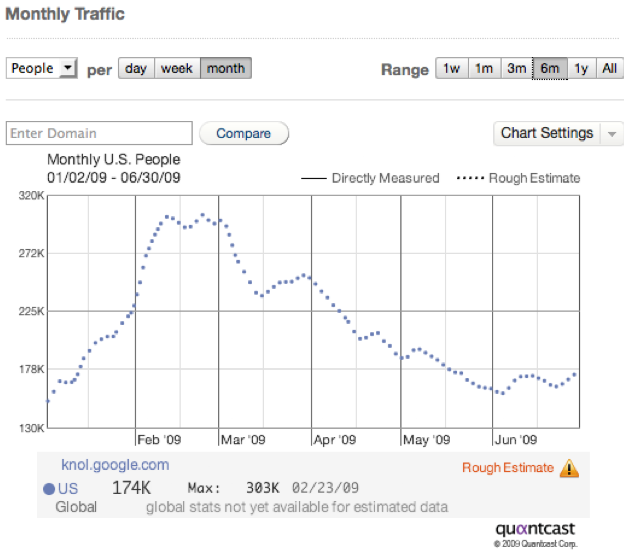
We’ve known for a while that Google’s Knol is no Wikipedia killer, but now the knowledge-sharing site is being reduced to a sad Craigslist wannabe. The original idea behind Knol was that people could collaboratively write definitive articles about any topic they like and get rewarded by earning a share of the AdSense revenues for each page they author. Well, that model doesn’t work so well if nobody bothers to read the articles on Knol no matter how much search karma Google gives them. Quantcast estimates that only 174,000 people visited the site in the past month.

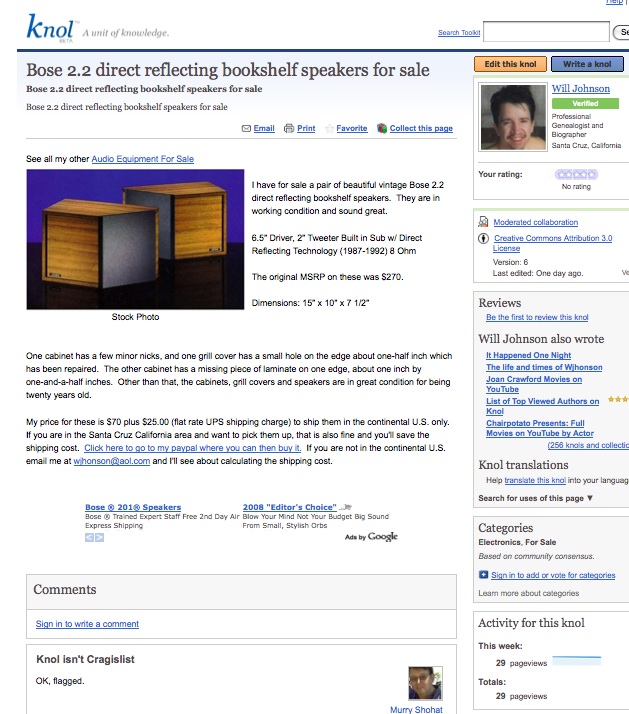
So what do you do if your Knol page isn’t throwing up enough AdSense pennies to make it worth your while? You try to sell a pair of stereo speakers directly to the few lost souls who somehow end up at Knol. Will Johnson, a self-described “professional genealogist and biographer,” decided to share his Knol-edge of a pair of “Bose 2.2 direct reflecting bookshelf speakers for sale”—his own (only $70). In fact, he started his own Knol Marketplace and bookstore.

While selling your junk on Knol is not necessarily prohibited by Google. Knol’s content policy seems to allows for commercial activity as long as it doesn’t drive traffic (and potential ad clicks) to another site. But a group of some of Knol’s top writers who actively police the site feel that it violates the spirit of the service. They don’t want Knol to become another Craigslist.

Sadly, Knol just never panned out. Google should just end its misery, just like it did when it killed other under-performing projects such as Lively and Google Notebooks. Knol will never come close to Wikipedia. It can’t even cut it as a classifieds listing site.
Advertisement

Responses

Comments rss icon

  • It’s a shame google couldn’t pan it out, but perhaps; they’re better suited as a graig list wanna be?

    • If Google really wanted to kill Wikipedia, it would have done some acquisitions of some wikis in order to get content on their own project to help give it a dedicated community of editors at the onset and content that could compete with Wikipedia… Wikia basically does that and much more successfully. (And as it looks like both have the same business model…) The problem is that for a number of projects like say Fan History, if given the choice between Google’s knol or another solution, Google isn’t going to be my first choice because I can’t install the software on my own server. I can’t brand it effectively. I don’t have the metric/analytics options that I do elsewhere. Or that a hosted wiki solution like PBWorks, WetPaint, SocialText, etc. would give me if I didn’t need as much control and wanted to be on some one else’s server…

  • whats knol? so google as another site other than youtube that they make no money from!

  • Google is always put out there as this incredibly innovative company. Outside of search, I don’t see it. They’re a graveyard of failed attempts to copycat other ideas.

    • Google voice . . .

      • Google Voice came from a company called Grand Central.

      • I wouldn’t call that “innovative”, just a good, solid service. Anything they own that could really be called innovative (outside search) has been bought up from the outside, like youtube or blogger.

        • And then with blogger, it became a great big blight on the web. :( A place where people did loads of google adsense fraud with Google’s tacit permission, which hurt the overall brand of the product Google acquired. Given that, I wouldn’t put blogger in the same category as YouTube.

          • I agree with Laura here.

            Look at Vivendi. They own Activision Blizzard Entertainment. Blizzard Entertainment owns World of Warcraft. They also own lets see NBC Universal. NBC owns SciFi (SyFy). And on and on and on. They own a lot. But nobody says HEY LOOK! BLIZZARD AND SYFY are the same!!!!!?!!11

            Google is a huge company, that is a parent company for many other companies that just add the ‘Google’ tag.

        • Maybe failed projects like Knol, Lively & Notebook are a side-effect of a company with an innovative culture. Google are big enough to try their hands at a lot of things and probably anticipate that a lot of the things they try will be abandoned.

          That said, I never liked the idea behind Knol – why go after the Wikimedia Foundation when there are bigger fish to fry? I never thought Google’s role in the world should be as scourge of FOSS projects like Wikimedia & Mozilla.

      • Technically, Google didn’t come up with the idea for Google Voice. The bought a service called GrandCentral back in 2007 and just recently got around to relaunching it as Google Voice.

    • gmail, maps, docs, chrome…

      • Gmail isn’t spectacularly better than many other email services. What advantages it has couldn’t be classified as innovative, just good. Maps I’ll give you. Docs is no different from a dozen other services. Chrome is highly overrated; Firefox is still the best.

        • Chrome also uses the underlying rendering engine that Apple has worked on for years. WebKit is a great rendering engine, that complies to standards nicely, but I thought I would just point out that Chrome does not use its own rendering engine, something every other browser does. And as great as WebKit is, and even Chrome for some matter, the underlying issue will always remain that Apple is the one progressing WebKit. Therefore Google has no say, nor can they speed up the process of Chrome and the advancement of the Web by relying on Apple.

          No hate towards Google or Chrome, but thought I’d mention that Chrome does get this public image that the browser is amazingly superior, but it runs on borrowed technologies.

          Just giving credit where its due, which Google probably does not mind.

      • Google Docs was once Writely. I used to use that service, and I miss it very much. I’ll wait for Office for the Web now, just to play it safe, so I can possibly really have a 10,000 Column Spreadsheet on the web.

        Maps is not something Google started from scratch, rather just took Mapquest and made it look much better and added better features. I will concede that this product is superior, hence I look forward to Google Wave, which is made by the same team.

        Other Google products that have people raving, that were acquired are already listed above:

        Youtube
        Google Voice
        (and I’m sure there’s many more)

        • Is anything ever “started from scratch”, or is everything based on something earlier, and is an improved or different version of something that already existed?

      • Google Wave, is home grown and I think will eventually be a big deal.

  • I think knol is no match for wikipedia. Wikipedia is dynamic, fast and fresh. Knol is kind of slow and unchanging compared with wikipedia.

  • What a dumb idea!

  • clarification: the marketplace on knol is the dumb idea

  • Knol will probably get more traffic from this article than they did all last month.

  • …a branding failure. Who would ever call something they respect a “Knol”? right up there with Zune.

    “Knolpedia” might have had a better chance I suppose.

  • “Google should just end its misery, just like it did when it killed other under-performing projects such as Lively and Google Notebooks. ”

    Not going to happen. Knol isn’t a loss leader like those services. Those were an easy kill. I’m willing to bet that Knol is cash flow positive. People who arrive at the knol pages probably click the ads enough to make this true, despite its dwindling traffic.

  • Very Funny. First time I’ve ever heard of knol

  • I always felt Google didn’t promote Knol enough. Even when they had certain well written articles comparable with, if not better than wikipedia, wikipedia still got better search rankings. It was sunk before it even had a chance to take off. It’s time they took a look at its search alogorithm. It gives too much preference to wikipedia. Other encyclopedias don’t have a fair chance against Jimbo Wales’ drama generator.

    • “Other encyclopedias don’t have a fair chance against Jimbo Wales’ drama generator.”

      Well, that is a matter of perspective. If you do a targetted, niche MediaWiki wiki, you can get ranked first or second. It just requires a lot of content on your wiki/encyclopedia. It also requires a whole lot of SEO work, link building and promoting. And then sometimes, it requires just dumb luck of having people click on your wiki page because they assume that Wikipedia will cover it a certain way, won’t have adult content, etc. We’re slowly doing it with Fan History but it means we have what amounts to one person for content (with traffic in mind) and one person for link building… which is far from ideal when you’re trying to do something for a greater “good” but there you have it. People who think that Google doesn’t give other wikis the chance really need to just put in the damned work. Day after day. For months. (Wikipedia didn’t happen over night.)

  • ah, but more importantly, what happened to all the articles about twitter here?

  • Google Knol never really took off. They should just scrap it.

  • Google = one hit wonder

  • One thing I noticed of Google is they rarely ever mention any other projects/services that they have besides Google itself, Adsense and Adwords which all relate to search.

  • Wikipedia needs more competition. Wikipedia is perhaps the first source of information many people turn to, but Wikipedia censors. Knol is one of the few potentially viable competitors.

    Due to the perpetual ranting of a troll with an opposing viewpoint, the Network of European Technocrats aka NET (http://en.technocracynet.eu) was blacklisted. I am not a member of that group, but I would like to cite material on their website for articles I write on Wikipedia. I am blocked by Wikipedia from doing so. NET is a European organization (with most press coverage about it in Swedish), so that Wikipedia accepted the troll’s argument that NET is not sufficiently important to be allowed on Wikipedia. Unfortunately, Wikipedia is the “Google” of online introductory articles. It is not quite a monopoly, but it is effectively nearly so.

    So limited as Knol’s readership it, we need it as an alternative channel of information to Wikipedia.

    • Why should Knol be the alternative? All it does is scede more power to Google. Rather than use Google’s products, the better answer is to use other services that are out there OR to create valuable resources on your own. There are a number of wikis out there that are trying to compete with Wikipedia. wikiHow, wikiTravel, AboutUs, Fan History, Foodista are all ones that I can think of immediately.

  • Time to kill it. Just put it out of its misery already!

  • Edit: So limited as Knol’s readership IS, we need it as an alternative channel of information to Wikipedia.

  • The dude that left a comment on the guys page cracks me up. Talk about having NO LIFE!

    Anytime you take it upon YOURSELF to police a site you don’t even own??!? You need to buy a CLUE …. why he was looking at speakers?? haha.

  • This is the first I have heard of Knol, it just goes to show that all projects that Google can put out will not necessarily be successful. I am sure at the time of release, wikipedia was doing well, so why not setup the same thing and offer to reward the contributors. What should be considered, is why it failed? Anyone know?

  • Nobody pointed out…quantcast stats you used are *June* NOT *July* metrics.

    I’ve been waiting for them to update myself…and, reading this, I got overly excited they have their July stats ready – nope :(

    Compete.com does have July stats…but, you need to pay $$$ to get traffic data at the subdomain level, which makes no sense, imho.

    Knol, btw, was never intended as a Wikipedia Killer – it was a Hubpages / Squidoo / About.com killer (b/c wikipedia doesn’t run ads…and, only the hubpages, squidoo guys do the revenue share thing).

    Still, each of those (hub / squid) get ~8-12 million+ visitors per month…and, Knol ain’t come close to “killing” them, yet.

    Other issues…the ad placement…I know, I know, nobody likes ads, but if you’re trying to entice people with revenue share, stifling them with bad ad placement won’t do it. And, while hubpages went all nazi on my brother and nuked his stuff, reported him to Google, etc, etc, a few years ago, at least they and squidoo, both, allow linking out…though hubpages has gotten paranoid about it, from what I’ve seen. Sniff.

  • So Google did not succeed in something! I am glad Wikipedia is still here :)

  • I would like to thank Eric for driving more traffic to my pages. I especially love the clipped image so everyone can see my Full Movies! My number one page!

    http://knol.goo...4hmquk6fx4gu/45

  • It’s great someone created a marketplace in Knol. What could make it bigger is that the content created is related only to an author who can be trustworthy or not, but there isn’t a censor but content policy (btw, the link “actively police the site” is wrong, could it be http://knol.goo...y5eowy8suq3/42# ?). That’s closer to freedom than Wikipedia.
    Knol has a lot to improve, Wikipedia takes years of advantage. Anyway, nothing to do with an encyclopedia, different products. It’s looking for its own place beside Squidoo or Hubpages but trying to reach them is also difficult, it is user created content shared it free! I hope Google promotes it despite years of losses.

  • Google’s main problem is that they only want to create new Web Software Services that are Free and Ad Sponsored.
    This is great for all Web Users, but as future Business Models for Google – it is so last year.

    Only recently Google complained that Apple’s App Store will soon be a thing of the past, as the only true App Store is the Global Web.
    But this is where Apple totally rules Google in how they offer Web Software Services to the masses.

    iTunes and the App Store are serious revenues earners for Apple and they are some of the few Web Software Services which bring in ‘instant dollars’.
    Apple’s Business Model for Web Software Services is almost the same as its Hardware Devices BM, ‘Cash is King’.

    Google on the other hand needs to start looking at new ways in launching Web Software Services that can earn ‘instant dollars’, instead of hopeful Sponsored Links.
    Which is why half-baked Services like Googlebase, Lively and Knol are never truly supported if the Sponsored Links are thin on the ground.

    What if Apple came up with the idea of Google Wave before Google and called it ‘Apple Wave’.
    They would never dream of releasing it in the public domain for free.
    ‘Apple Wave’ would be released in the ‘App Store’ for a certain price and future ‘Apple Wave Apps’ would also be made available to buy.

    Over the coming months the releases of both Google Wave and the next version of Apple’s iTunes will show you just how far apart both Google and Apple are when offering Web Software Services.

    Just imagine if Apple ever considered offering their own Sponsored Links Services within the iTunes and App Stores.
    Now that would be a ‘Google Killer’.

  • Google has some good technologies that are very promising !, Have a look http://www.phpc...eb2-mashup.html

    And Gmail IMO is becoming a defacto email standard for a lot of people !, people transitioning from ymail to gmail are huge

  • could this be yet another failure for Udi Manber?

  • i never once saw a “knol” article come up in Google’s search results for anything (and I know some articles have been written in the spaces I search a lot).

  • That’s really sad, I like the knol site a lot!
    It’s a nice (working) application and adding content is very easy.
    But you’re right no-one is reading the articles there (the same to me) :)
    it happens mostly to sites where to much spam and link leacher are present ;)

  • knol-body even heard of knol until know

  • its just another in a sad list of failed google product ventures, with a list so long its laughable, when will it end? Oh right, when they stop having billions of dollars and nothing to do with them.

  • Google Knol was never a wikipedia competitor as it was projected.

  • Very funny. Write more stories like this about google failures. Show the world that just because something has “Google” brand name it doesn’t mean it wont suck.

  • How about ORKUT. That is one more crap. Why dont they just trash orkut too.

  • Poor Google???!!!

  • Guys…just wait for Google Wave :D

  • This is par for the course for Google.

    In its entire history of existence Google has been able to make exactly 1 product work: paid search. And that is only because they managed to steal the business model from Overture.

    Every time Google released another (ill conceived) product, its fanboys went into hyperventilation and proclaimed that “this is going to revolutionize the world!!!” while in reality the only thing it is achieving is to burn up some of Google’s tremendous cash flow from its monopoly search business.

    Let’s look back:

    Google video: the “Youtube killer”
    Google base: the “ebay & craigslist killer”
    Orkut: the “myspace & facebook killer”
    Google checkout: the “paypal killer”
    Google Answers: the “Yahoo Answers killer”
    Knol: the “wikipedia killer”

    Google’s history is basically 1 homerun (paid search) followed by a long and uninterrupted string of me-too products that quickly flamed out.

  • Google video: the “Youtube killer”
    Google base: the “ebay & craigslist killer”
    Orkut: the “myspace & facebook killer”
    Google checkout: the “paypal killer”
    Google Answers: the “Yahoo Answers killer”
    Knol: the “wikipedia killer”

    ????????? : Google Killer?

  • yeah Knol is something. I have visited once before but don’t plan to very often.

  • hey, what’s wrong with being a Craigslist wannabe? http://allofcraigs.com lol

  • Google can do two things to reverse its Knol mis-fortune:

    Install plumbing to rid the system of Knols that fail to achieve reader-voted 3-star rating after 120 days. This will purge the stench of decay in search and surf. I estimate that 30 – 50% of Knols will evaporate. Readers will return when the beach is clean and the air is breathable. There are thousands of worthwhile Knols that deserve attention (like Twitter and Tweet)

    Set new clear Content Policy: No sale ads, no emulation of Craigslist or eBay or any other site specialized to sell items or services, or recruit employees. One infraction = account block.

    • Prediction and I hope to be wrong:

      Google Knol will not react. They won’t even answer their faithful authors who have sought clarification by using site tools to register their concerns. One leading writer called it “a watershed moment.” Another said she was disgusted to see ads when she’s worked so hard to build solid articles.

    • “Install plumbing to rid the system of Knols that fail to achieve reader-voted 3-star rating after 120 days.”

      What does that do? Seriously? Companies should open it up, not close it down. Even Wikia glommed on to this fact and basically opened up their service so anyone could create a wiki. They have several thousand wikias with around one article… but hey, all those wikis are potential search engine bait for click throughs on ads.

      If they really want to get serious and make Knol viable, they need to basically get existing wikis with traffic and content to use the service. They need to lure them away from companies like Wikia, WetPaint and SocialText. They need to offer money (buy out) to wikis who pay their own hosting on their own servers in order to get content… and then play SEO magic so none of those sites loose traffic when they transition to a new url.

      Pruning isn’t the answer here UNLESS they want one wiki and want to directly compete with Wikipedia.

  • One of the small reasons these launches do not succeed is due to the fact that they don’t have a main destination of their own.

    Sub destinations like

    search.yahoo.com
    google.com/knol

    are more often than not a recipe for disaster.

  • Should anyone really ever say “poor google” anything. Something tells me google is doing ok.

  • When it opened, Knol might be more accurately compared with Associated Content, HubPages or Helium and had strong content from recognized experts. But a relatively few decisions, such as making identity verification for content providers optional, increasing the focus on revenue sharing, allowing blatant commercialism in the content, etc. has sent Knol more in the direction of Squidoo than Craig’s list.

    The face off with Wikipedia was never quite right anyway. While Knol is similar to Wikipedia in providing free and open access to knowledge content, there are a number of important differences. Unlike Wikipedia, Knol is not strictly speaking an encyclopedia, but a knowledge sharing system.

    The encyclopedia format works well for topics that are descriptive, factual or historical in nature, while Knol’s knowledge sharing approach can be focused on topics that cannot be fully explored based on descriptions, facts or history.

    For example, if you want to know the diameter (or a wonderful array of facts, photos, maps, etc.) of the Earth, go to Wikipedia. If you want to know what is good for the Earth’s future, Google hoped Knol would be a better place for that discussion.

    Encyclopedias typically require editors or special contributors to take the work of multiple contributors and fashion it into a one-article-per-topic format. Good editors make every effort to represent the diversity of views, but they rarely are able to reproduce the full impact of the original contributors’ thinking.

    Also, the encyclopedia approach encourages editors and contributors to have the final word in reducing disparate views to their common elements. This often creates a tug of war between opposing views to be won by the stronger or more persistent proponent. The result can be more representative of capitulation than consensus.

    Knol had a vision that if contributors could not agree, they would develop separate articles. So there are some pretty fundamental difference between an encyclopedia and a knowledge sharing system.

    Nevertheless, anyone trying to catch Wikipedia as an encyclopedia is not likely to succeed, but the game is still very much afoot in knowledge sharing.

    Wikipedia definitely proved it was the future of encyclopedias. But somewhere in the various combinations and permutations of features and approaches in Associated Content, HubPages, Helium, Knol, Squidoo, Maholo, TechCrunch, Techmeme and the like, is the future of sharing knowledge… and some believe that is the future of publishing.

  • One comment on Murray stating that Knol won’t care. If you look at the sidebar for example on the article he is mentioning you will see ads for other speaker systems like Klipsch or Bose or Pioneer or whatever. That ad placement is what Knol would like to have. Money always talks.

    Some of my work has ad placement by Disney. Who is going to do ad placement on an article that talks about the spin of the electron or the meaning of Kant?

    Knol is not Wikipedia. Knol has also been geared toward making money off ad placement which you can share (pennies) through Adsense or whatever it’s called. So I predict, that if someone posted an ad to say sell a Lexus or a Frigidaire, that Knol would be very happy making the extra bucks off the ad placements that would create in the sidebar.

    Another difference between Wikipedia and Knol, is that there is much less internal linking in Knol. The internal linking in Wikipedia is quite extensive and some people get sucked in and stay sticky for hours while they research something. You simply don’t get that in Knol. The overwhelming majority of each new hit is generated by a Google search, not from internal links. It’s not quite a community, it’s more like Google Sites with cross-space linking.

    • Will, you need to learn how to quote. I did not say Knol won’t care. My reply: http://kno.li/18

      • Okay well you said “Google Knol will not react. They won’t even answer…”

        My response is that Knol, to become a profit-center for Google, wants Knols that promote ad placement of some kind. That is how they make money.

        There are still many areas of business that aren’t represented well in Knol and I’m sure they would be interested in anyone developing those more fully.

        Knol was never intended to be an ivory-tower-only project. If someone wants to write an article on every episode of Pokeman, I’m sure that Knol would love it.

        • On your last point we agree. Why don’t we just tackle the obvious. Tell the world in clear, bell-ringing terms how your ads are “units of knowledge.”

          If you cannot (one can), you should remove them. You are abusing Knol even if it’s a sinking ship.

          Sold anything on Knol?

          • That’s not hard Murry. In one spot you have a picture, name, dimensions and specifications of the object plus it’s original MSRP and make-dates.

            That’s knowledge.

            I sometimes find it difficult to find all the relevant details of some product in one spot online. This is especially true of vintage items. Sellers don’t always include what you want to know.

Leave Comment

Commenting Options

Enter your personal information to the left, or sign in with your Facebook account by clicking the button below.

Alternatively, you can create an avatar that will appear whenever you leave a comment on a Gravatar-enabled blog.

Trackback URL
Short URL

RealTime CrunchUp Sponsors:

bugbugbugbug
Techcrunch on Facebook