
YC-Funded Directed Edge Sees A Post-Search Web Where Recommendations Rule
by MG Siegler on August 6, 2009

picture-131Whoever manages to change the nature of content display on the Web from a search problem to a recommender problem will reap tremendous rewards.

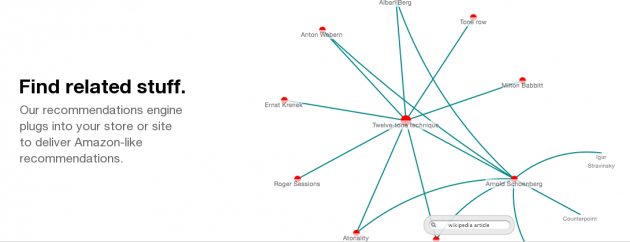
That quote, by Greg Linden, the man behind Amazon’s recommendation system, is the dogma of Directed Edge, a new Y Combinator-backed startup in the recommendation space. Amazon, of course does product comparisons, but there’s no reason recommendations shouldn’t be a part of news consumption, music consumption, social networking, basically everything we do on the web. And while there are no shortage of companies out there that focus on some of these different fields specifically, Directed Edge has developed a system that can be plugged into all kinds of different sites.

And for sites that implement its system, it does the recommendations in real-time. “We can take data sets with millions and millions of data points and figure out what’s related to a given item in a few milliseconds. Most recommendations engines pre-compute stuff rather than generating the recommendations in real-time like we do,” Directed Edge co-founder Scott Wheeler tells us.

Wheeler claims they can do this because of the graph database they created in-house after they realized the off-the-shelf options just weren’t good enough for what they wanted to do. And much like Linden’s quote, Directed Edge truly believes that we’re about to see a shift on the web away from search and towards recommendations. And real-time is crucial to that. While we’re starting to see that trend take off in the social space right now, Wheeler believes it will spread to the rest of the web shortly. “Fundamentally we believe that shift is coming, and we want to be a big part of it,” Wheeler says.

Despite the recommendation system being fairly complex, they claim that a person running a site can get Directed Edge’s service up and running in just 15 minutes. And obviously, to be useful such a system would have to work with the data you already have, and that’s exactly what Directed Edge does thanks to its binding system that recognizes a wide range of web languages.

It may be hard to imagine a web where search isn’t the utterly dominant way we interact with everything, but it’s certainly not out of the realm of possibility that something like recommendations could become a big part of it. We’re seeing large sites like Digg also putting a lot of focus on recommendations. And then obviously there’s the Netflix Challenge, which just ended. That’s the web Directed Edge wants to see.
picture-141

Advertisement

Comments rss icon

  • Recommendation systems are a technology in search of a market.

    • 25 percent of Amazon’s revenue come from recommendations

      • Neither Netlfix nor Amazon are not in the business of selling recommendation systems. Trying to build a business around creating recommendation engines is an entirely different proposition.

        There are about a dozen startups in the valley that define their business as building recommendation engines.

        That’s not a market. That’s a technology in search of a market.

        • Of course there is still great potential in just having a really fast engine for building recommendation services. While there may be little value in a Recommendation System without a topic — there is much value for someone with a Topic but no recommendation system.

      • Ycombinator chickenhawk VC mischief returns. - August 6th, 2009 at 7:40 am PDT

        Techcrunch edits “cute” replacing Ycombinator with YC—in the hopes of building a better brand and avoiding the legion of criticism that accompanies every Ycombinator press release and subsequent failed deal?

        Are you friggin joking?

        Take a penny from these chickenhawks at your own peril, kiddies. Beer and pizza and topless waitresses aint worth 51% of your company, losers.

        Ycombinator: The subject of every “Stranger-Danger” talk at school.

    • Don’t we have many different sites that do the same? In fact, I have been using these sites for heterogeneous recommendations a.k.a recommendation across categories:
      a) http://www.cruxle.com which takes my Facebook profile or Myspace profile and creates recommendations for me based on my favorites. In simple terms, I can even search for something and get recommendations.
      b) http://www.boilingpage.com which provides recommendations in real time. i.e. based on real-time data. I love this site since it shows what’s hot among people now and if I click something it’ll show what other stuff are popular .. there is real-time recommendations

      In my opinion, recommendations are very important, but there are too many players out there. So you need to have something really unique to offer.

  • Wut? Is any site out there actually using their technology successfully? That’s kinda the basic test of interestingness for automagic recommender thingy news

  • The driver of the trend to the searchless web? It is of course the value of relevance.

    But (web graph based) recommendations are just one method. Depending on the situation of your demand for information/data/content there are other methods to be combined e,g, context identification. In the future we will have this with ever more sensors, defining not only place and time, but may be your emotional state too, people around, near and far, back story, user models …

    We will have a person-centric web (person not versus “social” but the social graph being the center of being a person!).

    The user experience traversing the web will be more like an endless discovery of things, news and persons, with a smooth navigational control instead of “shooting” queries and get result lists then.

    And think of the “mobAR” trend – Mobile Augmented Reality combines nicely with interaction free realtime information blending.

    Exciting.

    Post-search, yes. And post-SQL, too. There is a lot of development in graph based stuff, just because the demand for flexible, permanently changable, realtime solutions in a “situational web” (3.0??) with all that social and context graphs.

    related efforts:
    Sones (Germany) – http://www.sones.com/
    Neo4j – The Benefits of Graph Databases :: Tech Video http://www.best...graph-databases

  • Yes, we’ve been using Directed Edge recommendations on the Popcuts Music Store for a while now, and it was very easy to integrate, works reliably and seems to produce meaningful results. For us, this was a great way to provide such features (similar songs, users with a similar taste, personalized recs), compared to rolling our own.

  • Well a good idea and concept.

  • One has to admit professionalism and perseverance pays in the long run http://www.thessayist.com is an excellent aide for your academic needs.
    Read this article to gain valuable insight – http://bit.ly/n6HuE

  • Scott an Valentin, gogogo! It’s good to see a few more thoughts from Berlin ruling.

  • This is what http://facebook.com is trying to do with its “Like” links – gather votes for recommending stuff to friends (and it works quite well). http://tastekid.com is trying to do it for music, movies and books (with a user experience similar to the one of a search engine). Makes sense to shift towards recommendations, at least in some cases.

  • The guys at http://www.scarabresearch.com/ also has a recommendation platform Scarab, that can be built in to existing Java solutions with relatively little pain. They empower the largest online local book store in this part of Europe.

    • Yes, indeed – we have Java bindings, which is also based on a minimal HTTP-based protocol.

      But indeed, we’re using a different approach, by tailor-making algorithms for each specific customer and each specific business domain, vs. the seemingly “one size fits all” approach I see on the Directed Edge web site.

  • What is with all the Y-C press releases on TechCrunch? How in bed is TC with YC anyway? This is a technology in search of a market and there are a number of companies doing this stuff — why does TC waste so much space covering every freakin’ YC company?

  • Greg Linden’s premise is strong and backed by evidence (e.g. see The Conversation is Shifting by John Battelle) — Directed Edge is on to something.

    Users reach content by clicking on links.

    Search engines serve up somewhat elderly links, determined by algorithms.

    Social media gives you a stream of links that embody trust/recommendation/immediacy.

    Trusted links will dis-intermediate search engines. At MashLogic, we’re taking a different approach from DE; we give users the power to shape their link destiny.

  • Is this really that new? It seems like recommendation systems are pretty old-technology these days.

    http://www.traderbots.com

  • If it works for users, good on em.

  • Sounds promising:can possible add a lot of value. Grabbing human opinion/insight and distributing it to exactly the right places is the big challenge for search, content sites, e-commerce, social networks, etc. In an indirect way, it’s connected to what Truffls.com is trying to do.

  • This looks awesome. I don’t know if it is necessarily going to be the future of the web. But, it does a very good job at what it does. I have been looking for something that can do this exact thing. I will have to give this a try.

  • This looks awesome. I don’t know if it is necessarily going to be the future of the web. But, it does a very good job at what it does. I have been looking for something that can do this exact thing. I will have to give this a try.

  • Go get it…. another horizontal stripped….

  • Surprised no one mentioned Yahoo’s adoption of Bing as part of this discussion. I would say that Yahoo is making a move to stop wasting resources on search and focus on their web properties that will capitalize on “post-search” web.

  • I heard http://www.metaflavor.com has been developing a recommendations engine for menu items. Not sure what you feel like eating? Meta Flavor learns your unique taste by virtue of you rating individual menu items (over 4 million of them) and based on your ratings can give you personalized recommendations. For example, say you gave some chicken marsala a two out of 5 star rating. Meta Flavor now knows you like Italian food and specifically Chicken Marsala, it can now recommend some highly rated chicken marsala at an Italian restaurant you haven’t tried. I think that’s a cool idea.

  • This is a brilliant idea. Really, it is. I’m not sure if they are the first company to provide this service, but if they get customers and keep them happy then they’ll be very successful.

Leave Comment

Commenting Options

Enter your personal information to the left, or sign in with your Facebook account by clicking the button below.

Alternatively, you can create an avatar that will appear whenever you leave a comment on a Gravatar-enabled blog.

Trackback URL
Short URL
bugbugbugbug
Techcrunch on Facebook