Here Come The Twitter Patent Lawsuits. TechRadium Files The First One.
by Erick Schonfeld on August 5, 2009

Twitter is being sued again, and this time it isn’t some angry baseball manager who doesn’t like people impersonating him on the service. This time it is a little more serious. Twitter is being sued for patent infringement by TechRadium, a Texas-based technology company which makes mass notification systems for public safety organizations, the military, and utilities.

TechRadium is basically claiming that it thought up the whole concept of mass notifications first, and points to three issued patents: Nos. 7,130,389, 7,496,183, and 7,519,165. According to the lawsuit, which was filed yesterday on August 4, 2009 in Houston, Texas (full document embedded at bottom of post):

TechRadium develops, sells, and services mass notification systems that allow a group administrator or “message Author” to originate a single message that will be delivered simultaneously via multiple communication gateways to members of a group of “message Subscribers.” A member of a subscriber group can receive such message in their choice of any combination of voice message, text message e-mail and so on. This technology is patented by the Plaintiff, TechRadium, and marketed under the trade name “IRIS”™ (Immediate Response Information System). Among other things, the patented IRIS™ technology eliminated the need for an Author to send multiple identical messages, and allowed Subscribers to select the most convenient form of notification for them.

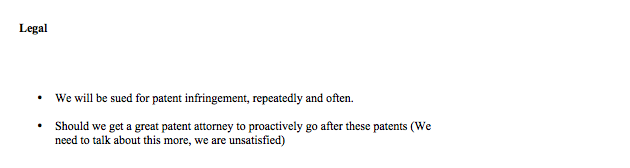
Twitter works across text messaging and e-mail, but not voicemail (yet). The very concept of unifying different message communication systems is what is in dispute here. Whatever the merits of the lawsuit, you can’t say Twitter didn’t see this one coming. Way back in a February, 2009 strategy meeting (see Twitter Papers), the company discussed potential legal threats.

Legal

• We will be sued for patent infringement, repeatedly and often.

• Should we get a great patent attorney to proactively go after these patents (We need to talk about this more, we are unsatisfied)

I hope it hired that “great patent attorney” because this could just be the beginning.


TechRadium Vs. Twitter patent Lawsuit

twitter-legal-threats-patents

Advertisement

Responses

Comments rss icon

  • The patent documents appear to be documenting something more sophisticated than what Twitter was set out to do. I could be mistaken though.

  • Another ridiculous patent…

    • “Internet Relay Chat (IRC) is a form of real-time Internet text messaging (chat) or synchronous conferencing[1]. It is mainly designed for group communication in discussion forums, called channels[2]” copy form wikipedia.org

      The patent of TechRadium is not a valid because:

      “group administrator or “message Author” to originate a single message that will be delivered simultaneously via multiple communication gateways to members of a group of “message Subscribers.””

      “group administrator” = IRC op
      “message Author” = chatter
      “message Subscribers” = chatters in channel

      originate a single message that will be delivered simultaneously via multiple communication gateways to members of a group = chat in channel of IRC

      Just different attorney wording. In that keys Jarkko Oikarinen the creator of IRC should sue thousands of companies that have been improving the idea of IRC and interpret it in different ways.

      • there’s a difference between IRC and TechRadium or Twitter.

        IRC is a bi-directional ongoing chat, not a single-origin, multi-receiver communication. You don’t “subscribe” to a message-originator, rather you join a channel AT THAT TIME and receive all messages, by all originators IN THAT CHANNEL, during the time you are connected to that channel.

        It looks to me that TR has something here in that they have an existing patent on the single-originator delivering to the multiple-subscriptors on multiple platforms in near-to-real-time – exactly like Twitter.

        Just because you can stretch a paradigm to match another for purposes of argument does not mean that it invalidates when two other paradigms nearly exactly match.

        • Yep, the IRC -> TechRadium comparison isn’t all that compelling.

          However, patents aren’t valid when there is existing prior art, no? Like that which is found in Alarmpoint, which has been around since at least 2000?

          http://www.alar...mp;article_ID=8

          • Possibly – the term “prior art” doesn’t necessarily mean that the technology didn’t exist – you can do something and if you didn’t patent it and someone comes along and formalizes it or extends it or changes it – OR even comes along and develops the same thing without knowing about your product (i.e. yours was limited in release or whatever) and they do patent it, yours may not be considered prior art. Prior art is supposed to be knowledge that could be considered common to someone in that field.

            How far that AlarmPoint was widespread, I don’t know.

            It does not, however, seem to be subscriber-based or multi-modal. It seems to be pretty strictly telephony based – things that depended on a single protocol – a pager signal.

            The thing that I see as distinct with this (and I’m not saying it’s valid. . .just an observation) is that this allows a subscriber to a: subscribe themselves (AP doesn’t), b: determine the mode or modes of delivery, c: do translation in language, d: translate text to speech and vice versa depending on the delivery method desired, and d: allow multiple origination methods, including voice or text.

          • Try telling that to Apple who has patented the MagSafe power adapter allegedly used in electric countertop stoves since the nineties.

        • not if it’s a moderated channel – I was just observing last week that much of the communication I used to do on IRC has migrated to twitter, which resembles nothing so much as a moderated IRC chat room where I’m the only moderator (while I am simultaneously joined to many other such rooms, each moderated by a different friend I’m following).

        • Cali-Boom: if you read careful I am talking about idea of IRC. I did not say that TechRadium is using the technology of IRC, but the idea of it. I am trying to say that the idea is improved in different ways and users are able to communicate between each other.

          For example this blog system.

          “group administrator” = TechCrunch
          “message Author” = TechCrunch, I, you, we
          “message Subscribers” = TechCrunch, I, you, we

          “originate a single message that will be delivered simultaneously via multiple communication gateways to members of a group” = I am subscriber via RSS Feed and follow up TechCrunch channel.

          If TechRadium sue Twitter that mean they should sue FaceBook, Microsoft, MySpace … and thousands of companies using the “technology of” TechRadium.

          • The idea here is that techradium is suing for the reason that they own patents, that’s a bit more concrete than an ‘idea’. They OWN the idea and are simply targeting twitter because twitter is offering their similar service for free—direct competition. Facebook and myspace aren’t competing (knowingly or unknowingly) with techradium.

    • Prior art: dialup BBS message networks. Same as Twitter, only slower.

      http://en.wikip...g/wiki/RelayNet

      From what I can remember, RelayNet had a central hub, whereas FidoNet was a little more daisychained.

    • Get all the money - August 5th, 2009 at 8:42 am PDT

      Patents are not dumb when you was first to do something and some company comes along and steals your idea.

      I tell you what, if patents are dumb then credit card pin numbers are dumb, then house keys are dumb.

      I am sure you are the type of person that root for the “cowboys” in those old films when they killed and pillaged the Indians.

      What’s dumb is that no one can come up with a new idea anymore so they just get some startup money from their “in-crowd” friends and try to create something hoping they can hype it into popularity.

      Thank god for patents, and lawsuits because I really believe there are a lot less murders and homicides from victimized inventors against infringers because of it.

      It could be worst!

      • It’s patents of common approaches like this one that are stupid. Messaging systems are common, and I have worked on internal ones for companies. The teletype machine was this, and it is just commonsense to target multiple message systems as they become available, and not worthy of a patent.

        • Teletype systems were “kinda-sorta” like this – except they went to specific end-points over a single protocol and system.

          This specifically targets multiple self-subscribing end-points over multiple protocols. . .

          If it explains a specific methodology for doing so, I would say that would be patent worthy. . . and reading the text of the filing, it does look like IRIS is indepth enough and extensive enough to be worthy of a patent – not just a troll.

          As to why it may have taken so long to file – perhaps they have been looking to see if it did infringe enough to file. . .we all know the legal process takes a while and remember, Twitter really hasn’t been around for all that long. . .

      • I don’t agree with such sweeping statements as “Patents are dumb”. However, the system is being overly abused: patenting “mass messaging”? That is rather silly — and it’s even sillier that someone in the USPTO actually approved this patent.

        On the other hand, if a company has spent “x” amount of months/years developing a product, then a patent is clearly necessary.

        IMHO, a patent should only be granted with respect to the time and money that went into producing that patent — a drug company that spends $XX million of R&D over 10 years to get a new drug to the market deserves a patent.

        Similarly, coming up with a mathematical formula to compress videos should also be patentable.

        However, generic and “sweeping” patents (such as “mass messaging to one or more persons” (with no concrete implementation or research) is actually useless and counter-productive, discouraging innovation.

        Don’t you think it’d be ridiculous if someone filed a patent for “time travel” — without actually implementing it?!!!!

        Just my two cents worth…

        • Software patents are dumb. The claimed investment in a software solution is also completely out of sync with the adverse effects on the society. Software patents are usually too broad, so in the end it’s the actual idea which is patented instead of a specific implementation in a particular context. Software patents are also completely incompatible with open source,. See how Microsoft sued TomTom this spring, for this ridiculous VFAT naming…

          My PhD thesis opponent (computer science) was once called as an expert witness in a patent trial. The patent holder claimed that they had invested one year development time in a specific algorithm. My opponent was called, was described the problem and she sat down with pen and paper. It took her 15 minutes to come up with an identical algorithm. The court cancelled the case immediately.

          Another stupid thing with patents nowadays is that they are often treated as assets by obscure companies, the patent trolls, which may have no activity at all within the area of the patent…

      • OK, let me rephrase that.

        Software patents are really dumb.

    • Yeah thats like saying rich people are bastards.

      Sour grapes dude.

    • Patents are dumb and give opportunist shortcuts.

  • While I respect the ingenuity and work of patent holders, I also get a whiff of “Man, WE should’ve done it that way! Grrr…uh, um, SUE ‘em!” when I see such lawsuits get filed after a so-called infringing product has been well-established.

    • That seems to be exactly what is going on with this lawsuit.

      All the technology needed to send messages via email, sms text-message from the web, rss feeds, etc… is already out there and readily available. Amassing it together in a semi-unique manner or application (micro-blogging) is not an idea significant enough to constitute “intellectual property”, unless maybe you have an IQ of 5!

      simple shit (which twitter is for the most part) that any half decent programmer can come up with in a few hours, or even few days, should not be patentable, regardless of who comes up with it first.

      “hmmmm, lets take Wordpress MU and limit it to 140 characters, hack in a freely available PHP script that will send those mini-posts out as SMS text messages, and then we should patent that shit because it’s soooo innovative and light years ahead of all the technology that has ever existed on planet Earth. Yeah, that’s the ticket.”

      • Is Twitter really taking business away or harming the company suing them or is the suing company just fishing for money by attacking an unrelated market? Did Twitter develop their application in a clean-room environment without prior knowledge of existing pattens or did they fully know about the patents and try to skirt them? Lets see what the case reveals

      • I would have to disagree.. TechRadium used their service for government work (to generalize), to tell a group of secret agents who to kill? bourne ultimatum ANYONE?

  • Lawyers are what is wrong with this country!

  • Did the suit get filed before or after Tech Crunch published TwitterGate?

  • In my opinion USA has a big problem with patent laws. I think this hurts a lot of the inovation.

    In Brazil, for exemple, you can patent machines but you cant patent ideas for services or softwares. You have copyright laws to protect you code but thats about it.
    This allows people to create softwares that compete with yours, and forces competitors to inovate all the time so they can stay ahead.

    • but what about if your idea is easily replicable (like twitter) and you are a startup in the field of giants? i see the negatives of software patents but completely ruling out patents for software doesn’t seems to be an efficient solution.

      • @ujjwalg: Twitter is of course easily replicable, but it’s an idea that’s so stupidly simple that it literally wasn’t worth anything until it started to catch fire. If there’s anything we’ve learned about successful startups, it’s not about the “big idea” but the execution behind it. The fact is, even if these assholes had thought of the exact same idea the Twitter guys had, they didn’t bother executing on it. And if they had there’s no guarantee it would have taken off. I think Twitter was created at the right time and place and no one could have predicted its success, frankly. This lawsuit is frivolous and embarrassing.

    • Patent laws in USA stops a lot of untalented companies from infringing on something someone thought of first.

      If you came up with the cure for Cancer and Phizer then comes up with a cure, should you be erased from history and shut out of business because your not as big as Phizer?

      Maybe in other parts of the world this kind of monetary rapping is ok, but thank god I am an American and here, you can build a life on a great idea.

      Twitter should have done a patent search…

      Now they risk a $500 million injunction.

      Good luck.

      • “• We will be sued for patent infringement, repeatedly and often.

        • Should we get a great patent attorney to proactively go after these patents (We need to talk about this more, we are unsatisfied)”

        Because these documents are now public, this proves that Twitter was aware of such patents and “WILLFULLY INFRINGED” on them.

        Willful infringement makes way for “Treble Damages” especially in the IP lawsuit friendly jurisdiction of the Southern Texas court system.

        If this company demands retro treble damages of $0.05 per “tweet”, pray for Twitter.

        • That’s not willful infringement. Just saying “we will be sued over patents” only implies you are aware that patent lawsuits will occur, not that you are infringing on actual specific patents.

        • No, that doesn’t mean they were aware of the patents. To me it just means that they know with big success comes greedy patent trolls, so they’re expecting to get sued, whether or not they’re actually infringing on anything.

          Now, I’m generally very anti-lawsuit, but based on a quick read-thru of “the facts” it seems somewaht legit. Of the 3 patents this company owns, the earliest one was awarded Oct 2006. This means at the very latest it was filed in Oct 2003, but perhaps even earlier (patents take a minimum of 3 years from filing date to be awarded). The other two patents were awarded in 2009, which means they were filed in 2006, which is around when Twitter, and no one knew about Twitter for at least a year after that.

          So this doesn’t sound like the typical bullshit patent lawsuit. Although I have no read their patents but assuming they actually describe something that Twitter also does, then it seems fairly legit, as they filed for all of their patents either before Twitter existed, or right around when twitter launched.

          I do not think Twitter intentionally infringed on these patents. That’s dumb. They may or may not have been aware of them prior to this lawsuit being filed – who knows.

        • All start-ups with high-profile VCs with huge growth rates anticipate being sued by patent trolls from all sides. Noting that there will be opportunists lurking to capitalize on revenue potential from a hot start-up is not an indication they believe there is actual IP infringement taking place. Get a grip and go execute.

          FYI, it’s Pfizer.

      • Your example isn’t really accurate though. The way that would work is you come up with a cure for cancer. Phizer finds out and starts making and selling the drug. You sue them for patent infringement and start down the path to bankruptcy because Phizer can through hundreds of millions of dollars in legal fees your way. Even if you win (and odds are that you won’t) you’ll be so broke that you might as well have not even tried.

        I know, depressing view point, but something that is repeated again and again in large patent infringement suits.

        • A company like Phizer would settle way before the legal bill got too outrageous..

          The issue with Twitter is they are operating from VC funding and would need to VC up much more just to battle these legal issues which as the article says is sure to be the beginning.

          It wont take much for this lawsuit to shut Twitter down with an injunction. Let’s hope there is some resolution and Twitter avoids such a dreaded fate.

        • No, Pfizer can’t just start making your drug and selling it–they need FDA approval, which is too expensive to risk without getting a license from you. This is essentially what happens when a Drug giant buys a tiny biotech–its usually to add to their pipeline.

          In software, I’ve always understood that patents are relatively easy to work around. Are these patents covering a particular tool or mechanism, or a process and a result?

      • ‘Twitter should have done a patent search…

        Now they risk a $500 million injunction.’

        Finally, some common sense ou don’t need to patent… Twitter dropped the ball…

  • So this patent would also cover ICQ, Yahoo Messenger, AOL, and any other IM service out there. Another troll lawsuit.

  • I skimmed over the patents and there’s no way they are going to win this, they might as well sue the entire internet for copyright infringement.

    • That’s kinda what I was thinking. Like, we patented the idea of broadcasting messages originated from one person to a group of people?

    • The problem is not patents, the problem is too many armchair pundits that think a single-serving of knowledge on this entitles them to come to a reasonable conclusion or a conclusion that patents are evil. Patent infringement is a complex matter, and anyone who “scans” the patents and reads the story cannot possibly have enough information to do anything more than make a wild guess… We’re all entitled to our opinions, but be careful what you buy into. Lastly, but for patents, why would any company spend $$$ to develop a product if a competitor could then sell it for less by ripping it off and avoiding the development costs???

  • this is certainly a major threat to twitter, maybe not this suit, but some others will surface. twitter is an accident. As such, they may be trampling on other peoples IP. Until we get another system this is the crappy one we are stuck with.

  • At least the *389 patent was filed in April 2005 – multi modal group notification with escalations is at least a decade old. I can think of several companies like TeleAlert and MobileSys who were doing this kind of notification at least in late 90s or early 2000 and they were hardly alone. Any one of SIs were working with Pager networks like SkyTel earlier than that and custom modules for trouble ticketing systems like Remedy that did similar work were around too.

    IANAL but the prior art on at least that patent should be overwhelming.

    • THANK YOU!

      The first commenter to actually read the patent and make a thoughtful reply instead of just harping about the problems about the patent system.

    • Question for you (since you do seem to know what you’re talking about): its my understanding that, in order to win any damages from Twitter, TechRadium would have to demonstrate that they actually LOST MONEY from the infringement. If they never had any intention of creating a system like Twitter for public use, its hard to see how they can make that argument. Is my understanding correct?

      • Where on earth did you hear that? That is 100% completely false. You do not need to have any intention to commercialize a patent whatsoever to sue.

        Think about someone in a university research lab who discovers a next generation microprocessor technology. Do you think it would make sense for him to go set up a chip business to compete with Intel?

        I think you might be referring to breach of contract where the award are sometimes based on damages.

  • Can’t really see how Twitter can be sued for this. Might as well sue anyone involved in email marketing as well then ?!?!

    What a silly patent. Hasn’t just about everyone involved in online/email marketing infringed in this so called patente then??

    • Your right, but when an individual sends a multi email, this is personal use and not in direct competition with the offerings from this litigating company.

      I don’t agree with non practicing entities, but if a patent owner is operating his/her patent idea in public, then a suit is valid.

  • Isn’t this more or less the same what RSS feeds and the like are already doing for years? What’s the new thing here?

    I really fail to see the sense in any kind of patent nowadays. They are exclusively and entirely abused to print money, hinder competitors or keep technologies off the market.

  • make something great – and you will be sued. only, if you are sucessful of course. ridiculous, but sadly inevitable it seems. I’ll put TechRadium, which I’ve never heard of before, on my don’t-like-them list.

  • We need to distinguish between Patent Law and Copyright for software.

    Patent Law is (broadly) about saying I came up with a clever idea for a “process.”

    Copyright Law is specific to the code and hard work that goes into making a clever idea a reality.

    Mass notification (as a process) is something a zillion people have thought up and there are a zillion applications in the marketplace (um, check your email box), each application, provided they didn’t steal from one another’s code base, is separately Copyrighted and protected.

    Intellectual Property should no longer be applied to “high level concepts” (software or physical world) since it only protects those who have an idea and paid a Patent Attorney, hoping to someday cash in on the idea when someone else has a similar idea for a process, but executes.

    The simple solution is that Patent Law should not apply to Software, physical objects, maybe, but, not software. A developer’s code is protected by Copyright. Anything else is absurd.

    I can pretty much guarantee there are very similar Patents to TechRadium’s that could be perceived to be infringed upon by Twitter or a thousand other companies. TechRadium just the first Patent Trolls to crawl out of the cave…

    • Copyright law protects the expressions and arrangements of original “authorship”, and Congress expresses decided to include software as authorship.

      Because copyright law protects only the expression and arrangement of original works, another person can take the precise idea behind the the creation, and simply rearrange it their own way and be protected by copyright law.

      Additionally, copyright law does not process ideas, not does it protect expressions of the ideas. Rather, it protects methods and processes, both of which are not within reach of copyright law.

      Therefore, copyright law does almost nothing for software since software is about processes, and patent law is the only real protection.

      • “Additionally, copyright law does not process ideas, not does it protect expressions of the ideas.”

        Sorry. Mistyped. That should read: Copyright law does not PROTECT ideas, it DOES protect expressions of the ideas.

  • I agree with @burke… Why the wait – Over three years!?

    Is this a don’t get to creative on the web or someone will find a patent and sue?

    I think that there should be some limits as far as time is concerned, it’s not like Twitter was hiding from anyone for the last three years!

  • The claim in paragraph #7 has prior art back to the sixties. It’s probably happening to you every day each time a spammer sends to a list containing addresses of other email lists. There are thousands of different “communication gateways” on the Internet. For example gmail vs Outlook.

    ARPAnet gatewayed into email mail systems on DecNet and IBM’s network back in the 70’s.

    Automated email translation systems have been around since the 80’s.

    This is all ancient technology. Just because we added a new network, SMS, doesn’t meant you get to patent all of this again.

    • Oldest post on that wikipedia topic is 2004/12/28. It’s all about the dates of the prior art relative to the patent. US patents can be filed up to 1 year after release of the “invention”. European patents need to be filed before any public release. Twitter lawyers should be able to dig up some prior art to fight this. Will be interesting to see.

  • Interestingly, the firm representing the plaintiff http://mostynlaw.com specializes in hurricane insurance claims.

    From their home page …

    “As hurricane insurance lawyers and Texas injury attorneys our Houston and Beaumont teams will help you get all the money you deserve for your homeowner, business or church property damage claim or personal injury”

  • TechRadium may as well sue every internet company in existence including Google, Yahoo, Microsoft, Apple, Oracle, etc because all these companies developing product and technology for mass information dissemination from single author like email, sms, im, etc .

    but I really doubt these companies will bother with TechRadium since they have much better thing to do. Any publicity is a good publicity, well, at least now I know there is such company call TechRadium.

  • They should’ve waited until twitter actually starts making some money.

    at the very least, this company doesn’t just squat on ideas, they actual have built technology that they sell/license.

    thumbs up to techradium for not just patenting ideas, but putting them to use.

  • Haha, they’re the same company that made this Spec Ops Swat game?

    http://www.play...ing-freedom.htm

    I remember playing it religiously many years back.

  • TechRadium develops, sells, and services mass notification systems that allow a group administrator or “message Author” to originate a single message that will be delivered simultaneously via multiple communication gateways to members of a group of “message Subscribers.”

    Then why aren’t they going after Microsoft, Linux, Apple, Sysco, etc?

    • Mass Notification was the key word in that sentence paragraph. As far as i know, Microsoft, Linux, Apple, ‘Cisco’, develop/sell software-hardware based material, not communication technologies.

  • You should not be able to patent and idea unless you have implemented it. It’s like someone having an idea that “flying” would be cool and then suing the Wright brothers when they manage to do it.

    Patents for software should be banned. To implement any idea in software you have to figure out the source code. That is what separates the men from the boys. Lots of people may know how a 3D game engine works in principal, but could you code that from scratch? Thats the hard part, not knowing a technique but implementing it.

    Everyone has ideas, “execution” is the real bitch ..

  • Have anyone tried to patent the idea of taking a shit?
    Maybe I should do it, so 7,000,000,000 people around the world would pay me $1 for every time they take a shit!

  • If we had patent law way back when, could someone have patented the push-button? How about the door handle? Or the pen? Or are these ‘things’ and patents only cover ‘processes’?

    How about the process of opening a door using a door handle? How about the process of separating two rooms with a door?

    • That’s how the patent system is supposed to work: free exchange of useful ideas (in publicized patent applications) in return for limited-time exclusivity of use by the creators. Don’t tell me the founders of twitter don’t search and read patent applications. TechRadium might have difficulty holding the latter 2 patents against Twitter, though, because they weren’t filed until December 2007. I believe Twitter has been available for use a bit longer than that, not to mention the design and implementation period prior to that. The first patent cited above was filed in April 2005. Twitter’s founders might still be able to dodge that patent if they have evidence of having invented similar technology by that date.

      • The numbers just don’t add up if they had anything going in ‘05 based on where we were with the entire social networking buzz. If so, I would imagine there would have been tweets dating back that far from their first test and the other members of administration..

  • Yeah,

    I was gonna do a podcast on this issue but I can’t afford the royalties.

    http://arstechn...ed-by-uspto.ars

    We live in hell. Patents are only one of the seven levels.

    The others are copyright, health industrial complex, DMCA, insurance, patriot act, consolidated media ownership, and number one cause of the symtoms is……. drumroll please, corporate takeover of government.

  • All that hard work has finally paid off.

  • Not good for Twitter. Its fair to guess that the company suing was hoping for Twitter to first get acquired or go IPO so Twitter would have lots of cash in the bank.. ala Vonage
    Based on the immediate lawsuit this goes to show that the company filing the lawsuit does NOT believe that Twitter will amount to much. So, might as well raid the cash they have bow before it runs out.

  • I disagree with the people that say that this company should sue just about everyone on the internet. The patent explicitly says that it applies to messaging systems that work on multiple types of networks. Email, while it may pass through multiple networks is still just one type.

  • I worked for a company called Strategy.com, a subsidiary of MicroStrategy, that was doing exactly this in 2000 before going out of business. This simple application should never have been granted a patent.

  • I’m a patent agent. For those of you who don’t like software patents I’m wondering if you therefore think a scenario such as the following is reasonable and acceptable: A startup works for 5 years on a great innovative new idea–maybe, for example, the website asks you to fill out a questionnaire and then gives the name of the one person in the world who will love you more than your mom. The company launches a website to offer the feature. My question is, is it ok with you if another company comes along a week later and offers the same feature, i.e. a direct ripoff, except maybe it doesn’t work so well.

    • Yes, because if they can implement it in a week without stealing the code it IS OBVIOUS, and therefore not patentable.

      Any startup in the software business that works on a single idea for 5 years without interaction is DOA anyways – just imagine if a firm had trotted out Mosaic in 1999, after getting the “great idea” of a web browser in 1994.

      • Well, I patented some work in biometric recogition for a small company that had worked on it for over 3 years. They then sold the patents and prototype software to an industry leader for over $10M. They definitely weren’t DOA. Some inventions take years and are very hard to get right, regardless of whether the implementation is hardware or software.

        • You are correct about inventions. There is nothing inventive about TechRadius’s system though – hundreds of companies did it before them, including ours. It is a typical case of patent system abuse.

          • I wonder, have you experienced IRIS yourself? Unless you’re a subscriber I’m pretty sure you don’t have authority for your statements.

            I personally know the CEO and most of the employees at TechRadium. I know how powerful their software is. IRIS is used by many schools and government agencies in the US. Tom Ridge is a senior advisor.

            I’m pretty sure this lawsuit isn’t about the theory or concept of messaging across multiple systems, but rather the specific techniques and code involved.

    • Rob, if it doesn’t work so well then the better company will win, and everything is rosy in your scenario. On the other hand, if the new company is better, they produce a better website and implement the new feature better, then they sell it better too…that’s competition, and if the person who had the original idea can’t make money from it then that’s just bad luck, try again. More ideas, not less.

  • what a silly patent !! it’s not new either , this is a standard publisher-subscriber message communication system, countless s/w are built using this technique.

  • Good riddance! I hate Twitter!

  • These guys sue everyone…

    They even sued my company Blackboard Connect Inc….

  • Can or would Twitter pass the damages off to TechCrunch via another law suit for exposing the Twitter Papers which basically admit to patent infringement?

  • Am I the only one who thinks they patented Spam?

  • Twitter sued? I’ll tweet to that!

  • yawn.

  • This is just stupid. “The very concept of unifying different message communication systems is what is in dispute here”. More and more services interface against each other, how can anyone patent inevitable (and obvious) technological progress?

  • I had a product in 1998 that did exactly this, and have much earlier prior art. Hey twitter, if you want I can sell you the rights for the prior art for our stuff for a small fee of say, $10M.

  • Patent laws need to be reformed. This is starting to get out of hand now.

    The technology this company claims to own the copyright on is so broad that they could sue more than just Twitter.

    The reason it took so long for them to sue is because they were waiting for Twitter to be evaluated at a high number, so they know going after them will yield some cash.

  • more substance, no fluff…
    ———————-
    http://www.pcwo...er_patents.html

    “The problem is the Twitter architecture. The way they have it set up is technology that is squarely within TechRadium’s patents,” said Shawn Staples, an attorney with Mostyn Law, in a phone interview on Wednesday.

    Consequently, organizations could use Twitter to do the type of mass notification that TechRadium provides via its IRIS (Immediate Response Information System) technology.

    “There have been recently some municipalities and other organizations who have claimed they’ll use Twitter for emergency notification systems, and that’s technology that TechRadium has spent many years and a lot of money developing,” Staples said.

    IRIS lets organizations broadcast a single message to multiple recipients who can receive it on a variety of devices like regular phones, cell phones and fax machines. It’s intended to quickly alert people about emergency situations.”

  • Look who’s back at it again. I worked for a company that was sued by them…for the same reason. They managed to get patents on an idea that has been around for a while. It didn’t go anywhere thankfully but this is a stretch. Anyone remember SCO? Neither do their customers…

    These types of trolls are the reason the patent system seems broken. What IS broken about the system isn’t that these patents get issued. It’s that these patents get issued to companies that don’t use them or are incapable of really making them bankable assets. Instead, they bang around waiting for someone to try to do the next logical technological step forward and try to get rich quick.

    Don’t these idiots realize this will always lead to ruin? Sure they might get someone to settle for a few million once in a while…but then one day someone huge (not Twitter) will kick their ass back to Texas and they’ll just bitch and moan until their next patent scheme surfaces.

    Maybe it IS time to think about ditching patents and rely on trade secrets alone. After all, competition is better than monopolies and patents only foster monopolies. Innovation is the only way we’ll advance as a civilization and monopolies don’t innovate.

  • http://mfeldste...rthless-patent/

    TechRadium is sueing everyone in sight

  • This stupid lawsuit is annoying for twitter, but great for the community as a whole. It’ll serve to raise awareness to the idiocy of current patent laws, esp. when it comes to software patents and their abuse by patent trolls.

  • Patents are really stupid. They encourage people not to have more good ideas. They encourage companies to have good patent lawyers, not good ideas. They are conservative tools, used to keep the rich rich.

    If a company has a good idea, they profit from it first. But why should they be able to protect the idea? If another company can do business better they should be allowed. Competition works, patents are anti-competitive.

    • [Jonathan] “If a company has a good idea, they profit from it first. But why should they be able to protect the idea? If another company can do business better they should be allowed. Competition works, patents are anti-competitive.”

      Your logic is wrong. No one said better business methods cannot be created. The issue is about people using methods that another owns and has inventorship rights to. If a person can create a better business process, then do it. But unfortunately, using a process that someone else has publicly stated rights to in creating a “better” product is unfair.

      Be original and create something better, or use the existing process with permission, then improve it.

      If there were no protections for processes, then what incentive would people have to create and publicly offer those processes?

Leave Comment

Commenting Options

Enter your personal information to the left, or sign in with your Facebook account by clicking the button below.

Alternatively, you can create an avatar that will appear whenever you leave a comment on a Gravatar-enabled blog.

Trackback URL
Short URL
bugbugbugbug
Techcrunch on Facebook