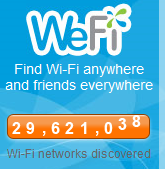
WeFi’s Directory Nearly 30 Million WiFi Hotspots Strong, Raises More Funding
by Robin Wauters on August 4, 2009

Lightspeed Venture Partners and Pitango Venture Capital are pouring more capital into WeFi, operator of a global, community-based network of WiFi hotspots, in an undisclosed Series B round of funding and following an earlier round by both investors secured back in May 2007. The follow-up financing was provided to support WeFi’s business and financial needs, and according to the release is being allocated toward expanding development, marketing efforts, and strengthening unspecified partnerships.

The WeFi community so far has mapped over 30 million WiFi access points, and counting. Next to this directory and the community formed around it, the startup boasts a free software program that allows users to automatically connect to WiFi locations wherever they are. The tool, which was previously only available for Windows and Mac users, is increasingly finding its way to mobile devices, which makes a lot of sense. More specifically, the company has recently introduced applications for the Windows Mobile, Android and Symbian platform.

Additionally, WeFi recently announced the launch of WeROK, a mobile entertainment / communications portal as well as the opening of WeFiApps, a WiFi powered app store for mobile tools.

WeFi was established in February 2006 by Yossi Vardi, Tamir Scherzer, Arnon Kohavi and Shimon Scherzer, and is incorporated in Delaware, U.S. with R&D facilities in Israel.

Advertisement

Comments rss icon

  • Does not make sense to me at all. What software tool do you need.Every wifi enabled device has a built in tool that searches and finds the various hotspots available in that particular area.
    Unless as I suspect this is another kakameme idea around selling advertising through a unified system of hotspots there is no real value to an end user whatsoever.
    A community based on WiFI networks must be just part of the hype cycle.
    So I sign up for this service & can see where I can get a free hotspot and then talk to others in that hotspot … ooooh wow how great is that.
    Wonder how much TechCrunch got paid to push this service..

    • You raised a good point…there.

    • What if I want to know which place has WiFi in advance so I can plan accordingly?

      • …and you think this will help you? I tried using the maps on the wefi website a couple of months ago to see where i’d be able to connect in Amsterdam. found a hotspot not far from my hotel. when i got there – guess what – no hotspot detected by my laptop.
        besides, jiwire provides this service in a much more reliable way.

        • it might happen, but the info getting better by the minute.
          I like the app on PC and even more on mobile my android is always connected nothing like it in the market

  • trying to understand how this differs from something like DeviceScape (which I’ve been using for a couple of years).
    Even Fonero (which I have but am very unimpressed with) offers a similar solution.

    It looks like their business model is to get people to download a toolbar that (I guess) hijacks search and promotes other “useful” services and disguise it with an IM client (so you have to get your friends to sign up for it be be useful) and something that duplicates existing OS functionality.

    Now… if it was location aware and could direct me (accurately) to the nearest usable WiFi hotspot that might have some benefit in a strange city…

  • I hope their software is better than their webpage, which instantly drives my Firefox cpu usage up to around 98%.

  • Most of the Wifi spot they claim are “Free” on their maps are not free at all. For example, it shows Wifi is “free” in downtown Manhattan at the Hilton. It’s free for Hilton guests, not for everyone else. What is the big deal about this service…? May be Techcrunch found some kind of a link between this service and twitter… mention the Twitter and you have a story on TechCrunch.

    • The DB isn’t perfect but … its getting better by the minute.
      Try the apps they are so cool (I recommend especially the android version)

  • Another bad investment. Good luck though.

  • Smells like BS, i wouldn’t invest a dime.

  • Overall based on the comments so far people seem to raise similar questions.Now the question is who are these folks who put money into this venture & for what reasons.I bet if you read the details of what the deal really is there will be a whole bunch fo conditions.
    I just wonder if TechCrunch or any others who report on such deals have the ballz to ask the Investors what are the terms and also what was the reasoning behind this investment besides the Obvious PONZINATION of the whole venture invetment hype concept.

  • While I see the need for a wifi location & login tool I can’t see the point in 30 million listed locations when most of these are private/secured or switched of by the time they’re added to the database.

  • I also wonder how they will make money.
    We have seen so many internet sites of this kind….
    Fon did not succeed up to now.
    But it i good to see some still beilieve in this kind of company.

  • yeah, I don’t get it. I open my laptop and it tells me networks that are in range and secure or not. I think they want to have little network owners offer a paid service, a cut of which WeFi keeps. So what looks like an unsecure network in someone’s house becomes accessible to me for a micro-payment.

  • Have never used their service, but it would add real value if:

    1) Each user’s installed software actively seeks out free Wifi spots and attempts to call a page hosted by Wefi through any unsecured hotspots it finds. Where a hotpot was not free, it would keep a log and report it to Wefi next time it connected. This way they could provide a decent representation of actual free wifi spots (even with a rough estimate of uptime).

    2) A very different business model and not likely to be adopted by any small player: They enabled users to open their wifi up in a controlled fashion (would prob require control of the router or additional hardware), with users being able to set the cost of access (by time or bandwidth usage), speed, max bandwidth usage in total and kick/block abusers (with a pro-rata refund.

    Any payments (from customers and to wifi owners) would be done by WeFi, which would be free to access in order for users to top up their pre-paid credit or subscribe to a plan etc.

    • I was also thinking about something like you’re second point. Although as a costumer I’d like it to be free.

      Like, You share you’re wifi with the community and you get to use other’s wifi. The company only provide some sort of identification and fraud/security reporting. Might be an utopia though, there would be too many problems and nobody would share…

      • Yeah free would be awesome. I believe however that the ability to charge a small fee (e.g. $0.5/hr, not $10/hr like many current hotspots) would be huge incentive for people to adopt the service.

        People making their net available would benefit by earning some money to put towards their monthly internet bill.

        People using their net would benefit by the increased availability of hotspots and the drastically reduced cost (due to there being more competition).

      • You should follow some major upgrades ahead

  • jorge W smalltree - August 4th, 2009 at 3:23 pm PDT

    i just tried to use the service to locate a few hotspots in my area that are free… It wasn’t on the map…

  • It is interesting to see that almost all comments on this page were written by people who didn’t even try WeFi and don’t understand what it is about. Not going to address every single comment, but here are a few points for y’all to think about. The thing with WiFi is that you would really want it to be transparent – just turn on your WiFi-enabled device, and if there is any available WiFi network around, you would expect to just get connected. And if you move about, you want to be re-connected to some other available Wi-Fi network. With the jungle of Wi-Fi out there today, it is just not happening. If you are a smart user and know how to open up the WiFi network wizard, all you can see is which networks are “secure” (that is, encrypted and need the password of the network owner to connect) and which are non-secure. But out of the non secure networks many are not really open to the Internet – some are blocked by MAC filters, some will let you connect but then when you open your browser you are taken to a portal page where you have to pay or login, and some you can actually connect, but the connection quality is downright lousy. What WeFi does, using the millions of users who have already installed WeFI on their devices, is collect the data of millions and millions of such WiFi networks, and analyze them by putting together the“intelligence”gathered by the clients, and figure out which networks are really good, which are not, which are congested and so forth; WeFis network intelligence can also figure out which spots are really open to public use, which are just left open because the owner chose not to encrypt them and which are managed by public Wi-Fi providers like Boingo and Trustive. The results of this analysis are cached on the client devices and are used to connect automatically and re-connect to the best Wi-Fi network around, always preferring spots where other clients have already connected and got good Internet connections.
    To the guy who commented on the maps – have to admit that we are racing to catch up with our web maps, we are simply facing much faster growth than we have planned for, so there are a few glitches on the web maps… working on that – thanks for the comment.
    As for making money, I hope people understand that we can’t share everything with everyone, just wait and see… we can just say that there are additional uses to our technology that are becoming stronger as the virtual network coverage grows, and these are being licensed to big commercial players. There are also several business and premium services coming up, and money/distribution generating initiatives such as http://WeFiApps.com and http://WeROK.net – but we will always have a free version for everyone – the people give us power…
    And to those smart asses who like to trash VCs and scream “bad investment” – come out and say who you are and what great successes you have delivered, and then we can talk. There are smart and experienced people behind that money, they know much more than you can about what WeFi is really going to do in the world, so just wait and see.

  • so download the app and join the community

  • that’s all very well and good, but what will the app actually do for us other than that im thing? by the sounds of it, it just records wifi hotspots and builds up on that community network.

    not to sound paranoid or overly critical or anything but my world domination sense are tingling Xp

  • I tried to uninstall and the program won’t go away. Yes it just gets tangled up on the OEM wireless searches.

    D-Link packaged a fine mapping software but it outdated itself, but it went a step further than mapping wireless routers by mappng all computers by picking up their wireless and possibly bluetooth.

    I think I feel radio waves getting crowded …

Leave Comment

Commenting Options

Enter your personal information to the left, or sign in with your Facebook account by clicking the button below.

Alternatively, you can create an avatar that will appear whenever you leave a comment on a Gravatar-enabled blog.

Trackback URL
Short URL
bugbugbugbug
Techcrunch on Facebook