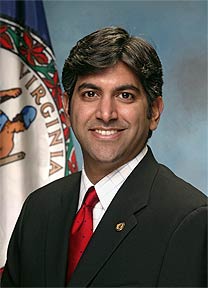
 Tonight Aneesh Chopra, US Chief Technology Officer and Associate Director For Technology, spoke at the Computer History Museum in Mountain View during his first trip to Silicon Valley since he took office in an event that is being put on by the Center for Democracy and Technology, the Churchill Club, and TechNet.
Chopra kicked off the evening by stating that this is the first of many visits to Silicon Valley, where he hopes to continue an onging dialogue throughout his tenure as CTO. He then began exploring some of the ways that technology is having a major impact on our personal lives, briefly describing some of the ways he and his wife have used the Internet to help seek advice in raising their child. But while we’re doing a great job leveraging technology in our personal lives, he says this hasn’t translated to “global competitiveness” and public policy.
In a recent report put out by the Information Technology and Innovation Foundation, it was found that the US, while doing well with regard to innovation in terms of an absolute measurement, was seeing very little growth compared to other countries. Likewise, our growth in E-Government has been stagnant, as have our improvements in higher education and improving the next generation of our workforce. Even in areas that we’ve done well in, we’ve largely failed to continue improving, setting the stage for the Unitied States to fall behind in the future.
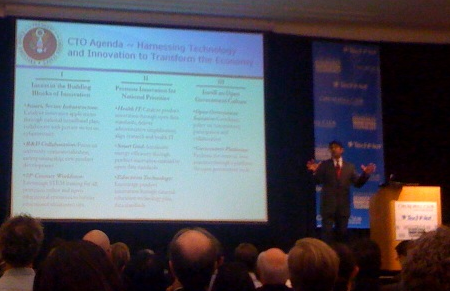
To deal with these problems, and others, Chopra says that his job is to balance long term policy making with near term changes.
Chopra says that part of the problem we’re dealing with involves figuring out the ‘verbs’ — we know what tools could possibly help (the ‘nouns’), but we need to decide what we’re going to actually do with those tools. He recalled a story from his time serving in Virginia, when the school board was looking to update its old physics text books. Going through normal procedures, updating the text books would take as much as four years. Instead, Virginia assembled a team of scientists throughout the state and the US to write chapters for the book for free. Scientists and professors accepted to task, and managed to write and have a book up for approval within a year.
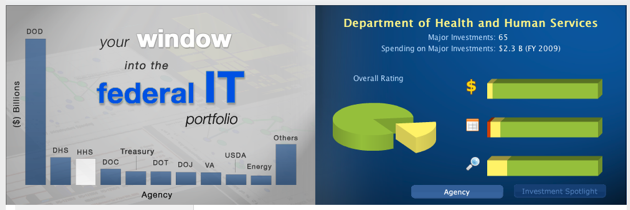
Some of the tasks we have to undertake will be years in the making, but Chopra pointed out a few ways that we’re already making headway. On June 30, the government launched the Federal IT Dashboard — an extension to the government spending site that had been previously launched. The site allows citizens to see how their tax dollars are performing relative to IT investments. Since launching, the site has seen 30 million hits.
Likewise, Chopra talked about a new product being undertaken to help modernize the Citizenship and Immigration Service, which is not known for being particularly customer friendly. The service will soon be launching a new online site that will allow for online checking of application status, as well as alerts via SMS, Email, and the website.
Chopra says it’s “not the easiest thing to bring innovation to Federal government” (a statement that brought more than a few chuckles). But he and his team are working to find open government platforms for blogs, wikis, and peer collaboration tools that could be easily deployed to multiple agencies throughout the government.
Q&A:
Q: One of the initiatives for the Obama administration is digitization of medical records. But there’s resistance in the industry and privacy concerns, legistration that imposes restrictions.
A: The president was very clear when he annouced his cybersecurity policy that as a nation we have to maintain the openness of the web while at the same time addressing the cyber security threat. It isn’t a question of one or the other — it’s if we get the cybersecurity framework right, it can fuel the next wave of growth. I would say the same is true for healthcare. If we can get the privacy and security frameworks right, it would fuel a set of product innovations. The President has also been clear that we need payment reform as part of digital migration for health. Incentives today aren’t designed to encourage prevention activity. Many peole say that doctors don’t like technology. But I don’t know a doctor who doesn’t use a product called Epocrates. That gives me confidence that if we build better products, they’d use them.
Q; I teach IT. What kind of values should I start to instill in my students?
A: We must listen to customer need. IT and ‘business people’ can speak different languages, we don’t listen very well. We need to ask better questions. Put IT thorugh customer experience design workshops.
Q: How are going to change culture that keeps government organization behind the times?
A: There are tools today in Washington that we don’t use very well. The Defense Department has defensesolutions.gov, where they can take any idea and turn that into a process that would get looked at. For example, the DoD wants a ruggedized forensics kit for the field. Anyone in the valley could submit an idea. We need to use the tools better. We also need to push the envelope for other tools (X Prizes) we haven’t really embraced them in all. We do need procurement reform, we have leadership at DoD looking into it and other organizations.
Q: When you’re trying to do innovation you run against existing software. A lot of software in government is old. I was wondering whether you’ve begun to look at this troubled systems, come up with strategies?
A: I will say in defense of a number of agencies, there are some reasonably well architected solutions in place. I am a big fan of open collaboration, not specifically open source though. I have no problem with people purchasing Oracle or Microsoft, the challenge is that a lot is spent developing on that stack afterwards. So when we adopt a financial system, we have to put in provisions for snow plow accounting, because it doesn’t come with that but our state needs it. But while we have to do that custom stuff, we’re trying to improve sharing which could let that module be shared between states.
Q: Talking about cyber security, we thought it would boost innovation. But given recent resignation of Melissa Hathaway..
A: When Obama made annoucment about cybersecurity coordination he was explicit that they would work together with me and our CIO to bring policies in line with our federal government. Depsite her resignation, we’re working fast and furious.
Q: There’s a conundrum: the more private info you put on the web, the more it helps, but it’s subject to various abuses. How we square this circle? Is more government regulation the answer?
A: We have policy framework around privacy. I will not lead the debate on that, but I’m very sensitive to the choices. My belief is that consumer preference will be a leading driver of policy.
Q: You’ve talked a lot about Health IT. What are the verbs.. you’ve talked a lot of about nouns
A: Two words that matter: meaningful use. Congress is making incentive that require that doctors are meaningful users of technology. There is a set of public commmittes, you can download draft version of what “meaningful use” should look at, there are verbs about simplifying admin costs. Making sure you track your presecription uses. Make sure you can identify cholesterol, and so on.
Q: Higher education is tough. It’s easy to do courses online. It’s hard with the fractured structure. We don’t have interstrate highway of credentials, etc. Terminal systems done on local basis.
A: My impression is that community college foundation will probably the most leveerated opportunity. The system is very keen to adopt technology.
Here’s a video of the event recorded by Robert Scoble: