Should Journalists Be On Twitter? Three Quarters Of NYTimes Readers Don’t Think So.
by Robin Wauters on July 31, 2009

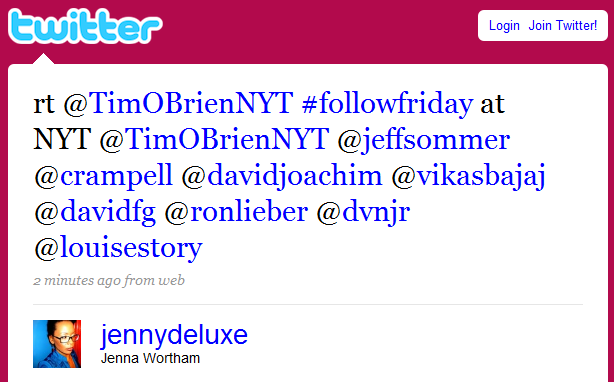
Apparently, the New York Times is still unsure whether its reporters should be allowed to Tweet or not. Intrigued by this tweet from writer and consultant Stowe Boyd, I registered for the New York Times’ Insight Lab, an online community / focus group made up of Times readers interested in providing the media company with direct feedback.

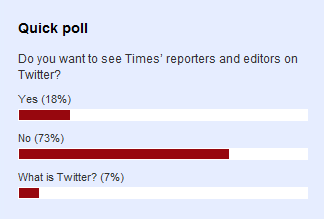
The homepage features a quick poll asking members if they want to see Times’ reporters and editors on Twitter or not. I guess this is the most pressing issue the New York Times wants to hear from its readers about.

For some reason, close to three quarters of the respondents indicated that they’d prefer if the journalists stay far away from the micro-sharing service. Only 7 percent had no idea what Twitter is. There is zero indication on the site how many people are actually registered members of the Insight Lab, let alone how many so far participated in this poll. Nevertheless, I’m surprised to see the negative answer leading at this point.

Update: the NYT tells me The lab launched three weeks ago and currently has approximately 3,000 members, of which 455 members had responded to the Twitter poll at the time they contacted me. The media company emphasized that it has a robust and growing presence on social media sites like Twitter (more than 1.5 million followers to @nytimes and many individual journalists, with large Twitter followings).

In my mind, journalists are free to join any social networking site they want as long as they conduct themselves online the way they’re supposed to behave in meat space e.g. not embarrass themselves or the publications they work for and never do or say anything that could call their professional reputation into question. Here’s their policy on those sorts of things (a wee bit paranoid indeed, but understandable).

What’s the point of asking readers if Times journalists should be on Twitter, come to think of it? Maybe the Times is just looking for guidance, but something tells me they’d get better answers if they asked this question on Twitter itself. The @NYTimes account has 1.5 million followers, which is probably a much bigger sample than the people who managed to find the poll hidden away on the Insight Lab site.

Twitter’s far from perfect, but it’s not a fad. In my experience, you can get a lot of value out of the service as a reporter even if you choose not to engage in public tweeting but rather keep to a close circle. Heck, even Twitter Search seems to me an essential tool for journalists tracking breaking stories and events. Why would readers want journalists to be less informed?

Help the New York Times by answering our our own poll:

Advertisement

Comments rss icon

  • In short, yes. I personally believe that twitter will ultimately consists of free twitter posters, and subscription based posters.

    • They can be on Twitter imo only if they serve like real journalists like posting the real stuff and not some paid up stores like most news agencies does which makes then #fail in the long run. Mike posts a lot of real and original stuff which is why TechCrunch is #hit !

  • They can be on Twitter, but I’m not interested in *seeing* them there, which is what the question asked. I don’t want to get to know the personal lives of the journalists, I want to retain the image I have of them in my mind. As perfect, smarter than me, or at least much better authors than me, willing to take risks for a story…

  • I think this survey is skewed by online PRINT IS DEAD MSMERS HATE US AND ARE OLD types.

  • Journalists certianly shouldn’t be prevented from using twitter. I’d say that twitter is so powerful that if a journalist isn’t using it they are at a disadvantage.

    It’s also used by many as a kind of RSS alternative.

  • What I think you are really getting at is how there is a whole new meaning to “branding” and how now that applies to people. It is not enough to brand the new york times, you have to brand the people who write the stories.. and from an individual stand point it makes sense because it creates loyalty to a writer giving that person a mobile audience they can take with them if they change jobs. I can see how this would be scary for the higher ups because they would lose central brand loyalty. The power would be with the pions..

    • I agree with you and this you made a great point. With new media it is now possible to easily and personally brand yourself as an individual. Unfortunately it is also easier to find associations between individuals and their affiliation publications/corporations, as well.

      This is such an interesting issue. I think sometimes it easy to forget that businesses and papers really are just groups of different individuals. Though perhaps a case can also be made (in Gestalt fashion) that the sum of an organization/publication is greater than its parts :P ?

  • Better questions: should their editors edit every tweet?

  • All the survey asks is whether readers want to see the writers on Twitter, not whether they want them to be on Twitter. In no way can you infer from this survey that “close to three quarters of the respondents indicated that they’d prefer if the journalists stay far away from the micro-sharing service,” just that close to three quarters of respondent aren’t interested in seeing them on Twitter. Whether the motivation behind the disinterest is that they are against the service or that they just wouldn’t read it is ambiguous.

  • Because 3 quarters of NY Times readers are 70+ white males who could care less about tech

  • I think the survey results reflect the culture of the New York Times readers…everyone I know who reads the NYT savors the opportunity to immerse themselves in the volume of information presented and in the experience of consuming it. They’re just not into cursory reportage that skates across the surface of stories. Twitter in a reporting context is an early warning system, it’s a way for reporters to send out an alert that they may be on to a story or may have a new detail, but I think NYT readers want to wait until the story is fully baked before they engage with it. So this is more about NYT-reader culture than it is about the viability of Twitter as a journalism tool.

  • I believe the Twitter/journalist angst is related to Twitter/lawyer angst (see E.g. “Should Lawyers Tweet with Clients?” in the AmLaw Daily- http://bit.ly/Ol5uq).

    Both groups maintain a set of confidential relationship and need to take care to avoid conflicts (a completely manageable issue, IMO).

    Both industries are also being tremendously disrupted by the web, so Twitter is a straw man for that business model anxiety as well.

  • I think perhaps people may have interpreted the question asking “Do you think journalists should be posting to Twitter INSTEAD of writing for the paper. Or at least maybe those who aren’t on Twitter interpreted it that way.

    But I agree, the question is pointless–obviously if the NYTimes has 1.5 mill followers, there is a demand to be on Twitter.

  • I read the Times obsessively–yes, still in print because it’s a better experience–and these results make sense to me. Twitter is mostly a waste of time that only contributes to decreased attention spans and stupid hashtags. It doesn’t really make much difference to me if Times reporters or Tech Crunch writers or whoever is on Twitter. Maybe if J.D. Salinger was on Twitter, that would get my attention. That said, I think it can be an effective research tool, but as a Times reader, it seems mostly irrelevant.

  • I absolutely want to see journalists on Twitter! I think Twitter is becoming such a powerful tool for keeping on top of what people are talking about online (trending topics, buzz words, basic opinions) that I think journalists will do themselves a tremendous disservice not keeping on top of what people are saying in Twitter (and correcting rumours when necessary =).

    Additionally, one of features of Twitter I’m really starting to appreciate and love, is how businesses and publications are using it to bring their associated personalities back into the open for people to get to know and interact with. Especially for a journalist, the ability to discuss and elaborate on points of interest (or contention) in their publications seems valuable and helpful.

    I still believe that EVERYONE (not just journalists) need to use discretion and be honest in their online postings/tweetings- state when they are voicing a personal opinion versus a fact, for instance.

    All that said, I love discussing this issue because I think in the day and age of social media and mass-scale web communications, this issue of a professional/personal image is becoming an increasingly important one to address.

    Right now I am thinking that if a person as an individual does all they can to be honest and use discretion in both personal and professional postings- the two should be one in the same. Would love to hear other peoples’ opinions on this!

  • Of course NYTimes reporters should be on Twitter – they should (and most do) indicate that RT’s are not endorsements by the New York Times. If journalists were left out of Tweeting the credibility of Twitter as a medium would drop way down and it would become nothing more than another rumor mill.

  • I wonder if the respondents would rather think of Twitter as community journalism, and the image of “real” journalists on Twitter sort of deflates that image.

  • the answers should be : yes i would follow them, yes they can be on there but i won’t follow them, no they should not be allowed on there at all…

    as it is, the question justs asks if you (ME) would like to see them there… the question is not specific enough and the answers could have double meanings because the question is flawed

  • That’s about the most worthless survey question I have seen. Trying to extract meaning from it is equally as worthless.

  • I want to see ALL journalists on Twitter so we can engage them on a platform they or the bosses cannot control.

  • Twitter is not secure, and until it is, this is a premature question and issue for the NYT. However, I agree that if you work for a newspaper with a reputation to protect, and have a signed employment contract that governs online behavior, then it could be expanded to include Twitter.
    Which means, that if an employee violates that policy, they can be fired in a New York Minute! Who the heck would put their reputation in the hands of an insecure social networking site that can’t protect its members’ identities let alone stop the avalanche of spam and “false positives.” I think this is all a marketing scam being promoted by marketing gurus who have no clue about what works when and where. Some social networking sites are not appropriate for all content. What’s so hard to understand?

  • Hello! I ‘m a journalist and I ‘m not tweeting about my private life. But Twitter is part of the tools we need to use to stay connected with the world on which we are reporting. Also as pro. investigators we know how to cross different informations in order to sort the real from the fantasy. I wonder how much the ppl who answered this survey know about the nitty gritty of journalism work?

  • Me thinks Me see a cat in the hen house. Think about it as subscriptions decline online social ad spends increase and News that is older than 5 minutes is old news – who would benefit by this negative policy.

    Seems a sad attempt to try & keep readers on a paper page. Where in fact if they stifled their talent and the generated publicity by meeting their “NY Times” news readers where they prefer to read ie twitter, FB or their website. they will views.

    Twitter is feed that leads all the chickens to the coop so….the cat won’t get fat if it quits feeding the chickens.

  • Well in my opinion it should have been worded as a two part question. Do you think NYT editors and reporters should be on Twitter? and Would you follow them on Twitter if they were? I agree with Dan Grossman The original question only asks if we want to ’see’ them on Twitter. I think they should be on twitter, (especially those that report/edit breaking news, technology or business related news) as long as they keep their tweets professional which I’m sure they would. But i wouldn’t necessarily follow each of them. I think the only NYT employee i do follow is TimOBrien.

  • Wow, after seeing this poll it has changed my life. “Just kidding”. This is a meaningless poll. They should have included who likes granola.

  • I don’t mind journalist on twitter, on a personal account. The moment they start using twitter as a source…it gets blurry fast. Twitter, as with all social media, is opinion. I want my news based on fact and not opinion, 2nd hand accounts, or hearsay.

  • Should people be reading the New York Opino… uh TImes? 3 out of 4 Americans who aren’t uptight New York liberal elitists or West Coast Hollywood degenerates don’t think so.

  • There’s a difference between edited and unedited content coming from individuals.

    For example, I cannot tell you how many times TechCrunch published disappointing rip-and-read posts because no one stopped to think before regurgitating what someone else said (that was obviously untrue).

    That should not happen with an editorial review process.

  • Let’s extend the question further.

    Who wants to see the lying ultra-leftists at The New York Times – who passionately hate bloggers because it totally bypasses their decades of control of the expensive dead-tree/mass broadcast mainstream media – publish *anywhere*?

    I don’t want to see their paper, I don’t want to see their tweets, I do not care to read their junk in any venue.

  • Surely the nice thing about Twitter is choice: people use it in their own way – I’m sure the journalists will still get stories without Twitter, and Twitter will still exist without them.

    But with such a high ratio of journalists to general populace on Twitter, higher if you include aggregators and bloggers, they must, at very least, be missing out on the general news buzz at times.

  • What a useless misleading poll.

  • i think they should be. I already get most of my news from links in Twitter now. It’s easier, faster and more timely than web browsing or RSS.

    • I think you should “follow” NYT then for their newspaper’s feed. I think that’s very different from individual journalists having their own “twitter” pages.

  • 1) Putting such a poll on a blog like TC automatically results in flawed findings. Of course people on a “new media” site are eager to see journalists participate in this new media tool as well. (I on the other hand vote no.)

    2) Placing journalists on Twitter is almost as bad as putting them on myspace. Journalists are not in the business of “entertaining” like Barbara Walters, for example. They are to be taken seriously as credible writers for a respected brand (although, I personally do not prefer the NYT for my news). Having journalists “tweet”, in my opinion, draws their credibility as serious writers into question. I don’t care whether or not Barbara Walters or anyone else for that matter is on that site. A serious journalist, in my opinion, should not be on Twitter, MySpace, or any other trendy media tool.

    3) Placing journalists on sites like Twitter, in particular, increases the likelihood that they can compromise their stories and their sources…these people DESERVE to be PROTECTED. We’ve heard numerous stories already of everyday civilians falling prey to criminal activity simply because they “tweeted” personal, random details about their whereabouts, their work/place of employment, and the like. The same could happen if journalists are “tweeting” their whereabouts and other random details about themselves and what they’re doing.

    “Real” journalists have no place on Twitter, MySpace, Bebo, etc…

  • F facebook, F myspace, and most of all, F twitter. And just to show that I’m not discriminatory with my non-objective reporting of the angst in all my antisocial social networking F’s, FTW and everyone in it. (Except their Mothers, unless their Mothers are MILF) Yes that’s right, F You! And F U2 too. Bono my A**.

    Hey, guess what?
    Boy have I’ve got a social network for you…
    In my pants!
    Oh wait a minute, that’s a social disease.
    Never mind.

    TechCrunch drools! (drools is my own special slobbering idiom for rules)

    Was that too many characters for a twit? (Or tweet or whatever the F they call it)

  • Real journalists shouldn’t be on Twitter, as it’ll ruin Twitter’s credibility for being the best rumor mill on the web.

  • ann curry’s tweets are some of my favorites. what she did and continues to do on twitter in the case of Iran and their elections has been very informative. i suppose it is how journalists conduct themselves. just say’n

  • I think this survey is skewed by online PRINT IS DEAD MSMERS HATE US AND ARE OLD types.

Leave Comment

Commenting Options

Enter your personal information to the left, or sign in with your Facebook account by clicking the button below.

Alternatively, you can create an avatar that will appear whenever you leave a comment on a Gravatar-enabled blog.

Trackback URL
Short URL
bugbugbugbug
Techcrunch on Facebook