Whether it’s a sign of economic recovery or just investment bankers getting ready to take off the month of August, there’s been a lot acquisition activity lately. In the last week alone, IBM purchased SPSS for $1.2 billion, Amazon bought Zappos for $928 million, Sprint paid $483 million for Virgin Mobile, AdKnowledge paid $50 million for Super Rewards, and Yahoo picked up Xoopit for $20 million.
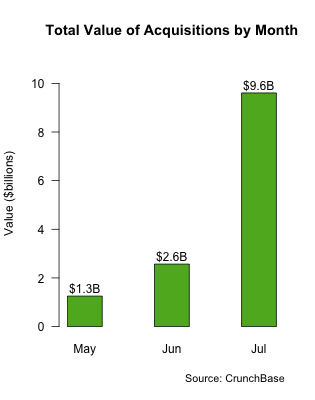
So far in July, the value of the acquisitions we track on CrunchBase totals $9.6 billion, which is nearly three times more M&A activity than the $2.6 billion we tracked in June. M&A exits already started to perk up in the second quarter , according to our latest CrunchBase report. But the increased deal flow on July suggests that corporate buyers are opening up their purse strings even more while acquisition prices are still relatively cheap.
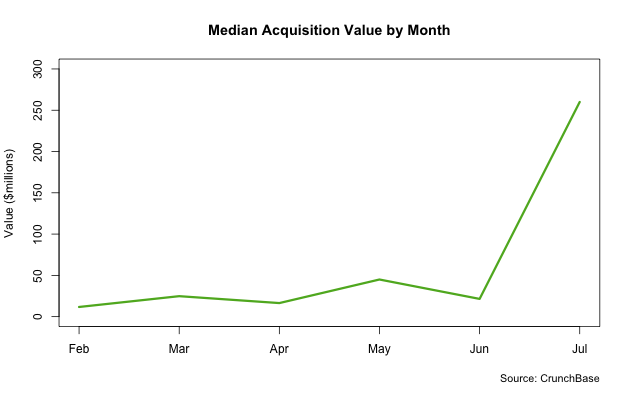
But the bargains might not last. Already, the median acquisition price leaped up to $260 million in July, from $22 million in June. Most of that jump was due to some very big transactions such as the ones listed above, as well as Agilent’s $1.5 billion purchase of Varian and Bristol-Myers’ $2.1 billion acquisition of Medarex. Still, you know what they say about rising tides . . .


I like that Crunch base actually collects all this data and tells us that the overall things are looking up. Thank you for doing this.
it would be more interesting to see the implied EV/LTM revenue multiples of these transactions. puts everything on equal footing and prevents one huge transaction from skewing a data set.
How do you calculate EV for a private company?
Great point. EV includes all sources of capital, so it’s primarily equity + debt – cash. I say primarily because you should also add preferred, convertible, minority interest, etc. It’s basically what you’d have to pay to own the ENTIRE company without obligations.
Agreed. Data are great. Relative to EBIT and Revenue is more interesting.
wow…. ang yaman… heheh thanks for sharing….
I agree with Kevin above. This is good collection of statistics by TechCrunch and really insightful. Thank you TC
Just wondering if you are using SPSS for all the statistical calculations
?
Actually I use R, it goes a long way. I like to support the open-source community.
any rumors on what apple might acquire?
Just wondering if you are using SPSS for all the statistical calculations ?
Suffice to say, Techcrunch is Techcrunch again.
Yeah it seems to ebb and flow – looks like we’re starting on an uptrend. Nice
Should be noted that because of this M&A activity, there was a 50% reduction in “Why is this news?” comments.
You forgot about Bankrate, purchased by APAX….which is significant because we will likely see PE groups get active as a new class of acquirors, due to the existing amount of funds they have raised and the fact that acquisitions dont require debt (unlike traditional LBO/MBO’s) that they are accustomed to.
I think those are great stats but, any merge & acquisition takes a long time before it is made public and/or announced.
Here we are only seeing the result of all of them, and they happen to be in July.
So I know wonder when those transaction (M&A) started?
For the sake of simplicity we can consider that lets take numbers from the month when the deal was announced. Anyways if you take it over a year or more then the data starts making more sense since a kind of cycle is followed. So if lets assume that typically a deal takes 4 to 6 months then also it will be cyclical in nature and still what we are seeing is a fairly correct assumption
Although M&A groups pitch all the time, there is tons of time pressure on actual M&A transactions because this is the best way to ensure confidentiality.
Seeing this chart shows promise and hope for the future of the economy.
It’s a survival stage for some Web 2.0 startups that have high burn rates (e.g. SearchMe went bye bye). Thank goodness we don’t and can ride out this wave.
Citing median acquisition value does nothing to explain the statement “bargains might not last.” All this tells you are the sizes of the companies being acquired. A $1.1 billion company is cheap if it is truly valued at $2 billion.
The statistics you should be showing are the changes in comparable multiples, ratios such as enterprise value/revenue, enterprise value over EBITDA, etc. These are the statistics that determine whether or not an acquisition is a good bargain.