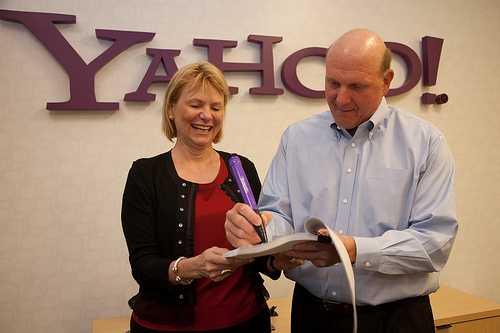
Microsoft and Yahoo announced their search partnership this morning. In a nutshell, Microsoft will power search technology for both companies, while Yahoo will take over ad sales. Here are my notes from this morning’s Yahoo-Microsoft conference call (I’ve bolded parts for emphasis):
Carol Bartz: This is a great day for Yahoo. A game changer. benefits for Yahoo. half of all Internet users come to us, but face a formidable competitor in search. share investment expense to scale the market. Our vision is to be center of people’s lives online. We must do that by working on our own properties or working with others like Microsoft.
Only covers search and search advertising business. Self-serve advertising will go through Ad Center. Yahoo will continue to integrate search in its properties but back-end technologies will be powered by Bing.
What this deal is really about is scale. Advertisers want an alternative that has scale. Everyone wants a real alternative and advertisers are no different.
Ballmer: About creating efficiencies. The search scale we will get for Bing will allow us to create greater innovation for searchers and advertisers.
Win-win agreement for MSFT and YHOO. Both get more scale, advertisers get more scale, the whole industry will benefit.
Carol Bartz: Terms of the agreement. Gives MSFT a 10-year license to Yahoo’s core search technologies. will integrate into AdCenter, which will power both our search and theirs. Display is separate.
MSFT pays 88% TAC on Yahoo’s owned and operated sites for 5 years.
Revenue will come down a bit because of revenue share, operating income will be $500M higher, costs $200M lower, operating cash flow $275M higher at full implementation.
This deal won’t happen over night. We will work with regulators. Anticipate closing the deal by early 2010. Will begin with major markets including the U.S., transition to Bing in 3 to 6 months, transition from Panama to Ad Center will take 12 months.
Q&A
Q: Why not add a display advertising component to the deal? How big is the RPS [revenue per search] gap?
Bartz: On the display side we wanted to keep this as simple and straightforward as possible.
Ballmer: We are taking a big bite here. Search is more well-known when it comes to automation on the selling side. On RPS, I don’t expect a negative consequence on our P&L, but a risk we are willing to take. [Also antitrust concerns, which he doesn’t mention]
Bartz: This is more about making the outside world feel comfortable because we are very comfortable with [the RPS the deal will generate]
Q: You moved from a deal that would generate a boatload of cash to a deal with a boatload of value. Why no upfront fee?
Bartz: What was really important to Yahoo was that we had a deal that flowed successfully through our P&L. What we really wanted was a significant TAC rate. As far as we are concerned the boatload of cash is preserving our revenue line
Ballmer: You take the current revenue mix Yahoo has, a certain RPS, we are guaranteeing that. If it is the same query mix and same market it ensures revenue only varies by the TAC amount and nothing else, that is a floor, not a ceiling..
Q: Transition costs?
Ballmer: There will be two years of transition costs. Upside really comes as we improve the relevance of search ads. As we improve monetization on both Yahoo sites and MSFT sites, there is clearly upside in that. Our upside comes as execution builds. For us the investment will be a few hundred million over the next two years to get this to work.
Q: How does this affect total CapEx?
Ballmer: Some additional CapEx, nothing that affects FY10 for us. We have a plan where some Yahoo engineers over time may move over to Microsoft.
Q: What if any opposition will you face in Washington to make this all happen?
Ballmer: We will face some opposition from a competitor who may not want more competition. Certainly we would expect the competitor to be aggressive. I think we have a good case for how this improves competition for consumers and the advertiser. We will be called on to present that case in Washington and Brussels.
?: Will start filing process next week. Google has 78% of paid search. Don’t know of any instance where a company so dominant made antitrust objections to a deal.
Q: Any impact on jobs?
Bartz: Yes, there are certainly many Yahoo search employees who will be asked to take jobs at MSFT. There will also be search employees [who get redeployed]. Unfortunately there will be some redundancies in Yahoo. This is a transition over the next 2 and half years. Nothing will change until we get regulatory approval, but yes, there will be redundancies, but in the future.
Q: Do you have a number?
Bartz: That is in the planning. We have no numbers to announce at this time.
Q: How much does this affect the place search takes in Yahoo’s services?
Ballmer: The way the deal was constructed, most complex part of the discussion, was to ensure that engineers on both sides could innovate around and about search around other things as much as the other company can, and to protect the privacy of the consumer that they deserve. During the last many months, the challenge was not just to work through the high-level financials but to work through these details.
Q: How can Yahoo be innovative if MSFT takes over search technology?
Bartz: There is a lot of innovation that happens above the search result.
Q: What does this mean for mobile?
Bartz: What we are very interested in is doubling down on the mobile experience to integrate search into that, to integrate our content. Being able to have integrated search is important and also frees us up to innovate on the other areas. Allows Yahoo to do want we do well, be the center of information, entertainment, friends and family.
Q: You said what the TAC rate was for O&O, but what is TAC rate when Yahoo sells on Bing.com? What assumptions are you making for risk to affiliates (YHOO)? How do you convince Google advertisers to run a multiple campaign.
Bartz: On Bing there is no TAC, that is MSFT’s revenue . . .
Ballmer: You don’t know when you sell a campaign where the keyword will show up. You are buying the keyword on both environments.
Bartz: That is exactly right. You are really selling the combined market. On affiliates, it makes sense they would go straight to MSFT. The small advertisers don’t want to learn three platforms. What is important is that there is scale. They know how to answer into the Google ad system. We really expect we can provide a much better experience for this tail of advertisers and win them over.
Ballmer: The gap where we will be when we put our platforms together will be there, but it won’t be 800,000 [advertisers]. Google is something like 92% in Western Europe. At least there is a clear alternative choice.
Q: How will Bing use Yahoo search code?
Ballmer: Our engineers know Bing and will build to that platform, but we wanted to make sure we could put together our expertise and code with Yahoo’s expertise and code. We are very pleased it is not a rip and replace.
Bartz: On the paid search side, we are the provider for MSFT now in most of the international geographies. So there are both platforms to consider.
Q: Innovations as part of the deal?
Ballmer: We have access to two of the best sets of technology. Do we think we will have better algorithms for relevance? Yes we do. There is a feedback loop in search. the more searches you serve, the more you learn about what people click on. Scale drives knowledge. There is a return to scale from seeing that much activity [that is more] than Yahoo or MSFT see independently.
Bartz: We should talk about innovations on the ad sales side. Online advertising is in its pre-infancy. All of that is enhanced because it is a bigger marketplace.
Q: Why is this deal better than the one MSFT had on the table last year?
Bartz: I’ve done some exploring of that. there is actually more fiction in the market than fact. The big difference is that it was perceived as more of an upfront payment and a lower TAC. That is not interesting for us. We feel this is a true partnership with the technology and selling.
Ballmer: The deal last year was tailored more towards an investor than an operator. This deal is different, not better. Less upfront payment, and definitely a higher TAC rate.
Q: What pushed this through?
Bartz: Transferring paid search so people are comfortable with the platforms. Like the proverbial snowball down the hill once it gained momentum.
Ballmer: It is not like we come here with a two-page term sheets. I think we have well over 100 pages to describe what we are doing. What we were spending our time on wasn’t the high-level principles.
Q: Doing a partnership is harder
Bartz: Sure it is. Dating is one thing, but having a partnership is another. We had to make sure we were committed. It is a distraction. We will put the right team in place to make the transition. Once we got to the point we believed it would be advantageous for us, we moved ahead. That is what a partnership is.
Q: What will happen with other areas of search, Yahoo News, delicious, etc?
Bartz: When we talk about internal Yahoo search that is some of the innovation we are looking at doing. Paid inclusion we will decide on later. We have full flexibility on what to do inside our site. That is the important thing, there is a lot of value there to add search to our properties.
Ballmer: It was important to us to structure the deal to give Yahoo full flexibility [to add search to its services].
(Flickr photo via Yahoo).