
Modern Technology Brings More Productivity, Longer Working Hours
by Robin Wauters on July 24, 2009

There’s no denying it any longer: research has finally proven that new technologies like laptop computers and mobile phones have increased our productivity significantly.

Furthermore, mobile communications have resulted in us working longer hours, too. That means modern technology is likely to be thanked for the wonderful state of the global eco … never mind.

Anyway, the shocking findings come from staffing firm Kelly Services’ “Global Workforce Index” (via eMarketer), which shows that no less than 78% of workers in the US and Canada – across all generations – believed that gadgets such as laptop computers and mobile phones have effectively increased their productivity. Over half of the respondents even said they felt ‘much more’ productive, and only 2% said it made them worse workers (I’d love to meet them someday).
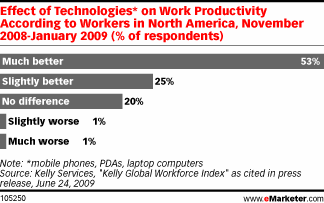
Other key findings: more than seven in 10 workers from all countries considered the ability to work outside of the office a ‘positive’ development, and 87% felt an office telecommuting policy would be attractive to them as employees.

In addition, 30% in North America, 33% in Europe and 41% in the Asia-Pacific region agreed that they were working longer hours because of mobile communications.

Never one to accept study findings without checking and then double-checking the facts, we’ll conduct a little research of our own:

Advertisement

Comments rss icon

  • I think sites like Jeroo.com a real time calendar can increase productivity. However, there is always room for abuse in anything. Like I saw two coworkers playing a game with pencils; whoever cracks it wins.

    Meaning, everything can be abused. Its all up to the worker.

  • I remember being more productive resulting in spending less time working… Hmmm perhaps we need to start being productive about work instead of checking facebook updates.

    • Exactly. Plus the poll was taken on the basis of belief which translates to perception, not necesarily fact.

      I know plenty of people who use the latest gadgets, the main culpit being the new smartphones, and they swear by them in terms of increased productivity saying things like “it allows me to do what I need to now, so I can do what I want later”.

      …which is bull. They often have a hard time completing any task, even a non-work related one, without looking to their new brain (’smart’phone) for the answer.

      I recommend reading “The Age of Spiritual Machines” which speaks to what we can expect and not expect from our reliance on computers.

    • Think about how amazing it was to send out a message for multiple people in different geographical locations around the world. try doing that with out a Facebook/technology?

  • I think that in certain cases it is perfectly reasonable to say that technology makes you a worse worker. If your job doesnt neccessarily require you to be on computer every second, i’m sure the continuous distractions make you worse!

  • More productivity brings less happiness, less satisfaction.

  • I recall research showing that after the 2000 recession, productivity increased as a result of new tech (Blackberries, etc.) and longer hours (e.g., being tied to Blackberries, etc.). As a result, after the rebound, companies were leaner than before the 2000 recession.

    So, during this recession, the layoffs per company were less compared with the level of downturn(although more companies were hit and it was a deeper recession) since companies were already fairly lean (e.g., look at some of the layoff headlines.

    I think its safe to assume that when the economy recovers it will be set even tighter than before and productivity requirements being even higher because of a different mindset and increased competition.

    Will this impact the “stickiness” so many sites strive for? I think so. During the 2000s, I knew of workers who appeared to be on Facebook all day long. In the future, I don’t think that will fly with employers. I think FB will be fine, but the overall “stickiness” pie will shrink per user and sites like LinkedIn that focus on productivity (”get you what you need asap”) should do well as they monetize that productivity. JMHO

  • I think it’s time for businesses to realize that if work invades the home, home MUST invade work. That’s the deal.

    So please… Check FB, Twitter, HuffPost, ebay, personal email, etc. often and at will and companies have to be ok with that. After all, you’re writing that memo to the team on aligning sales and marketing strategies at 10:47PM on a Thursday night when you should be snogging your wife.

    • wow, can’t wait to have you on my payroll

    • Derek- Agreed. I think if someone’s required to work long hours, they should be allowed to use their work computer (and work hours) to check in on life. There should also be a “safe harbor” to employees from a privacy perspective. I’ve been concerned about employer’s rights to invade employee’s privacy when employee are “at work” (check their emails, sites visited, etc.) when employees spend so much more time at work. There’s definitely tension there and I expect more clashes in the future.

      At the end of the day, employers will likely be able to limit surfing at work, but any surfing permitted should be private.

  • It’s good to have technology around, but this intrudes your personal time.

  • This research does make a lot of sense and it’s something that needs to be carefully looked into. I constantly myself doing work related stuff at home when I should be just kicking back and enjoying life. I’m always checking my work email, making sure the social networking sites are doing well and checking stats to see how the online sites are going. At my previous job, I was so upset and burned out, I almost quit because of the long hours. http://ziggytek.com/

  • Please don’t go with western philosophy and research it has only short term goals in mind.

    I have tried to find answers to, if any co-relation exist between productivity, development and human growth.

    Can our feelings of joys and sorrows could ever be measured by indicators which are based on material productivity.

    Please visit my blog if you have time.

    http://karmaeco...s.blogspot.com/

    Thanks

  • “more than seven in 10 workers from all countries considered the ability to work outside of the office a ‘positive’ development.”

    Gee, really? Here are some other softballs from the poll:

    Would you prefer to pay $4.50 a gallon or $2 a gallon for gasoline? Would u like to drive 40 miles each way to work?

    Pajamas or polyester?

    How many hours a day would you like your boss to bitch at you?

    ***Can anyone else think of any other genius questions that might have been on this poll?

    • People see the ability to work outside their offices as freeing, etc. Since the positive thinking bs has been pushed on us, we all like to imagine the good side of things only. How about the flip side of the coin? Working outside the office brings work everywhere else and makes you a slave 24/7.

      ++good, eh?

  • Internet access is to a large extent a distraction. What percentage of workers really “need” internet access for their job. At my company, we noticed overall productivity goes way up during the two occasions when we lost internet connections for 2 days.

    I know that when I have deadlines or have to do something very important, I move to my laptop and turn off the wi-fi on my laptop. That way I am not interupted by allegedly “urgent” emails.

  • Yeah, this result is all hat & no cattle. It reports perceptions, and for *years* the perception of productivity with computers has varied *widely* from other measures of productivity. A new piece of research stating the tautology that people’s ownership of productivity tools has a very high correlation to their perception that the tools increase their productivity–lol. silly of you to mention it. sillier if someone paid to do the survey.

  • Modern technology certainly has increased productivity. It has done so at the cost of family, happiness and overall well-being. Companies now expect to get ‘X’ amount of unpaid overtime from employees by employees remaining available on nights and weekends. In effect, the American worker has decreased his own pay by allowing this to happen. Upper level managers receive pay on the order of 10-100 times that of average workers for the increased availability. I personally think its time to turn off the cellphones and laptops when you leave work!

  • As if it wasn’t already obvious… Laptops and other things like business phones really help productivity.

  • On a better note, the Information Age is dragging the United States (the world?) kicking and screaming past the redneck dark ages we’ve lived in for the past 50 years.

  • I know that the days I’ve worked from home, I’ve written more for the company, delivered more creative material, and handled requests more promptly. I think partly it came from feeling the need to prove that working from home actually did have its value, so I didn’t want to slack off and give the impression that it was a waste of time to let me do it, but I think also since I had the house to myself it was also the utter lack of office distractions like shooting the breeze.

    Also, Derek’s on to something about if you’re going to work from home outside of 9-5 hours, then the company should be a bit flexible with a little home invasion too. Only makes sense.

  • Is someone working 50 or 60 hours per week really being more productive? They are using more hours to do more work.

    This is a bit OT; but I think that employers have become accustomed to laying off people and having those that are left pick up the extra work. This is why 50 and more hours are required. And many, out of fear of layoffs are working those hours.

  • I thought this was worth posting here as well as on your Vote page, how many readers share this same experience?
    Susan Grisanti Guitarist
    2009-07-24 16:42:10 ET

    Prior to the new ‘technology’ age of the last 10 years, I had time to go to the park, read great books & in general more time to be much more highly creative. Now I spend those same 30 hours a week managing my social networks, my websites, my online business. My bottom line income has dropped by 1/2 over the last 10 years because of the increasing global competition in my field exacerbated by, you guessed it, the internet & global technology. And technology has greatly increased my expenses, the cost of owning & maintaining the right computer, DSL connection etc…while my bottom line has dropped by 1/2. I used to spend the ‘technology money’ on advertising, which brought in even more business. Investing in technology wiped out 1/2 of my AD budget. Tech Crunch, here are the facts: any new technology makes 4% of it’s followers 96% of the money to be made. The people that benefit the most $$ from new technology are the ones who invent & manufacture the technology. I’m sorry to sound so negative, but do your homework & you’ll see this is true. New technology has wiped out the ‘moms & pops’ regional businesses around the globe. I used to have a very big list of local followers for my business. Now 50% of them go online & find better deals that I can’t compete with. I’m sure this is the story in millions of small business owners.
    Let me add one more thought here, I find I’m less connected with my clients when I’m having to spend so much time each week just managing technology, whereas before I simply ran print ads & paid a phone bill each month. Now clients demand so much more before they use my services: they want to see my website, refernces etc…which means they are also shopping competitors websites at the same time. This has cost me 50% of my clients, the opposite of what the desired effect was supposed to have been.
    I had a very solid, excellent business prior to the internet age.

  • Technology has allowed us to do more, and it has spread into our personal lives. But that is our fault. We as a culture have not yet learned how to leverage our technology for the best.

    We have to be willing to draw the lines ourselves where they were naturally drawn by the absence of technology in the past. Just because we have the ability to be connected at all times, doesn’t mean we must be.

    However, if employees are salaried, and employers expect them to be on call 24/7, then I agree with MPFree and Adam above: employers need to give some freedom to employees to do personal things while at work.

  • Thanks for the information

  • I can’t imagine working without technology. It enables me to do so much more, in much less time and really see measurable impacts. I couldn’t agree more with the results of the survey cited that by being able to do my work anytime from anywhere, I have a much better work-life balance. Video conferencing has also played a big part in my ability to have immediate face-to-face access to colleagues and customers anywhere to collaborate, build relationships, and drive decision making much faster to increase productivity. It is becoming much more prevalent in our lives and will continue to grow as a vital business tool.

    Cheers!
    jeannie.mcpherson@TANDBERG.com

  • i voted much worse because although when i didn’t have things that contributed to my everything instantaneous syndrome, i actually got work done back in the day…now i’m a multitasker and i think i’m better at fiding means to not get anything done. i love procrastination. technology is my drug. well that’s only one side but yea i would say that without techy things i wouldn’t get a lot of things done in the way i like things to be done. i appreciate it, but i also loath it.

Leave Comment

Commenting Options

Enter your personal information to the left, or sign in with your Facebook account by clicking the button below.

Alternatively, you can create an avatar that will appear whenever you leave a comment on a Gravatar-enabled blog.

Trackback URL
Short URL
bugbugbugbug
Techcrunch on Facebook