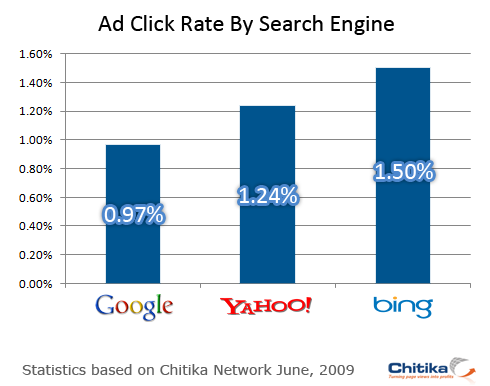
Are people who search on Bing more commercial than Google searchers? According to a study by search-advertising network Chitika, visitors who arrive at sites from organic search results on Bing are 55 percent more likely to click on an ad than if they arrived from Google.
Chitika looked at the clickthrough rates from 32 million ad impressions across its network of more than 50,000 sites in a week in July. Visitors from Bing clicked on an ad 1.5 percent of the time on average, versus a 0.97 percent clickthrough rate for Google visitors and a 1.24 percent clickthrough rate for Yahoo.
One reading of this data is might be that Bing users are more susceptible to ads, and in fact may have used Bing in the first place because of the Bing ads Microsoft is plastering all over the place. (Kinda makes you wonder what will happen when that ad budget goes away).
But a more likely explanation is that Google represents the vast bulk of the traffic, 83 percent to be exact. Bing only represents 8 percent. There is a law of large numbers at work here. The more traffic that comes from any one source (i.e., Google), the lower the clickthrough rate is likely to trend. If the market share was reversed, Bing would undoubtedly have a lower clickthrough rate.
But that still leaves the question of just who are those people on Bing?
| impressions | clicks | CTR | % more clicks (Bing) | |
| 26,929,367 | 260,518 | 0.97% | 55.11% | |
| yahoo | 3,157,648 | 39,008 | 1.24% | 21.47% |
| bing | 2,236,366 | 33,558 | 1.50% | |
| total | 32,323,381 | 333,084 | 1.03% |


Google: 260,518
Bing: 33,558
I think that is more important, is it not?
yeah see the overall numbers, google rocks always!
I think the title of this post is wrong, no? 50% more likely is not the same as twice as likely.
Here in Arlington Virgina it different than my hometown in India because it not what more important it what make the most money it depend not on the search engine it depend more on the browser the browser people use make a big diffence in how much they click it the browswer also make a big diffence on how likely you click on an adversiment.
I think Bing places ads in a primary position on the page, so that it is easier to click on a paid ad, than an organic ad.
Its pseudo-deceptive, but if someone clicks on it, then they obviously have an interest in learning more about the link and it is relevant to their search.
As for Google, most of us are trained to avoid looking at or clicking on the paid links.
Too many ads really bad thing in bing, especially on main column. Search engines should make it public the share of main column and side column clicks, many novice users click the first “link”.
google can rock all it wants, but i will still bing yo mama all night long….
bing traffic almost equal to yahoo after two months in business?? are you serious?? I bet mainheads from goog really cant sleep right now!
plus, post like this and more people switch to bing to advertise.
and no — it doesnt matter to me which search engine is more popular and has more clicksthrough — it is important where I can spend less money and get more impressions — -that is bing right now!!
Ah yes… but I think the other reading of this is: is this sustainable? If the people who are using Bing simple those that are more susceptible to advertising, then they might be more valuable to websites now, but they might also be only using Bing because of all the marketing Microsoft is throwing into it.
The argument is, all anyone has to do is outspend Microsoft. I know that is easier said than done, but the market share Microsoft has acquired is just the low hanging fruit that can be bought. I would not expect the rate of growth to be all that sustainable, but that varies with how much of the market share you think is for sale.
Bing is the youngest search engine, so it’s creating some sensations
I thought click-thru ads were supposed to be dead in the water and that what mattered were personal twitter and FB recommendations…
No, social recommendation ads is probably the best but these type of ads are only good for companies that are already popular and have ‘fans’ who can recommend the brand, plus it relies on someone in the social circle to already be an advocate which is not really practical is it? recommendations seem to be good for sizable services where it is likely you have a firend who is customer or local businesses where if you have a friend locally it is very likely a few members of your social circle are customers!
No… I believe the ratio is more important.
In order to generalize on populations, you need
a) large sample size (which the study supplies)
b) normalized metrics with which to compare, i.e. ratio of clicks to impressions, i.e. CTR
I personally feel like
33,000 / 2,000,000 versus 260,000 / 27,000,000
is significant, especially considering the sampling came from a wide variety of publishers (50k unrelated websites) through which around 80% of the US population has passed (Chitika’s numbers from another comment).
It cannot be disputed that there exists a correlation between using Bing to find websites and a higher probability of clicking an ad when arriving at that website.
Now what conclusion you’d like to draw, explanation you’d like to offer, or how you might use this data to your advantage, is all up for debate.
“But a more likely explanation is that Google represents the vast bulk of the traffic, 83 percent to be exact. Bing only represents 8 percent. There is a law of large numbers at work here. The more traffic that comes from any one source (i.e., Google), the lower the clickthrough rate is likely to trend. If the market share was reversed, Bing would undoubtedly have a lower clickthrough rate.”
How can you make that statement at all? You are saying that simply because more people use Google that it *literally causes* fewer of them to click through to ads? Are you kidding me?
And the law of large numbers would actually suggest that both of these sample sizes are more than large enough to be statistically relevant.
Can you give me any kind of source that discusses “The more traffic that comes from any one source (i.e., Google), the lower the clickthrough rate is likely to trend”?????
I agree with Fibbeh – what is this nonsense about the law of large numbers affecting a proportion? The law of large numbers says that the more observations you have, the more closely the average will approximate the “true mean.”
That is, more observations gives you better data. That’s it. The only effect the law of large numbers could have here is that the Bing data are flawed due to the small number of observations. But I think two million data points is “enough,” since most statistics become consistent between 10 and 100 data points.
If you’re trying to repeat something a statistician said, maybe go with a direct quote, because your paraphrasing mangled this section beyond repair.
No. No such source exists – that paragraph is utter rubbish
“It cannot be disputed that there exists a correlation between using Bing to find websites and a higher probability of clicking an ad when arriving at that website.”
This is exactly the point of the article, even though the way it is framed makes it seem more like ADS are performing better on Bing. In fact, the article is talking about ads on DESTINATION pages, not on Bing search pages. (Amusingly, those ads are most likely to be generated by Google’s AdSense, given their market reach.)
To my eye, if seems more likely that the data is suggesting that people who come from Bing organic links tend to navigate away from the pages Bing has identified as “most relevant” by clicking on ads for other websites once the destination page is reached.
Ergo, the page the searcher landed on was not what they wanted, so they choose more often than people directed to result pages by Google’s algorithm to click a link that takes them to a different result.
In other words … Bing’s organic results aren’t as relevant as Google’s organic results.
I think its gonna stay like that for a while
google still sends more traffic to all of my sites
ya… if bing had (even) 50% of Google I’m sure the numbers where below 1% for its users.
Irony of the Day:
@Stupidscript has the smartest analysis of the data presented thus far.
The organization benefitting the most from this data is Chitika. Though this research data is generating much publicity for Chitika, the conclusion being reached by most of the reports is flawed.
This data actually suggests a net benefit for the site publishers, not Bing. For the site publishers, this could be beneficial because it results in more ad revenue.
Go back and read @Stupidscript’s comment.
@Stupidscript, who are you?
Bing is ill.
I’ll tell you what happens
When you go from Google, you probably arrive at the right page to begin with.
When you go with Bing, you are not exactly where you need to be, but you see an ad there which takes you to where you need to be.
It just tells you that Google gets you better results.
And where are the numbers to support your theory? Out from your backside? The same twisted logic could be applied to google market share i.e. searches. People don’t find what they are looking for, so they keep searching one after another term thus, google has larger number of queries per searcher than other in turn giving them greater query market share.
Also, you could argue that google users are so dumb that they need google as they don’t know sources for most of the information. thus, google has higher market share.
No numbers, and that is why it is a theory, and a theory it remains till it is proven.
Did you mean hypothesis ( http://en.wikip...wiki/Hypothesis )?
He wasn’t wrong to say theory.
I think everyone understands exactly what he means.
‘Correcting’ it to hypothesis is entirely unnecessary.
and a little bit anal.
“When you go from Google, you probably arrive at the right page to begin with.
When you go with Bing, you are not exactly where you need to be, but you see an ad there which takes you to where you need to be.”
Exactly. That is how the cookie crumbles.
Hahahahahaaaa
I think it also has something to do with the way Bing displays ads. Ads take about a half of the search results page !! And if you do the math once I have searched “Dublin” for instance, before I scroll down, I have 8 ads in my face and only 3 search results!
check it out, its surprising!
http://www.bing...LH&filt=all
You can fix that by putting really high resolution on your monitor.
yes but anyways, you still get much more ads on bing, compared to google for the same search
I only see 4 ads…
2 on the top, 2 on the right sidebar.
I get no ads on that search…just a really helpful breakout of various areas of the official dublin tourism website.
On google, you get one ad above, and three to the side.
maybe because i usebing from france and you don’t… when i click the link though I still see 8 ads and only 3 to 4 search results depending on the resolution!
I get no ads.
I get these ads from france:
http://farm3.st...f23594114_b.jpg
Would clicking the link above significantly alter Bing’s market share?
This doesn’t have anything to do with how Bing places their paid search results.
It just says that people who arrived at sites from Bing tended to click Chitika ads more often than those who arrived from Google.
Well, that was just my guess from my user experience using both search engines.
Since im a regular user of Google I know where the ads are, therefore I know how to avoid them. When you’re not a very regular user of Bing (few people are, the launch was about 2 months ago…) and get so many ads right in your face, you’re more likely to click on them, especially if they’re relevant with your search, which it was in my Dublin example.
I get 8 ad results as well – 3 on the top, 5 on the side.
Google on the other hand produces only 1 ad result for me.
I think what people forget is adsense was really the first… and so when it came out people would click on the ads, however after after clicking on googles ads and being taken to crap sites confidence was lost in the interface… the reason why yahoo and bing have higher click rates is because they are still new.. that said in 10 years the % of clicks will likely average out unless these companies start to actually care about who is advertising.. I will never click on an adsense ad unless I am just doing it to support a website I like… even then I just close the page it takes me to because I have no confidence in google to take me to a useful website.. and jack google has way more surface area… so your numbers are pointless..
I would rather guess that those people using Bing (probably mostly IE users that do not know how to change the search engine) do not know what an ad is and what’s a search result and accidentally click on the ads.
Who in his right mind (except for tests) would use Bing anyway? Pretty much every sane person is happy to not be forced to use a MS product. Why in hell would one choose to use Bing then?
Do too!
you sir are an idiot!!!
Wow…that’s funny stuff. Let me get this straight. So Bing users are stupid (obvious to you). Anyone who clicks an ad is also stupid (because they don’t know they’re ads, also obvious). Therefore, Bing users click more ads.
Interesting. Your logic and other statements make me think that you might want to give Bing a try…you’ll probably like it.
He didn’t say they were stupid. They are just ignorant on the subject. Most people don’t know and care what a search engine and a browser are and yes, many people can’t see the difference between search results and ads. People who still use IE are either microsoft fanboys or people that are computer illiterate or noobs, that doesn’t mean they are stupid at all. Many smart people don’t know how to even start a computer.
Thanks! Saved me a hell lot of explanations.
Massive generalisations, but good luck to you.
“fanboys or people that are computer illiterate or noobs” – I guess that means about 80% of the population?
You are the ignorant one dude.
The most informed people looking to buy online would actually be compelled to use Bing. You see this search engine comes with a small scheme attached called Cashback. You can get a reduced price simply by coming from a Bing page.
So next time you want to buy something, give Bing a chance and hunt those ads. Now that you’re not ignorant anymore and all that…
I am using Bing and not using Internet Explorer. Its my default search engine in both Chrome and Firefox
I use bing and yahoo because I dislike a single company dominating internet search. Bing also happens to be a great product.
“I would rather guess that those people using Bing (probably mostly IE users that do not know how to change the search engine) do not know what an ad is and what’s a search result and accidentally click on the ads.”
which would be 80% of human population??
this is techcrunch — most people are tech related, but outthere you got people not so much into IT. still though — bing numbers after 2 months being officially online — very impressive.
It is pretty impressive… but again, I think this study just shows that they’ve only reaped the low-hanging fruit (those that can be persuaded with advertising).
wha? “low-hanging fruit”. “persuaded with advertising”. Nonsense!
I tend to use Firefox and Chrome, and I’ve been a Googler for years. I’ve been testing Bing more and more and I’m starting to like it a lot as I’m becoming more comfortable that it’s results are good. For me, when I searched on Dublin, the resulting presentation and links were much more useful on Bing than Google.
Don’t take anything for granted, many former leaders are either followers or dead, and MS has a long history of persevering until they win.
As for this article, it doesn’t offer any useful insight, just some interesting data.
Makes sense to me
I myself am a Bing user (though occasionally I do use Google myself) but I can see the logic behind the fact that since most likely people who currently use Bing are ad people, but this could be likely as well:
Google themselves certainly have quite a bit of ads on search results, like go and Google “I want to buy a laptop”. You will see ~3 sponsored links above the results (Bing does this too) but if you look at Google’s sidebar, there are about 8 more. All listings for HP, Dell, Toshiba, etc. So a user (I myself would too) click that instead of going to another site. Because after all, I want buy a laptop, how much further do I need to go?
Now, Bing “I want to buy a laptop”, you will see those sponsored links at the top, but like 1 on the side. So people are more likely to go browsing other sites for topics such as those, and those sites will probably have ads for purchasing a laptop (or computer, whatever) and they will click that link.
But that’s just my theory. Basically, Bing needs more advertisements, but maybe Google needs less, then AdSense users might make more money because Google wouldn’t flood the user with so many ads before people actually get to sites. Makes sense to me
As far as I know, Google already does that. Showing fewer ads means the per click price is higher. It is in Google’s interest to show fewer ads and Google knows it.
The bing ads are better. try searching for a consumer item and you will see the ads facilitate the buying of them item better on bing than on google.
Getting better results from your ads is basically anticipating what the user will want to look at next.
I think you hit it dead on. Bing’s ads are simply better and more attractive which increases a users chance that they will click on it. When using Bing I don’t mind clicking on an ad or two because they actually relate to what I am searching for in the first place.
So simple. It just indicates Google gives you the relevant result, where as bing gives you irrelevant result which makes you click an ad to go to the relevant result…
How many tests have you performed to reach this conclusion? Can you provide a couple of your search terms, I’d like to see what you’re talking about.
maybe all the google employees are getting tired of clicking their own ads?
This study isn’t actually of the ads in the search results, but ads on websites after people have used the search engine to get there. So if someone comes to your site from Bing, what’s the chances they’re going to click on one of your ads vs. someone who came to your site via Google?
The study didn’t “study” that specifically… But if Google ends up showing you all these advertisements that are displayed on the sites themselves, the users will end up clicking on Google’s, and not the end sites.
Basically, Google is, well, in a sense, screwing over AdSense users.
I think warren buffet has been crusading that point for years. no wonder ad sense users are harping about google and google shares/ad revenues.
Long-term you become more desensitized and thus click less.
you are right.. first came google..then yahooo and now microsoft… kind of common sense…
Don’t forget that Google takes fraud clicks and duplicate clicks out of the counting in a more honest way than the others.
Haha you wish! Care to substantiate that assertion?
“There is a law of large numbers at work here. The more traffic that comes from any one source (i.e., Google), the lower the clickthrough rate is likely to trend.”
Why, Erik? I don’t understand this conclusion.
My thoughts exactly…but I didn’t say anything at first because it seemed pointless because the whole article and 90% of the comments are basically made up garbage to try and support a conclusion that the authors had already decided was true. There’s a LOT of very sketchy “critical thought” in this article and comment thread. I have to put “critical thought” in quotes for obvious reasons.
Thank you – I wondered if I was alone. Thispost was one WTF after another, starting with the title asserting 50% is the same as double.
Because Erik is a ‘Pundit’ – he knows everything
.
Could one reason be the bing cashback program? I use adblock so I don’t usually see the ads, but when I’m buying something I would do a search through bing with ads enabled and would click on an ad with cashback sign.
Are Bing Users Twice As Likeley To Click On An Ad AS Google Users?
No?
I noticed that too. Kind of a stupid mistake.
wow, people click on Chitika ads?
if it holds, it would be game changing. Doubt it will hold as Bing grows. I agree with the comment on the law of big numbers.
Two words: Bing Cashback.
Bing Cashback is cost per acquisition based and not cost per click based. It’s a completely different product from Bing’s search program.
Interesting .. how does the law of large numbers relate to Google’s results in this study and your deduction?
“The more traffic that comes from any one source (i.e., Google), the lower the clickthrough rate is likely to trend.”
Isnt the LLN more about the stability of the mean in a long set of observations. Like the randomness involved in a coin toss.
+1
TC writers sound increasingly like the McKinsey consultants working for Enron. Pull shit out of your a$$ and make some money.
Yes, the author clearly doesn’t understand what the law of large numbers means. Bing CTR can not be explained by LLN. It’s more likely a function of page layout, as others have already pointed out.
How about the law that .97% of 83% of the search market will always bigger than 1.5% of 8% of the search market?
Am I missing something here? The headline says “Twice as Likely…” and the study says “55% percent more likely…”. Isn’t twice -100% more likely?
Lol… No. ;_;
Did you go to MS_School?
Bing Cashback actually is the one that tells advertisers they’re ads are twice as likely to be clicked on.
There is two versions of the Cashback program: Cashback Shopping and Cashback Search.
Cashback Shopping is the shopping comparison engine. Cashback Search places the Cashback “gleam” on your ad. Because the gleam is present, people are more likely to click.
Alternative Explanation: Google is better at identifying click fraud?
No… Most people use AdSense. Either way, it has nothing to do with Google or Bing detecting fraudulent clicks. It has to do with the ads being displayed (and obviously) clicked on the sites Google and Bing lead the users too.
Has anyone considered the fact that a non-trivial amount of searching on Bing has to do with products and the cashback program? It can add to the number of ad clicks, especially if people can’t differentiate between a cashback ad and a non cashback ad.
Obviously Bing users are more susceptible to being persuaded by ads. That’s how they got to start using Bing in the first place.
What happens when more internet savvy people start using Bing instead of Google. Well, my friends the tables will turn.
Amazing…it goes on and on. Are you suggesting that “Internet Savvy” is measured by how much you avoid clicking on ads? Must be nice living in such an obviously simple world.
There’s more red herrings in this thread than than a seaside smokeshop.
People, this has nothing to do with the actual ads on Google, Bing or Yahoo. The study was done on websites not search results pages. So, taken directly from the article if I start a website today and put ads on the website I can expect a higher CTR from Bing users. However, the study just takes CTR into account and not anything such as total revenue or eCPM so that higher CTR could pay far less than the lower CTR from Google.
it’s because bing is used by the same type of people that use hotmail and/or internet explorer.
LOL…there are a lot of you out there. Read up the thread chain here for why this logic is ridiculous, but I hope you people keep posting. I love the irony that the most illogical arguments or explanations here are coming from the people that are insinuating, if not downright stating, that all of these crazy Bing users are dumb.
FTW, @billwil! And to the heart.
Doesn’t matter the nature of who’s doin’ the clicking, or why. The point should be, anyone hoping to write a website that makes money by being clicked-toward, should cater to the search engine that harvests the most clicks. If it turns out to be Bing, and if SEO for Bing turns out to be substantially different from SEO for GoOgle, then mebbe a little SEO for Bing is in order!
What’s in YOUR wallet?
very simple: bing cashback
http://pages.eb...s/cashback.html
This is interesting. If anyone is buying domains monetized on Google traffic, let me know. Still a market for 4cent clicks.
I don’t know if anyone has mentioned any of this, but Bing’s click thru rate (CTR) is higher because of the change in they’re algorithm that took place from when they went from Live Search to Bing.
I work in paid search advertising, so I’d like to think I’m a somewhat reliable source. Bing’s new search algorithm will actually learn your search behavior…meaning, that if you some that does not tend to click on paid search ads on certain searches or queries, they will simply stop serving them to you.
So really, Bing is showing less paid advertisements than they were previously. And since CTR is calculated by the number of clicks divided by the number of impressions (ads showing on the page), this makes more sense. There is simple less impressions being shown than before…so the CTR is actually artificially higher because of that…not because Bing is getting that much more traffic.
AdGooRoo actually came out with a study recently that discovered that Bing is showing 25% less paid advertisement’s than they did with Live Search.
I can atest to this. Two of my clients that advertise on Bing have shown horrible performance ever since Bing’s launch. And for some reason branded terms are not triggering paid ads. Branded terms are ALWAYS the highest traffic drivers for paid search campaigns. When we reach out to our reps at Microsoft, they have no idea why this is happening and still have not come up with a proper explanation other than the change in algorithm.
So basically, yes…Bing sucks….at least for advertisers right now.
Also, to comment on Yahoo’s CTR being higher than Google.
My one thought is that it’s caused from Yahoo Search Submit Pro (YSSP).
What this does is embed paid listing within the natural search results. This gives advertisers an advantage in getting credit for a purchase within Yahoo’s search results other than the paid search listings being shown above.
Ryan – interesting comment – but it has absolutely ZERO to do with the article.
The article is about the ads running on websites – NOT the ads on Bing/Google/Yahoo/etc.
It is amazing how many comments there are from people who didn’t actually READ THE ARTICLE. (RTFA?)
50% more is not “twice” as much. It’s half-again as much.
That is good news for Bing as they will attract more advertisers to come, good news for new SE
Some ways I like bing better. I got $65 cashback on my new iPhone 3GS from bing. My friends got $120 on their HP Laptop purchase ?
Way to go!
(And Google users find the shops where they get it 65/120$ cheaper right away, without the cashback hassle …)
The real question is what percent of Bing’s marketing budget paid for Chitika to spend time publishing this study? Because honestly, at 8% of the search market, .5% higher CTR isn’t even worth talking about.
Chitika is not affiliated with Bing or has anything to do with Bing. We get ZERO dollars from Bing (direct or indirect). This is NOT a paid study. Its analysis done by our data analysts based on data from the Chitika Network (currently 201M unique US users – around 80% of US).
The study is based off 32M impressions. Any data analyst will tell you that it is “statistically significant”
- Alden
CTO, Chitika, Inc.
32M impressions are statistically significant only if they are randomly sampled.
If so, you have a network wide CTR of 1%. You would be the best CPC network on the planet by a large margin and publishers would be flocking to you.
Rainier,
I see that you have commented a few times to this article. Thank you for taking time to read through it and ponder the information.
Here is a little bit more background that you may find useful. Chitika is providing a very unique value proposition for advertisers, publishers and end users. We are delivering the most relevant ads to end users anywhere within our network of publishers. The results for all three constituencies are fantastic: Advertisers see high quality traffic that meets or exceeds their ROI objectives; publishers earn great cpm revenue while showing highly relevant ads; end users see ads that are of interest to them.
I appreciate you taking time to participate in this discussion. Let me know if I can answer any questions about our services.
jeff sable
In looking at my site stat logs, I’ve noticed that the clicks shoot through the roof on ads when there’s a surge of interest coming from the MSN search engine. I haven’t seen the same thing from Bing yet, but something about the demographics makes me wonder whether people that search with MSFT do in fact tend to click on ads more.
Someone else briefly touched on one of these reasons why Google has a lower click rate, the lost trust in Google ads. I can tell you many times when I try clicking, what I think is a legit ad, ends up being some span ad about getting a free iPhone etc. If google were to stop using their adsense and have better ads then yeah, they’re ad click rate would be much higher. Bing is still relatively new and so people are still trying to figure things out. http://ziggytek.com/
Wow.. Amazed how many people appear to have not actually read the article, decided that this is all about Google paid results vs Bing paid results and waded in with the same old arguments.
“People who arrive at sites from .. Bing are 55 percent more likely to click on an ad than if they arrived from Google” – That is, ads served on the destination site, and nothing to do with any ads shown on search results.
Also, while its tempting to pounce and flame on the comments suggesting “Bing users are dumb”, I do get what those posters are trying to say, however clumsily they phrase it. It’s not about ‘dumbness’ by any means, but I should imagine a lot of the Bing search traffic comes from people searching directly from their MSN homepages (as with the Yahoo! stats).
However much this offends our liberal sensibilities, the reality is that this represents a very different demographic from anyone reading this (who are probably more likely to have a highly customised Netvibes or Google homepage), and that demographic has a very different mode of interaction than the average tech/techcrunch-minded browser.
Talking about demographics, with Google commanding around 80% of the search market in the US and north of 90% in most European countries I would say it is a safe bet to bin this idea of a more elaborate and tech-savvy Google search crowd. That being said, as part of my PhD in Information Retrieval I conducted analysis on several large clicktrough logs from different search engines and as a result I am somewhat prejudiced towards AOL users. I do not recall the exact percentage but something like 30% of the queries in that log (the famous one, copies should still be out somewhere in the web) were URL’s.
this is good to hear.When is the pubcenter going to be opened to the public?Do you have any info?
I think you’re right. If Bing was sending more visitors the click-through would go down dramatically.
who is the best..google or bing?
Ya that’s true…… Nobody can beat google…..
was doing some deep research yesterday and keeping track of the paid ads (which for the most part were getting me faster to where I wanted to be then the organic ones) and there were 3 pages of google sponsored ads (when clicked on “more sponsored links”):
1) didn’t show me which ads I’d already clicked on (nor were they in the same sequence as the main search page nor were the links purple instead of blue), which was super annoying and a waste of $ for the advertisers/ google gets twice the money for links I didn’t want to see again
2) of the 34 results, 8 of them were crappy link pages used by SEM scammers.
the chitika report is self-serving and bogus. if average CTR on cpc ads were 1% as the report implies, publishers would have trouble paying their bills.
@Rainier – I would suggest speaking to any publisher who runs the Chitika Premium ads. On 99% of Chitika publishers, the CTR is higher than Google Adsense.
> From your previous comment: If so, you have a network wide CTR of 1%.
Yes. The trick is knowing when NOT to show ads. You can see our philosophy here: http://chitika....te-advertising/
> publishers would be flocking to you.
Umm .. they are. You dont reach 4 in 5 unique users in US (and 427M worldwide) if publishers are not flocking to you.
- Alden
CTO, Chitika, Inc.
>There is a law of large numbers at work here. The more traffic that comes from any one source (i.e., Google), the lower the clickthrough rate is likely to trend.
I was thinking that has nothing to do with the LOLN. But then I notice you are not writing about *the* LOLN, you are writing about *a* LOLN. Must be a new one that you made up. Would be nice if you could give some supporting arguments if you are making up a new law though.
On the other hand, given that your audience doesn’t even understand the difference between clicks on the SERPs and on the actual websites, they can most likely be convinced if you just throw in some statistical term without any relevance.
I hope Bing beats the hll out of Google! Google are snobs!!!
Bing continues to Rock 4 me!
i’ve resisted using bing…because i had horrible experience with windows live search, and although my homepage is set to msn i just avoide search there all together and head over to google…but i always get a prompt to download chrome and i’m resisting that too because i’m fine with what i have and the way i go about searching for things. if i was really bothered i would download chrome and get better service, or i would use bing and most likely get a link that routes me away from what i searched about. it’s an interesting piece. disparancies are pointed out from the commentators and i can’t help but agree with them. if you’re an msn user, which i am, but one who doesn’t know much about navigation, which i also am, you will most likely use the bing soe box at the top of the site and also click on as many ads/prompts that come your way. i can’t deal with all that noise so i use google and if i want to i will occasionally click on a google ad…but i don’t want to be spammed for my efforts so i avoid those as well. but i don’t have a lot of ad’s bombarding me like in the early days of google when i search out something. the numbers to this is interesting but i think it will level out.
I have used Bing and I like it! It seems the results generated by Bing for a given search are closer to what you are looking for.
thanks for share
I think total revenue and per visit value is probably more interesting.
Here are my results from a few days. Obviously Google brings in the most traffic and revenue. Surprisingly Yahoo consistantly has the highest per visit value. Bing has not been a considerable factor although it did recently pick up our Sitemap and has started scanning us like crazy. Possibly we’ll see more traffic from it as they start listing our pages more.
Visits, revenue, transactions, conversion rate, per visit value:
yahoo 51 $471.36 4 7.84% $9.24
google 11,173 $22,980.44 184 1.65% $2.06
aol 211 $270.98 3 1.42% $1.28
bing 560 $110.58 3 0.54% $0.20
You can’t really assume that more Bing visitors will equate to lower click rate of ads. 2.2 million is a good sample size and it’s common knowledge that microsoft search users are more ad aware because they are less computer savvy. I’m actually surprised the gap isn’t larger than what was stated