Gmail Tries To Make It Easier To Unsubscribe From Spam Newsletters, But Fails
by Erick Schonfeld on July 23, 2009

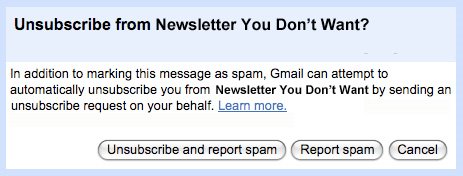
When it comes to email, less is more. So I applaud Gmail’s efforts to try to reduce all the unwanted emails in my inbox. Its latest attempt to make it easier to unsubscribe from unwanted email newsletters is well-intentioned, but falls flat on its face in its current form. When you report a newsletter as spam, you may now see the notification box above asking you if you want to automagically unsubscribe as well. You would click “Unsubscribe and report as spam” and Gmail will unsubscribe for you.

Sounds too good to be true, right? Well, that is because it is. First of all, it only works for messages which include a “List-Unsusbcribe” header in the email with an accompanying “mailto” URL. No self-respecting spammer would include those. But wait, it gets worse. The feature is purposely not activated for known spammers. Brad Taylor, writes on the Gmail Blog:

This only works for some senders right now. We’re actively encouraging senders to support auto-unsubscribe — we think 100% should. We won’t provide the unsubscribe option on messages from spammers: we can’t trust that they’ll actually unsubscribe you, and they might even send you more spam. So you’ll only see the unsubscribe option for senders that we’re pretty sure are not spammers and will actually honor your unsubscribe request. We’re being pretty conservative about which senders to trust in the beginning; over time, we hope to offer the ability to unsubscribe from more email.

Just to repeat that: the unsubscribe-from-spam-newsletters feature does not work for known spam. Okay, I guess that makes sense. It’s a losing battle, and spammers will obviously not cooperate. But why then combine this feature with the report-spam button in the first place?

The Gmail team should separate the two functions. It should just make an unsubscribe button appear on email newsletters which contain the correct header information. I get annoyed at all the email newsletters that come into my inbox, but they are not all spam. Some of them I even subscribed to myself in moments of weakness, although most of them I have no idea how they start appearing in my inbox. But even for the unwanted ones, I realize it is not necessarily the publisher of those email newsletters who signed me up. And not all of them deserve being labeled as spam. I just want an easy way to unsubscribe.

Can you give that to me, Gmail?

Update I heard back from Google. They say a regular “unsubscribe” option already exists. It’s really hidden. You need to click on “show details” at the top of the email, and then there should be an unsubscribe option for those email newsletters with the proper header information. It would be much better if they just made it a big, glowing “unsubscribe” button that appears when available.

Advertisement

Comments rss icon

  • I don’t really see the issue. Google’s touting it less as a “spam newsletter” unsubscriber (as you put it), and more as a newsletter unsubscriber with extra security of never receiving future newsletters since they’ll be sent straight to your Spam box.

    As it’s written above, known spammers will still be detected and moved to Spam via the normal algorithm.

    • Err, it wasn’t written above. Just omit that little part in the 2nd paragraph.

      Your feature request is a valid one. I hope they add an extra selection to simply “Unsubscribe” sans-spam reporting.

      • Yeah, this doesn’t fail at all. If you send back something to the spammers they know it’s a used message box so they spam more. Were you born yesterday?

        • But the spammers *already* know it’s a “used message box” – if they actually care to monitor replies – because they don’t get a bounce message back.

          But in reality, the reply addresses on 90%+ of spam emails are false, so real spammers aren’t going to get your unsubscribe reply anyway, whatever Google does. It would go to the poor sap whose email address they are faking.

    • why does it fail? it’s one thing saying they should put a button somewhere else and another saying that it just fails.

      kudos to google for not allowing spammers to abuse this feature (which would automatically confirm your email address, thus leading to more spam)

      i think it’s a great feature, as long as they add a separate button.

      • I totally agree. If they can trust the newsletter enough to send back an “unsubscribe” request then by default unsubscribe shouldn’t be marked as “spam” since implicitly they believe the marketer is responsible enough to abide by some email etiquette.

        Also what if you only want to unsubscribe “for now”? Maybe your inbox is a little unmanageable but you might sign up again? By marking it as Spam would future emails go to the Spam folder?

      • Atleast they are working on something unlike companies like yahoo who just work out with more advertisers to fill your mail boxes.

        • Uhhh I don’t get spam from Yahoo! advertisers… what are you talking about?

          And oh yeah in case nobody noticed Hotmail already has this unsubscribe feature since forever.

          • You don’t spam from Yahoo? SURPRISING & SHOCKING. From which world are you? My Yahoo mail is full of spam. Not that I subscribed to so many newsletters, it just happens with Yahoo. With gmail, Spam is very less, to the minimum compared to Yahoo or Hotmail. Good to know that these guys are at least trying to do something to reduce even that minimum spam.

  • As I believe they mention there, a lot of lazy people will report spam instead finding the unsub link, so that makes sense. What I would like to have seen is them then *not* report the mail as spam if they try to unsub, at least initially.

    Actually, I think where this really fails for good senders is that Gmail wants to send an email to unsub the user after they click that. Many places use the List-Unsubscribe header as a link to a proper unsub page, which means it won’t work for them. That’s made worse since many, many reply-to style email addresses (which would likely end up in those mail-to links) for newletters are not monitored very well.

  • Here’s the end goal:

    1) an unsubscribe button that doesn’t report spam
    2) all the mailing list companies make it main stream to actually unsubscribed from their lists via this function by gmail
    3) all the other email clients (hotmail, yahoo, etc) start to supply the feature.
    4) The developers of custom newsletters blasters also prepare their software to be unsubscribed in this manner
    5) the spam rating of quality emails and newsletters goes way down since “report spam” isn’t getting clicked on it all the time (i.e. people are taking responsibility for signing up for something, and choosing to unsubscribe instead).
    6) And ultimately it’s easier to determine what is actual spam because their spam rating will be so high.

    Great idea. Please give me the “unsubscribe” button with the report spam!

    • Strongly disagree, here’s why:
      1) If an unsubscribe button that doesn’t report spam was the goal, they should just do that–they don’t need to embark on a flanking unsub/spam button hybrid. Anyway, they do offer an unsub button but they’ve hidden it–so that isn’t their goal.
      2) As far as email senders conforming to this, well, they already do, but usually through another technology that isn’t user facing. AOL, Yahoo, Microsoft Live, Comcast will send complaint data back to legitimate senders. GMail, because they are too smart to do what everybody else is doing, decided to go back to a less used standard and decided not to make it clear if a sender has a good enough reputation to be sent this information.
      3) As far as other domains using this, Microsoft Live was the first a few years ago–it didn’t catch on because like GMail, they would only allow the functionality for senders that were almost surely not spammers
      4) I’m not sure how “custom newsletters blasters” are different from “mailing list companies” so, I guess you can read my response to #2 again.
      5) True, I suggest GMail offer a true subscribe button, make it available to all legit senders (rather than just business partners), and educate its user base on when to click unsub and when click spam.
      6) Again, IF GMail were to offer a visible unsub button and differentiate it, then people could choose to unsub or click spam, thus making their spam rate numbers more accurate, but this not what they’ve done–at all.

      Other than the fact that GMail has chosen a protocol which the rest of the email community has left behind and implemented it in an oddball way and released it only to a small amount of secrete partners, but there is another huge differentiator between GMail and the rest of the top receiving domains–GMail will not communicate with bulk email senders. They have concentrated on technology, and they are pretty damn good at it–I’ll give them that. But the fact that they won’t be a part of the industry limits their vision and understanding of it. Someday they’ll come around, if they don’t conquer the world first.

    • Most of the major ESPs (email service providers) have been working on this forever. Hotmail has long had it and it is a great feature.

      Google has failed by simply not getting the issue. People use Report Spam as a convenience tool when they don’t want to receive further emails. This means legitimate email senders get spam reports when really people often just want to unsubscribe. Fine to also incorporate it with the “Spam” feature but we need that separate “unsubscribe” button! I know the major ESP’s would line up behind this.

      The good thing that Google did was not make the unsubscribe feature available for all senders – its not that hard to round up the hundred odd major ESPs that drive the majority of legitimate email newsletter traffic.

  • They should automatically filter that out

  • I am very liberal with Gmail’s “report spam” button. I feel a little guilty sometimes when it’s not truly spam — but something legit I just want to unsubscribe from. I think this new feature is a step in the right direction.

    I would prefer a simple “block sender” button though. Facebook needs one too.

    • Completely agreed. Seems a bit sensational to call this a “fail.” Its definitely a thoughtful step in the right direction.

      Also, to the writer, the proper prefix to negate “activate” is “de,” not “un.” So it should be “deactivate” not “unactivate.”

    • Pud, say it ain’t so! It’s because of too many people with an itchy ‘Mark as spam’ finger that led to your July 18th “Latest from Pud” to go directly to my spam folder. Yes, it can happen to you too!
      I like the idea of a spam button on one side, unsub button on the other, but I also would like GMail to have some sender-facing efforts (no, I don’t count their Bulk Senders Guide as adequate) so legit senders could have some means to get their mail back in the inbox. Many senders, such as yourself, are doing something to get filtered to bulk and they have no idea what they can do to fix it.

    • Pud, you may not be so gung-ho to click this is spam–your July 18 ‘The Latest from Ask Pud’ went into my GMail Spam folder. They do it to good senders to and offer no meaningful guidance how to ‘fix’ what may or may not be broken.

      (I think my last comment was eaten, sorry if this becomes a double-post.)

  • A big problem with the way it’s structured now: some very legitimate mailing lists will be erroneously labeled spam. After using the feature a couple of times, some people will think, “Oh, to unsubscribe, first I click on the Spam button, then I can click Unsubscribe.”

    Most users won’t do this (I hope), but it does not take many to really tarnish a mailing list’s reputation. This will affect even squeaky clean, double-opt-in mailing lists.

    Making this function separate from spam reporting, like the original post says, will probably neutralize this entirely. Easy for the Gmail team to do, fortunately.

  • I love junk!

    Call me!

    (805) 768-4521 http://bit.ly/15YC9c

  • The wording is incorrect but I think this feature has legs. It’d be great to be able to unsubscribe without leaving Gmail.

    Unfortunately, the term spam is so overused and junk mail so prevalent that any sort of ‘unwanted’ email is often labeled spam even if the recipient initially did sign up.

  • I don’t really see the problem with the feature as is. Marketers who insist on using email as a means of promoting their products deserve to get marked as spam if through their ineffectual newsletters cause the user to want to unsubscribe.

    If your content is good and useful, then you’ve nothing to worry about. If they’ve relegated this responsibility to a third-party that won’t play nice, all the more reason for them to get stamped as spam. You’ll get very little sympathy from me as regards Spam.

    I think Gmail has already been quite nice in unsubscribing when marking the spam.

  • I think this is perfectly permissible and appropriate.
    By not responding to known spammers it gives them less information about the activity of your account. The less information they know about my account, the better. Keep it up, Google.

  • Hotmail has had this feature for awhile

  • Most users don’t realize that when they ‘unsubscribe’ from a malicious spammer, they’re actually *verifying* that their email address is active. With a verified email address, a tenacious spammer will dedicate more resources to striking that inbox again.

    For those wondering, that’s why Brad says, “… we can’t trust that [spammers will] actually unsubscribe you, and they might even send you more spam.”

  • Good post… but please use a spell checker!

    “button in teh first place?” – unless teh has become a dictionary alternative to “the”

    also have a random = in a sentence “No self=respecting spammer”

    Seriously Erick, your writing for a big blog… is spell checking really that much of a chore?

  • ummm….more like the author of this story fails. That quote cited from the gmail blog sounds like a perfectly legitimate explanation. You can call the feature imperfect, but really? fail? really?

  • Err, actually I think the point of the feature is much less to ‘unsubscribe’ you from spam (where did you ’subscribe’ in the first place?) but to let lazy users unsubscribe from a legitimate mailing list you YOURSELF subscribed to (maybe while registering an application or something).

    Gmail does the work of letting the company know that you wish to unsubscribe yourself.

    I imagine that this was added because many users who simply didn’t want to get any more messages from some mailing list were marking it as spam and screwing up Gmail’s spam detection process for the rest of its users.

  • Whatever, now this makes me feel less guilty about clicking the “Spam” button for newsletters that have shitty unsubscribe procedures.

    I like this improvement. I’ll be using it.

  • I remember in the late 90’s there was an email client that let you fake an email server response ‘no such recipient’ to a sender of spam emails.

    Had Google used that approach to the ‘unsubscribe’, it would not have to exclude neither the spammer nor the legitimate mass mailer (like CNET). The reason is that a legitimate site would see this as an indication that this email is no longer valid and remove it automatically (that’s a standard feature with mailing list servers). For the spammer, such a reply would not indicate anything as it is the same response they get for any junk address and it is likely they will prune it out too.

    Now Google guys are clever. Anyone cares to speculate why they did not use this approach?

  • Ahem…here’s the thing. Spammers use unsubscribe requests in large part as a means of verifying that email addresses belong to real live human beings. It’s the same reason that viewing remotely hosted images in email is turned off by default except for trusted senders in most webmail & email clients. If you view images, they can record in a database when each email was viewed, your location, what browser you use, etc.

    They then use verified emails to trim their lists. That’s why they don’t turn on the auto-unsubscribe for known spammers, and it’s perfectly justified.

  • Unbelievable as it may seem, there are email newsletters that you can subscribe to that are not spam (because you subscribed). These newsletters are not sent to people who do not ask to receive them (unless someone else forwards the newsletter, which most producers ask that you not do).

    If later, you decide you don’t want to read the newsletter you subscribed to, you should unsubscribe. All newsletters have unsubscribe capabilities, usually through email reply or via a web link in the newsletter. But many folks are lazy and report the subscription as spam instead of unsubscribing. This causes problems for the newsletter producer and other people who still want to read the not-spam newsletter, but are now blocked because the newsletter is labeled as spam by the receiving service.

    Google is simply making it easier to unsubscribe from non-spam newsletters.

    You cannot unsubscribe from spam (by definition). This feature has nothing to do with spam. Try to put spam out of your mind when thinking about this feature. spam spam spam spam

    • It’s hard to put spam out of your mind when looking at this feature when the buttons clearly states “unsubscribe and report spam”.

      I can see what Google are trying to do, which is good, however, there are a lot of implications to their strategy which this particular blog post points out. I don’t necessarily believe that they have failed, their logic is sensible, however – it just makes it more difficult for legitimate email marketers who have done nothing wrong to begin with.

      • I should have said more about how Google is setting up this option. They certainly aren’t helping by combining “unsubscribe” and “report spam” in the same button. You are right on all points.

  • As someone who sends out a newsletter regularly I’m a little disturbed by the idea of confusing readers about “opting out” vs “mark as spam”.

    OK, so say someone on the list thinks my newsletter is “spam”, maybe they forgot they subscribed, maybe they’re just lazy. But now its even easier for them to take the lazy route to marking the mailing as spam instead of simply opting out.

    Its almost like Google is trying to punish us for sending out legitimate newsletters.

    I wouldn’t be surprised if this is a covert tactic to eliminate the email newsletter as a publishing format. Google wants people to use RSS, so they can monetize via Feedburner and Google Reader and maybe cut down on gmail storage volume.

    Over the long term it greatly benefits Google to eliminate the email newsletter. Think about it.

  • what I wud want the first button to do is, when I click on it, the newsletter must be unsubscribed (and not mark spam the first time). but if I receive the newsletter after a couple of days, then it must automatically be reported as spam.

    I would love this as the functionality of the button because that is what I do manually now.

  • I run a few opt-in lists with proper and clear unsubscribe instructions at header and footer.

    Everyone on my lists has chosen to be on them.

    Yet with every mailing there is someone like Adam who chooses to opt-out by clicking ‘report spam’ rather than simply opting out through the unsubscribe instructions.

    I get to see who they are. I also get warned by my email delivery provider that I am sending spam, and I get a negative mark on my account.

    If everyone chose to opt-out this way then I would be blacklisted.

    Any responsible email sender makes it easy for you to subscribe – don’t report them, click the link.

    • It is exactly with case like your in mind that I proposed that Google’s “translation” of the “Report as Spam” would be to make further emails from the same sender to the same recipient be a mail server response of “no such recipient”.

      For you that would be much more friendly – no penalty.

      If you and other start asking Google for this we may actually see it happening…

  • I couldn’t agree more. I read Google’s post twice but wasn’t able to understand the reason of this ‘facility’

  • I agree to google that you shouldn’t even try to unsubscribe from a spammer. But the fact that by default you show users “unsubscribe and report as spam” is really just stupid. First google acknowledges that it will only show the unsubscribe button for some trusted senders and then it lets you report them as spam. I think the probability that a trusted sender is also a spamer is small so this button is really useless.
    They should have just shown the simple “unsubscribe” button like hotmail does but no they had to be different on this one too… well google different is not always good. This time it’s a really big disappointment.

  • I like very much the writings and pictures and explanations in your adress so I look forward to see your next writings.
    To provide useful information, please click to view
    Bose headphones
    ghd Hair Straightener
    Women is Dakota
    Sundance UGG Boots

    Thank you!

  • Moer effective in getting rid of unwanted subscriptions on neswletters… Look for a valid mailadress attached to the organisation that sends you the newsletter (e.g. something like ’sales@newsletter.org’. Than make a Gmail filterrule to have the newsletter forwarded to that adress (en 10 more if you can find them, like the administrative contact, te tech contact etcetc). Make sure to also mark that this tyoe of mail should be deleted after the forward. Let Goggle do the job & you never see those newsletters anymore …

Leave Comment

Commenting Options

Enter your personal information to the left, or sign in with your Facebook account by clicking the button below.

Alternatively, you can create an avatar that will appear whenever you leave a comment on a Gravatar-enabled blog.

Trackback URL
Short URL
bugbugbugbug
Techcrunch on Facebook