
Covestor Now Lets You Trade Alongside Its Top Amateur Investors
by Erick Schonfeld on July 22, 2009

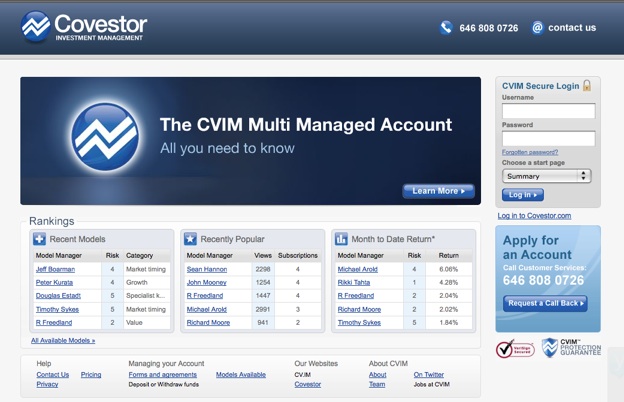
The end game for many social investing sites is to create their own investment management products that link member’s brokerage accounts to the trading data generated by the top portfolios on each site. Today, Covestor is the first major social investing site to launch a stock trading product. It is called Covestor Investment Management (CVIM).

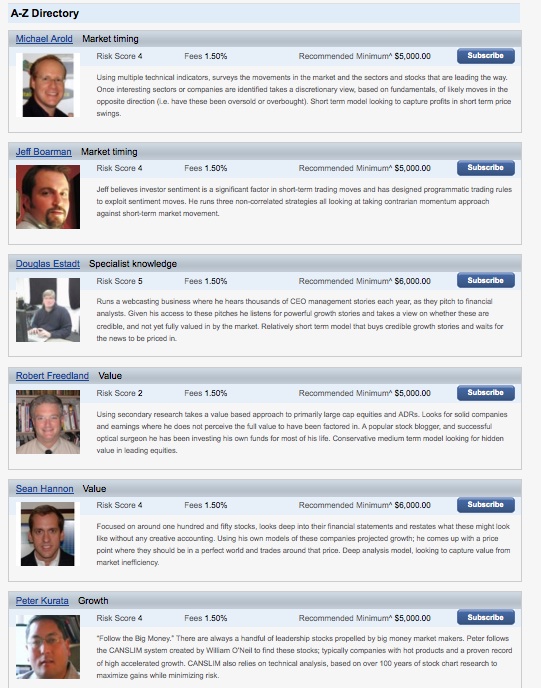
Covestor had to become an SEC-registered investment adviser (like competitor kaChing did last December, although kaChing still has yet to launch an investment product). Covestor has seeded CVIM with ten of the top traders on its site, representing a variety of investment styles from growth to value to market timing. Most are amateurs, but there are a couple registered investment advisers and one accountant in there. You can see their portfolios on Covestor, but the ones they trade on CVIM are different and you get only an aggregate view of their returns and top holdings. Once you subscribe to them, you get a full detailed view.

What Covestor is actually selling is investment data. Each of the ten “portfolio managers” are trading for their own accounts. They never hold any of your money. CVIM merely links their trading data to a brokerage account you set up either with TD Ameritrade or Interactive Brokers. You select which accounts you want to follow, and CVIM automatically instructs the linked brokerage account to mimic the trades in proportional amounts. Covestor charges a management fee of about 1.5 percent of your assets being managed, or $12.50 per month (whichever is greater), which it splits with the investors being tracked. You also end up paying the fees for each trade to your brokerage (up to $17 per trade).

Covestor CEO Perry Blacher argues that at least you know exactly what you are paying and that this can turn out to be less than investing in a mutual or hedge fund:

With a mutual fund or hedge fund you absolutely pay per trade. It is another transparency issue. The mutual fund does pay commissions, they pay fees to the broker that sells stock to them it is just you don’t know how much commission they paid as it is reflected in your own performance. In other words they may have bought a stock at $11.25 but it will appear as if it were bought at $11.13. They wrap the commission into the cost of the security/securities.

In the end, nobody is going to care about the fees. It is the performance of each portfolio that matters. I’m not convinced that really good amateur investors can do any better than professional investors. Over time, they nearly all get beaten by the S&P 500. If you take a look at how each of the ten Covestor “model managers is doing, some are beating the S&P 500 this month, but none are beating it over the past three months. I’d definitely want to see some outperformance before I put any money behind these guys. But I like the fact that Covestor is leveling the playing field for smart investors to virtually manage funds and compete with the institutional establishment.
Advertisement

Comments rss icon

  • Step 1: Become a Covestor “amateur investor”.
    Step 2: Pick a penny stock with a tiny market cap, and buy tons of it.
    Step 3: Wait for your “followers” to automatically do the same, thereby pumping up the value.
    Step 4: Dump the stock at the inflated price.
    Step 5: Repeat.

    • PRoblem with your thesis is your lack of research…CVIM doesn’t allow companies under $50 million marketcap, nor illiquid names, but I like your assumption-making, keep it up and you can become a Wall Street analyst someday!

      • Mr. Sykes,

        I agree with your defense. The person above doesn’t understand the intricacies here. Obviously the case he illustrates would have been the first case covered when this product idea was originally conceived. That being said, I can’t stand your comments and sarcasm. I really wish you would just stop. You’re intolerable and nobody really cares what your opinion is.

        All the best.

    • Hi Dave

      This is Rikki from Covestor here. Thanks for your comment. We are a regulated investment advisor. We have a fiduciary responsibility to our clients.

      As well as legal and liquidity contstraints, all trade orders pass through our compliance filters before we publish them or trade on our clients behalf and we have mulitple systems in place to prevent that occurence.

      Our goal is to offer an opportunity to genuine talent where-ever they come from – because we don’t believe Morgan Stanley or UBS has the monopoly on great investors.

      Hope that helps

      Cheers Rikki

  • This is brilliant. It completely eliminates the uncertainty over the security of funds invested with a financial advisor. The money stays in my brokerage account but the professional manages it and I gain the benefit of their wisdom. This completely eliminates the Madoff problem. This completely disintermediates so many financial parasites. Awestruck.

  • It goes without saying that Covestor and its money management model is the natural end game for retail money managers. In some other countries, mutual funds are viewed as bizarre products. Why people give money to these organizations to manage, when their incentives are completely misaligned, boggles me. Covestor aligns the incentives between the investor and the manager. I can’t wait to use their service!

  • Welcome tot he future of investing…no longer will those who dont perform have any say whatsoever in your lives…very exciting times, good bye frauds!

  • Oh and Erick, not sure if you realize this but the “Professional Wall Street Investors” arent doing so well, not one of the 10,000 stock mutual funds was up last year…last time I checked Covestor DOZENS of “amateur investors” banked nice profits…learnnnn

    • It doesn’t matter that some amatuer investors did well last year…What matters is which among them will do well this and next year…You are chasing a target that is always moving–good luck.

    • Timothy: Don’t embarrass yourself. Of course no mutual funds were up last year. Unless the fund prospective was to short the stock market, it’s obvious they all went down. You need to look at their performance relative to the overall market. Yes, I agree with you that mutual funds are overpriced products that under perform the S&P in the long run, however, the returns of an amateur investor is only as good as his luck.

  • “not convinced that really good amateur investors can do any better than professional investors” – Seeing as how most professional investors do so poorly, this shouldn’t be hard.

  • Covestor Investment Management is a real innovation in that it provides a new way for investors interested in active management to find new strategies to invest in (many available nowhere else), the strategists they invest alongside have their own skin in the game and also CVIM represents a new channel for pros to reach retail investors (think “portfolio strategy supermarket”). As with many game-changers, it requires a bit of vision to imagine its impact on the market. CVIM is leading the way in creating a new means to access multiple portfolio strategies within a single managed account (called by CVIM the Multi Managed Account).

  • That’s a very interesting concept and in my opinion one whose time has come. I like the transparency and the fees seem reasonable. As to the investors not being professionals, this leads to one of the greatest misconceptions in investing: that the “professionals” must always be making money. The last year has removed the wool from the public’s eyes and shown that yes, the professionals do bank consistent profits year in and year out (from the fees they’re charging you to lose your money).

  • I thing the concept is great, let the individual investor revel in their success and let the rest of us be able to follow along and participate…..

  • They need $100M for marketing, in particular brand marketing. Anything short of that and this product will fail.

    • Professional investment management firms will be so threatened by this software system that they will buy it next month. But alas, the toothpaste is out of the tube, the genie is gone from the bottle, elvis has left the building. This does to Merrill Lynch, I mean Lehman Brothers, oops I mean Bear Stearns, uhhh I meant…anyway…this will crush broker dealers the way Google Adwords crushed the ad agency media planning departments.

      • yes, because anytime there is a better way, consumers will change behavior, right? If humans made rational decisions, most everything sold at Walmart wouldn’t exist.

    • Inbound marketing experts would disagree. The power of the Web is that disruptive ideas like Covestor Investment Management can become widespread based on “word of mouse,” to quote David Meerman Scott. Check http://www.webinknow.com to learn more.

  • This product is great – not only do you have complete transparency in seeing what the people who I’m following are actually buying, I also get to keep the securities in my own account – so no Bernie Madoff problem. This is where the mutual fund industry is going to have to move to sooner or later; good job Covestor for getting there first!

  • The days of 2 and 20 are going away. If I could have followed Sykes last year my port. would look a lot different…Now I can. Hooray.

    • lol…good luck following people who will consistently make money. The guy up 40% this year will be down next and so on and so forth.

      • David, I think you are mistaken. JMO. Here’s why: Charles Kirk from thekirkreport.com is a good example. He’s one of the most decent, hard-working investors I’ve ever watched, chatted with. He posted his returns for many years…it eventually became a distraction and was adversely hitting his trades. But if I could’ve auto piggy-backed on his trades, I would have. Covestor has made it is possible. Doesn’t mean he’s he won’t have a drawdown, but what’s exciting abt covestor, is the potention for unaccredited investors to create “hedge-funds” or better, “fund-of-funds” for further diversification. Just my opinion.

  • The future of financial market analytic-based algorithmic trading has already begun. IBM predicted in a report in 2006/2007, that by 2015 brokers will be out of a job as everything related to trading in the financial markets will be automated and analytic platforms will become the norm and any vendor that’s not going to jump the automated analytics bandwagon will be out of business. (IBM – The trader is dead, long live the trader!)

    Here is a quick glimpse of what this future is all about from a cut & paste of the original article:

    “Humans made redundant as super-trader does the sums?”

    Algo-trading is still the domain of physicists, mathematicians, statisticians, engineers and once these platforms are made easy for the general user who may lack deep mathematical knowledge to understand (in which the vendors in the industry are heading towards to in making their tools user-friendly), then reliance on other expert traders/advisers would be something in the past, because the analytic tools will make every user a wall street expert (ie, the same proprietary algos used by analysts from Wall Street, would soon be available to the average Joe Public).

    The competition is fierce at the moment and it will become more fierce over time as Prof. Andrew Lo, Director, MIT Laboratory for Financial Engineering quoted in the New York Times (”A Smarter Computer to Pick Stocks”):

    Now it’s an arms race.

  • Crowdsourcing of investments has been done for a long time. It’s called the stock market. Buy an index fund or market ETF.

    Oh, and ask Cake Financial how this has worked out for them as a business. Not a new idea.

  • Won’t be long until investing becomes cool again and Covestor portfolio managers become Internet ‘celebrities.’

  • If I start to follow a day trader and have CVIM perform my trades, won’t I get crushed with fees for trading? For example with TDAmeritrade each trade costs $10. if I only have $1000 to invest, those fees will shrink the account very quickly.

  • Falafulu,
    I worked for the leading company that sells CEP technology for Algo trading.
    Algo is going to be a force in the market but it’s not going to be the market.
    Covester is not Algo trading… there are humans making decisions.
    The market is also not just about trading… it is about investing. “In the short term, the market is a voting machine, while in the long term, it is a weighing machine.” -ben graham

  • Big congrats to everyone on the Covestor team! This is very exciting news and just what this industry needs, more transparency.

    This really needs to be checked though:

    “Over time, they nearly all get beaten by the S&P 500. If you take a look at how each of the ten Covestor “model managers is doing, some are beating the S&P 500 this month, but none are beating it over the past three months.”

    Here’s the top-ranking trader on Covestor: http://www.cove...br/timothysykes

    Click on 3M or even 1M on the chart, that’s a prettty big gap above the S&P there.

  • I would much rather follow the pros at AlphaClone than 15 year old kids on Covestor. Do you really think a 2 year, survivor-biased track record is better than David Einhorn and Warren Buffett? Seriously?

    Didn’t Marketocracy’s mutual fund (and Cake and Vestopia) fail doing just this?

    PS I fully expect Covestor to succeed, but fully expect their investors to fail miserably.

    • Covestor has commited invesors with deep pockets- Cake and Vestopia didn’t.

      Cureently, Covestor competitive advantage is just that: deep pockets that supports the company’s grand vision.

      My firm is researching trends and business models in the financial services industry and by no means such a platform can succeed without strong VC backing. Covestor will need additional inflows of capital to get traction. They have investors who are willing to take a risk. As you pointed out, not all investors are willing to take such big risks.

      • Michelle, I find the consultant & research company Aite Group the best out there in finance related reports & researches. You can find lots of stuff from their website which are informative (unless you’re from Aite yourself).

  • This kind of article is why I still read Techcrunch. Groundbreaking.

  • @davehensley I think the idea is great and well intended. 90% of the users will use the product in its intended manner. The other 10% will follow Dave Hensley’s model to try and trick everyone to buy valueless stocks and then sell their shares the second people follow.

  • CV.IM has gotten to a place when Cake and others couldn’t get to…monetizing the platform on its own. What the product can’t prevent is HNW investors going around the platform and cutting a deal directly with the trader. The advantage, however, is that the investor never loses control of their own account.

    The platform offers real innovation in money-management. The fees will/should eventually come down.

    And, unless the pros don’t know what’s good for them, a few will put their trades up on CV.IM and see how well they do.

  • Hi David,

    I understand that Covestor isn’t algo-trading, however the point that I am trying to make is that analytic systems is the future. A system that does the analysis for the user automatically, where the final decision is left for the user to execute it him/herself. It is algo-based trading but the difference here is that the final analytics output is left for the use to act upon rather than the computer doing the trading on its own. Perhaps I can call it, machine-algo-based-trading & human-based-trading. They use the same algorithms, except one system is automated while the other one is human-executed.

    The defining advantages of these algo-based systems (whether machine-based automated execution or human-based manual exectutions) are that the systems will give a very very deep picture of the market. Now these metrics are to be used by the machine itself or the human. The only advantage of machine execution compared to its human manual execution (even though the same metrics the algo produced) is one is much faster to act (since arbitrage opportunities come & go in seconds or minutes), while the other is slower to act and the human emotions may creep into the mind of the human trader and override the metrics produced the by algo. By the time a decision is made (buy/hold/sell), the opportunities had gone.

    My overall contribution here, is that onlne systems of today should move into analytics (to target either retail or institutional traders who want to use the analytic’s for machine auto-executions or human manual executions based trade), because that is where the industry is heading. Well done to Covestor for bringing their platform to the market, but perhaps analytic is something to be considered in its development at some stage.

    PS : I am entering the arms race (according to Prof. Andrew Lo) in this domain as I am working on such online app.

    • The problem with program trading is your software needs to be developed during the same cycle that the market is currently in. Program traders developed during the bull run in the late 90’s are failing miserable during this bear cycle. The triggers that signal a buy and sell are completely different during different market cycles. What program trader would have realized the financial and automotive sectors would be the leading indicators for the market for numerous months? None. That is why human intelligence will always be apart of the equation.

      • Of course human intelligence is still needed since the market dynamic changes all the time.

        Some variables that have been built to some models may have arbitraged out over time and have no influence at all in the models (factor models or APT – arbitrage pricing theory) so human intervention is frequently needed, since the algorithm/s can delete that variable by itself (rule-based), but it cannot know in advance of a substitute variable for the replacement of that outdated variable – but we humans do). APT algorithms have many different variants today, some proprietaries and some are publicly available in various economics/finance/physics/mathematics/statistics/engineering/signal-processing/computer-science journals. They only vary in their ability to price financial instruments correctly (ie, minimal error). Economic variables that get arbitraged out will be deleted (by humans – the modelers) and new variable/s will be added in. That’s how it is supposed to work.

        On the other hand, the modern portfolio theory (MPT) is not just about opportunities. There is no such thing as 100% profitable for a specific model all the time. On average, the models will beat any non-quantitative-based (ie, analytics) investor most of the time in terms of profitability. Models will occasionally make a lost, but on average they will make profits that outperformed market bench-marks. MPT also minimizes your lost, since lost in the financial markets is something unavoidable and it is a fact of life, whether the trader is using models or no models. However the differentiating point here, that those investors using MPT will at least minimize their loss if everyone makes a loss in the market because of the direction of its movement.

        Here is an example. Suppose that there are only 4 stocks in the universe and they are Google (G), Microsoft (M), Oracle (O) and IBM (I). Suppose that only you (John) and me (Falafulu) are the only players/investors in this universe of 4 stocks. Also suppose that we started out with equal amount of let’s say $100,000 each. Let’s also say that we both want 8% annual returns. So, between you and me as investors in this 4-stock universe & 2-man player in this small financial markets, when you try to allocate or decide of which of the 4 stocks (all or some of them) that you’re going to invest your $100,000 in order to achieve the goal of 8% annual return, is going to give you infinite possibilities of how you allocate. The question is, which combination of weights (proportions) that will minimize your lost just in case the market will move against you? Here are some possibilities and as I say, it is infinite:

        Portfolio 1 (Allocation)
        ==============
        G – 10% ( = $10,000)
        M – 60% ( = $60,000)
        O – 0% (= $0)
        I – 30% ( = $30,000)

        Portfolio 2 (Allocation)
        ==============
        G – 15% ( = $15,000)
        M – 60% ( = $60,000)
        O – 5% (= $5,000)
        I – 20% ( = $20,000)

        Portfolio 3 (Allocation)
        ==============
        G – 0% ( = $0)
        M – 0% ( = $0)
        O – 5% (= $5,000)
        I – 95% ( = $95,000)
        .
        .
        .
        Portfolio Nth
        ==============

        Now as you can see, the the combinations (permuatations) is infinite, even with 4 stock universe? But the world stock market isn’t a 4 stock assets is it? But the permutations is much much higher than the already infinite possibilities with a 4 stock universe, considering that the US has more than 10,000 listed companies alone. Can you imagine the permutations of 10,000 stocks? Unimaginable! Which of the above combinations of stock weights (proportions) that you’re going to choose, which will be profitable if the market movement favours your position and you get max profits, and the same compositions will also protect you (insured) if the market movement is against you, then your loss is at a minimum (minimized)? If you don’t know the answer, then just flip a coin.

        Ok, here is what MPT algorithm does. MPT will tell you exactly what proportion that goes to G, O, I, M which will target an 8% annual return and at the same time minimizes any potential loss if the market moves against you, and this is irrelevant if the market is bull or bear (although they will affect the amount of profits and losses), but the concept of maximizations & minimizations are there, irrelevant if the movement is bull or bear. Anyway, I’ll leave the more detail explanations to professional investors and financial advisors to fill them here for you, since I am not a financial analyst by training nor by trade. My interest is purely algorithmic development & implementations for software application in this domain.

        Last, I don’t know if MarketRiders are using the proper MPT techniques as portfolio allocations (optimizations of weights or proportions) & portfolio re-balancing algorithms or not , since I haven’t used their system, but if they do, then these guys are bringing these advanced techniques to ordinary investors , where these methods are only found in Wall Street & the likes or advanced analysts.

        • lost should be loss (from previous message post).

          There is no way I can edit my post. I could have thoroughly checked it, but anyway, English is my 2nd language, probably you can tell John, its obvious. I wish that TC commentaries is editable or preview like other blogs do. In that way, one is able to spot the error.

  • I find the concept very appealing, but am not convinced why an investor would want to pay 1.5% of “Total Assets” for such service. For an average annual return of 8%, this fee would be about 20% of my profits.

    If I have enough assets, I can hire a RIA who would not only manage my finances, but would also offer personalized advise. So is the service only targeted at younger people, who can not afford an adviser?

    To my knowledge NO financial adviser would want to seek customers just on promise of good returns, and I guess Covestor too would not want to lure customers this way. Is it right?

    If yes, then why would someone want to “bet” his money and pay for the service? Or is it just a smart way of luring people by showing hi-flying investors who have got high returns even in this economy. In short, how is it different from betting?

  • David,

    Here is an article that probably clarify of what I said in my previous messages:

    A London Hedge Fund That Opts for Engineers, Not M.B.A.’s (New York Times)

    This hedge-fund uses the metrics produced by the analytic system for them to use and not necessarily machine auto-execution, but it is still algo-based analytics. These analytic type systems will move from institutional traders to retail traders over time, because institutions employ people who understand these algos and their use. For retail versions of these system, the user must be shielded from having to know complex stuff behind the app itself, where they can just focus on making decision based on the metrics produced the system. This is where the advantage comes in, if Covestor may consider a plan to develop theirs at some stage to have analytic capability, because with the massive financial information today, we are drowning in it but starved for knowledge and analytics can make the job easier for the user.

  • if you’re interested in non-traditional “automated” investing you should take a look at marketriders.com as well. TC covered them earlier- I actually use the service now and have been happy with it.

    • Adam, if I have to give my personal opinion on which is better amongst the current online investing systems that have been covered here at TC, I would give MarketRiders the top spot. I haven’t used it before but based on the description on their website of what they do, I am impressed. One is portfolio allocation and the other is portfolio re-balancing, which they’re both algorithmic and are cornerstone techniques in Modern Portfolio Theory or MPT (originally developed by Economic Nobel Laureates, Markowitz, Miller and Sharpe – 1990).

      MPT development (a continual process) has advanced since the day it was first developed, to today where it is getting better (accurate) with new researches that are pumping out and being published in the literatures on a regular basis.

  • Nice thing about Covestor is that I could compare my past performance to the suggested amateur managers. Even though it did not take into account the massive 1.5% per month!?! fee, the performance was still nothing to get excited about. Actually would have just been more money out the door in most cases.

  • How does this differ from KaChing?

Leave Comment

Commenting Options

Enter your personal information to the left, or sign in with your Facebook account by clicking the button below.

Alternatively, you can create an avatar that will appear whenever you leave a comment on a Gravatar-enabled blog.

Trackback URL
Short URL
bugbugbugbug
Techcrunch on Facebook