People Are Using Google Reader “Likes,” But Some Hate It. And It’s Flawed.
by MG Siegler on July 20, 2009

picture-163

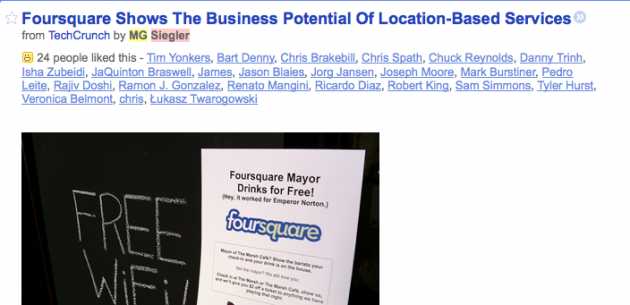
As we expected, the new “like” functionality in Google Reader seems like it’s seeing some good usage. Certainly, given that “likes” are fully public, we’re seeing much more social activity on feed items than previously with Google Reader’s “share” or “share with note” functionality. And that’s good. In a world of Twitter, FriendFeed and Facebook, where social sharing is very easy, Google Reader needs to become more social, more alive, if it’s to continue growing.

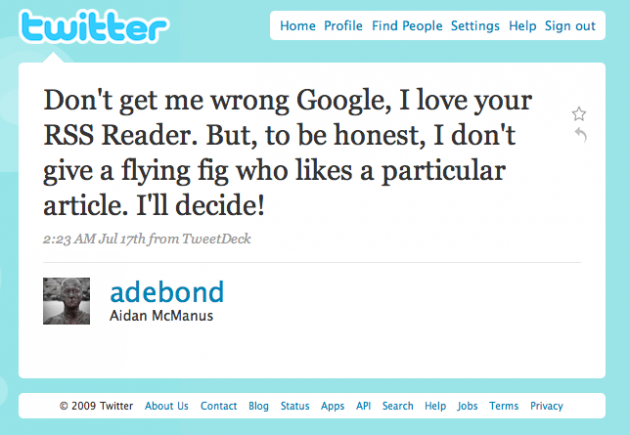
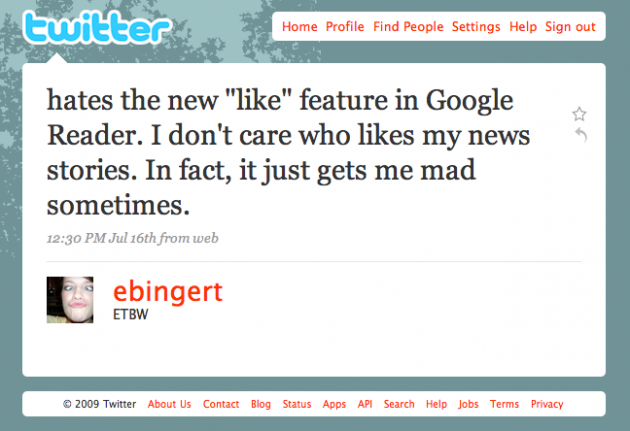
But quite a few people don’t like the functionality — at all. A search of “Google Reader Likes” on Twitter returns results that are nearly evenly mixed between people curious about the feature, and those that wish it would go away. Says one user on Twitter, “Hating the new “like” feature in Google Reader. I don’t want to see Likes from the Unwashed Masses. Anyone know if I can disable or filter?” That seems inline with what many are saying. They don’t care who liked a story, and want a way to turn the feature off. And one user has already created a script to do so.

Personally, what I think what the feature needs is more options. There definitely should be one to turn it off, but there should also be something that lets you sort items in any feed by the number of likes it has. While some people hate the idea of only reading what someone else likes, for popular feeds, it’s actually a somewhat useful filter in determining the most interesting articles. (But again, only in feeds that are popular enough to have many likes to begin with.)

The ease of “liking” an item is good. And I like that it’s not right next to the “star” at the top of an item so users have to at least pretend they looked at an article to “like” it. From what I’m seeing, since Google Reader implemented this feature and the search for users functionality, the number of requests for people to follow my public Google Reader shared items feed has gone through the roof. Again, that’s a good thing to keep the service moving in the direction of social.

But there is one very key flaw to the idea of Google Reader “likes” — if you read news as it comes in, you’re likely to read it before anyone is even able to “like” it. To take that idea further, the longer you wait to read your feeds, the more useful the “likes” are as a social feature. That rewards reading stories late, which is pretty much the opposite of the real-time sharing that Twitter and the like offer.

And unlike FriendFeed, where someone “liking” an item often brings it to the top of the stream, once you read an item in Google Reader, the likelihood that you’re ever going to read that item again is small. The whole concept seems to work against itself, presently. Now, this could change when Google Reader “likes” have their own API, and third-parties can do interesting things with them. But for now it seems to be encouraging RSS reading — already a slow medium through feed readers — to be done even slower.

Hopefully, Google’s ultimate goal here is to create some sort of “Best of” feeds area which you can visit at any time and see what hot items are across Google Reader. It really should have been doing this from the beginning with the “shared” functionality, but it never implemented it. Instead, Digg has owned this area, and now others like Bit.ly are about to enter that game in a big way.

And so Google’s social strategy remains flawed. There are an increasing number of pieces there, but no one can yet put them in place.
picture-174

picture-183

Advertisement

Responses

Comments rss icon

  • I like it. It gives a nice insight to what I might need to take a second more and look at it. Realize that the same people that have Perez Hilton in their RSS aren’t the same that subscribe to TC’s RSS, as well.

    • (Eh, those were incomplete thoughts and I wasn’t finished…)

      Additionally, it’s clear that there just needs to be an option to turn these “ON” and “OFF” in the settings.

    • All likes okey, but why on top? they can show likes at bottom of the feed post. Goog sees too many people using goog-reader, wants to capitalise that. Monopoly there is undercurrent for outside viewers because goog clubs all services under google.com domain to avoid detection by third party traffic calculators.

  • I like the “like”, its kind of diggish.

  • Here’s my tweet about the subject: “Google’s social apps look like they have Asperger’s syndrome.”

    It really seems like Google doesn’t know how to act socially. “Likes” are meaningless when they come from people you don’t know. That’s just meaningless information. If you could filter by location, and get to know people around you who like the same stuff, or use that to find new feeds–the possibilties are endless–but THIS is just awkward.

  • Have you made it a rule to mention Twitter in absolutely every post? This refers to 10% of posts not about Twitter already.

  • I’ve never used Google Reader… My favorite reader is Streamy

  • Actually that “best of” stream is already available, sort of – you can subscribe to Google’s “what’s hot” list, and in fact it’s shown on the Google Reader home page when you aren’t logged in. I read many feeds as they come in, but it still manages to constantly recommend stuff to me that I hadn’t seen.

    But you’re right, there’s not a lot of value in seeing the “so and so liked” list when I’m just reading a non-aggregated feed.

  • Can you please rewrite the title to something that is not ambiguous and grammatically frustrating? “People Are Using Google Reader ‘Likes,’ But Some Hate It, And It’s Flawed” is at the very best a run-on and at the worst illogical.

    “People are using Google Reader ‘likes’, but some people hate it” is one coherent thought. “And it’s Flawed” should not be compounded on to the end without enough subordinators to make it clear that this is a logical proposition, not a compound sentence. It’s not clear if that is people’s opinion, some people’s opinion, yours, or a statement of fact. If you are trying to say “a, but b therefore and because of c”, “and” is certainly shorter than “therefore and because of” but does not provide any indication of the logic you are attempting to employ.

    On another note, two huge screenshots of tweets does not a majority make.

  • Wow, I sure wish I had so little going on in my life that I could get MAD about something so trivial as the Like feature in Google Reader.. especially when it’s so easily ignored. It’s not like it’s hugely intrusive, after all!

  • I find the likes useless (I didn’t write the post so why do I care how liked it is?), but the thing I found superbly annoying was how they gratuitously converted “people sharing with you” to “people you follow” and “people you share with” to “people following you”. And suddenly my list got larger.

    I mean, this isn’t Twitter where we consciously chose to follow other people, these followees just showed up from our automatically populated Gmail contact list (which is also annoying a but separate issue from GReader). But I guess this just is their response to the problem that shared items used to all be publicly viewable?

    Google’s (lack of) privacy controls drive me nuts. Was there another TC post about this “people you follow” bs?

  • The “Likes” encourages people to write more, if you are a blogger, it is a feedback.

  • I don’t mind it, but I found it a bit odd they put the “xxx people liked this” at the top, and then the button to flag it as liked at the bottom.

    I think if they integrated the Like button with the count at the bottom of each post, then it be much less intrusive to those that dislike it, and more intuitive for those that want to use it.

  • I like it, too..different people have different opinons…

    ——–
    sharing with u guys,if u want to manage ur personal things or optimize ur pc,desktopgather is an ideal choice…it has music and funny games too…i’am happy because i’ve search it for a long time…

  • Isn’t it ironic that people who don’t care what other people think of news stories they’re reading believe that we might actually care about what they have to say about it in twitter?

    Pot, meet kettle :-)

  • Flying fig is the greatest descriptor of anything ever.

  • I usually try to restrain myself and only post when I have something to add to the conversation.

    But….

    “Hating the new “like” feature in Google Reader. I don’t want to see Likes from the Unwashed Masses. Anyone know if I can disable or filter?”

    Screw you. Unwashed masses? Screw f*cking you.

  • Now I have to both ‘Like’ and ‘Share’ Reader items

  • I’ve only got 10 people in my reader now. Of those very few comment but those that do are snarky and funny.

    Like is, well… not as entertaining. Also, this raises the level of ways to massage the articles in Reader but I’m unclear on what it is doing.

    Like <— meh
    Shared <— was useful but no comment
    Shared with Note <— my favorite
    Comments <— this doesn’t seem to work
    Starred <— I never understood this one

    • Starred = Save, but not publicly.

      I tend to use it if I think I won’t have time to read it at the moment, or that my phone’s browser will crash, or if I simply want to save it for later, but not make it public. (There are reasons to hold some aspects of your reading habit cards close to your chest)

  • If you all like Google Reader you should totally check out Feedly. I know it is sort of a shameless plug, but I ran across it a few weeks back and it has changed my Google Reader experience. Let me know what you think.

  • I probably do not know even 0.001% of the people who are the “likers” here at TechCrunch but when reading the blogs of those people who are also reading my blog I know some of the the likers and unlikers.

  • Is the social twist Google is pushing on this product one that increases usefulness or just another social tweak in an “Industry of Cool”.

    Making an RSS aggegator – a simple, incredibly effective service – have the mess of social implications is painful to see.

    (Beyond that, the good, old, troubled Bloglines still has a more attractive user interface).

  • I think my twitpic from a few days ago sums up the irony nicely.

    http://twitpic.com/ar0do

  • I like ‘Likes’ on Google Reader but don’t place much emphasis on them at the moment, I prefer the ability to find friends to follow as that’s more valuable!

  • I use google reader on the desktop and the iphone. On the mobile versione there is no like yet, and honestly I don’t miss it.

  • Maybe it’s just me, but why does EVERY web service need to be a social network? Why can I not just read my feeds in peace and quiet, without the knowledge of who else likes or doesn’t like the article I’m reading. Do I NEED to give a damn about what other people think? And in the event that I do give a damn, why could I not just go to the post and read the comments? I don’t mean to sound harsh; I just suppose I’d rather that the “Like” option (and similar features) be optional. I know I probably sound like a grumpy old codger, but I’m actually 23. My point is just that social networking doesn’t work (and doesn’t need to work) for every web service. Stick with what you’re good at, and don’t try to be like everyone else or something that you’re not. Or rather, if you must be creative, use your creative abilities on new things, rather than trying to imitate.

  • I think the likes feature is more likely to be used by people to spam their profile link than it is by genuine fans of an article.

    I think it looks very out of place where it is in the article. In fact, it’s a very poor choice of location because it looks like it’s part of the article not google reader, which is what I initially thought before I looked up more info about it. It should go at the bottom with all the other “tools”.

  • I value screen real estate quite a lot in web applications and the newly introduced likes feature of Google Reader has taken valuable real-estate away. While you can hide the number of likes, I did want to see the number. So I moved it to the most logical place. Right next to the “Like link”

    http://userscri...ipts/show/53924

    Screenshots http://bit.ly/251Faz

  • For the users who likes the “liked” feature, you can see the items you liked using this undocumented google reader url:
    http://www.goog...com.google/like

  • For the companies under the post, what decides what is their? If it is based of company names in the article why isn’t facebook there?

  • Can’t believe its a post from you! Now you can add it to the examples of “I do write anti-Google posts too” when someone calls you “mostly Google” :-)

    And Twitter…. well, thats inevitable, hehe.

  • I like very much the writings and pictures and explanations in your adress so I look forward to see your next writings.
    To provide useful information, please click to view
    Bose headphones
    ghd Hair Straightener
    Women is Dakota
    Sundance UGG Boots

    Thank you!

  • I actually think the “liking” feature could be used in an entirely different way than people are currently viewing it, and it’s something I’ve been hoping for for over three years now:

    Google Reader’s New “Liking” Feature

Leave Comment

Commenting Options

Enter your personal information to the left, or sign in with your Facebook account by clicking the button below.

Alternatively, you can create an avatar that will appear whenever you leave a comment on a Gravatar-enabled blog.

Trackback URL
Short URL
bugbugbugbug
Techcrunch on Facebook