
Microsoft Popfly Gets Squashed
by Robin Wauters on July 17, 2009

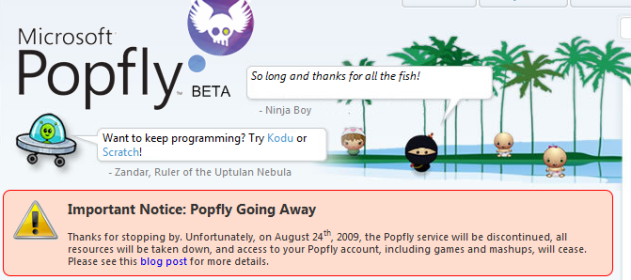
Microsoft has announced that in late August it will be discontinuing availability and support for its once popular mashup creation application Popfly. In a blog post, team leader John Montgomery confirms the internal deadpooling, although he doesn’t call it the way we do. He writes that on August 24, 2009 the Popfly service will be discontinued and all sites, references, and resources will be taken down.

Montgomery points developers to Microsoft’s Web Platform and Xbox development program as all projects that were created using Popfly will effectively be discontinued completely.

TechCrunch got an early look at the Silverlight-powered application when it debuted in private beta mode over 2 years ago. At the time, mash-up and widget creation tools were all the rage, with Yahoo introducing its Pipes web app just a few months prior. Google got in the game with its Mashup Editor a bit later, but that service never left private beta and the company ultimately announced it would be axing the product last January. Two days ago, the team even reminded developers that it would soon be shutting down.
ProgrammableWeb in its coverage of the discontinuation of Microsoft Popfly points back to a February 2008 article in the NY Times, in which the newspaper talks about Montgomery and Popfly in a positive light, with the product manager being lauded as “an example of how it just might be possible for someone to teach dinosaurs to dance”.

Last fall, his team introduced an intriguing software Web service called Popfly that is intended to make it possible for nonprogrammers to plug together Web components and data sources quickly to create useful new Web services. For example, news feeds could be added to digital images, or data lists to maps.

Introduced at the Web 2.0 conference last year by Steven A. Ballmer, Microsoft’s chief executive, Popfly was picked by PC World magazine as one of the most innovative computing and consumer electronics products of 2007. It has garnered more than 100,000 users — the company says the exact number is confidential — and now has a library of more than 50,000 “mashups”: new components or Web pages that have been created in a visual snap-together fashion, like Lego blocks.

Web 2.0 Conference organizer Tim O’Reilly also gets quoted in the article, and he apparently expressed skepticism early on:

“Popfly shows me that Microsoft still thinks this is all about software, rather than about accumulating data via network effects, which to me is the core of Web 2.0,” said Tim O’Reilly, the founder and chief executive of O’Reilly Media, a print and online publisher. “They are using Popfly to push Silverlight, rather than really trying to get into the mashup game.”

Seattle-based tech blog TechFlash got a bit more information out of Microsoft regarding Popfly’s sudden death. In an e-mail to editor Todd Bishop, Redmond says Popfly was simply no longer part of its refocused strategy, which was outlined in light of the dismal economic situation.

(Thanks to everyone who sent this in as a tip)

Advertisement

Comments rss icon

  • Silverlight IS cool,when i first used it ,i love it.

  • Technology is a fickle business =[

  • Pipes and Popfly had the same problem: To complicated for casual users, not powerful enough for professional users.

    A combination of iMacros and Perl still works best for our web scraping and data collection projects.

  • I’m happy that I haven’t written important things that would use Popfly. Makes me wonder about the viability of other mashup services.

    • True. Definitely we need to rethink about other mash-up services. Popfly cannot be termed as neither “extraordinary” nor “bad” it is something in between. But why is MS shutting down?

    • I take your point but remember that any mashups that are built using Popfly and “installed” somewhere will still continue to work even when Popfly gets shut down – there’s no reliance on Popfly.
      In this respect its different to (e.g.) Yahoo Pipes. If pipes got shutdown that’d be it – no Pipes would work anymore.

      -Jamie

    • why would you write important things on a beta platform? it’s best to wait until it’s out of beta….if you did on the beta flatform and it gets shutdown then that would be your mistake

  • Hmmm so what does the future hold for other mashup services??? I think Microsoft have more important projects on the go.

    Bill Gates Foundation just bought or are thinking of buying a stake in struggling online sports retailer JJB, JJB shares shot up slightly.

  • I think this story is not so much about a new service and a new industry or startup or whatever else.
    This story is about using closed prprietary technology whose existence and quality depends not on the number of users or their opinions but solely on the financial and strategic decisions of one commercial, publicly listed company.

    This is a story about open standards for infromation exchange on the web.

    All of you Silverlight lovers – if the guys at MS who made silverlight and who have worked on it from the beginning were to join another company like it happened in the case of Yahoo’s mass exodus, your silverlight investment or website account is really a fragile entity.

    Among the many things you can do right about choosing the most stable system / setup is to choose products that use open, standard data formats and prototcols.

    Whether it is Microsoft or Google or Linux or Apple, stay away from closed formats and closed protocols for long term infrastructure investments.
    Security does not come from obscurity. Obscurity is security theater. And stability definitely gets reduced by products and services that use non-open data formats and standards.
    Hence the good thing about Flash being opensource and HTML5 and OGG video.
    Google and GWT and Android would have been dangerous if they were not opensource.
    We still have no control over the backups of our data across hundreds of servers worldwide, but at least the data and the protocols are open.
    And they have APIs too.

    We have to make sure that they never ever stop supporting older APIs, but that they keep them all there, working and online. That’s for Google.

    For Microsoft, I encourage you to think a bit too :)

    • One of the common misconceptions about Popfly is that one required Silverlight in order to use any of the mashups it produced.
      In the majority of cases that wasn’t true – the output was HTML & JavaScript.

      Hence, I think your argument is a bit weak.

      -Jamie

  • This is the story of engineers thinking that everyone can or want to think their way. Even if it was quite easy to set up a mashup, programming “way of thinking” was still needed to use pop fly. Also, most people just doesn’t want to do mashup and people that does have more powerfull tools to do it …

  • Microsoft caught with it’s zipper down? LOL

  • Maybe they just renamed the service to something more memorable like bingfly?

  • Sometimes you’re the windshield sometimes you’re the bug

  • Another way for microsoft to take your ideas and make them theirs……….free of charge……..you think it shutting down………well sure what better way for them to get your ideas for free and make money off it later down the road……………He he he …suckers

  • John Slockovick - July 17th, 2009 at 9:56 pm PDT

    Popped goes the fly.

  • Maybe they saw the Rules project, then just gave up :)

    With Popfly, you can plug an event feed into a pre-canned behaviour – but to conceive a new behaviour Microsoft requires you to be a programmer and opt in to a whole world of pain.

    Rules was driven by the need to do the ‘hard bit’ which Popfly gave up on, letting non-specialists actually author their own behaviours.

    See Rules screencasts at http://btrules.com

    Disclosure: I conceived and led this mashup project when I was working at BT, but the team has really done wonders to prepare for Beta launch since I’ve been on sabbatical so much of the credit goes to them.

Leave Comment

Commenting Options

Enter your personal information to the left, or sign in with your Facebook account by clicking the button below.

Alternatively, you can create an avatar that will appear whenever you leave a comment on a Gravatar-enabled blog.

Trackback URL
Short URL
bugbugbug