Twitter’s Internal Strategy Laid Bare: To Be “The Pulse Of The Planet”
by Erick Schonfeld on July 16, 2009

On Tuesday evening more than 300 confidential Twitter documents and screenshots landed in our inbox. We said we were going to post a handful of them only, and we’ve spent much of the last 36 hours talking directly to Twitter about the right way to go about doing that. We’ll have more to say on that process in a couple of days.

The documents include employment agreements, calendars of the founders, new employee interview schedules, phone logs and bills, alarm settings, a financial forecast, a pitch for a Twitter TV show, confidentiality agreements with companies such as AOL, Dell, Ericsson, and Nokia, a list of employee dietary restrictions, credit card numbers, Paypal and Gmail screen shots, and much more.

These are the last two documents we are going to share: a subset of the detailed notes from a set of executive meetings that took place between February 12 and June 9, 2009. Much of the information in these notes is either personal in nature (new hires, etc.) or too sensitive to share. What’s interesting of the rest we are posting here with our commentary. These notes include never-before revealed discussions between Twitter and Google, Microsoft, and others, as well as details of product planning, company goals, employee retention, and new proposed terms of service and APIs. Even acquisition targets such as CoTweet and Twitpic are discussed (and sometimes dismissed). It’s important to note that we have been given the green light by Twitter to post this information – They aren’t happy about it, but they are able to live with it, they say (more on why they did that in our later post).

One other caveat – as we’ve said before, these documents are rough meeting notes, not polished documents meant for broad consumption. There are lots of typos and outdated information. But on the plus side, the rawness of it shows the dedication and deep commitment of this team to making Twitter into a world-class company.

Finally, there are some details about partner discussions, particularly around Google and Microsoft, that we are just not going to publish. Twitter has been in negotiations with both companies around a broad set of transactions for months. But we aren’t going to go into great detail about exactly what has been discussed, or Twitter’s strategies toward those negotiations. So while it looks like there is a lot of detail around those discussions below, the most sensitive stuff has been removed.
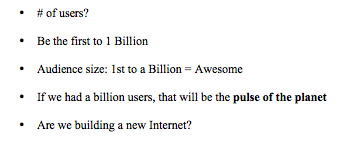
Let’s start with a key strategy meeting which took place on February 25, 2009. One of the audacious goals laid out in the notes of the strategy meeting is for Twitter to become the first Web service to reach one billion users. The notes are laid out in bullet points with each one reading like a Tweet: “If we had a billion users, that will be the pulse of the planet.” In the meeting itself, Stone tries to put his finger on what Twitter is by calling it more of a “nervous system” than an alert system.

A lot has happened since February. Twitter’s site has gone from an estimated 4 million visitors in the U.S to 20 million, and nearly double that worldwide. However, the notes provide a rare view into the strategic thinking of the company just before it entered its current phase of hypergrowth.
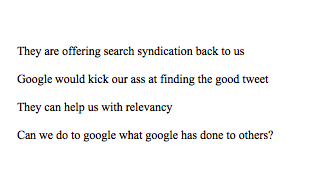
13Dealing With Google: Much of the discussion at Twitter meetings throughout the past six months revolved around dealing with Google and Facebook. In a March 13, 2009 management meeting, for example, during a discussion of a search deal with Google, the fear is expressed that “Google would kick our ass at finding the good tweet.” But almost immediately afterwards, someone asks, “Can we do to google what google has done to others?”

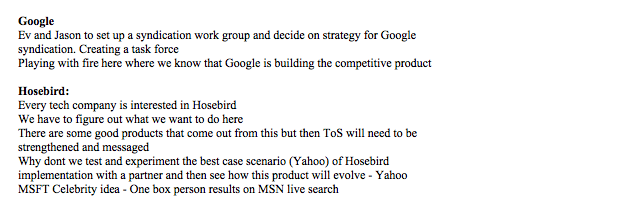
In a May 7 management meeting, Twitter’s search syndication strategy with Google is discussed, as is the desire of “every tech company” to gain access to “Hosebird,” an API Twitter is working on to deliver its full stream of Tweets to search partners and others. The attitude towards Google is cautious: “Playing with fire here where we know that Google is building the competitive product.”
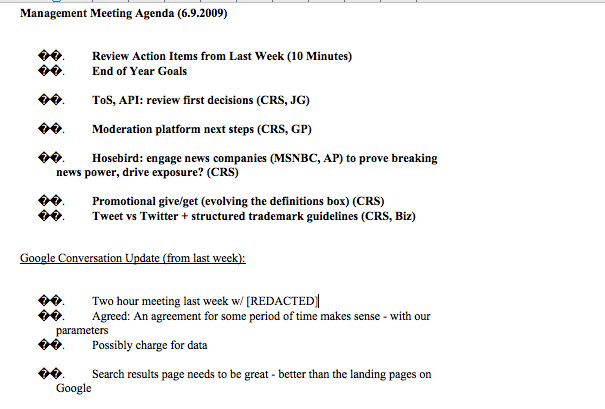
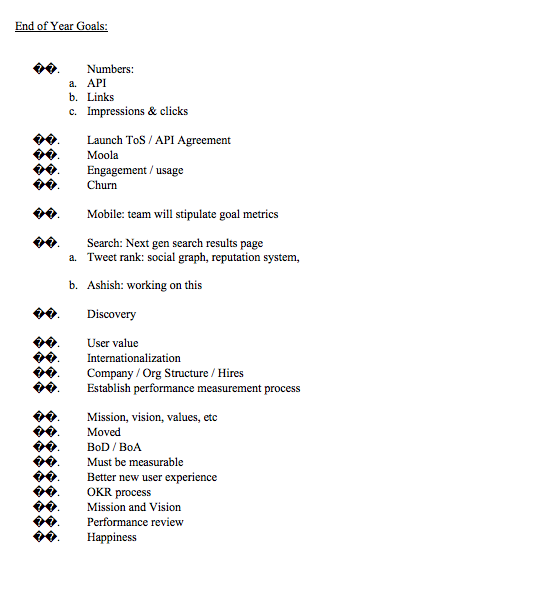
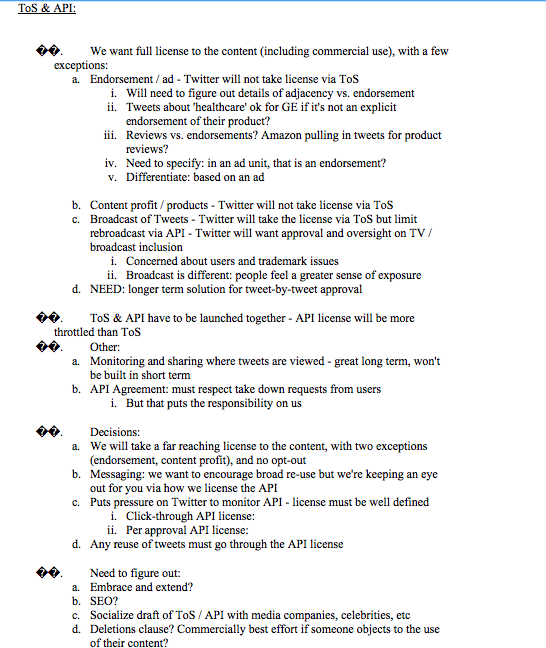
7But by June 9, things seem to have progressed with Google. After an earlier two hour meeting with Google executives, the Twitter leadership had decided that an “agreement for some period of time makes sense – with our parameters.” But at the same time, they resolved to that Twitter’s own “search results page needs to be great – better than the landing pages on Google.”9Company Goals and New TOS/APIs: In that same June 9 meeting, Twitter execs talked about their end of year goals, including a “next gen search results page” and a (much-needed) reputation system which internally is being called “Tweet rank.” The company is also hard at work defining a new Terms of Service agreement which will launch in conjunction with new APIs. These will determine what kind of commercial messages Twitter will have rights to monetize via ads. Twitter wants to “take a far reaching license to the content, with two exceptions (endorsement, content profit), and no opt-out.” Twitter also talked about making its API license “more throttled than ToS.”
9192

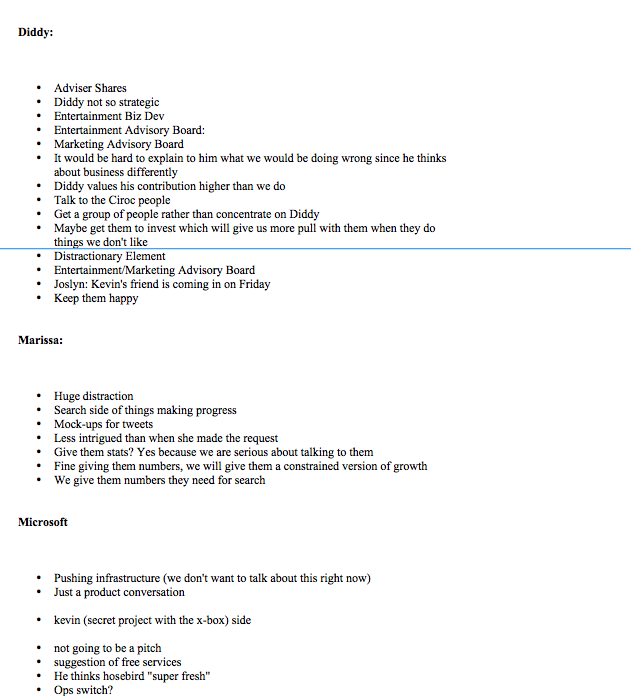
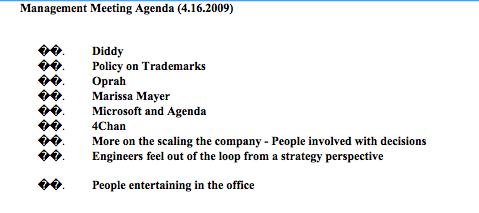
Diddy, Marissa, and Microsoft: Another thing that comes through from the notes is just how much everyone has been courting Twitter. The agenda topics for a Twitter management meeting on April 16, 2009 reads like a who’s who of Hollywood and Silicon Valley: Diddy, Oprah, Marissa Mayer, Microsoft, 4Chan. They discuss giving “advisor shares” to entertainer Diddy, a big Tweeter, but also see him as a distraction. “Diddy values his contribution higher than we do,” read the meeting minutes. In an earlier meeting on April 2, other potential advisors discussed included Shaq and Al Gore (presumably both would receive advisor shares as well).

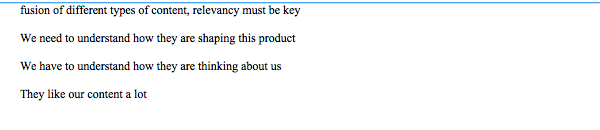
If Diddy was a distraction, Google product chief Marissa Mayer was a “huge distraction” who kept asking for stats on Twitter’s growth. Twitter management decided to give her “a constrained version of growth.” Finally, Microsoft wanted to talk about a deep infrastructure deal (”we don’t want to talk about this right now”) and a “secret project with the x-box.”
16-diddy-oprah16

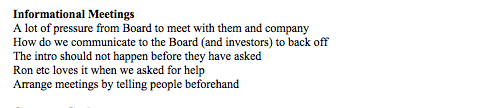
Despite the interest and attention, all the Twitter management really seemed to want was to be left alone, even by its own board members. In a May 7 meeting, they talk about how to put off informational meetings in a nice way: “How do we communicate to the Board (and investors) to back off.”
71

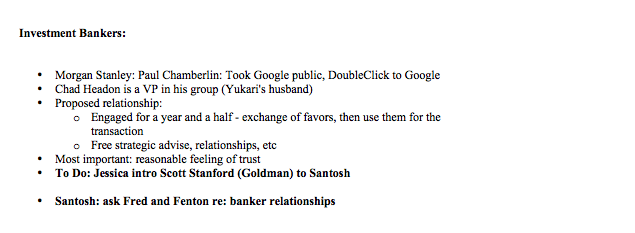
Exchanging Favors With Investment Bankers: On May 26, the Twitter management team discussed choosing investment bankers with the idea that they would engage them “for a year and a half – exchange favors, then use them for the transaction.” It is not clear what “the transaction” is, but it can only be an IPO or an acquisition.
26

Managing the Message: The minutes of that May 26th meeting also shed some light on how Twitter manages the media. Word had gotten out that a Twitter TV show was in the works, and Twitter decided it needed to “kill the story that “twitter is coming out with a TV show.” The message: there are “many users of Twitter – none are officially blessed.”
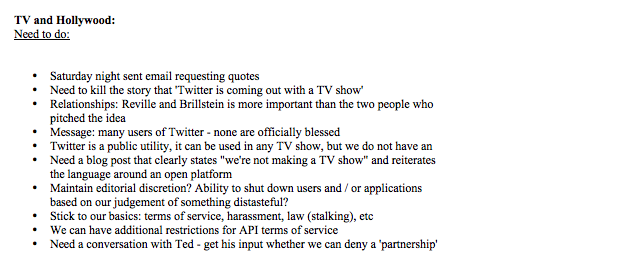
261

Identity Crisis: Let’s return to that key strategy meeting on February 25 (from here on out I’ll try to go chronologically). It is clear from the notes that the company was still struggling to define itself: Some stabs at defining the company’s mission included “Twitter is for discovering and sharing what is happening right now,” and “Twitter makes you smarter, faster, more efficient and more powerful.” Below are excerpts taken from throughout the document.
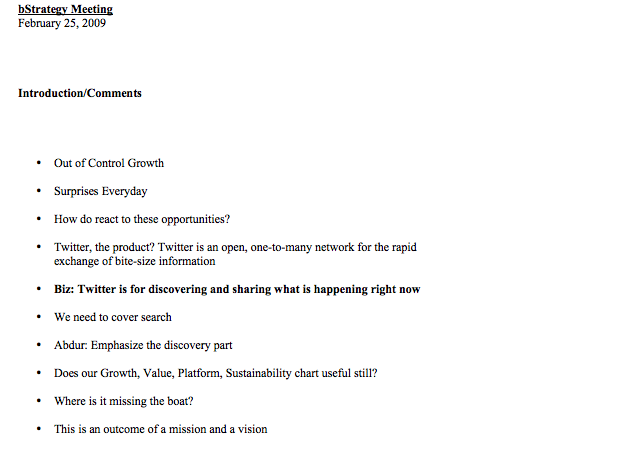
tw-strat-intro

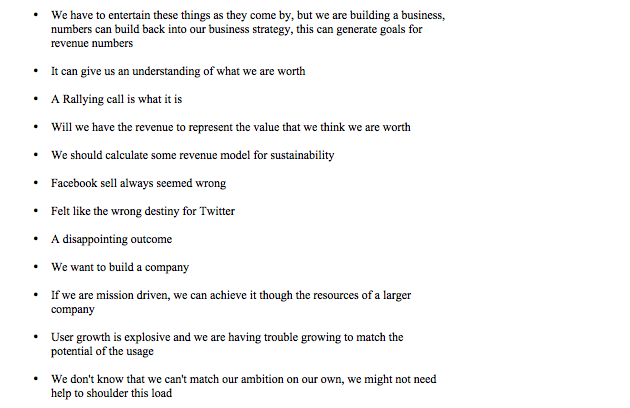
Acquisition Angst: The meeting took place after acquisition talks with Facebook fell apart last fall, and before similar talks with Google also went nowhere this spring. A lot of the meeting dealt with Twitter’s acquisition angst and trying to decide “What do we want to be when we grow up?” The company has an “IPO Bias,” yet realizes it will “always have to be open to Exits.” The “only type of acquisition we are interested in are ones where we stay in charge.” Perhaps that is what killed the Facebook deal. Twitter management felt that the “Facebook sell always seemed wrong,” that it was “the wrong destiny for Twitter.”
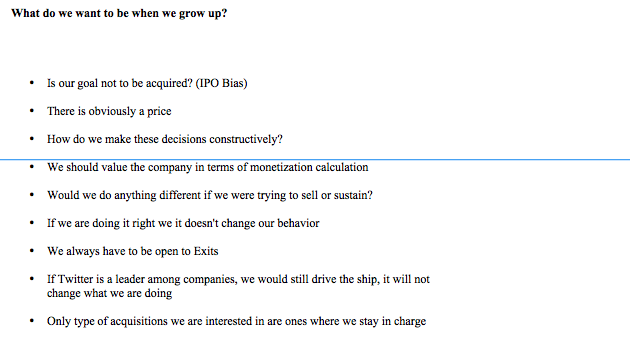
tw-strat-acquisition-angst

tw-strat-acquisition-angst-2

The Facebook Threat: The Facebook threat keeps coming back up. In one portion of the meeting devoted to discussing “How could Facebook kill us?” they list threats such as Facebook adopting real-time search, changing the opt-in options to make status messages public, emphasizing its SMS features, and generally copying Twitter’s functionality and user-interface (all of which have started to happen).
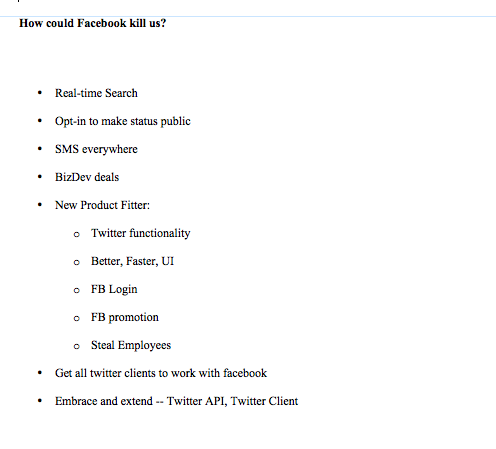
tw-strat-fb-kill-us-2

Defensive Strategy: The company also considered how best to defend against Facebook. “Make sure people are happy” is at the top of the list, followed by “cult” and “get more and better developers.” Doing a better job and getting “twitter everywhere” seems to be its best defense.
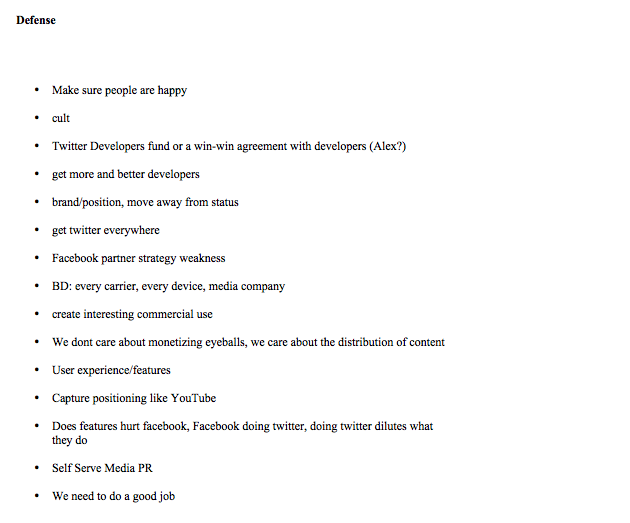
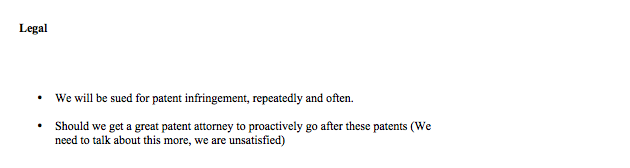
tw-strat-defense-against-facebook

twitter-legal-threats-patents

Real-Time Search: Twitter is clearly concerned about positioning itself against its two main rivals and potential acquirers. In contrast to finding out “what is happening right now” on Twitter, “Google is old news.” Yet during the meeting, the company is clearly preoccupied with search: “Twitter the product is a vehicle for twitter search;” “People don’t use twitter for search; and “Twitter should tell me stuff without me searching for that.”
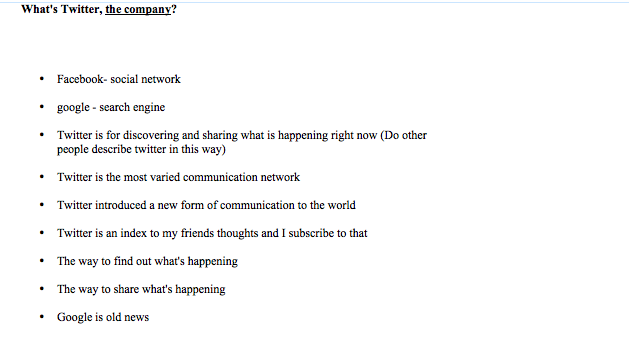
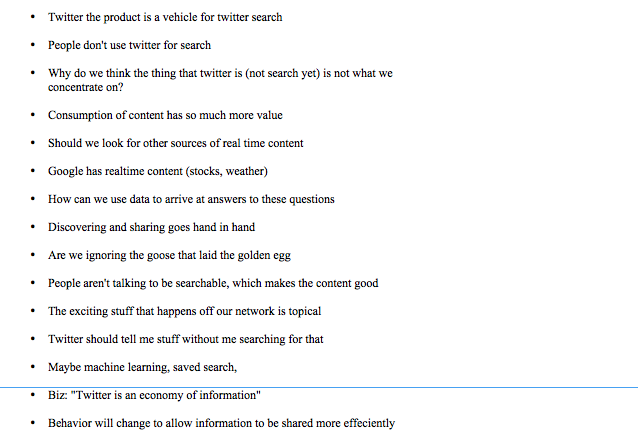
what-is-twitter-3

tw-strat-what-is-twitter-2

Financials: The company talks about its financial model, which boils down to generating “$1 per user per year” and going from 25 million users at the end of 2009 to one billion in 2013, with a user being defined as a “unique individual having a conscious twitter experience in a given week.”
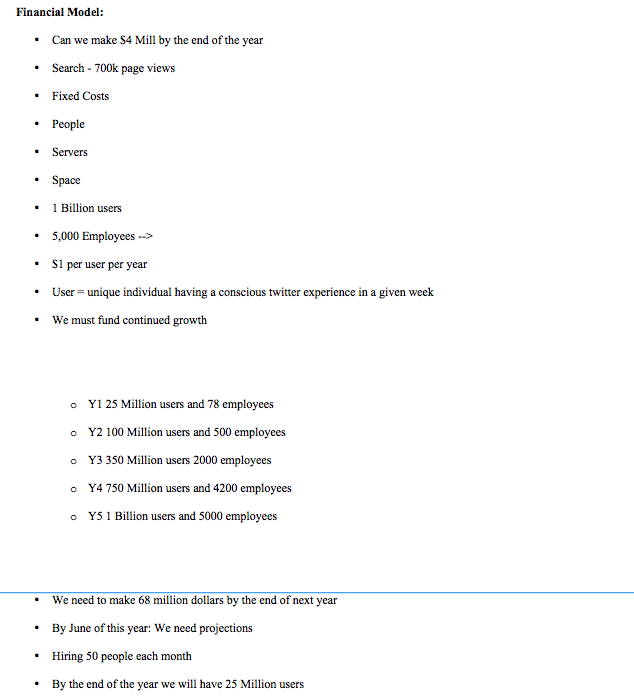
tw-strat-financial-model

Revenue Model: The strategy meeting also covered future revenue models, starting with verified commercial accounts, which is described as the “fastest way to make money without putting a whole organization behind it.” Another benefit to targeting corporate and celebrity users: “Charging more to fewer users is a good model.”

But it is the next business models down the list which start to become interesting. These include Search/Content Ads (with heavy users of the search API being required to run ads), Sponsored Tweets, “Adsense Widgets” (presumably Twitter ads which can run on other sites like Google’s AdSense, and in other apps) and payments.
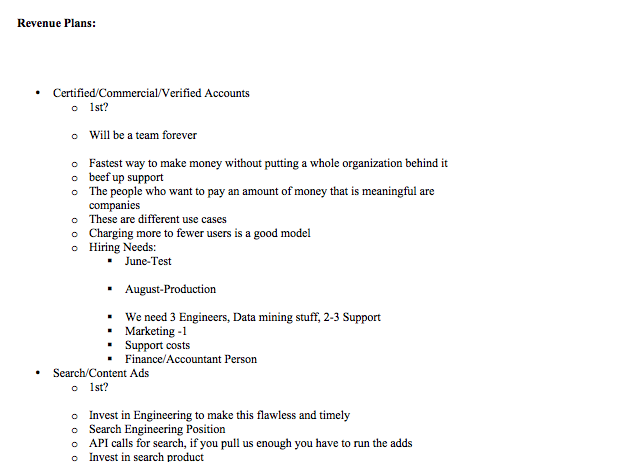
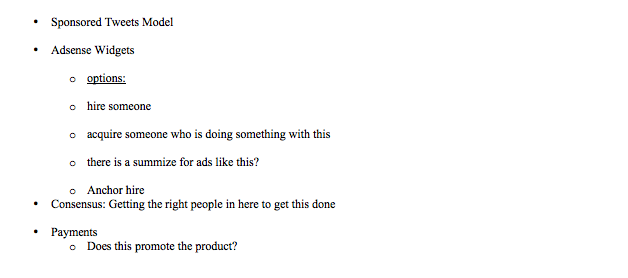
tw-strat-revenue-plans

tw-strat-revenue-plans-2

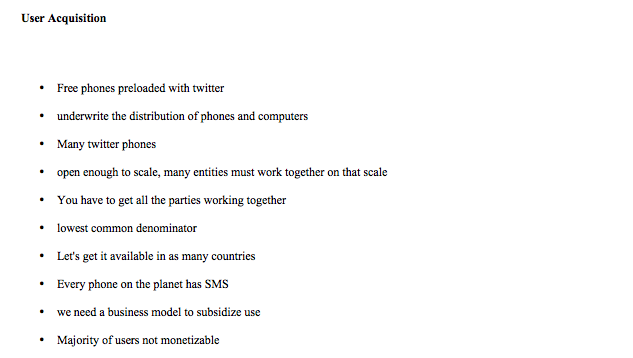
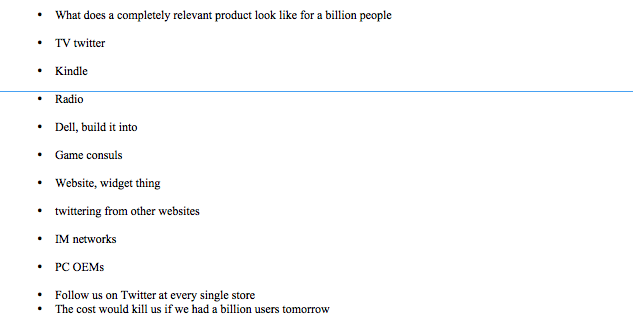
Getting To One Billion Users: The key to most of these business models is to keep attracting more users, and the company has some creative thoughts on how to acquire them. These include: “Free phones preloaded with twitter,” “TV twitter,” “Kindle,” “Radio,” “Dell, build it into,” videogame consoles, Website widgets, IM networks, and PCs. They also realize the “cost would kill us if we had a billion users tomorrow.”
tw-strat-user-acquisition1

tw-strat-user-acquisition-2

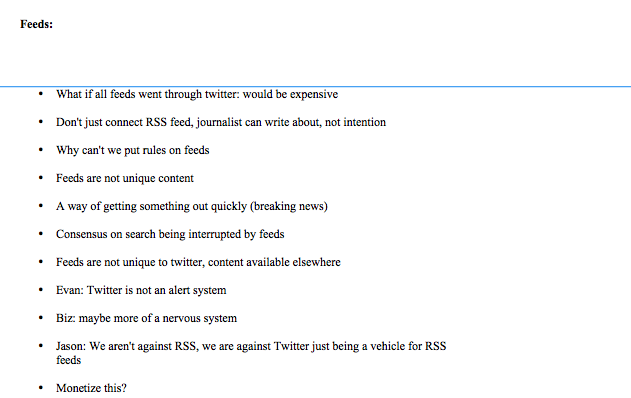
RSS Is The Enemy: The other expense they are worried about is supporting all of the RSS feeds that are migrating to Twitter. The people who run Twitter definitely don’t like RSS, and who can blame them? The big concerns expressed at the meeting were, “What if all feeds went through twitter: would be expensive,” and “feeds are not unique content.” (They are also too slow, but that is another issue).
tw-strat-feeds

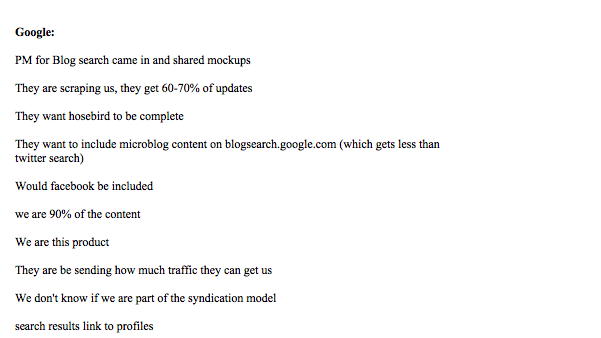
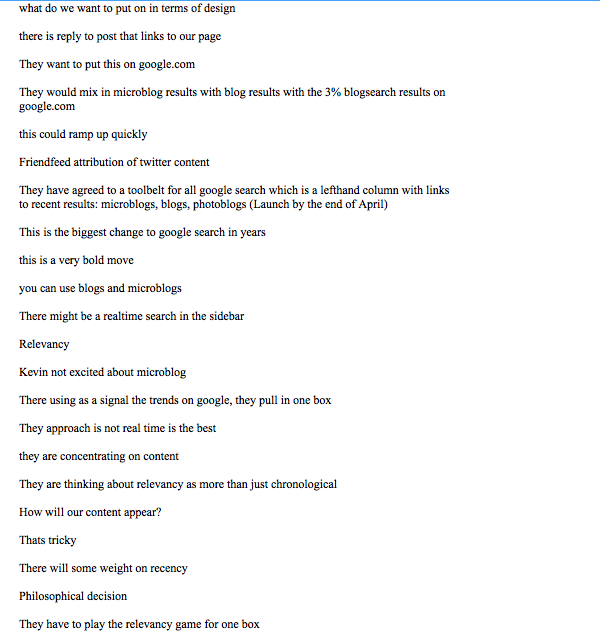
March 12, 2009 Meeting (Getting Back to Google): Moving forward to a regular management meeting on March 12, the subject of Google comes up again. Google’s blog search team was scraping Twitter’s site and getting only “60-70% of updates.” They wanted Twitter to hurry up with its Hosebird API so that they could start indexing every Tweet. The plan was to “include microblog content on blogsearch.google.com (which gets less than twitter search).” Already, Twitter made up “90% of the content” on Google Blog Search. As the minutes put it: “We are this product.” There was also talk of including microblog results on the main search page, which would be “the biggest change to google search in years.”
12121122

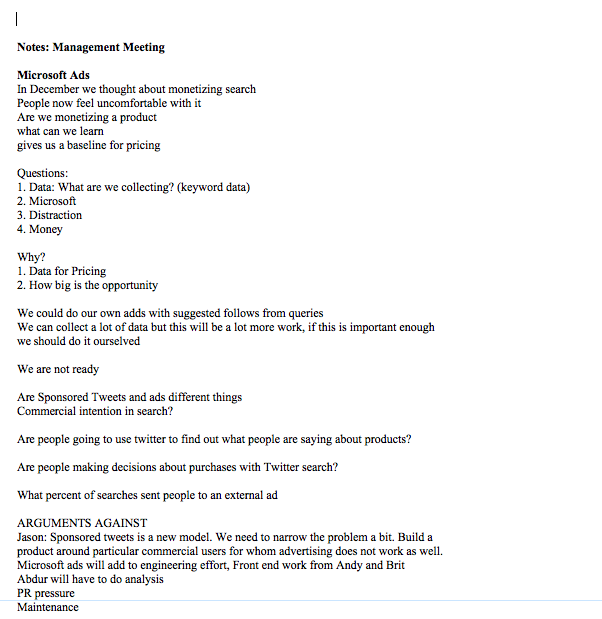
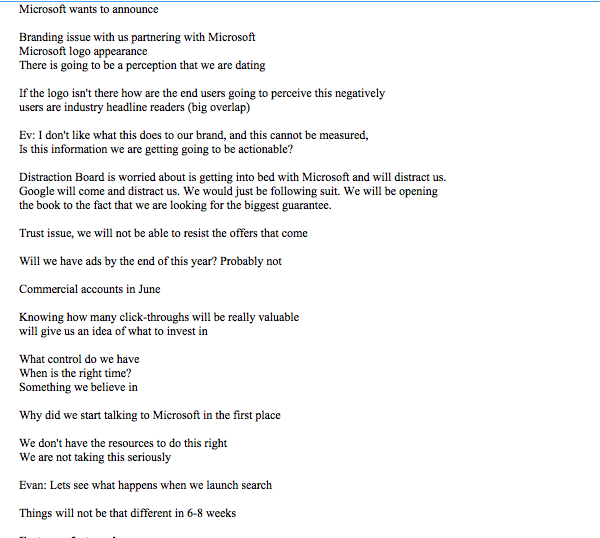
In that same March 12th meeting, Twitter also wrestled with a proposed search advertising partnership with Microsoft. The team was “not ready” and considered this yet another “Distraction.” Worries were expressed that it would strain Twitter’s engineering resources and that any partnership with Microsoft would raise branding issues: “There is going to be a perception that we are dating.” The board was also worried about Twitter “getting into bed with Microsoft.” By the end of the discussion, someone asks, “Why did we start talking to Microsoft in the first place”?
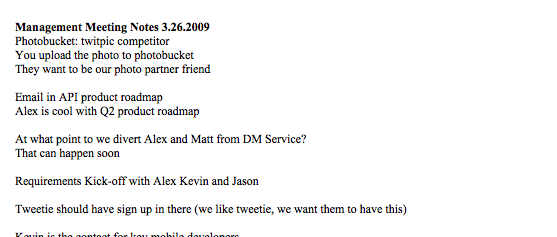
123124Twitpic, Photobucket, Tweetie: At the same time that Twitter was putting off Microsoft and Google, it was cultivating smaller startups. During that same March 12th meeting, one agenda item was “Twitpic- To buy or not to buy (1).” They decided not to, and the next week in a meeting on March 19, they decided to “bless” a competing Photobucket app called Twitgoo. Twitter also decided “we like Tweetie,” the popular mobile Twitter client in a meeting on March 26th.

19
26-photobucket-tweetie

Another Acquisition target: CoTweet. More recently, in a June 2 meeting where CoTweet and the need to support commercial accounts came up, the need to partner, buy, or hire came up, as it had in the past. And CoTweet seems to be identified as “another acquisition target.”

21

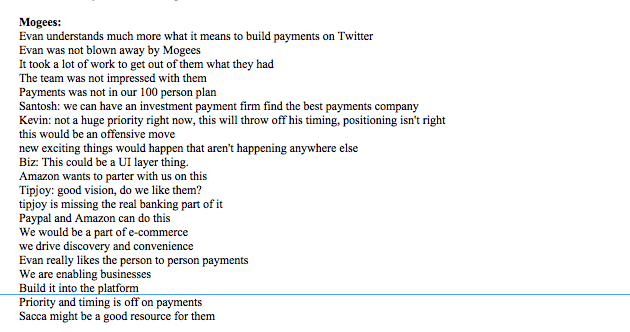
Mogees, R.I.P: You can also see what happens to startups that don’t get Twitter’s blessing. Twitter CEO Evan Williams was “not blown away” by micro-payment startup Mogees in a May 7 meeting because “Paypal and Amazon can do this.” Mogees doesn’t seem to be in service anymore.
73

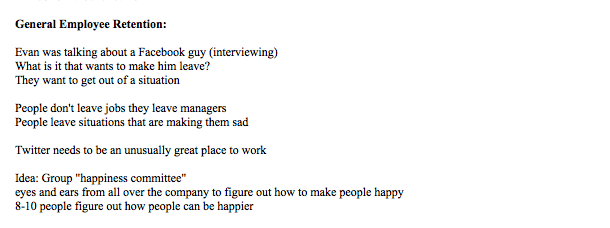
April 30, 2009, Employee Retention (”Happiness Committee”): Twitter’s management meetings also dealt a lot with how to keep employees engaged. The minutes for an April 30 management meeting talk about recruiting from Facebook and note: “People don’t leave jobs they leave managers,” they “leave situations that are making them sad.” To prevent that from happening at Twitter someone proposed forming a “happiness committee.” That should work.
30

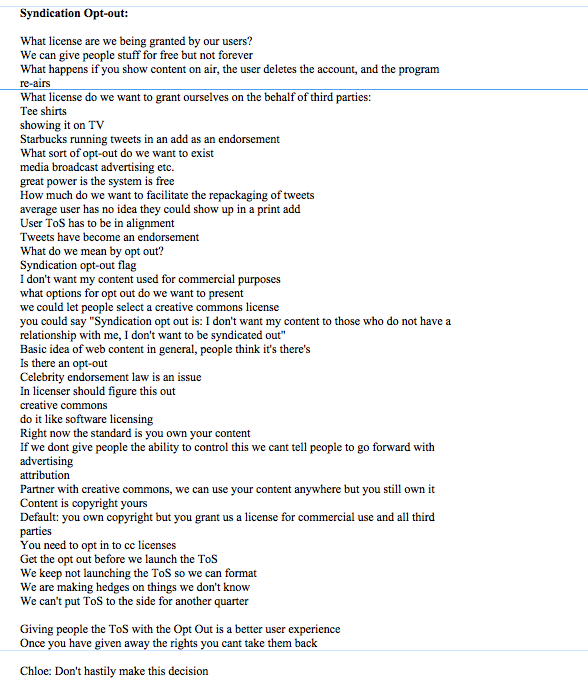
Nothing Is Free Forever: In that same April 30 meeting, the team talked about licensing Tweets to partners: “We can give people stuff for free but not forever.” There was also a fascinating discussion about how users should be able to opt out of having their Tweets syndicated by other media properties such as TV shows. One idea put forward was that your Tweets can only be syndicated by other people or entities who already have a relationship with you.
301

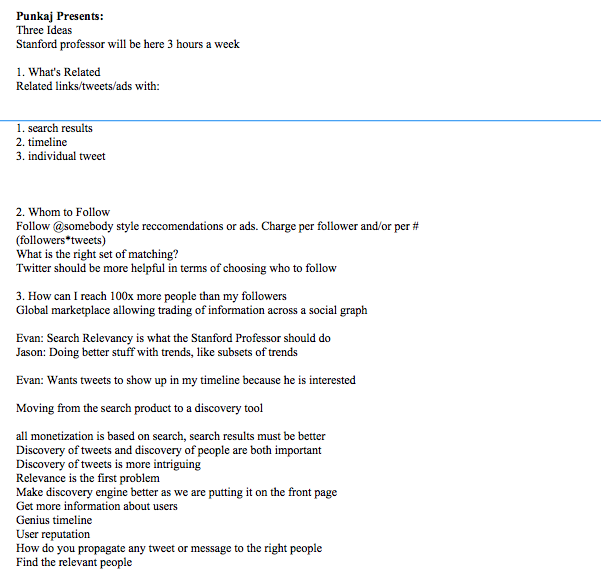
Search as Discovery: Another interesting discussion on April 30 had to do with search as discovery and the work of a visiting Stanford professor. The notion of charging per follower is contemplated.
72

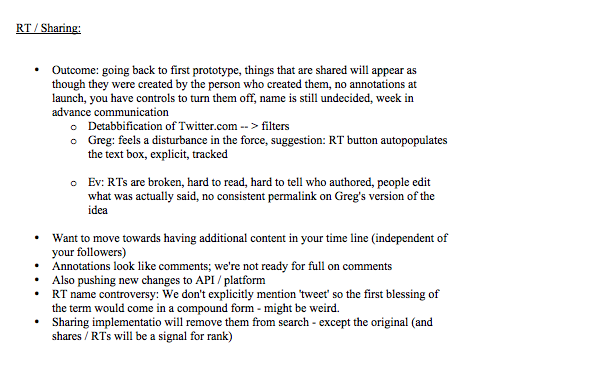
Retweeting (A “Disturbance In the Force): Finally, everyone’s favorite subject, retweeting, was brought up in that June 2 meeting. It looks like Twitter is going to adopt it as a formal feature, but Evan Williams is concerned that retweets are “broken” because it becomes “hard to read who authored, people edit what was actually said.” Well, yeah. There’s only 140 characters, you know.
22

Advertisement

Responses

Comments rss icon

  • Wow, Twitter has truly planned everything to the T.

    • good stuff

        • It’s one thing to leak documents that are in the public interest. If Twitter was planning on harvesting human flesh in Palo Alto slave mines and using it to power smoke-spewing meat servers, that’s one thing, and it has genuine journalistic value. (Startups: don’t get any ideas.)

          But this is just an insight into the workings of their company. It says a lot for them that we’re all wondering what their business model might be, in part because we want them to survive because we find it so useful, but that doesn’t make these posts right. They’re the tech blog equivalent of posting pictures of some celebrity getting changed in his or her own bedroom that you took with a zoom lens from half a mile away.

          It’s creepy, and we really don’t know anything new at the end of it.

          Yet this is the web. The things this industry are doing are getting more and more ingrained into society. They’re becoming important socially, politically, environmentally, academically – and as a result, so many stories to tell. Silicon Valley isn’t a bubble any more. Why not go and see what government is doing with social media and identity management, or figure out why Iran was all over Twitter but Honduras wasn’t? Tech is a part of life, and it would be glorious to see TC’s very talented bloggers expand their scope.

        • Man this is some blog post…

          • This is some of the weakest strategic thinking I’ve ever seen in my life. How embarrassing to be on the Twitter management team. These people are truly hopeless when it comes to business.

      • I like this post…good job TC. I must say that internally Twitter appears to have no clue what it’s doing. How a whole company can fill up everyone’s work week for months on end when the service itself can’t be monetized is just crazy.

        The best part is the 5 yr. plan. In 5 years, the world will have moved on from Twitter and it’ll maybe have 100 million users total…if THAT.

        Twitter’s problem early on was the customized URLs. It’s awesome if you’re @scott or @scottc…but now it’s like @scottc1423 and witha billion people it’ll be like @sc0ttc1432×98o.

        No one wants that crap. With Myspace/Facebook the username wasn’t a huge deal because most people paid little attention to it. With Twitter though, that’s the KEY for anyone to track someone. Twitter’s limit is based purely on its retarded 15-character limit username. Simple as that.

        • “If THAT”.

          Because 100 million users would be such a joke, right?

          • It’s a far cry from 1 BILLION. …and 100 million isn’t a number that’s sustainable even for Twitter. I predict that will be what it has at its peak.

            And don’t laugh about websites coming and going. Myspace is a perfect example of a “web 2.0 trend” that has overstayed its welcome.

        • If I was at the helm I would have sold out already.

      • Is it right or wrong to post those documents & info? At our office it’s not a clear answer. Where do you stand? Vote here http://tinyurl.com/mgha62

        • who cares if it right or wrng, i’m just enjoying the festivities provided by twittergate ;)
          lol, the Twitter Guys have been exposed for being the fufu eatin’ mofos that they really are ;)
          http://twitter.com/markmayhew

        • Bacically from the hub-bub above twitter see google as the chumps that will buy it, unfortunatly for twitter google need to monetise youtube before they can evn think of buying a mania, I know google are late but how late are they that they would actually purchasae a company in twitter that is ripe for diffusion.

      • Excellent post with complete inside stories of twitter, only if twitter team is happy reading it here!

    • I’ll hand it to you, TC. Publishing these documents (and hopefully more to come) has shed light on what a “successful”, albeit not monetary yet, start up is experiencing.

      It’s like the ugly girl in junior high coming back from summer break after going thru puberty and now everyone wants her. Twitter is the sexy girl.

    • You’re kidding right?

    • Kudos you you Tech Crunch. Great article and clears some questions as to how well Twitter’s management is operating. I think this gives those who say “Twitter doesn’t know what they’re doing” a second thought.

      James F.
      Owner, Free Twitter Backgrounds

    • Twitter is doing things the right way. http://bit.ly/GRdfA

    • Yes. I’m especially impressed how their security strategy was outlined to meet the growing demands of their people and assets.

    • The world of these companies (Twitter/Facebook/etc) is consumed within a closed perspective that emanates from the social graph of their employees. Twitter could be so much bigger if the ideas inside the company were scaled to co-create with the minds outside of this limited geography. Running these companies seems so ‘un-internet-like’.

    • I think they’re in way over their heads. They have overly big ambitions. And they’re clearly concentrating more on their ambitions than starting small, continuing to develop their niche, and do it really well. They are coming from the perspective of “lets take over the world” instead of “how do we add value, and people around the world will love it”. It just seems like the wrong approach.

      • clueless…

      • “Wrong approach” if they were you and me.
        They’re not. Twitter is big. It’s going to be everywhere. Without outsized ambitions like those, nobody becomes Google. Microsoft or Apple. Like it or hate it, they’re the Next Big Thing (TM).

        • Not really. Microsoft, for example, is and was focused on creating great software that provides a real service. And is incrementally profitable. The fact that its business is scalable has allowed them to get to where they are. Microsoft didn’t start with “lets take over the world” and then work backwards.

    • this is certainly a great deal of planning from the twitter’s side. Some things should be always kept in boardrooms and not displayed on the internet.. but who knows that this could give twitter a more burst of publicity and users!

    • Creepy is how TC is asking permission rather than simply reporting - July 17th, 2009 at 11:39 am PDT

      If THIS is the future of blog journalism, we, ladies and gentlement, are all screwed.

      Imagaing Woodward/Bernstein asking the White House Permission before printing their stories?

      When your pals are your sources, and your sources are your pals…

      …and attorneys negotiate ahead of time what should or should not be published…

      …blog journalism no longer can be trusted.

      Nor its owners and reporters.

    • I’m not sure if I agree with Twitter or Techcrunch…Twitter says they had no permission to post these, but I do enjoy reading them :-) Thanks.

  • Now throwing Twitter under the bus, but I see a growing (and disturbing) trend here with unsecure code across the board.

    Much of this has to do with learning code from samples in books / sites that do not practice good, secure coding practices.

    Everyone who codes web apps should be required to go back and watch the Google EDU seminar from Mike Andrews: http://video.go...636580663884360

    • I’d like to see how you’ll explain to your boss that you need twice the time of the competitors to do your project because “you want it to be secure”.

      And then your users use “password” as a password and blame you for “not following good coding practices”

  • cuz of this. I couldnt sleep the last 2 days + was at funeral + getting married in a week man o man

  • I’m sorry, but I still find the posting of this stuff completely poor form.

    That said, congrats to twitter on being rational, and well thought out on your plans.

  • Just not cool at all Mike – because you have the docs isn’t reason to publish.

    • You don’t understand journalism, do you.

      • This isn’t news, this isn’t journalism. If YOU understood that, you wouldn’t be trying to justify criminal behavior with words you do not understand. The documents were stolen, and while Arrington may not be complicit in under the law, publishing them still makes TechCrunch little better than the National Enquirer – no morals, no ethics, and no claim to the word journalism.

        • It’s definitely amateur journalism! So sorry it doesn’t fulfill your expectations, but that doesn’t make it any less so.

          Transparency of new endeavours like Twitter is great to see. It would be different if Twitter is more open and transparent and honest, but they are a business like any other, and this shows us that they are interested in survival.

          Not just making a fast buck (like newspapers nowadays!)

        • This is 100% news and journalism. Papers post what they get if it’s newsworthy, all the way up to the NY Times, Post, WSJ, etc. Assuming Michael is not lying, TechCrunch showed quite a bit of restraint in what it chose to publish or not publish.

          • Why do you think that “papers post what they get if it’s newsworthy?” All you know is what they *do* publish (and simply publishing it doesn’t make it newsworthy, which a quick perusal of almost any paper on any day will attest). You don’t know what they have that they choose *not* to publish.

            It’s also common that quality news organizations hold back a story for weeks or months, in order to get it right, make it better, connect it with actual news, present it better, etc.

            TechCrunch waited, what, a day? Probably they were scared of getting “scooped” by a truly journalistic outlet. I’m sure they didn’t think that the law-breaking, disgruntled person who divulged Twitter’s private business to TechCrunch was *above* divulging the same documents to whomever else.

        • @Daniel, have you considered that TechCrunch can be whatever it wants to be? It can be the National Enquirer today, the WSJ tomorrow. It’s running a business and has to accept the consequences. In this case, I’m guessing it’s generated more revenue and has gained readers. What about *your* ethics? If you’re concerned, stop reading!

        • @Daniel You’re missing the point. Arrington thrives on this crap. Controversy = more traffic. He doesn’t give a shit about ethics, clearly, so long as he gets his. TC blogger gets spat on? Great, more traffic. TC posts documents that could harm Twitter’s relationships with competitors and partners and future investors? Who gives a flying fuck, more traffic.

          • If Arrington didn’t give a crap about morals and ethics, all of the documents would be out and on the front page of TC. He’s obviously torn over this subject, or at least the TC staff is. The fact that they’ve spoken with twitter and consulted with them is very honorable. They could have just screwed them over by posting this stuff. Who knows, maybe it would have been bad enough to deal a significantly large blow to twitter and even take them off the map? Probably not, but still. I haven’t been a TC reader from the beginning, but I agree with everything I’ve read thus far, including the decision to post these documents. In fact, if I were in their place, I would have posted many more, if not all of the documents, but maybe that’s why I don’t own a blog with millions of readers. Keep it up, TC.

          • +3 It’s appalling that so many people here view as “restraint” TechCrunch’s decision not to post all the docs, which according to TC included extremely private, security-related information: credit card numbers, alarm codes, employee agreements that likely included names, addresses and social security numbers. Honestly, the people who posted their support for revealing it all, and who also posted links to their own websites, are maybe about as with it as the gems who post drunken, 1/2-naked pics of themselves online. Disappointing mentality; poor decision making.

        • How can we be sure that this whole drama is not a result of now desperate Twitter looking for some news coverage?

        • Someone please kick Daniel in the Balls! - July 18th, 2009 at 5:49 pm PDT

          Idiot, nitwit, twit Daniel:

          You have it ass backwards, fella. The issue isn’t the criminality of printing documents (it isn’t criminal to publish leaked material–moron) it’s TC attempt to be both news source and PR firm to Twitter.

          You confirm the documents authenticity. You determine its newsworthiness.

          AND YOU PUBLISH IT.

          Twitter won’t sue. Wouldn’t win if it did.

          Newspapers know this. Historians know this. Homeless people sleeping on newspapers know this. Retarded kids with headgear know this.

          So why, idiot Daniel, don’t you?

      • TC isn’t journalism — it’s a blog that makes some money. Any schmuck can write a blog post. They posted this info for pageviews, nothing more.

  • What a read this was!

  • Yes WOW says pretty much sums up everything I need to say about this.

  • This is more and more like a PR piece for Twitter as only the “positives” are reported – partnerships, growth etc…

    A bid to dispel the gnawing realization that Twitter has no business model in a “credible” way (hey, its a leak, it HAS to be true).

    One wonders if this is just a big orchestrated saga by Twitter’s PR.

  • Misappropriate of trade secrets, California Civil Code, sections 3426.1-3426.11. You’ve been served.

  • Maybe the government should control everything. I trust them alot

    • I hope to God that you are kidding.

      • Why you not trust your government? They know everything that is good for you. Soon they will give you healths care. I can’t just wait

        • Peter Vasilopoulos - July 17th, 2009 at 9:29 pm PDT

          gee why dont we just have the government control everything, they can give me the gas i deserve, they can pay for my food, i cant wait to be communist!!!

          do you want anything to do with how you live?? what a trustworthy government now our unemployment is over 10% in many states–GO GOV”T!!!

          I’m 16 and i realize the downhill path we are in, i’ll tell you what…the hardworking money-making lifestyle that has kept this country surviving is looking less attractive; i might be able to keep more of my own money if i skip college and live on welfare, bright idea??

  • Reading through all of this, I have nothing but even more respect for the folks at Twitter.

  • This is like Pandora’s Box…

  • Fascinating, and will surely be great grist for the mill for the books that will be written about Twitter, whether it succeeds or fails. Most disturbing here is how seldom anything related to stability or true scalability comes up: it seems to all be about BizDev, basically. It’s probably what the execs understand most, but remember how previous fads were sacked by performance/stability issues (e.g., Friendster)…

  • Thanks for publishing these documents Erick. Super insightful.

    (Most interesting section: Microsoft convo)

  • pdiddy isnt gonna be happy, lol.

    Also- lol @ shares for 4chan/moot.

  • I like Twitter less now that I know all the details. The mystery of mega startups without a revenue model (what will they do? what will it be? where are they going with this idea?) is one of the things that makes them so interesting. You’re ripping that away.

  • WOW!! I am founding a web company with friends and I have just saved this writeup to help us when planning strategy.. This is an academic document to me..

    Thanks for sharing Twitter/Erick and Hacker Troll! :)

    @7p: Thanks a bunch for the video.. I will be following you on Twitter in the next few mins :-)

    Just in case you are wondering what I am up to.. you can check http://getOnePage.com

  • It could helped to break the post into multiple post… too long a post to read…. phew! Didn’t even reached half-way reading and i was tired!

  • I hope you guys get sued so badly for publishing this. Publishing stolen information is so childish. (hey look what I got)

    Sad day for the internet community.

    • “It’s important to note that we have been given the green light by Twitter to post this information – They aren’t happy about it, but they are able to live with it, they say”

    • I’m not a lawyer, but publishing people’s private pornography seems the same as this (e.g., Paris Hilton video), but no one seems to stick up for those victims like they are sticking up for poor, poor, dumb Twitter. I suspect that that is why Twitter is “not happy about it, but they are able to live with it”, because they HAVE to live with it. To me, Twitter is just Paris Hilton (and I’ll leave out the allusions to them “both being screwed”). Too bad for them.

      • Actually there was a court case about the video. The man who published it was the man who filmed it, and therefore the man that owned the video. It wasn’t stolen, or leaked to a 3rd party, so it’s entirely not the same.

        • Ok, what about the Miley Cyrus pics that were stolen off of MySpace?

          That was one hacker boy who grabbed ‘em and gave them out for people to publish.

          They ended up everywhere, including the nightly news on tv. And, since she was under 18 at the time, they were technically child porn.

          This is no different.

    • Journalists are generally protected from suit for publishing stolen information unless they stole it themselves.

  • obvious marketing stuff is obvious. but very well done. must agree with taylor – chapeau, twitter folks!

  • This all makes a lot of sense apart from the 1 billion users. Twitter is a tech service for tech savvy people and not one of my “normal” friends are on it or ever will be. Not everybody want to let people know what they are doing now however bloggers, entrepreneurs and promoters do which is what has fueled its growth.

    • Your friends may be sub-normal, Niall – even my extreme non-techie friends in the wilds of southern Ohio are getting into Twitter.

      • Jackie, I hope you’re joking. Average people may have heard about Twitter (thanks mostly to stupid Oprah and Kutcher/CNN) but HEARING about Twitter is a FAAAAARRRRRRRR cry from using it.

        Twitter is all about severe narcissism and posting/reading updates every minute or two EVERY day. Regular people will real lives, jobs, concerns, chores, errands, etc. DON’T have time for it.

        • Scott, you sound sooo MySpace! (when it was ONLY for rock bands, as you would have probably posted somewhere).

          I do have a real life and have (as well as a LOT of people wether techie or not) job, concerns, chores, errands, etc. and we all HAVE time for it.

          What is it with you people that think the universe is limited to your block (or your followers/following list, to be twitt-related?.

  • I pray to god techcrunch gets hacked.

  • Ah ok, let me scroll to the place where Twitter somehow actually gets me to pay $1 for commenting in a search box…

    Ah nowhere, k thx bye. I would say ads, except everyone knows you don’t use Twitter through Twitter.

    I still see no reason why Facebook or Google (or heck) even Myspace doesn’t simply build their own.

    Twitter’s “engineering/expertise” is laughable and at best covers ground any major social network has conquered and with more users..

    • Twitter could provide ads within the twitter data itself, much as google embeds adsense directly in webpages, then offer a premium or subscription version that didn’t embed any ads at all, or offer such a stream to partners using their data to remove all ads from the stream if they pay a certain fee.

      I am not saying it would work, but their are ways for twitter to monetize via ads.

    • Just because people use a third party client not the web interface doesn’t mean twitter won’t be able to serve up ads to them, and any app that doesn’t play ball would get its API access withdrawn. Look how the ads show up in the stream in in the free desktop version of Tweetie. Key phrase in Twitter’s docs is: “API calls for search, if you pull us enough you have to run the adds [sic]“.

      • This would be pretty easy to defeat. Just enclose a legit (i.e. conforming) app within a third party wrapper that would filter out the ads. They might outlaw it but they couldn’t prevent it.

    • Over 55% of Twitter users actually use the web interface. Also, as previously mentioned, Twitter can easily embed ads within the stream if they want.

  • Distributing stolen goods = journalism?

    Maybe it’s legal, but it ain’t ethical.

  • Hope you consulted your legal team before posting this as I am pretty sure you just exposed yourself to legal action. If twitter wants to get mean, they can.

    Also, I am a firm believer in karma. I wonder which site is going to post your personal or confidential documents when you get hacked in the future? Perhaps everybody will show more class than TC just did, but sadly, I don’t expect that.

    It would amuse me to see Twitter come swinging with a big legal ( and morally justified imho ) stick. I typically hate such lawsuits, but this one is completely justified if it happens.

    • The last thing on Twitter’s mind at the moment is another distractor. I doubt very much legal action will be brought upon TC. Plus, Mikey is an ex-attorney, he can handle it :)

      And what’s it called? The “Oprah Effect” the more a company wishes the documents not be shared, the more it gets distributed. You can’t stop it, you just got to roll with it.

    • I guess Mike is not a lawyer.

      New York Times Co. v. United States (403 US 713)

      Publishing confidential document’s isn’t illegal without meeting an extremely heavy burden, which Twitter certainly wouldn’t meet. Unless I missed some sort of national security discussion somewhere in the notes?

      Everyone should point to this case each time someone in this thread (or later posts) tries to say publishing is illegal. I mean, “Illegal” has an actual meaning ya know?

      • Don’t be so sure. Amazingly googling “Publishing stolen documents legal code” returns references to this exact case ( damn googling indexing is getting fast! ).

        http://www.citm...itter-documents

        Pretty much the conclusion seems to boil down to “maybe”.

        Put simply though, regardless to the legal vagarity ( personally I wouldn’t want to be the company that starts a precident case… ) in this case, there is still the ethical aspect. I do applaud them for not releasing full documentation, but enough of what I have read here is capable of being damning to Twitters future operations, especially in relations to third party companies that probably would have prefered their partnerships kept private.

        • There are numerous examples of news sources publishing private documents every month. See the recent publication of Gov. Mark Sanford’s private e-mails with his mistress. This sort of thing is pretty common; Twitter would have no case.

          Besides, what damages could they claim? They have no revenues.

  • Is it this illegal? Twitter should sue and TC should be prosecuted for possession of stolen property. I am certian the negotiations were TC tell Twitter they planned to use the documents and that is extortion.

    EW you need to file a criminal complaint. Freedom of the press does not cover stolen property or extortion.

  • Lot to learn for early stage start-ups and budding entrepreneurs from this post. Good PR for Twitter. But I still disagree with posting such sensitive information about a private company.

    Wow!!

  • Care to post the section about 4chan?

  • The amazing thing is that they wrote all that stuff down at all, let alone leaving it in a place where it could get hacked.

    Thanks for doing all that work and all that went on behind the scenes, Mike. Great work.

    • I was thinking the same thing. We have notes like this written down at my company, but unless perpetuators got onto actual laptops and looked at things like OneNote, I’m not sure how anyone would get them. This kind of important BD and board meeting stuff isn’t typically posted on any kind of public file sharing site and it is very rarely even emailed around without serious IRM. My .02.

      • You don’t get it. They were typing the stuff directly in Google docs. They probably don’t even own a traditional word processor.

        • Oh I get it…that’s my point. WTF would one do that at a board meeting for?

        • Then they probably should buy one – it’s not that expensive. Come to think of it, at least one word processor is already installed on their laptop with operating system.

    • Sorry, didn’t look at the byline… Great work to you, too Erik.

    • Great work???

      A hacker stole them and handed the files to TC.

      Great work??? FAIL.

        • Fail what?

          The TC team got documents sent to them because they’ve established themselves as the journalistic outlet with the most guts, and the best ability to figure out the real story.

          Then they found the most interesting bits out of 300 pages, much of which must have been crap, and presented the best bits in context so it’s understandable and clear.

          You are going to need more than just the one-word punchline ripped off from another blog to make your case here “dasein” and “Edward.”

          • I’m sorry. I agree with you, but I think it needs to be clear that they have not sifted through and found the most interesting things. I think those would be the list of CEO applicants from other corporations and all the juicy stuff that screams scandal. This is somewhat interesting, but TC has been very careful about posting nothing controversial. Yet.

          • (Replying to my own bit because it won’t let me reply to Alec) below…

            Good point. I think that shows, however, that TC is being responsible and showing us the stuff that is substantial and not the stuff that is salacious.

            Nothing wrong with a little gossip, but ill-gotten gossip feels a bit more slimey than this post, which is helpful and significant in a broad context.

  • Look, you guys have every right to publish a ‘Story’ regarding tech but what you are doing here is completely unethical.
    Knowing that these documents were obtained illegally and knowing that they are confidential in nature makes you an accomplice after the fact to theft. A case could also be made regarding the use of stolen materials for personal gain and also regarding the possession of stolen property. Perhaps even corporate espionage.

    Whatever personal grudge you have against Ev and Biz is a matter between you guys and should not be dragged out into the open like a couple of grade school punks for a public pissing contest.

    I would hold Techcrunch to a high degree of moral ethics than this but I see now that is misplaced faith. You are damaging your own brand with this juvenile attempt at Journalism if you can even call it that. You are also pissing off legions of Twitter users that may have the technical ability to take you down and do to Techcrunch what you are doing to Twitter. I hope for your sake that doesn’t happen but if it does, serves you right.

    Shame on you Techcrunch and especially Erick Schonfeld. Someone with your technical reporting history ought to know better.

    In the meantime, knock this shit off.

    • New York Times Co. v. United States (403 US 713)

      This is so absurd.

      • Michael Bennett - July 16th, 2009 at 3:54 pm PDT

        I can’t for the life of me figure out why you’ve associated that case with this situation.

        That case dealt with whether the President could invoke privilege to prevent a news source in order to maintain secrecy.

        What’s happened here is a private company was hacked, the hacker sent those files to a private press source, and tech crunch posted them.

        Unfortunately, this argument will likely come down to intent and whether the information posted was sufficiently newsworthy.

        Twitter has no doubt incurred serious damages a result. Not from it’s consumer base, but in dealings with other companies; eg it’s attempt to monetize users.

        This could be Twitter’s death.

        • Because it is the seminal case in the press’s right to publish. If the President of the United States cannot stop the publishing of stolen top-secret documents, what is the chance that some meeting notes from Twitter rise to a higher standard? Like it or not, it’s legal.

      • Former Lexis-Nexis Editor - July 17th, 2009 at 5:50 am PDT

        What Techcrunch did was definitely unethical and they should be ashamed of themselves for doing so.

        What they’ve done is also probably illegal.

        At this point someone will undoubtedly respond with “NYTimes v. US”, but that case is of tangental precedent at best.

        I edited thousands of cases when I worked at Lexis-Nexis, and I can say with absolute certainty that there are dozens of other cases at both the state and federal level which apply to this situation.

        Law is applied unevenly and different jurisdictions have different outlooks on it. Depending on the location, particularly which state this occurred in, the people behind Techcrunch might be fine or they might have their entire lives destroyed.

        Maybe no suit will be brought, maybe charges will be filed and the prosecutors will refuse to pursue it, or maybe a suit will go forward.

        A lot of people will say things like, “Freedom of speech does not include yelling ‘Fire!’ in a crowded theatre.” Actually, it *does* include that right. However, were one to do such a thing, you could be brought up on criminal charges for inciting a panic, and you’ve opened yourself up to civil suits if anyone was injured.

        Even if Techcrunch ultimately wins any such lawsuit brought on them, the cost to fight it will be enormous. The only winners will be the lawyers, who will be able to buy new Mercedes-Benzes after the dust settles. The big ones. For their kids.

        • Then you must be familiar with Near v. Minnesota, Miami Herald v. Tornillo, Smith v. Daily Mail, and Bartniki v. Vopper. There is a ton of case law establishing that there are very severe limits to how the government can regulate what the press chooses to publish.

          TechCrunch may be sued, because the First Amendment allows anyone to sue anyone at any time. But, that’s not the same thing as something being “illegal” (i.e. criminal). And Twitter would need to prove monetary damages, which would be difficult as they have no revenues.

  • This was awesome. Great afternoon read. They have this entire thing planned out.

  • This is one more good reason to love Techcrunch. I really appreciate these things of being agressive and giving the right information at any cost.

  • LOL @ pdiddy being dissed tho….hahah…

  • man – i’m seriously thinking this stuff shouldn’t be published with this much detail.

    I don’t know him personally, but I’d think Ev is going to be pissed when he finds this on TechCrunch

  • These docs were obviously obtained through illegal or (at best) unethical means. By publishing them, TechCrunch stoops to a new low.

    This is not journalism.

    • Some journalists (not a few) hide the truth and respond to particular interests (lobbies, political parties, companies, their boss ;) so I would not count much on journalism and more on common sense.

    • Half of the shit the site posts is “stolen” by your definition. When there are pictures of a new device that hasn’t been released to the press, when an MS employee leaks pricing or features, when a Best Buy employee scans a pricing list, when… It’s all “stolen” by your definition.

  • I hope they find a way to not charge for their services. Ad-supported is the way to go.

  • Remind me to use only pen and paper from now on.

  • AM I the only one who thinks this leak is benefiting twitter?

    These guys are on top every aspect of the business. Kudos to them. If anything, now they have added a more personal feeling to twitter that wasn’t there last week.

    Twitter is family now. I want to see them cross out every task on that plan and do well.

  • So doesn’t this contradict Arrington’s argument about news being something someone somewhere doesn’t want published.

    If you’re going to have Twitter censor your posts, shouldn’t you just not publish? Why get Twitter’s approval? If you’re going to publish anyway, then what does it matter what they think? If, on the other hand, you’re worried about what they might think, then don’t publish. Seems this halfway step is a bit of a cop out.

    That said, there’s a lot of good info here, well edited and all. But it leaves you wondering if the more negative (for Twitter) information has been left out.

  • Before everyone goes postal on TC and Erick for publishing this information, be sure to look closely at the key quote Erick included above:

    “It’s important to note that we have been given the green light by Twitter to post this information”. <<- That’s very important folks!

    While it is sad this information was hacked and stolen from twitter, the posting of this leaked information was *approved by twitter*; albeit under akward circumstances to say the least.

    Erick – nice job on covering soo much detail. Yep, I think this is the biggest blog post you’ve ever written!

    My heart goes out to twitter. I truly am impressed with their vision and strategy. They’re aggressive and spunky – I like it!

    @SusanBeebe
    http://susanbeebe.com

    • Frank "Grayhawk" Huminski (@grayhawk) - July 16th, 2009 at 2:04 pm PDT

      “It’s important to note that we have been given the green light by Twitter to post this information”

      Translated:

      TC “We have these internal documents, and we’re going to publish them, one way or another. Want to work with us?”

      Twitter “What choice do we have?”

      Instead of TC and Arrington doing the correct and ethical thing and saying “Y’know what, this ain’t none of our damn business. Hey, Twitter, someone is hacking your crap and making internal confidential information public!”

      Just because someone else will kick a puppy doesn’t make it right for you to do it.

      But then, what else should we expect from MA?

    • RE: “It’s important to note that we have been given the green light by Twitter to post this information”. <<- That’s very important folks!

      Ev post on Twitter: http://twitter....atus/2676203744
      @TechCrunch @arrington “we have been given the green light by Twitter to post this information” What?! By whom? That’s not our understanding

      Doesn’t really look like permission.

    • Well, Ev, one of the founders just tweeted:

      Ev:@TechCrunch @arrington “we have been given the green light by Twitter to post this information” What?! By whom? That’s not our understanding

      So…either there is a massive miscommunication or one side is lying.

    • Dissapointed Watcher - July 16th, 2009 at 2:56 pm PDT
  • Thanks for this article.
    I respect Twitter even more (although I feel quite bad for them tonight, given all their competitors are going to absorb this valuable information)
    In any case I cannot wait until all documents are available on the net. For any startup founder, this is invaluable resource!

  • A long, but very good read. Well worth it.
    As many have indicated, I too wouldn’t have published the info. just because I had it. That said, and given that you’re a journalist, not publishing all of it was a very smart move.

    Back to Twitter …
    It’s awesome to see that they have much of their @#$% together. I would agree, especially now that we’ve seen a “Penguin FB” tweet out there by a Facebook developer (http://bit.ly/BHvep), that the Twitterfication of Facebook is just around the corner. And if they offered anything like BigTweet, then Twitter itself will be bombarded by FB-mostly tweets. Sooner or later, that may mean the end of Twitter’s model.
    I also don’t like or agree with the TwitterTV thing. In my opinion, Twitter ought to consider bolstering its services to include images, video and even tools like what tweetmeme offers.

    Finally to monetize, perhaps they can bundle some of the services they’d offer into a Pro and even an additional Pro+ account that offers things for a very small fee … under $5. I have ideas on how to do that for them, but since I’m not an employee, I can’t really offer them for free ;)

  • What I wouldn’t give to be a Bay Area CEO…

  • I almost need to print this out, so much information to read. I do feel kind of guilty reading it though.

    I know people are ranting and raving about these docs, but I hope this turns out to actually have a positive effect on Twitter.

  • Twitter is like Compuserve in 1991: hugely popular, but it will be irrelevant in 5 years. It’s great that they want to be the pulse of the internet, but with open/decentralized microblogging, the pulse of the internet is THE INTERNET.

    It’s not surprising they are scared of RSS – it’s the most widely deployed open protocol today that is in this vein.

    • that’s not what they are talking about when discussing RSS – they feel all those services posting automated tweets out of RSS feeds are straining the system at Twitter

    • Yeah I don’t quite see how they can be the PULSE the internet and stuff.
      The internet is by it’s nature decentralized, that’s why we like it. The information is out there but you can never have it ready-made-to-go. You search for it all the time, it’s just that you got better tools nowadays with the aggregators. I think the future belongs to tools like netvibes,igoogle etc.

  • At least they don’t have to be worried about the engineers being out of the loop anymore!

  • A significant percentage of all Twitter users are fake, created by primary users and user teams adding make-believe bulk. Attrition and inactivity add up to another good percentage. Finally, it is not possible to practically follow a network of >1000 users. For all of the reasons and the obvious ones, Twitter will never be a public company and my file bankruptcy in 2010.

Leave Comment

Commenting Options

Enter your personal information to the left, or sign in with your Facebook account by clicking the button below.

Alternatively, you can create an avatar that will appear whenever you leave a comment on a Gravatar-enabled blog.

Trackback URL
Short URL
bugbugbug